Sappho’s Poems as an Ethos for Women’s Ritual by Jill Hammer

Photo by: Zac Jaffe

For by my side you put on

many wreaths of roses

and garlands of flowers

around your soft neck


and with precious and royal perfume

you anointed yourself.


On soft beds you satisfied your passion.


And there was no dance

no holy place

from which we were absent.


–Sappho (trans. Julia Dubnoff)


Sappho, the poet from Lesbos (630-570 BCE), was considered one of the greatest poets of her time—one of her epithets was “the tenth Muse.” I discovered the poems of Sappho in my thirties and was utterly captivated.  I had newly embarked on a relationship with a woman and Sappho’s love poetry (though by no means exclusively lesbian) supported the expression of eros between women.  Yet even more than that, Sappho’s poems supported an erotic relationship between self and world—a relationship that included ritual as a form of intimacy.  I’m not a Greek scholar—I experience Sappho’s poems in translation. Yet the translations I read back then were a revelation: a world in which women lived in circle with one another.

Continue reading “Sappho’s Poems as an Ethos for Women’s Ritual by Jill Hammer”
Unpacking the Midterm Elections by Anjeanette LeBoeuf

Anjeanette

As the dust is settling, with the mixture of finishing counting ballots and races being conceded, the true realities of what happened in the 2018 Midterm Elections is taking concrete form. From the earliest hours of November 6, numbers showed that both Democrats and Republicans, old and new, were taking to the polls, flexing their democratic rights, and showing the political regimes from local, state, and federal levels that the current state of being is not acceptable.

Continue reading “Unpacking the Midterm Elections by Anjeanette LeBoeuf”

Lei by Elisabeth Schilling

Mauro Drudi’s installation of LEI (SHE/HER/YOU – formal) in the Chiesa de San Cristoforo on the Sicilian island of Ortigia where I usually take a bus to daily has become the shrine of women I’ve been searching for. Each time I cry, I am glad I can feel something: those tears are a mixture of communion, comfort, and recognition.

When one enters the church, there are two converging walls. On either side, a woman’s face is painted in shadow and light, gazing off toward the light, is reproduced over and over so that the number of women looks almost countless. They are the same face, a reproduction of Antonello da Messina’s “Annunziata” in the mode of pop art. The difference is not in expression. They all wear the same thoughtful, complicated, neutral countenance, holding deep thoughts and experiences of suffering and wise knowing, both acceptance and maybe resistance; they have lived and might be any age, although I see in our connection my own. The difference is between glossy, unblemished surfaces of wood vs. surfaces weathered, slightly ragged, sometimes scribbled on with ink. The former, found on the right when one enters supposedly represents the “positive” woman, the “western woman [. . . representing someone] happy, gorgeous, well-kept.” On the left, about these representations, Drudi says, “Which artist can paint the skin of a woman who has been abused, beaten, exploited, captivated or disfigured with acid? In my opinion, nobody, and so I let the material speak: the wall of a beach hut destroyed by a storm; woods and materials used and abused [. . .]; exhausted panels deriving from carrying tons of goods, tables, packagings, production wastes.”

Continue reading “Lei by Elisabeth Schilling”

Vayeitzei: Rachel and the Practice of Niddah by Ivy Helman

29662350_10155723099993089_8391051315166448776_oThis parshah contains the account of Jacob’s marriages to Leah and Rachel, (who happen to be his cousins) as well as the birth of his 11 sons and one daughter.  It describes the long amounts of time Jacob worked for Laban in order to marry Laban’s daughters, and recounts the trickery of Laban giving first Leah, the older daughter to Jacob, before allowing Jacob to marry who he wanted to, Rachel.

Like the relationship between Hagar and Sarah, there is animosity between Leah and Rachel over Jacob’s love as well as the ability to bear children.  This animosity spreads to the maids of Leah and Rachel, Zilpah and Bilhah respectively, as they are used by the sisters to conceive children on their behalf.  One can see also this animosity in how Leah and Rachel name their sons.  Yet, the parshah also contains two aspects that seem at odds with such a patriarchal perspective.  First, there are five named women who play key roles in the goings-on.  Second, Rachel is an active agent.  Continue reading “Vayeitzei: Rachel and the Practice of Niddah by Ivy Helman”

The Women of Lech Lecha by Ivy Helman.

29662350_10155723099993089_8391051315166448776_oThe parshah for this week is Lech Lecha (Genesis 12:1-17:27).  I’ve actually written about Lech Lecha on this forum before, concentrating on the parental aspects of the divine.  See here.  However, this time I want to look at the Torah portion from a different angle: what happens to the women?

While I’m concentrating on this theme, the parshah is rich with other material on which one could comment.  For example, the Holy One asks Abram to leave his home and all he’s known to travel through and eventually live in a foreign land.  There seems to be much fighting and strife between various rulers in the area through which they travel.  Abram too goes to war when Lot is kidnapped.  The first covenant between G-d and humanity takes place.  The deity promises many blessings (from land and material prosperity to innumerous descendants) for Abram and Sarai if they obey the terms of the covenant.  We also learn of the markers of the covenant: name changes and circumcision. Continue reading “The Women of Lech Lecha by Ivy Helman.”

Gardening through Grief by Marie Cartier

A friend of mine has been in hospice with Alzheimer’s. And she died today. There will be a  day when I write about Barbara… what a great friend she was. How I hate that she is no longer in my life. How I know how hard it is for her spouse to lose her. How hard it is when someone so vibrant leaves your community.

But writing about her was not what I could do today. And today is when I had this blog due.  I decided after I learned that she had passed – to garden. Barbara used to help my wife water the garden. It was something comforting and familiar and useful that she did with us.

Continue reading “Gardening through Grief by Marie Cartier”

Breaking the Silence by Chris Ash

Christy CroftYesterday, Time Magazine announced that its “Person of the Year” for 2017 would be “The Silence Breakers” – the name it has given to those women who helped launch and made headlines in the #metoo movement. This movement was started by activist Tarana Burke in 2006 to highlight the sexual abuse of women of color and was sent viral by actor Alyssa Milano in 2017. It speaks volumes that this designation falls exactly one year after Time awarded this honor to Donald Trump for the political shift heralded by his defeat of Hillary Clinton.

This defeat that was fueled, at least in part, by the way Trump’s own normalization of sexism, harassment, and assault played on the fears and bitterness of misogynist voters hell-bent on preserving what racial, gender, and economic privilege they could continue to hoard for themselves and those like them. This defeat, and the ensuing glorification of a sexual predator and rampant misogynist, in turn fueled a movement of people, mostly women, tired of being scared into silence to protect the powerful who abuse. Continue reading “Breaking the Silence by Chris Ash”

Rest and Renewal: Gifts of Women’s Ritual Dance by Laura Shannon

 Samhain is past, and we in the northern hemisphere are once again entering the final outbreath of the solar year. At the winter solstice, light will be reborn. Until then, it is important to embrace the time of rest and renewal which is the great gift of this season. Like the falling leaves and the drying seeds, we too can relax and release old burdens. This is the best way, perhaps the only way, to draw new strength for the next active phase in the ever-changing cycles of our lives.
Many of us no longer follow the rhythms of the year and consequently subsist in an ongoing state of near-exhaustion. But rather than letting our energies get too depleted, we can learn to thrive within the limits of our available resources. As well as vastly improving the quality of our lives, this may lead to solutions for sustainable living in the long term – perhaps the most important skill humanity needs to develop now.  Continue reading “Rest and Renewal: Gifts of Women’s Ritual Dance by Laura Shannon”

Sisterhood, Service, Sovereignty: The Living Spirit of Avalon by Elizabeth Cunningham

Like so many women, I read Marion Zimmer Bradley’s The Mists of Avalon and got caught up in her vision of the Holy Isle and the priestesses who knew how to navigate those mists and travel between the worlds. Like so many women, I wished Avalon existed still.

In fact, Avalon does exist, because Jhenah Telyndru did more than wish. In 1995 she founded The Sisterhood of Avalon. Twenty-two years later, the Sisterhood is going strong and growing, attracting members from all over the world. I urge you to explore their website where the Sisters speak eloquently about their vision, structure, and purpose.

Continue reading “Sisterhood, Service, Sovereignty: The Living Spirit of Avalon by Elizabeth Cunningham”

Women Made of Fire by Vanessa Rivera de la Fuente

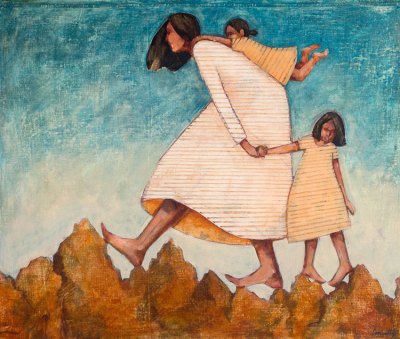
 climbing-mountains-with-children_webThis was going to be a post about my new life in South Africa; to say what it means for me the return to this country full of wonderful things to do, after an intense and grievous experience in 2015 that pushed me towards a totally introspective period in my life; I was willing to tell you how I managed to put myself together, come back, go out there to face my fears, gather the courage to speak my truth, look for clearance and healing in the same place and with the same people where I was wounded.

But that will be in the next post. Let me talk about my country.

I come from Chile, a country in the southern south of the world, poor in resources and rich in poets. I am Chilean by birth, and I took my first steps on shaking ground. I have survived 3 earthquakes, countless floods, a tsunami and a dictatorship.

I survived to be stronger, more faithful, more free and unbeatably resilient.

During the past 12 days, I have seen, as a distant and impotent witness, my country burning, overwhelmed by fire, in the greatest catastrophe of its kind in the history of the nation.

The fire has advanced more than 700 kilometers away from the first point of ignition, swallowing whole villages, with their houses, public buildings, animals and agricultural land.

I’ve spent these days with tight lips and enclosed in my thoughts, reading news on the Internet, thinking about my family, receiving audios that my sister records for me. My brother was injured protecting his house from the fire, my family is in the area of greatest catastrophe, currently declared “Area Zero.” My concern is huge because the fire is advancing over the city and the assistance seems to go three steps back … I believe in the power of prayer, but I also know the ferocity of nature because as a Chilean I am always expecting to deal with it. Continue reading “Women Made of Fire by Vanessa Rivera de la Fuente”