I recently reread the essay titled “Compulsory Heterosexuality and Lesbian Existence,” by late poet and essayist Adrienne Rich, with my students this semester. Published in the summer of 1980, on the heels of the Women’s Liberation Movement, I found that the essay still maintains its relevance and challenges us to remember that feminism is a political movement that itself must be continually interrogated.
The essay (which you can read here, with a foreword from Rich published 23 years after the original) has four sections which are titled only with the roman numbers I-IV. I labeled these sections for my students to try and capture the focus of each: I. Compulsory Heterosexuality – The Groundwork; II. Male Power and the Inequality of the Sexes; III. Lesbian Existence as Political Identity; and IV. Woman-Identification as Source of Power and Energy.
I still remember the first time I read Mary Daly’s Gyn/Ecology. It awoke something within me. Her use of language, the power of her writing and the ease with which she created new words taught me so much about the world around me and about the way the language, and subsequently its use in writing, shapes lives, choices, abilities and destinies. She also taught me about myself.
I was hooked, but not just on Mary Daly. Shortly after I finished her book, I moved onto other feminists writing about religion like Katie Cannon, Judith Plaskow, Alice Walker, Carol Christ, Rita Gross, Gloria Anzaldua, Audre Lorde, Adrienne Rich, Margaret Farley and Starhawk to name just a few. All of them, in fact every feminist I’ve ever read, has shown me the way in which words have power and how words speak truth to power. Ever since, I’ve wanted to be the kind of writer whose words carry a power that not only affects people but also inspires a more just, more equal, more compassionate and more humane world. In other words, I wanted to be a writer activist.
I was recently asked: Who is a theologian you admire? Since I’ve been deeply steeped in the Christian tradition, plenty of Christian theologians could come to mind—Christian theologians, that is, in the sense of humans educated in the Christian theological academy with the theology PhDs to prove it.
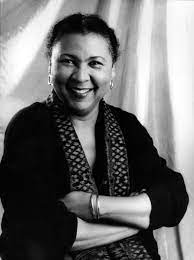
But when I think of theology, these days, I find myself thinking more broadly. Like Kat Armas, who wrote Abuelita Faith as a way of reflecting on and honoring the theological contributions of marginalized women, rather than men who sit in the seats of academic power—and like Sarah Bessey, who writes that theology, at its best, is a field where “everyone gets to play”[1]—I am skeptical of the assumptions Christians often make about who is or isn’t a theologian. And so, when I thought of theologians I look to for wisdom, I thought outside the box. I thought of writer and activist bell hooks.
Unfortunately, an inner darkness has been with me all fall hiding in the corners of my mind and disturbing my body creating headaches and stomach troubles during the day. Although I attempt to protect myself from a culture that I cannot control by not listening to news, watching television, movies or perusing social media I am painfully aware of the fact that politicians on an international level cannot even agree to discuss what to do about climate change – this after 30 years of doing absolutely nothing – creating in me a mindless fury that leaves me in black despair. The time of acting locally and thinking globally is long past. Thinking and doing must occur on a global level. Novelist Richard Powers states the obvious: “People can better imagine the end of the end of the world before the end of Capitalism”. Then we can move to the moon.
I have also been forced to acknowledge how difficult this year has been on a personal level. Aging is affecting my energy level, increasing the severity of depressed states, my sense of inner and outer balance. I am vulnerable and know it although I do my best to begin each day with gratitude as I first peer out at my beloved trees, a little nuthatch or chickadee, gaze at a silver crescent, or celebrate a pale pink dawning.
I love my new life in Portugal and I’m so happy and grateful to be here. However, I have encountered one major roadblock–I simply cannot replicate my daily writing routine that I’d relied on in the UK for nearly twenty years. I used to get up and leap right on the page, but now I keep horses on my property and their care and feeding come first, before I even get my human breakfast. And horse care is the last thing I do before sunset. If once I was a morning writer, now I’m a late morning/early afternoon writer. Writing gets sandwiched between horse care. Creative ideas bubble up as I ruminate while picking poo in the early morning. I’ve had to find a new rhythm that fits my new life.
Many of us, particularly many women, are struggling to find their daily rhythm while balancing the demands of remote-working with childcare, home schooling, and elder care as we enter the eleventh month of our global pandemic. This can be depleting, to say the least. To make matters worse, the old boundaries between work, family life, and “leisure” have unravelled and become impossibly blurred. Many of us feel under even greater pressure to be productive during this time.
Experts preach that we need to manage our time, plan every minute of the day by making little boxes for each task in our daily planner. I have tried to do this, but always rebel in the end. It seems a pointless task to try to force the flow of my day into orderly boxes. Instead I try to find what rhythms work for me so it feels organic rather than forced.
Now as a woman in my mid-fifties, I feel I have arrived at the other side of the mountain. I moved to Portugal, in part, to slow down. To be less frantically obsessed about work and career. To take a step back from the whole competitiveness of the writing world that can be soul-destroying and completely antithetical to the creative process. I’m done running myself ragged in some misguided attempt to get ahead. Perhaps I’m losing my “edge.” Perhaps this is what it means to be literally “over the hill.” You’ve come so far on your journey that it’s too late to return to old ways of doing things or old ways of seeing the world–the view is completely different up here.
Due to the radical reset of the pandemic, I think that a lot of people are arriving at this place, regardless of their chronological age. At some point we reach a peak of life experience beyond which there is no going back. We have entered a new landscape, brand new territory where the old maps will not get us anywhere. We have to seek a new direction. We have arrived in the place where we can claim our power, our inner sovereignty, and live our life to the rhythms that work for us.
For me this means abandoning the cult of productivity, the pervasive belief that living to work makes us virtuous. That our worth is determined by our output. This cult is particularly damaging to women who still carry the bulk of childcare and domestic work–the whole second shift of wife work that goes unrecognized, unvalued, and unpaid. I believe the majority of male productivity gurus can only adhere to their monastically rigid schedules because they have an unpaid woman in the background doing all the childcare and mopping up all the mess.
One thing I’ve learned the hard way is that, if we let it, the cult of productivity will completely poison both our creativity and our spirituality.
The cult of productivity diminishes our daily spiritual practice as yet another demanding task on our to-do list, a result-oriented form of competitive striving. “I’m not a serious spiritual seeker unless I get up at 5:00 am to meditate. How else will I be on track to achieve enlightenment?”
Spiritual practice is by its very nature the precise opposite of doing or striving. It’s letting go, surrendering to a state of pure being and receptivity, relaxing into the divine luminosity welling up in our hearts.
As for creativity, international best-selling author Hilary Mantel, one of my great idols, has written one of the best essays on the writing process I have ever read. Writing world-class literature, for her, is not a matter of locking herself in her office for eight hours a day or adhering to a rigid word count but of finding the right rhythm.
“I have to grab a notebook and write before I am properly awake,” she writes. “The day’s writing starts to unroll in my head. It’s fragile and often a matter of rhythm rather than words.”
Mantel stresses the importance of writers trusting themselves, trusting their creative flow, rather than obsessing about productivity. Good writing is not a matter of “persecuting paper with ink or pounding the keys. . . . You can’t measure your productivity day-to-day in any way the world recognizes.”
Then Mantel spills her secret that cuts the productivity gurus down to size:
I feel shy of saying this, because to non-writers it sounds lazy–but if, seven days a week, you can cut out two hours for yourself, when you are undistracted and on-song, you will soon have a book. Unoriginally, I call these “the golden hours.” It doesn’t much matter where I find them, as long as I do. I usually work many more hours. But sometimes I wonder why.
When we step into flow, either creative or spiritual flow, we enter a realm of timelessness, where our calendars and clocks dissolve into oblivion. We lose ourselves in that rich inner world. And it’s not forced. It’s not imposed upon us. The flow carries us. May we all be blessed with golden hours.
Mary Sharratt is on a mission to write women back into history. Her acclaimed novel Illuminations, drawn from the dramatic life of Hildegard von Bingen, is published by Mariner. Her new novelRevelations, about the globe-trotting mystic and rabble-rouser, Margery Kempe, will be published in April 2021. Visit her website.
Over the past few months, I’ve been struggling to write posts. This month is no different. I am currently sitting with four different half-drafts on three semi-related topics, none of which I seem to be able to complete. I’ve gone back to each of them numerous times. I write. I erase. I rewrite. I copy bits of one into another to save for some other time. I’m left with one sentence: this week’s Torah parshah is Bereshit (Genesis 1:1-6:8). Great. Glad to know that. Now what?
When writing, I often find myself in one of two camps given the current state of the world. Either, I have so much to say that I have no clear idea where to start, so I write three pages of more or less nonsense. Or, I find myself just so inundated with information that I don’t know where my opinion begins and another’s ends. I write another 3 pages of completely different nonsense. I get fed up with both. I start praying better thoughts will just write themselves. They don’t.
Over the past few days, I’ve been spending time at a church in Alexandria, Virginia conducting oral history interviews. I’m doing research for a project about the arts and the church that has me diving deep into the church’s congregants’ and leaders’ experiences. Yesterday’s conversations offered insight about many theological topics that interest me, but what was particularly encouraging was what I witnessed concerning women in ministry. That’s not what I was looking for, but it is what I needed to see.
Before beginning these interviews, I had already been thinking about the ways women’s authority and voice are often challenged. This past weekend, I attended a regional religion conference where I assumed a leadership position and my voice was sought out for advice and insight. I had great conversations with other women in academia about wellness and success while I was there. Attending the conference provoked fond memories of a similar conference many years ago, when I connected with many colleagues in this FAR community and we discussed the theme of “Women and Authority.” Those were positive experiences. But I had an unpleasant encounter, too, when I was on the receiving end of a male colleague’s condescending remarks. I was also made aware of a disturbing incident in which a woman of color was publicly disrespected while speaking at a university event and subsequently trolled. Those experiences triggered anger and deep sadness. To be honest, I also felt a sense of resignation and defeat. Patriarchy is just so persistent.
The poems below are excerpted from my new (I hope forthcoming) collection, Tell Me the Story Again. Ancient dreamer’s voice is one among many voices including sorrow singer, temple sweeper, sword woman, morose fool, merry drunk, grey cat and mouse, stone mountain, skeleton woman, mother rain and many more. The voices speak from a time perhaps just after (or long before) our time, in a real and magical world.
I chose to excerpt ancient dreamer’s poems because winter is the time, in Celtic lore, of the Cailleach, the old one, the divine hag. When I began writing the poems in 2014, my mother-in-law, then age 101, was in the last stages of her life. She slept and dreamed most of the time, and I would sit and daydream with her. She died two months before her 102nd birthday. When I took up the collection again in 2018 to complete it, ancient dreamer remained a strong presence and has the last word.
Lately I’ve been reading a few Paulo Coelho books. I won’t say they are beyond feminist criticism, but it’s not what I’m going to focus on this post; but as always, feel free to say in the comments why/if you find them problematic. I expect and welcome it because it might be another layer of this conversation that I don’t have time or am not yet emotionally ready for myself.
What I want to focus on is the solution the author seems to advance in each of his books, at least those I’ve read, to our perpetual unhappiness despite the evidence that everything is fine, better than might otherwise be.
Adultery: I never finished this one, actually. I had to take it back to the library the last time I had to leave Ireland, but I’m sure I will find it again and read the rest of it soon. So I can’t say what the ending revealed, but what sticks in my mind was the predicament of the main character. She, from her perspective, had it all: wealth, an interesting career she liked, an attractive husband who was attentive and kind, a family, health. This was why she was so confused that she was unhappy. This is the premise of many of his books: the person who doesn’t know why they are unhappy. Also, the observation that no one is really happy.
For about a year and a half, I have been working on a collection of poetry that I feel is worth something. I have been writing poetry since I scribed pages hidden between my math textbook when I was 9, gone through poetry workshops in graduate school where I produced a creative thesis, and continued to write off-and-on after that. I have an extensive cornucopia of poetry, but it was around last October of 2016, perhaps, that I decided to write my experience.
As a pre-teen, I wrote about what I thought my life could be, fantasizing about being an older woman with mottled relationships, missing opportunities to discuss my fragile relationship with my parents as the only-child-golden-child, my passion and doubts as a religious, my shame at not being more experienced. Even when I was in graduate school for poetry in Ohio, I didn’t think my life was worth excavating. I wrote dreamy, dense poetry that was surreal and symbolic but largely incoherent. I could again have written about my evolving religious beliefs, my curiosities and risks I took living outside of my home state of Oklahoma as a young woman for the first time, my declining relationship with my mother, or my insecurities again, but this time as a lesser-prepared graduate student in comparison with my literary and theory-laden colleagues.
On one hand, some might say the culture I come from is narcissistic and navel-gazing. I would agree, but just like I feel women can sometimes be selfish in a quite necessary and liberating way (as opposed to those around her accusingly saying she is “so selfish” for abandoning them/following her own path/needing a room of her own), I feel the confessional and self-reflective can be the healing and helpful side of the coin. For me, at least in my experience, my “finished” collection feels exactly this way.






 Feminism and Religion