


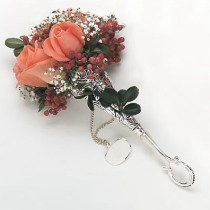
Instead of sending a billet-doux to your honey, present a tussie-mussie, a small bouquet wrapped in a lace doily or a fancier holder. Say you have a friend having a birthday and he already has too many neckties and she already has too many kitchen gadgets. Give them flowers or potted plants. The white camellia signifies “unpretending excellence.” Ivy, “with its clinging habit, is a feminine symbol” (sic., p. 53). The lily means purity. The peony symbolizes abundance. The primrose is a token of affection and respect. Get the idea? Your friends will be delighted by the flowery language.
Here’s flowers for you:
Hot lavender, mints, savory, marjoram,
The marigold, that goes to bed wi’ the sun,
And with him rises weeping: these are flowers
Of middle summer….
—William Shakespeare, The Winter’s Tale
Shakespeare’s plays are full of flowers, not only as props but also as metaphors. Perdita, the mad king of Sicilia’s lost daughter, speaks the sad words above as she hands flowers to the king of Bohemia and to one of her father’s former advisors. Another flowery Shakespearean girl is Ophelia. When Hamlet’s feigned insanity drives her mad, she famously wanders across the stage muttering, “There’s rosemary, that’s for remembrance … and there is pansies, that’s for thoughts.” Nineteenth-century Paris was madly in love with femmes fragiles like Ophelia. On the DVD of the 1868 French opera by Ambroise Thomas based on Hamlet, Ophelia sings a long, sad aria in the fourth act as she walks around the stage strewing flowers. Finally she stabs herself and falls upon the flowers and dies. The audience breaks into wild applause. She gets up and sings some more.
My favorite flower speech in Shakespeare is this one spoken by Oberon in Act II of A Midsummer Night’s Dream:
I know a bank where the wild thyme blows,
Where oxlips and the nodding violet grows,
Quite over-canopied with luscious woodbine,
With sweet musk-roses and with eglantine:
There sleeps Titania sometime of the night,
Lull’d in these flowers with dances and delight;
And there the snake throws her enamell’d skin,
Weed wide enough to wrap a fairy in….
The grounds of the Huntington Library in San Marino, CA (just north of downtown Los Angeles), are filled with topical gardens, including a Shakespearean one. The first time I went there, I got to see real, live, growing oxlips and woodbine and eglantine.
The language of flowers reached its greatest popularity during the Victorian Era (1837–1901), when social conventions prevented people from saying frankly what they were thinking or feeling. While Victoria sat on the throne, people had limbs instead of legs and even piano legs were modestly covered by fancy fringed scarves. Sentiment often replaced common sense, so lovers perforce found subtler ways to speak their feelings. If a suitor handed a girl a bouquet right side up, that meant he had positive thoughts about her; upside down, he had negative thoughts; and if he gave her wilted bouquet, well…. Every variety of rose or lily had its own meaning, and so did potted plants (the begonia signifies “a fanciful nature”), herbs (parsley is “useful knowledge”), and spices (cinnamon means “my fortune is yours”).
I used the language of flowers several time in Secret Lives. In Chapter 3, the coven of magical grandmothers creates sacred space in which an old woman named Sarah can safely make a life decision. They bless her with flowers:
“And now,” Holde said, “let us bless you in our fashion.” Someone handed her a small branch of dusky leaves. “This is myrtle, “she said, “an ancient symbol of love. Sarah, I give you love, our love for you and your love for yourself.” She handed the myrtle to Sarah and kissed her lightly on the forehead, then returned to her seat.
The next woman was Brooke, who stood and walked to Sarah’s side. “This is African violet,” she said. “Its symbolic meaning is ‘such worth is rare.’ I give you your own rare worth. Never forget it.” She handed a tiny potted plant with purple flowers to the older woman and gently kissed her on one cheek, then returned to her seat.
The third was Bertha. “This chrysanthemum,” she said, “symbolizes truth. It’s your own truth I give you. Consider it well.” With a light kiss on the lips, she handed the big crimson flower to Sarah, its scent reminding them both of autumn chores and preparations for winter. “Bright blessings.”
“This is laurel,” said Emma Clare, next, “since ancient days the symbol of glory. May you realize your own glory, the glory of your life, well and goodly lived. Bright blessin’s.” She handed the branch of dark green, aromatic leaves to Sarah, kissed her on her other cheek, and slowly returned to her own chair in the circle.
And on around the circle came the flowers and leafy sprigs—globe amaranth for “unfading love,” gilliflowers for “bond of affection,” spicy sage for “esteem,” zinnias for “thoughts of absent friends, “aromatic vervain for “enchantment,” scentless syringa for “memory,” and more….
Vickie prompted her daughter now. “Grammie,” the little girl said, “this is a pink rose and it means simplicity. I love you, Grammie, and … and I’ll miss you if you go away.”
As Sarah received the rosebud from the little girl, she also got a big, wet kiss. “Thank you, honey,” she whispered. “You be a good girl now, you hear?”
“I will. I promise.” Cindy returned to huddle very close to her mother, but her eyes never left the shining old woman in the center of the magic circle.
Late April and early May belong to Venus and Flora, the Roman goddess of flowers, whose festival was the Floralia. We can use the language of flowers to celebrate the Floralia today. Instead of sending a billet-doux to your honey, present a tussie-mussie. That’s a small bouquet wrapped in a lace doily or a fancier holder. Or say you know someone having a birthday around this time. Maybe he already has too many neckties and she already has too many kitchen gadgets. Give flowers or a potted plant. Refer to The Language of Flowers, which is a lovely, faux-Victorian “treasure of verse and prose” by Victorian writers, plus a lot of nice, sentimental Victorian art. It’s filled with flower lore. We learn, for example, that the white camellia signifies “unpretending excellence.” Ivy, “with its clinging habit, is a feminine symbol” (sic., p. 53). The lily means purity. The peony symbolizes abundance. The primrose is a token of affection and respect. Get the idea? Your friends will be delighted by the flowery language. Especially after you explain it to them.
Barbara Ardinger, Ph.D. (www.barbaraardinger.com), is a published author and freelance editor. Her newest book is Secret Lives, a novel about grandmothers who do magic. Her earlier nonfiction books include the daybook Pagan Every Day, Finding New Goddesses (a pun-filled parody of goddess encyclopedias), and Goddess Meditations. When she can get away from the computer, she goes to the theater as often as possible—she loves musical theater and movies in which people sing and dance. She is also an active CERT (Community Emergency Rescue Team) volunteer and a member (and occasional secretary pro-tem) of a neighborhood organization that focuses on code enforcement and safety for citizens. She has been an AIDS emotional support volunteer and a literacy volunteer. She is an active member of the neopagan community and is well known for the rituals she creates and leads.
Discover more from Feminism and Religion
Subscribe to get the latest posts sent to your email.


Oh, what a treat, Barbara! Happy Floralia to you and blessed bees!
LikeLike
Yes, what fun! A delightful read! A whole new magical realm to explore! Thank you!
LikeLike
There is a Shakespeare Garden in the fabulous Brooklyn Botanic Garden.
LikeLike
Donna, that’s cool. I’m glad there’s more than one Shakespeare garden. Until I went to the Huntington, I had no idea what those English flowers looked like.
LikeLike
Awesome post Barbara!
LikeLike