

This was originally posted on January 22, 2019
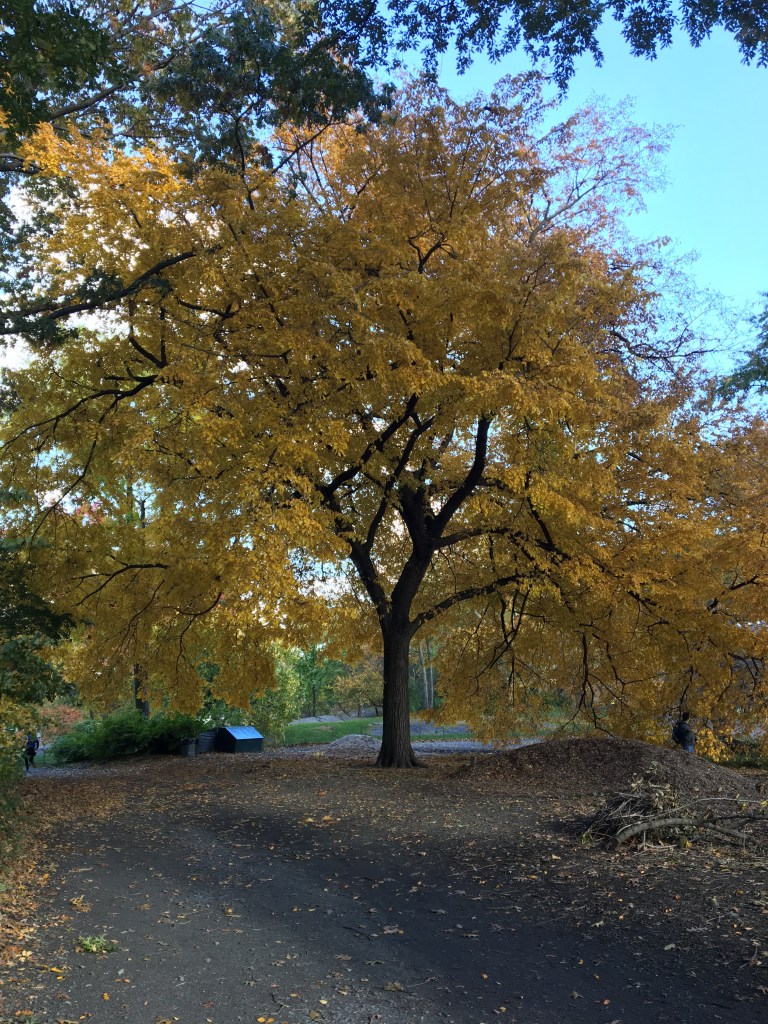
Almost every day, I walk in Central Park. There are certain trees there I’ve come to know: the gnarled cherry trees by the reservoir, the bending willows and tall bald cypress by the pond, the sycamores that drop their bark each summer, the hawthorn not far from Central Park West. Lately I’ve been taking photos of the trees to try to capture their essence, their posture in the world. The trees around me feel like friends, which is what an ancient midrash (interpretation/legend) called Genesis Rabbah says about trees: that they are friends to humankind. To me, they’ve always been a central manifestation of Mother Earth.
Currently, the national parks in the United States have no staff because of the government shutdown. Some people have taken the opportunity to cut down the rare and endangered Joshua trees in the Joshua Tree National Park—just for fun, I guess, or as a trophy of some kind. Meanwhile, President Bolsonaro of Brazil recently has indicted that he wants to remove protection for the rainforest, in order to allow development. It appears that my friends the trees have enemies. Sometimes the enmity is for personal/corporate gain, and sometimes the enmity seems to have no reason at all.
I take this unwarranted violence against trees personally. Deuteronomy chapter 20 teaches that humans besieging a city may not cut down the trees around the city for spite, nor may they cut down fruit orchards to build siegeworks. Human wars are not to be extended to trees. The text appeals to our fairness, saying: “Are the trees human to withdraw before you into the city?” Trees can’t run away; when there is violence, we have to protect them where they are.

One of my teachers, Arthur Waskow, points out that the trees breathe out what we breathe in, and we breathe out what the trees breathe in, so we are creating the Breath of Life together. The biblical name of God, Waskow says, sounds like this breath: Yhhwwhhh. I connect this teaching to the birth of my daughter. After she was born, I looked at the placenta and saw the image of a beautiful tree (the markings on a placenta look like branches). I felt, in that moment, so connected to the divine mother as Tree of Life. Just as my daughter, while in utero, breathed from the tree-like placenta, we are all breathing from the forests of the world.
Enemies of the trees are enemies of breath. The removal of trees from the world affects our oxygen and our air’s ability to cleanse itself. Ultimately, attacks on trees are attacks on all of us.
I am thinking about this as the Jewish holiday of Tu b’Shevat approaches. Tu b’Shevat means “the fifteenth day of the month of Shevat”— this day in the Jewish calendar is the Festival of the Trees. This year it begins the evening of January 20 and continues into January 21. The Talmud mentions the holiday as the date on which all trees should be counted a year older: it is therefore known as the birthday of the trees. In the 16th century, kabbalist Isaac Luria revived the date as a holy day and created it anew as a celebration of the Tree of Life.
For Luria and the kabbalists who came after him, Tu b’Shevat is a day honoring God as a tree-like entity sending its vital energies throughout the universe. Luria instituted the ritual of a Tu b’Shevat seder, a sacred meal based on the Passover seder in which participants ate fruit in a sacred way, with blessings, in order to release and uplift the sparks of holiness hidden in the fruit.

For kabbalists, the sacred feminine (Shekhinah, Divine Presence, also called Malkhut, sovereignty, or Matronita, Lady) is embodied in the physical world, and understood as the energy that sustains all life. One of the mystical Jewish names for the divine feminine is “the holy apple orchard.” In that apple orchard, souls grow like apples. In other mystical texts, the divine feminine is known as the “garden.” Trees and plants hold a special place in the theology and practice of the kabbalists. As the Zohar says: “There is no tree but the Holy One.”
The original Tu b’Shevat seder was mainly about envisioning God as a Tree of Life. In contemporary times, in many Jewish communities, the meaning of Tu b’Shevat has expanded. Tu b’Shevat has become a day to learn about the environment and honor the gifts that the earth gives us. Many modern Tu b’Shevat seders focus on learning Jewish texts about the earth and naming our responsibility to “tend and protect” (as Genesis says) the planet we live on. The fruits we eat remind us of the gifts that come to us from the earth, and the ways we depend on the health of the ecosystems within which we live.
This year, I feel the birthday of the trees not only as a day to celebrate, but as a day to stand in solidarity. The image that comes to me is the one from the beginning of Genesis, where God stations cherubim with a fiery ever-turning sword at the gate of Eden, to guard the way to the Tree of Life. We need modern-day cherubim to protect our planetary paradise. Who is going to guard the Tree of Life? Who is going to shelter the garden where She grows? This is my question for Tu b’Shevat this year: how can and do we become guardians of the trees? And how can and do we become guardians of the Tree that is the vast sum total of life on earth?
The midrash I mentioned at the beginning of this essay says that all trees converse with one another and with all beings. If the trees are speaking, we should start listening. And we should start speaking, too.

The Climate Ribbon is a global participatory storytelling project that helps us move from climate grief to climate action by inviting participants to share the beloved things they stand to lose to climate change, and commit to protecting all that we can. “Next year’s harvest.” “Clean air and water.” “The future of our children’s children.” The simple, heartfelt participatory project engages participants in thinking about what they love in their specific town, city, or community; it’s a collaborative act of story-sharing and commitment-making across generations. Together, our stories and commitments weave a giant thread connecting all of us us as we work for a healthy, sustainable planet.The Climate Ribbon is often created in the shape of a tree, honoring our planet as a tree of life. @climateribbon www.theclimateribbon.org
Discover more from Feminism and Religion
Subscribe to get the latest posts sent to your email.


I LOVE this post… Not only did I learn a new tree story but I deeply appreciate anyone that gets it – that all our trees of life are sacred (wrote scared by mistake and this is true too) Why do we have a tree of life in every culture if the tree herself is not sacred – and literally responsible for our breath…?????? And women – well – we are the advocates of trees -the enemies of trees are everywhere – in Maine we slaughter our ‘land trust’ trees – all in the name of thinning – clear cutting is destroying the ancient ones across the country and throughout Canada – we won’t stop until we have killed them ll I fear – replacing them with plantations to get more wood – If you haven’t PLEASE go to you tube and listen to one of the videos -Forest Scientist Suzanne Simard who knows more about how critical trees are is the second heroine of my life – the first being Rachel Carson… Thank you for this post – if you pay attention trees will touch you in ways you can’t even imagine…..
LikeLike