

It is now
in this liminal space
between the cauldron
and the cave,
as obligation struggles
to come roaring back
into center,
that we sense what we truly need
whispering beneath the surface
of all that clamors to co-opt our time
and all that howls
to claim our attention.
Stand steady.
Inhabit your own wholeness.
Cast a one word
spell of power: return.
Step into the sacred
right where you are.
Re-collect yourself.
Reclaim your right
to your own life.
Defend your edges.
Give clarity space
to crystallize
and your own knowing
space to emerge.
It is vital,
this work of reclamation.
Hold it holy.
Let the knots unravel.
Set yourself free.
There is something about the autumn season that breathes change into our hearts and lives. The sensation of standing at the threshold of change becomes palpable, in the air, in the trees, in your heart, and in your dreams. You wake and suddenly the air carries a whisper that wasn’t there before, a cool, sweet clarity that speaks of change, of crossing over, of standing at the edge of something both necessary and profound. The leaves begin their slow drift downward, walnuts fall with decisive thuds on rooftops, and we find ourselves ducking under spider webs that have appeared overnight across our doorways, as if the very earth is reminding us that we are always stepping through thresholds, always crossing from one way of being into another.
Autumn arrives as the great teacher of contentment and enoughness, inviting us to gaze upon its full colored beauty and sense our own deep at homeness on the land. This is the season of retreat, of full barns, and harvested fields, where the busy work of giving life is completing its cycle and preparing for rest. Perhaps we can learn from the land that is acceptable, even necessary, to release our endless striving, our constant reaching for more mountains to climb, and settle into the warm nest of where we are.
We live in a society that often feels ever restless, always eager for more, seeking happiness through accumulation. But autumn whispers a different wisdom: What if we can rest? What if we can pause the trying and savor the abundance? What if we could set aside the compulsion to do more, to be better, to fix ourselves?
The mist that rises on autumn mornings becomes our teacher. Where chill meets warmth, the luminescence of mist is born. And, mist can be seen as a visible representation of the threshold itself, the guardian of the in-between where cloudy dreams take shape and beckon us in. In these liminal spaces, we stay with our questions, we listen to our longing, we lean forward, cautiously but persistently, allowing ourselves to transform.
Standing at autumn’s crossroads, we discover we are like the orb weaver spider who builds her web across the bedroom doorway. I wrote about her last year and this year she is back. She nestles in that risky space between our two doors, in the crack where they meet, teaching us about inhabiting the between. We learn to duck underneath rather than tear down what blocks our path, adapting our lives as needed to respect where we are. Perhaps we are never really wholly ready for transformation, yet the wise rhythms of our lives tip us over the edge anyway, and looking back, we discover we have already leapt again and again in the ongoing unfolding of our lives and days.
Autumn is also a season of both celebration and intense industry, not quite fully time to sit back and rest, but time to harvest what is rich and sweet, to gather what we have chosen and tended over the year. Wisdom lies in recognizing our inner seasons, in knowing what is ripe and ready to be plucked, and what must be left to grow, and what can be left to wither and return to the earth. As Maia Toll reminds us in her book The Wild Wisdom Companion, there is no sense in taking what needs more time on the vine, for such fruits are sour and unnourishing, but it is equally wasteful to pass over what is truly ready, for when something has reached its fullness, more time leads not to growth but to rot and loss. Perhaps it is okay to take a deep breath and let go. Perhaps it is okay to take a deep breath and hold on.
The autumn threshold asks us to make peace with sorrow and impermanence, to honor the divinity of grief so that spring can return. Like Demeter mourning her daughter’s descent, we learn that attachment is not something to be severed or denied, but a fundamental human impulse that makes our experience meaningful and transformative. In the fertile darkness of letting go, we discover our freedom to re-create our lives, to dance with sadness while allowing joy to return home. In Robin Corak’s book, Demeter, in the Pagan Portals series, she writes:
Even Demeter, a powerful goddess, is not able to hold herself together and wear the mask of pleasant acceptance that is expected of her when faced with the injustice of her daughter’s abduction. Demeter shows us that it is okay to fall apart at times, and that anger and grief are perfectly natural responses to actions that dishonor and/or harm us, those we care for or humanity in general…we must, at some point, find a way to use our anger for the greater good. However, in order to do this with authenticity and sincerity we must be willing to first confront and listen to the madwoman within.
Threshold times, liminal spaces, crossroads moments, and between times are not always safe or comfortable. They ask us to listen to our own anger, our own sorrow, our own disappointments, and our own longing. They ask us to pause long enough to hear and to heed the madwoman within.
As we cross this threshold into the darker months, we’re invited to trust the process of marinating in mystery. The threshold of autumn reminds us that we are always invited to return, to mindfulness, to presence, to center, to connection, to purpose. Each physical doorway we cross can become a mini-ritual, a micro-practice of moving from one space to another with intention. When we feel frazzled or scattered, we can take a deep breath, put our hands on our hearts, and come back home right here, right now, because we are always, always invited to return.
In this season of thresholds, we learn to trust life’s delicate threads, to believe in the wisdom of letting go and beginning again. We discover that our sense of longing is itself a doorway, and that each life is a union of the enchanted and ordinary. We each have our own magic, our own center of power within. Despite everything, these are our lives still to claim, our invitation to step in.
Autumn teaches us that enough is an abundance, that we can rest in sufficiency while remaining open to the wealth of joy that yet surrounds us, despite the suffering, grief, and discord that also exists in this world. As we stand at the threshold, poised between the fullness of harvest and the quiet descent into winter’s cave, let us remember: we are embedded in a great web of sacred connection and support. We are never alone. We are always invited to return. Let us do so often.
Somehow,
the wheel of the year continues to turn
and life continues to unfold,
no matter how we might struggle or resist
the changes.
The doorway into fall
has been flung wide open.
October beckons
with her flavors of cinnamon and spice.
Beyond her cloak of orange and brown,
the crone of winter waits,
at the mouth of the cave,
quietly leading us on,
where the firelight flickers
and the cauldron steeps.
It is okay to pause here, now
for a time,
held between seasons,
leaves both green and brown,
air both touched with chill
and soft with heat.
We need times in the waiting places,
times to recollect ourselves,
to replenish and repair.
We need time for deep breaths
of gratitude
and cool breaths of clarity.
We need time to evaluate where we are,
what we’ve done,
and what is becoming.
Let us attune our lives,
choices,
and living
with the cycles and rhythms of the earth.
Step by step,
we make our way.
Breath by breath,
we choose.
Day by day,
we see where we are.
Let us remember
that we do not really finish anything,
we tumble with the turning
which is right where we belong.
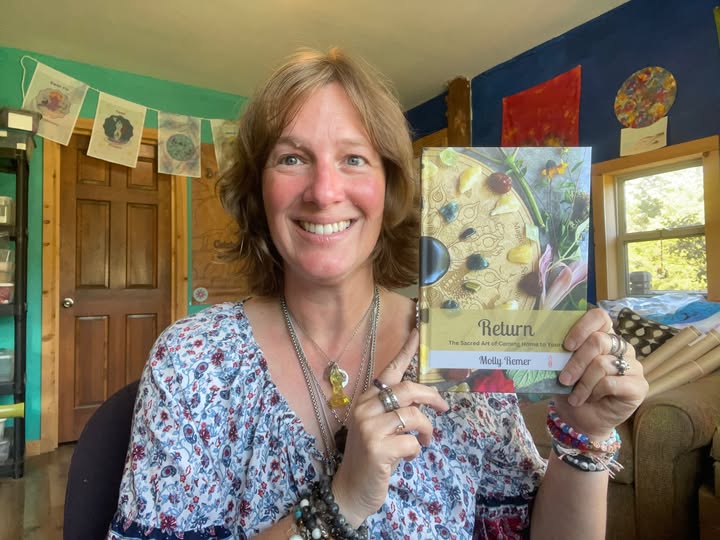
Note: my newest book, Return, the sacred art of coming home to yourself is now available.
Discover more from Feminism and Religion
Subscribe to get the latest posts sent to your email.

 Feminism and Religion
“Where chill meets warmth, the luminescence of mist is born. And, mist can be seen as a visible representation of the threshold itself, the guardian of the in-between” love these words – and oh yes, creating space for the madwoman within – this is a liminal piece – powerful – it slips through time –
LikeLike
Thank you for this post Molly. It so characterizes this season of Samhain, Day of the Dead, All-Souls day, etc . . .thresholds being the places of magic but only is we can stand to face what we find within. All ritual, all renewal, all remembering, all returning. Thank you for the reminder and the discussion of layers of such magic.
LikeLiked by 1 person
I love what you say Janet about thresholds being the places of magic BUT only if we can face what we find within…. The last dream I had showed a son acting like a madman while thrashing around on the floor – well? Who is this about ? Why me of course. Some adolescent part of myself that refuses to deal with life as it is…
LikeLike