Olive Tree from the studio of Judith Shaw. Judith has a special offer to purchase this artwork as a giclee print through August 24th. Details below.
With the trees burning around the world, in Canada and the US as well as in Europe and Africa, Asia, South America and more, it seems to be an especially important time to be with the trees, to recognize our kinship, and to celebrate them.
To see just how bad the fires are around the world, below are the links to two maps that are kept in real time. NASAGreenpeace
I don’t know when and where the initial hatred of trees began, but I would tag the Bible as an early and influential proponent of destroying trees.
The viciousness against trees appears to have grown out of a desire to erase Goddess worship in Biblical lands. The terms for Goddess groves were Asherot and Ashereem named after the Goddess Ashera. An individual tree was called an Ashera. The charge given to the people was to cut down everyone.
And ye shall overthrow their altars, and break their pillars, and burn their groves (Ashereem) with fire; and ye shall hew down the graven images of their gods, and destroy the names of them out of that place. Deuteronomy 12:3 KJV
But ye shall destroy their altars, break their images, and cut down their groves: Exodus 34:13KJV
Are you a woman (or man) who has lost touch with yourself spiritually — or
has never gotten in touch with yourself spiritually — or who just wants more joy in each day? If so, you may want to try entwining more goddess energy into your life. Many anthropologists believe that human societies were originally goddess-centered, and goddesses are still worshipped on every continent. Whatever your desire — strength, wisdom, compassion, fertility, creativity, sexuality — there is a goddess who can help you. Connecting with the goddesses who call to you — in the form of jewelry or art, words and music, or simply your thoughts — can sweeten and enhance your days with bright threads of unity, wonder, and female power.
But how to begin? The number and diversity of goddesses loved, worshipped, and celebrated throughout time and into the present, in every corner of the earth, is so breathtakingly large that trying to keep track of them can feel like counting the stars. To start you off, here are nine of my own favorite goddesses, chosen from among the most popular female divinities celebrated today (please note that many of them may also be known by different names or spellings).
Durga. The great Hindu mother goddess Durga is really nine goddesses in one. Durga’s nine manifestations — embodying qualities from courage to piety to blissful joy — are celebrated in India during a huge nine-day festival called Navarati. Durga is often pictured as a fierce goddess with many arms riding a lion. I have revered her ever since I found an ancient and powerful stone carving of her in the Asian wing of the Museum of Fine Arts in Boston. You can call on Durga’s invincible spirit when you need to be strong to your core!
Me (5th from right) with friends at a Durga Puja Celebration in Kolkata, India, many-armed Sculpture of Durga in background
Bright red tomatoes, fresh garlic, luscious blueberries, ripening seeds, a melon, one tincture and an ear of corn are spread over the kitchen table to mark this first celebration of the Harvest. At this fifth Turning of the seasonal Wheel, the Pueblo and Hopi Indigenous peoples celebrate the Corn Mother’s Abundance and I follow suit. Cedar stands watch in my mother’s vase etched with spinning wheels in blue.
The Sunstar is on the wane. The days are shorter as we move towards the darker months of the year. Yet look around – most of the wildflowers, bushes and fruit trees are seeding up and ripened berries disappear the moment they are tasty. The birds are watching and so are the bears.
With all this abundance I am struggling to bear witness to the fact that Earth is on Fire – that whole forests are being incinerated, that animals and people are dying. Here, smoke- filled air turn once blue skies into a sickly yellow soup. I plan my days around bad air, keeping Coalie and I inside when headaches and burning eyes strike and the worst of the smoke is entering our lungs and bloodstreams with irreversible consequences. All warnings have gone unheeded. Summers have become a threat to all; those that know, those who won’t.
How to re-dress imbalance is presently beyond my comprehension. We must surrender our lives to Earth’s wisdom which may be harsh. Consequences are the result of refusing to take appropriate action.
I have watched every episode of Law and Order and Law and Order SVU, and most of them more than once. Though there is police violence on these programs, it is usually investigated, and viewers are given the sense that it is not OK. Not living in black America or even in the United States, I guess I was under the illusion that police forces are no longer primarily white and male, that police reforms advocated decades ago have had some effect, and that cops cannot get away with murder.
For readers who don’t watch MSNBC as avidly as I do, stop and frisk, now banned in New York City, is the policy of searching (primarily) young black men hanging around on street corners to see if they have illegal drugs or weapons on their persons. This policy can lead to the incarceration of young black men for having one or two marijuana cigarettes intended for personal use in their pockets. Stop and frisk is not a policy on college campuses, where police are just as likely to find young white men and women in possession of illegal drugs. Why? Because college authorities and parents of white college students simply would not allow it.
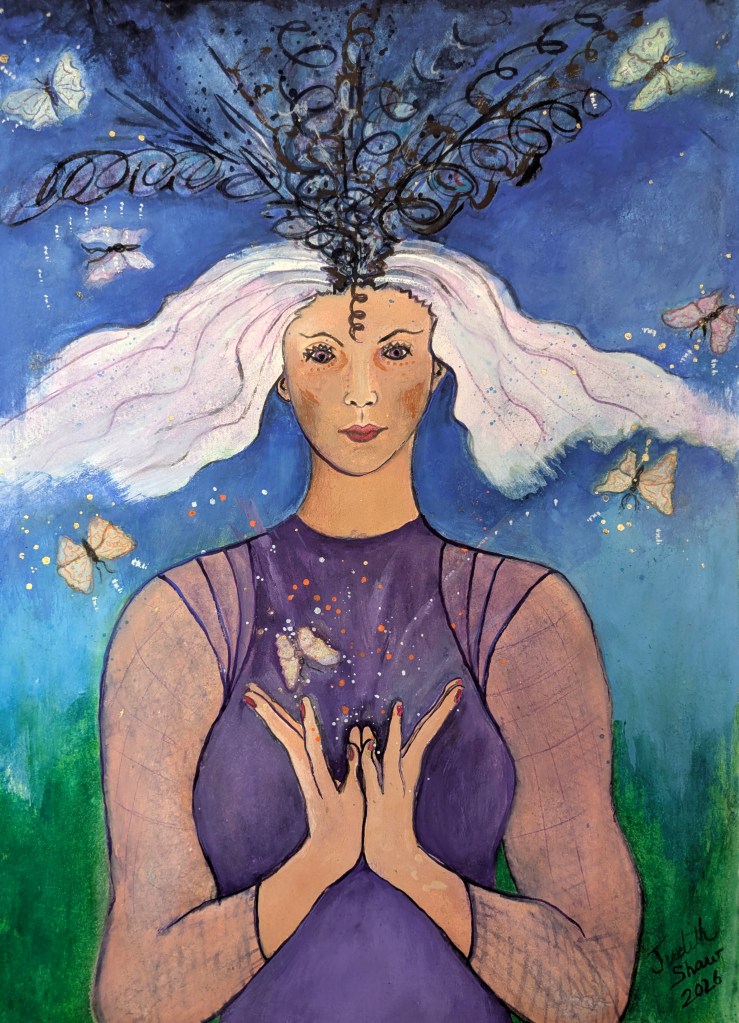
In this world of opposites, transformation is constant. Every moment the cells of our bodies are dying and being reborn. Matter, which flows from consciousness, dies but is reborn through the process of birth, death and rebirth. Some changes are fast and some are slow; stars live billions of years and butterflies live only a few days.
Ever since our collective experience during the COVID-19 pandemic, we both feel and are told that our world is transforming. Leaders—political and spiritual—talk about the need for transformation. Some want us to transform ourselves back to some imagined golden age, whereas other have eyes on the future, speaking of transformations we can’t yet imagine.
My own life has been one of continual transformation, an ever recurring experience of letting go of the old. I was told by an astrologer long ago that I came into this life determined to wipe the slate clean and transform myself. Admittedly it has not been an easy path, but my internal transformations have been a rich source for my paintings. Much of my art has been and continues to be about transformation.
At 28 weeks pregnant with twins, on a gorgeous summer day, I looked in the mirror and marveled at the way my body had expanded to accommodate the two lives within. I was proud of my body, proud of myself. I put on a black, lacy bralette with matching underwear and threw a lightweight open front kaftan on top. I set my phone on a self timer and took some beautiful shots of myself. Sitting on the bed. Standing in front of a mirror. Next to the crib, looking down at my belly.
The lighting was perfect; I felt ethereal—like the definition of a glowing pregnant woman. Pregnancy is magical for about 2 seconds out of 9 months and I was basking in them. I thought about God as Mother and smiled at the way my body reflected the image of God. I uploaded a photo to Instagram. Positive comments started to come in right away.
A few minutes later, my husband Colby walked into the room asking, “Did you just post a picture of yourself wearing a bra? That’s really weird.”
My heart dropped into my stomach. He had policed my outfit choices before, and it wasn’t worth the conflict to bring it up. This time felt different. This time I was carrying a baby girl who would be a sister in a family with two brothers.
‘Hansel and Gretel’ illustration by Karrie Fransman in ‘Gender Swapped Fairy Tales’ by Karrie Fransman and Jonathan Plackett (Faber & Faber, 2020). Used for commentary and review purposes under Fair Use guidelines. Website: https://karriefransman.com/project/gender-swapped-fairy-tales/
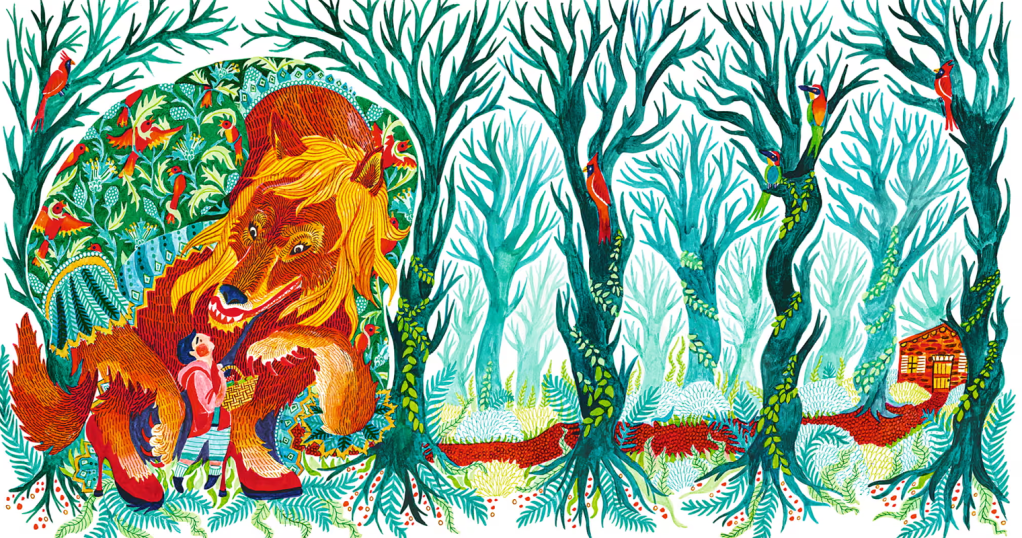
I have always adored fairy tales and folk tales, as they were the original, shimmering mirrors of my own interior world. In my own spiritual formation, I found my earliest refuge in the ‘monsters’ of the canon. I was drawn to the Selkie, whose power lived in her shed skin, and the shapeshifters who refused to be fixed in a single narrative. These were my mysterious teachers who offered profound knowledge, that I might have an interior life that does not match the exterior expectations of the world. By re-reading these archetypes, I see that the ‘liminal’ is not a place of exclusion, but the most sacred place of all: the threshold where the divine creates.
The traditional “curse” of the beast in fairy tales can be approached as a narrative of liminality, an invitation to exist in the “in-between” where nature and spirit intersect. This “curse” is, fundamentally, a colonial misunderstanding of power and a fear of the fluid. Figures like the trickster, the shapeshifter, and the mermaid reveal that the “soul” has never been bound by a static form.
‘Little Red Riding Hood’ illustration by Karrie Fransman in ‘Gender Swapped Fairy Tales’ by Karrie Fransman and Jonathan Plackett (Faber & Faber, 2020). Used for commentary and review purposes under Fair Use guidelines. Website: https://karriefransman.com/project/gender-swapped-fairy-tales/
For generations, books have served as children’s first primers on the soul, and long before children encounter formal theology, they are offered spiritual blueprints through folklore, myths, and fairy tales. Although folklore is a metamorphic and often subversive space, too often these stories have been constrained by essentialist moralism, a framework where goodness must be beautiful, evil must be deformed, and gender is an immutable divine decree. Imagine the princess waiting in passive, delicate virtue; the prince acting with muscular, conquering strength. Any disruption of these orders (think of the cursed beast or the transformative sea witch) is framed as a tragedy, a cautionary tale against altering one’s inherent form.
But these interpretations do a profound disservice to the expansiveness of the divine. Spiritual language does not need to be rigid; spiritual experience is often the opposite. In fact, the lexicon of faith, mysticism, and mythology is uniquely, beautifully equipped to honor gender fluidity and the trans experience. To diversify children’s literature is not merely a political act; it is an act of holy reclamation.
Mirabai Starr writes that to be a mystic is to “harvest the bounty of your own soul garden,” a place that is “both wild and tended,” sometimes lush and sometimes arid.
As summer’s heat presses in and the clamor of growth and change rises to a peak of abundance and urgency, we may begin to hear a summons from deep within. The cauldron call begins, at first a whisper and then an irresistible song that leads us away from the to-do list and into a mystical realm in which dreams and desire meet and begin to bubble into possibility. May we grant ourselves space for descent, even in the middle of all that is hot and bright and beautiful. May we listen to the yearning we feel to explore the depths, stepping out of the light and into the cool shadows that beckons us to steep. Right here, right now, in the middle of all that swirls, is when we are invited to stop, to put our ears back down to our souls and listen hard. It is now that we are invited to step into the cauldron of change, to sink down and in and let everything we are carrying soften and melt away while we remember how it feels to simmer in everything we have made, all that we love to taste and serve.
For years now, August has been my “Cauldron Month,” a dedicated time in which I take my life into the metaphorical cauldron of being, to reflect, to re-collect, to reconnect, to consider what I’m “simmering” in, what is bubbling and brewing in my days, and what needs to be scooped out of the pot. It is time in which I review the year to date and consider where I’m going, what I’m savoring, and what I’m dishing up to serve.






 Feminism and Religion