It breaks me down. My anger, my revulsion, my powerlessness. I have been searching for the way since I was a child old enough to remember my mind. For a time, I thought Jesus was a white guy knocking on my door after having seen a religious pamphlet placed under our windshield wiper. I’m not sure he has blond hair anymore, but I still feel him knocking. I have been in love with him for as long as I have been a self, so much so that I baptized myself as a little girl.
Somewhere along the way, I figured my little, lonely way wasn’t good enough, and I wanted a church home. I finished a doctoral dissertation trying to find some place I could hang my hat. I picked the Roman Catholic Church, despite what I knew of it and what I had to defend about its patriarchy and history to family and friends. I loved the conversation, the so-called “Catholic Intellectual Tradition.” I always felt myself to be a covert, a conversa, a definitive outsider, and someone not to be trusted entirely as a cradle Catholic might be trusted, yet I tried to be family. I’ve been bringing up my kids in the Church, volunteering, working in Catholic education, paying the boys’ tuition. I do work-arounds, making excuses for the exclusion of women, defying the Church’s stance on sexuality with a critical repertoire of cross-disciplinary scholarship. Lord, I even had to help my Seventh-Day Adventist mom with a hostile annulment process that was dropped on her unsuspecting by a horrendously insensitive marriage tribunal. It wounded us all. Yet, here I have sat, until this.
Trigger warning: child sexual abuse, domestic abuse
I was so thoroughly brainwashed that my voice changed without me realizing it. My appearance changed so much that close family members did not recognize me. Multiple therapists told me that I had undergone such sustained brainwashing and abuse that I was like a POW or a sex trafficking victim. Here is my story.
I will never forget the first time I came across the famous quote, “Feminism is the radical notion that women are people.” Reading that phrase rocked me back on my heels as few things have done. Suddenly, with that simple summary, so much of my experience, so much of life, so much of the world made perfect sense. Clarity struck, bringing both pain and relief: in my society, females are not considered human.
Having seen the image of a toddler crying while law enforcement questioned her mother, my daughter was filled with fear, anxiety, and confusion. After tearfully asking if she would be taken away from me, my nine year old followed up with the question, “Will Donald Trump go to heaven?”
It is true that the young girl was not a child who was being separated from her mother. Nonetheless, she has become the face of this time in history where American values no longer include “family values,” protecting children, or respecting human dignity.
The business mogul who claims a Christian identity with a room full of bibles to prove it, has made oppression, injustice, and the general devaluing of life the core of his administration. While Jesus calls us to embrace the stranger, walk with the least of these, to be a loving neighbor, and work for the liberation of every person, Trump’s actions and policies violate every teaching. And so, my daughter’s question was not out of line. Continue reading “Will Donald Trump Go to Heaven? by Gina Messina”
We live in a world in which women are the preferred target of different types of violence: physical, sexual, psychological, economic, symbolic and structural, among others. A type of violence we are not talking so much about is spiritual violence. This can be defined as using a person’s spiritual beliefs to harm, manipulate, dominate or control the person.
Spiritual violence includes, but is not limited to: disallowing the person to follow his or her preferred spiritual or religious tradition; forcing a spiritual or religious path or practice on another; belittling or making fun of a person’s spiritual or religious tradition, beliefs or practices; and, using one’s spiritual or religious position, rituals or practices to manipulate or alienate a person. Continue reading “God, Gender Violence and The Male Ego by Vanessa Rivera de la Fuente”
Shhhhh… good women are quiet. My mother was a beautiful woman, she never complained.
Denial is a silent violence that aims to make invisible a trauma maybe evident or not, to make it acceptable as normal and allow the victims of this trauma to be exploited from a system of oppression or people in power. Denial is that voice sugarcoated with correctness that asks us to shut up and sit down on our own pain so as to not disturb anyone. Is a silence that yells loudly, because sooner or later it will speak through the different ways we hurt ourselves and others.
It is not a mystery that women all over the world are subjected to a variety of violence and oppression. Women and girls are hijacked, raped, assaulted, murdered, their experiences mocked or banalized and their bodies thrown around like trash. People get outraged asking how this is possible? Well, this is possible because when a girl is born, she is “bestowed” the foundational denial that will allow the normalization of this violence and belittling during all her life: The denial that she is a human being. Continue reading “The Wings of the Butterfly by Vanessa Rivera de la Fuente”
One of the topics that has captured my deep interest during the last year is Epistemic Justice – and its absence, epistemic injustice – a concept which I reflect on often, since it has become a backbone idea in the approach of my work, my activism, my diagnosis of the situation of women in the global south and my vision of the world in which I would like to live. These reflections that I share with you do not intend to articulate a strictly academic presentation. They are my “thinking aloud” and don´t pretend to be completely right nor to establish a truth; rather they express the progress of a personal searching.
I speak as a Muslim feminist who loves to read and write about Feminism and Islam, but is not an academic nor aspires to be recognized as such in this field, although she writes papers and offers lectures in her own capacity on that matters. I speak as a community educator and social entrepreneur, who believes in feminism and spirituality as liberation tools. Since I accepted Islam, I took the experience gained in my work for the political empowerment of grass roots women to nourish an activism in the field of religion and gender justice. Continue reading “Religious Practice and Epistemic Justice by Vanessa Rivera de la Fuente”
On February 23rd 2018, President Trump addressed CPAC (The Conservative Political Action Conference). He put aside his written remarks again and spoke extemporaneously for seventy-five minutes on other issues, including immigration. During that part of his talk, he once more told the story that has become his recurring parable on immigration, one he used on the campaign trail in 2016.[1]
Essentially, it tells the tale of a woman who has pity on a snake she finds in distress. She nurses it back to health, shows compassion and even embraces it. During the embrace, it bites her and as she is dying, she asks “Why?” As Trump told it, the snake answers: “Oh, shut up, silly woman,” said the reptile with a grin. “You knew damn well I was a snake before you took me in.” He continued, “And that’s what we’re doing with our country, folks. We’re letting people in. And it is going to be a lot of trouble. It is only getting worse. But we’re giving you protection like never before.”
What is that protection? A wall, to keep “them” out and “us” in? (In this, The Handmaid’s Tale is prophetic.) Deportation of those who were born before their parents brought them to the U.S.? A media that follows the Trump’s lead in stereotyping immigrants and refugees from the Latin America and other places as illegal aliens, drug dealers, rapists, gang members and terrorists?[2]
Here we are, as I write this, a week after the horrible shooting of 17 students and teachers in Parkland, Florida. And the beginnings of a new student led movement: #NeverAgain—never another school massacre like what happened in Florida.
Today, one week after this horrific event, you had massive student walk-outs all over the country to protest the government’s refusal to do anything substantive about it. Here are images of student protests.
One of the out spoken survivors of the Parkland shootings, Emma Gonazlez, has turned into a spokeswoman/teen, for the movement, fueled by her fiery speech the day after the shootings.
Emma Gonzalez
She has continued to speak out as have the other students.
I am a college teacher, a college teacher in two public universities. I teach students one to four years older than the students at Parkland. Last week at one of the public schools I teach at there was an active shooter warning that turned into a hoax. I have in the past been on lock down because an active shooter was on campus. This is a very real problem for me.
Today I heard the president of the United States suggest that the solution to the every growing problem of gun violence is to arm teachers or other school officials with weapons. As a black belt in karate, I have had gun training and gun safety as part of my training and it is part of my self-defense resume. I had to learn it. What I can tell you about owning a gun (which I don’t) is that having a gun is not the same as knowing how to us one. I know how to disarm someone, if I am lucky and the fight goes in my favor. Anyone with any experience in self-defense will tell you that the quickest way to escalate a situation is to introduce a gun into the situation.
The Shakespearean quote, “something is rotten in the state of Denmark,” comes from a palace guard. After watching Prince Hamlet walk away with the ghost of Hamlet’s murdered father, the former King, the guard has a sinking feeling about how screwed up things are in his country.
And if you remember the play at all, things were pretty rotten. By the end of the story just about everybody dies. Revenge, misunderstandings, accidents, and lust for power are just a few of the causes of death. The guard was right. Something was rotting away at his country—something that was vacating people’s integrity and trust, something that was not afraid to use violence and lies to get its way, something that was blind with a hunger for more and more power no matter the cost.
When I was in graduate school, I learned to doubt myself. Despite having won Danforth and Woodrow Wilson graduate fellowships that paid for my tuition and living expenses, I was continually told by professors and male students alike that I would not finish my degree and that if I did I would get married, have children, and never use the degree I had earned. I tried hard to maintain my confidence in myself, but it was difficult when I was the only woman in the program. There was one other woman my first year, but she was older than I was, a nun, and I never saw her in class or at social events. My self-esteem was gradually eroded. If I had not had a fellowship, I would probably have dropped out.
Fast forward a few years. There were several more women in the program, but only one in theology, my friend Judith Plaskow, and she too struggled. I was working on my comprehensive exams and wondering if I had what it takes to pass them and then write a Ph.D. thesis. After the initial shock of being treated as if I was not the equal of the male students in the program, I began to look around me. A few of the male students seemed really bright, many of them were average, and some of them were plodders. I hate to admit it, but I looked at the least competent among them and said to myself, “If he can do it, then surely I can.” And I did. I passed my exams. A few years later my Ph.D. thesis was approved.
If contributions to the field are any indication, Judith Plaskow and I were not only as good as the most mediocre men in our graduate program, we smarter than the average ones, and at least as smart as the smartest ones. But we didn’t know that then. Men have been getting degrees and being promoted and moved up that ladder because other men like them, identify with them, feel sorry for them, and for lots of other reasons having nothing to do with excellence, and sometimes not even do do with competence.
Last week I heard Cecile Richards say something to Lawrence O’Donnell that reminded me of this. Speaking of the huge numbers of women who—inspired by the women’s marches–will be voting, registering voters, campaigning, and running for office in 2018 and beyond, she said women “totally understand that they can do better than who’s in office now.”
photo by Marie Cartier
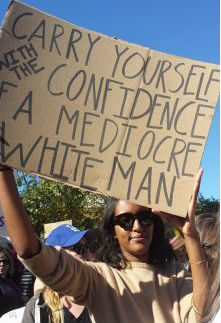
For far too many years women have been held back by lack of self-confidence and self-esteem. We didn’t think we could and we didn’t. We don’t think we can and we don’t. We thought men were smarter than us or had more time or more drive. The founder of the Society of Women Engineers at San Jose State told my classes that women who got even one B+ in an engineering class were likely to drop out of the program, while men graduated who graduated with C averages went on to get great jobs. Now we see truly mediocre white men holding public office all across the country and in its highest offices. The harm they are doing to women, to children, to the elderly, to people of color, to the environment has been a wake-up call for all of us. There are so many mediocre white men in office that women–of all colors and ethnicities–are realizing that we can do better than that! Once we begin to see what we can do when there are large numbers of us holding office all across the country, there will be no stopping us!


 Having seen the image of a toddler crying while law enforcement questioned her mother, my daughter was filled with fear, anxiety, and confusion. After tearfully asking if she would be taken away from me, my nine year old followed up with the question, “Will Donald Trump go to heaven?”

 On February 23rd 2018, President Trump addressed CPAC (The Conservative Political Action Conference). He put aside his written remarks again and spoke extemporaneously for seventy-five minutes on other issues, including immigration. During that part of his talk, he once more told the story that has become his recurring parable on immigration, one he used on the campaign trail in 2016.

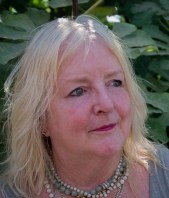 When I was in graduate school, I learned to doubt myself. Despite having won Danforth and Woodrow Wilson graduate fellowships that paid for my tuition and living expenses, I was continually told by professors and male students alike that I would not finish my degree and that if I did I would get married, have children, and never use the degree I had earned. I tried hard to maintain my confidence in myself, but it was difficult when I was the only woman in the program. There was one other woman my first year, but she was older than I was, a nun, and I never saw her in class or at social events. My self-esteem was gradually eroded. If I had not had a fellowship, I would probably have dropped out.