
Several years ago, I was pastor of a welcoming and affirming church. As a queer clergywoman, I thought that such a place would be the perfect place to flourish and thrive as a pastor. And yet, because of heterosexist and sexist microaggressions, I found myself anxious, depressed, and in need of physical, emotional, psychological, and spiritual care.
After a three-day retreat filled with self-care and soul-nourishment at a non-profit retreat center that catered to activists and artists , I felt as though a tremendous weight was lifted off my shoulders, that I could focus and find clarity in my vocation. Pausing to care for myself gave me the courage to leave my toxic job and live more fully into my calling. This experience taught me the vital importance of self-care.
Womanist Audre Lorde once proclaimed, “Caring for myself is not self-indulgence, it is self-preservation, and that is an act of political warfare.” Because caring for the self violates the patriarchal norms that traditionally dictate that you should be the one caring for everyone else. Yes, everyone needs to pause to care for the self. But oppressed minorities have a particular need for self-care, not simply as a way of refreshing oneself in order to do the work of justice, but as a vital part of the work of social justice. Because caring for yourself in a society—and a church—that wishes for you to do otherwise is an act of political warfare. When feminists care for themselves, it is a radical act of soul redemption, spirit rejuvenation, and a political and spiritual act of acknowledging your holy and innate self-worth. In case anyone has told you that you are not worthy, let me reassure you. You are worthy. And you deserve to care for yourself.
Continue reading “Self-Care is a Feminist Issue: Holy Women Icons Project’s 7-Day Online Self-Care Retreat by Rev. Dr. Angela Yarber”


 Yesterday I “paused” my post and left you with words from a dear friend Edyka Chilomé, a powerful “artivist” invested in the healing of our world. And our world is in need of healing indeed.
 I don’t know if I could be a deep-sea welder. I don’t know what the risks of lethal electrocution, broken limbs, or the bends would be. I suspect it can be a dangerous occupation, like operating heavy equipment on good old dry land or fishing for crab or even collecting garbage from the neighbors’ driveways. So too is this the case with window washing, paving, disposing of medical waste, brick making, driving a giant tanker truck, and more. There are aspects of the world I know I take for granted, but the moment I stop to consider what those aspects might be, I am humbled and reminded of the privilege it is to philosophize and ponder the functions of religion in the shaping and making of society.
 Even though snakes never inhabited Ireland, as in the rest of the ancient world both the serpent and the dragon were ancient symbols of life, fertility, wisdom and immortality for the Celts.
 These days I find it hard to write – I feel plagued with negativity, and the news and violence and overall hateful actions of others have weighed deeply on my soul. While I personally am ready to celebrate a milestone birthday, am another year closer to completing my Ph.D., witnessed the graduation of one daughter, experienced the independence of another, a milestone for my twins, as well as my father’s successful completing of another orbit around the sun after a year plagued with health issues – rather than joy, my heart is filled with pain – pain of the election, pain of the failure of our political system’s supposed checks and balances, pain of violence and bigotry like that enacted in Charlottesville, pain of terror attacks in England, Spain, Finland, France, etc. Where we ought to be united, we are divided. Thus, I write from a place of remembering – a place of strength – a place to say I count (as you count) – and I begin this blog in the voice of Enheduanna, where she becomes the first voice in history to reveal herself – her name, by simply stating – – “I AM.”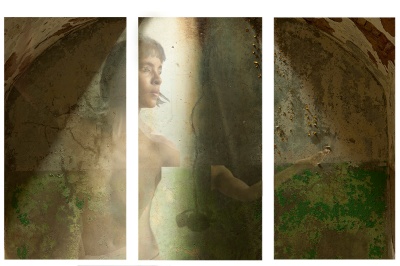
 Introduction by Maeve: Elizabeth’s July post usually features an excerpt from my Chronicles in honor of my feast day, July 22. This year the excerpt comes from the novel that opened the way for my story. Ever since a playdough figure took shape spontaneously in her hands, Esther, a minister’s wife, has been on a quest to find out Who She Is! Here she encounters the Lady as the Virgin Mary. (For my take on the BVM, aka Ma, the scene stealer, see The Passion of Mary Magdalen and Bright Dark Madonna.)
 Feminism and Religion