Calling All Biblical Wise Women by Rabbi Jill Hammer, PhD

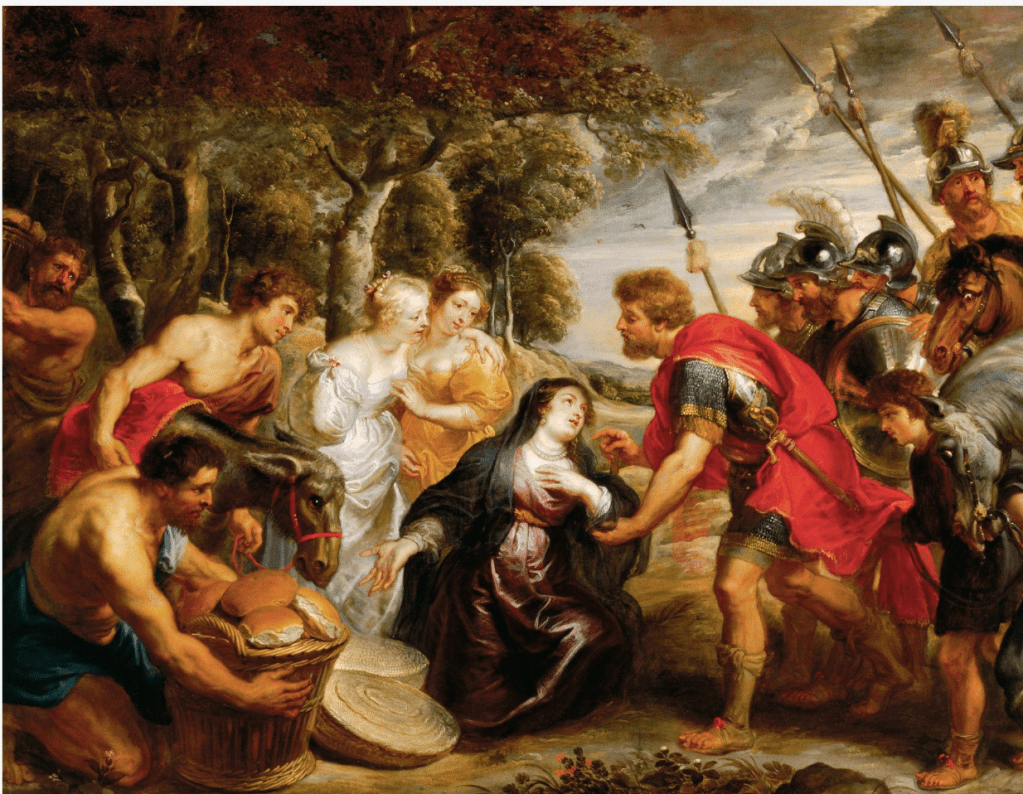
The meeting of David and Abigail by Peter Paul Rubens circa 1630

In these days when so many are afraid and aching for the people of Ukraine, and concerned about the lasting impacts of this war around the world, I cannot help thinking of the wise women of ancient Israel. These wise women, unafraid of confronting dangerous men, used their intelligence and storytelling skill to defuse violent situations between powerful adversaries and restore peace. May their wisdom be felt in the world now. 

The institution of “wise woman” appears several times in the Bible. In the Book of Samuel, a wise woman (chachamah in Hebrew, from chochmah, wisdom) steps in when there is a war, or political conflict, to promote peace. In II Samuel 14, after King David’s son Amnon rapes David’s daughter, Tamar, the king does nothing. Tamar’s full brother Absalom takes matters into his own hands and kills Amnon, then flees to another country.  David grieves for Absalom but won’t send for him. The wise woman of Tekoa appears before King David, pretending to be a woman whose sons fought, and one killed the other. The story she tells helps to reconcile King David with his son Absalom, at least temporarily.  

Continue reading “Calling All Biblical Wise Women by Rabbi Jill Hammer, PhD”

Carol P. Christ’s Legacy: Does Belief Matter?

Moderator’s Note: Carol Christ died from cancer in July, 2021. Her work continues through her non-profit foundation, the Ariadne Institute for the Study of Myth and Ritual and the Goddess Pilgrimage to Crete. This blog was originally posted December 10, 2012. You can read it long with its original comments here.

In recent days I have been pondering the fact that some people and some feminists seem to see the issues of religious faith and belonging to be rooted in birth, family, and community, while for others the question of belonging to a religious community hinges on belief and judgments about the power exerted by religious institutions.  What accounts for this difference in the way we view religious belonging?

Recently I watched The Secret History of Sex, Choice and Catholics, a film featuring Roman Catholic feminists and ethicists who dissent from the Roman Catholic hierarchy’s views on contraception, abortion, and homosexuality.  At the beginning of the film those interviewed state almost univocally that for them being Catholic stems from having been born Catholic. These Catholic dissidents continue as Catholics, even though they disagree with major portions of Roman Catholic teaching.  It may have been because they were not asked, but most of them did not name reasons of belief for remaining Catholic.

Continue reading “Carol P. Christ’s Legacy: Does Belief Matter?”

On The Baby and The Bathwater by Liz Cooledge Jenkins

It wasn’t until seminary—and even then, only sporadically—that I learned that many of the foundational figures in Western Christianity held some incredibly sexist attitudes. Somehow, in all my years of attending church, hearing sermons, participating in (and leading) Bible study groups, reading Christian books, and working in ministry, I had missed this historical reality. I just hadn’t thought about it. And the (mostly white male) Christian leaders who shaped my own faith apparently hadn’t thought about it, either. That, or they didn’t think it was important enough to talk about. Or they intentionally tried to keep it on the down low. Or some combination of these things.

In seminary, when influential theologians’ sexist views came up in class, inevitably someone would say—in a wise-sounding tone—“Well, we don’t want to throw out the baby with the bathwater, do we?”

Continue reading “On The Baby and The Bathwater by Liz Cooledge Jenkins”

Behold! The Treasures of Eden by Janet Maika’i Rudolph

The place and purpose of the Garden of Eden is a topic of endless fascination and interpretation. This blogpost looks at two biblical passages and the word eden itself to see what we can learn about its meanings. At its most basic, Eden is a garden of treasure and delight.

As I’ve written before, the written form of Ancient Hebrew words comes from the hieroglyphic tradition of Egypt. The pictures of the letters form a picture puzzle or rebus. The word roots are generally two or three letters. I use script called Semitic Early for my baseline of study.

Continue reading “Behold! The Treasures of Eden by Janet Maika’i Rudolph”

From the Archives: Women’s Bodies and the Bible by Janet Maika’i Rudolph

Moderator’s note: This marvelous FAR site has been running for 10 years and has had more than 3,600 posts in that time. There are so many treasures that have been posted in this decade that they tend to get lost in the archives. We are beginning this column so that we can all revisit some of these gems. Today’s blogpost was originally posted May 20, 2019. You can click here to see the original comments.

Trigger Alert:  The bible on its face is quite violent to women.

Amidst the ugliness that is American politics in general and abortion politics specifically, I began to look for guidance to understand what is happening. I ended up pulling out two books that I read long ago. The first is Woe to the Women-The Bible Tells Me So by Annie Laurie Gaylor. Gaylor, in turn, was inspired by the work of Elizabeth Cady Stanton in her The Women’s Bible which was originally published in two parts (1895 and 1898).

I had forgotten how inspired I have been by both books. Together, they motivated me to begin looking at how the bible is a foundational paradigm of our culture. I started researching how translations have been altered from original meanings. I have already written a few blogs about how the representations of Eve have been changed to strip Her of the roots of Her original power. Take a look here and here.

Continue reading “From the Archives: Women’s Bodies and the Bible by Janet Maika’i Rudolph”

Heart Vibration: Biblical Poetry by Janet MaiKa’i Rudolph

My inspiration for biblical verses this month comes from the lovely and soulful translations of Rabbi Yael Levy in her book Journey through the Wilderness (subtitled: A Mindfulness Approach to the Ancient Jewish Practice of Counting the Omer). She has given me permission to quote her translations (thank you!). I use 2 of her verses in this blogpost.

One of her translations aspects I found most fascinating is that of YHVH (LORD in the bible). She uses Mystery. I have used Mother/Father Creator, and more lately, Vibration.Being. I love her usage. It taps into the magic that YHVH is the ultimate Mystery of all creation. These beautiful translations are meaningful, differing, yet connected aspects of the holy name. These prism-like views come together to make an even more exquisite truth.  

For today’s blogpost my main focus is on several verses from Psalm 119. It is poetry which talks about the heart and chesed, or in English, lovingkindness.

Continue reading “Heart Vibration: Biblical Poetry by Janet MaiKa’i Rudolph”

Biblical Poetry: Vibrational Essence by Janet Maika’i Rudolph

Today’s biblical poetry reflects on two passages in Exodus 15:2 and 15:3. Both deal with the vibrational essence that gives rise to the splendors of life.

KJV is the traditional King James Version. MPV is my own Mystic Pagan translation.See notes below for my translations of various words including LORD.

Exodus 15:2

The LORD is my strength and song, and he is become my salvation:
he is my God, and I will prepare him an habitation;
my father’s God, and I will exalt him.
KJV

YaaaHaaaVaaaHaaa, is the source of my vivacity and song
Unveiling pathways of liberation.
Rooted in the potentiality of my ancestors
Resplendent in beauty.
MPV

Continue reading “Biblical Poetry: Vibrational Essence by Janet Maika’i Rudolph”

A Mystical Journey: Psalm 93 by Janet Rudolph MaiKa’i

Sometimes I’m asked where I get my inspirations for verses to explore. In this case it was from the God Squad’s Rabbi Marc Gellman who discussed Psalm 93 in a recent column. In his analysis, he used Psalm 93 to wax poetic about how powerful god is outside of nature. In fact, he declared that the worship of nature is idolatry because it only points toward God but can’t completely match God’s majesty. Ahem and Excuse me! With my ire raised, I had to go and look at the Hebrew from my own Mystic Pagan perspective. Rabbi Gelman looks at these verses and his take-away is that “God is more powerful than even the most powerful storm.” Ahem and Excuse me again!  

After delving into the Hebrew words, I see a whole other side to this powerful Psalm. I see the “power of God” [as he would say] or the “beauty of the divine [as I would say],” is that most awesome ability to midwife creation and birth. In other words, to make love manifest. I see in Psalm 93, an esoteric poem bursting with motion that begins by creating a place (Earth) for life to exist. This poem is filled with sound vibrations, thunderous surf, the movement of water and descriptions of thresholds. As the motion unfolds, one is invited to participate in the energies [powers] of the divine pouring out through these threshold gateways.

Continue reading “A Mystical Journey: Psalm 93 by Janet Rudolph MaiKa’i”

Biblical Poetry, 5th Installment

This is the 5th in a series of work I have been doing to translate passages of the bible into poetry that strips out the patriarchal overlays. You can read the previous posts.

In this installment I am grouping together some passages that deal with vibrational energy and its role in creation. We humans often express sacred vibration as song or chant. When we get into the vibrational flow they are truly uplifting. In the translations below, I have kept two of the words in Hebrew because of their wonderful vibrational essences:

Continue reading “Biblical Poetry, 5th Installment”

Lucky by John M. Erickson

This past weekend, I was asked by an individual why I decided to get my Ph.D. in American Religious History focusing on LGBTQ spirituality and sexuality.  Now, I’ve been asked this before, and if you know anything about me, you know I like to shock people at times, so my usual response is: “I have always been fascinated with people tell me I was going to hell.” 

It’s almost the end of Pride Month and I wanted to take a moment to reflect on where we’ve come and where we must go.

This past weekend, I was asked by an individual why I decided to get my Ph.D. in American Religious History focusing on LGBTQ spirituality and sexuality.  Now, I’ve been asked this before, and if you know anything about me, you know I like to shock people at times, so my usual response is: “I have always been fascinated with people telling me I was going to hell.” 

Continue reading “Lucky by John M. Erickson”