Hillary Clinton, What Happened and What Happens Now? by Marie Cartier

“In the past, for reasons I try to explain, I’ve often felt I had to be careful in public, like I was up on a wire without a net. Now I’m letting my guard down.” —Hillary Rodham Clinton, from the introduction of What Happened

I just finished reading Secretary Hillary Clinton’s new book, What Happened. It is currently Number One on Amazon, outselling even Stephen King’s It and Margaret Atwood’s The Handmaid’s Tale at this moment. Put another way- hardcover sales of the book are the highest for any non-fiction book in the past five years.

I’ve written several times during the past year regarding Hillary Clinton and the election of 2016. About the real meaning of “sanctity of life”—living a full life and voting for a candidate who believed in that for everyone, including women’s right to choose and also about the process of those trying to silence her/ shame her/ not listen to her and how she refused to be silenced.

Devastated after the election I wrote a post here on FAR. And months afterward, I wrote how many of us were not “over it” and were not “ready to play nice.” We, along with Secretary Clinton, are not “ready to play nice” still. And probably will not ever be. We may be willing to (as I will speak of later) lead with love and kindness—but that is different from “playing nice.”

Continue reading “Hillary Clinton, What Happened and What Happens Now? by Marie Cartier”

The Spirit and Jarena Lee: Inspiration to Break Boundaries by Elise M. Edwards

elise-edwardsI am so frustrated that we are still fighting to affirm women’s place in leadership.  I’ve been thinking about this struggle in the context of church ministries (especially preaching) and social activism, seeing a stark contrast between the way institutional churches and universities promote and subvert women’s authority and the ways movements like Black Lives Matter do.

Particularly, I’ve been struck by the ways that more radical movements employ language and practices that are based in spirit more than hierarchical authority.  I have found a theme emphasizing equality in humanity’s access to spirit in both historical and contemporary movements and writings about religious experience.  I’m certainly not the first one to notice or discuss how appeals to Spirit have empowered those excluded from dominant systems of power to challenge constrictive social structures, but I would like to share how this dynamic has become more visible to me so that, together, we might find encouragement, inspiration, and food for thought.

Continue reading “The Spirit and Jarena Lee: Inspiration to Break Boundaries by Elise M. Edwards”

Book Review: FLORENCE IN ECSTASY by Jessie Chaffee

FlorenceInEcstasy3DBook


Jessie Chaffee‘s Florence in Ecstasy is the most luminous debut novel I have read in a very long time. Imagine, if you will, a darker and more literary version of Elizabeth Gilbert’s popular spiritual seeker’s memoir, Eat Pray Love. This is not to diminish Gilbert’s memoir, which I loved, but Chaffee offers a much deeper dive into the dark night of a woman’s soul.

Hannah, a young American from Boston, goes to Florence, Italy to heal herself after her professional and personal life back home has disintegrated due to her anorexia. Surely, in life-loving Italy, where every meal is a celebration, Hannah can heal her disturbed relationship with food and her own body. Similarly, Eat Pray Love, with its luscious descriptions of Italian cuisine and Gilbert’s rejection of dieting in favor of buying a bigger pair of jeans, deals with body image issues and is often recommended reading for women and girls recovering from eating disorders.

But Chaffee’s novel, unlike Gilbert’s memoir, is no easy-going, feel-good read. Continue reading “Book Review: FLORENCE IN ECSTASY by Jessie Chaffee”

Are These Three Novels Prophetic? Part 2: Woman on the Edge of Time by Marge Piercy by Barbara Ardinger

Members of this community (and others) have been feeling that the world is out of balance since the 2016 election. There’s a feeling that people are becoming less kind and that some men (following the model that lives and tweets in the White House when he’s not at one of his golf resorts) are more misogynistic. I’ve heard that Orwell’s novel Nineteen Eight-Four is more popular than ever before. We seem to be living in a new dystopia. It’s very sad and very scary.

I’ve recently reread three novels that I think may be both prophetic and inspiring. I’m hoping that if you read them, too, you’ll inspired by their brave heras to keep on resisting. The novels are Gibbon’s Decline and Fall (1996) by Sheri S. Tepper, Woman on the Edge of Time (1976) by Marge Piercy, and The Fifth Sacred Thing (1993) by Starhawk.

The woman who is on the edge of time is Consuelo (Connie) Ramos, a Mexican-American who lives in a New York barrio and has a life so dreadful that even as Piercy describes the poverty and the abuse in exquisite detail, I can’t really see it…though I bet any homeless person who lives on or under a freeway overpass could add more horrific details. Connie’s father beat her, two of her three husbands beat her, her daughter’s pimp beats her. Her brother has anglicized himself by changing his name from Luis to Lewis. Her third husband was a blind black musician named Claud; it was while she was deep in mourning (and withdrawal) that she struck out at her daughter and injured her, which led to her first imprisonment (Lewis signed the committal forms) in an insane asylum that is immeasurably worse than, say, Dotheboys Hall in Oliver Twist. The bureaucrats who run the asylums have zero interest in their patients. If a patient complains of a burnt back (the pimp knocked Connie into a hot stove) or a headache, that patient is accused of making a “medical diagnosis.” The favored treatment? Huge doses of Thorazine, which has terrible side-effects. Connie finds herself “stymied, trapped, and drugged with Thorazine that sapped her will and dulled her brain and drained her body of energy.”

Continue reading “Are These Three Novels Prophetic? Part 2: Woman on the Edge of Time by Marge Piercy by Barbara Ardinger”

Are These Three Novels Prophetic? Part 1: Gibbon’s Decline and Fall by Sheri S. Tepper by Barbara Ardinger

Members of this community (and others) have been feeling that the world is out of balance since the 2016 election. There’s a feeling that people are becoming less kind and that some men (following the model that lives and tweets in the White House when he’s not at one of his golf resorts) are more misogynistic. I’ve heard that Orwell’s novel Nineteen Eight-Four is more popular than ever before. We seem to be living in a new, dystopic society. It’s very sad and very scary.

I’ve recently reread three novels written by women that I think may be both prophetic and inspiring. I’m hoping that if you read them, too, you’ll inspired by their brave heras to keep on resisting. The novels are Gibbon’s Decline and Fall (1996) by Sheri S. Tepper, Woman on the Edge of Time (1976) by Marge Piercy, and The Fifth Sacred Thing (1993) by Starhawk. Continue reading “Are These Three Novels Prophetic? Part 1: Gibbon’s Decline and Fall by Sheri S. Tepper by Barbara Ardinger”

Resisting Shame and Choosing to Live through the Loving Eye by Stephanie N. Arel

This week, I finished reading The Politics of Reality: Essays in Feminist Theory by Marilyn Frye, a text I had not encountered in my studies of feminism (in literary theory, psychology, philosophy, or theology) until now. In some ways, I wish I would have read it sooner. In other ways, I am grateful for this more recent rendezvous. From my current position and perspective – theoretical and personal – I was, I think, more able to hear the core message Frye conveys than I would have been years ago. I have less to protect now, and my ego is less fragile. In the text, she names the mechanisms around which Western – and patriarchal – cultures are founded. Her argument is fluent and cogent, even as it threatens the stability this culture offers. Our lives are embedded in it, even if our personal ethics point to alternative, feminist ways of living. Frye pushes her readers to live alternatively, so that we can recognize the times that we conspire/feed into/comply with patriarchal messages and clean the residue of servitude off of our skin.


For the purposes of this post, I engage two opposing concepts Frye presents in the text: the arrogant eye and the loving eye. Located in the chapter entitled “In and out of Harm’s Way: Arrogance and Love,” Frye investigates how men in phallocentric culture exploit and enslave women. The opposing, contradictory eyes of arrogance and love directly relate to the experience of shame which effectively serves to subjugate women in patriarchal culture.


Shame functions within what I call a logic of exposure. Shame relates intimately to the concept of being seen.  Affectively, shame results from our interest/excitement being partially truncated. For instance, we are drawn to someone (real or imagined); we are interested in their response to us, and somehow something interferes with the desire to connect. Contact is cut off, and interest/excitement partially halted. Shame ensues. We experience that someone (real or imagined) seeing us as other, different, foreign, maligned, wrong, or worthless. We are seen wrongly. This misperception alleviates joy and relates to the gaze of the arrogant eye under which (as the default gaze of phallocentric culture) we often find ourselves seeking approval.

Continue reading “Resisting Shame and Choosing to Live through the Loving Eye by Stephanie N. Arel”

Sexuality and Spirituality: Convergence or Alienation? by Stephanie Arel

stephanie-arelI just finished reading for review The Bloomsbury Reader in Religion, Gender, and Sexualityedited by Donald L. Boisvert and Carly Daniel-Hughes. Targeting an undergraduate audience, the text explores ways that religion, gender, and sexuality intersect and interact in a variety of religious traditions.

The book’s essays traverse a wide sampling of religious inheritance including indigenous traditions, Christianity, Judaism, Islam, and various Asian religions. The topics examined range from the culture of male love in Japanese Buddhism to various themes of love in Haitian Voodoo, from sexual desire in Beguine communities to Gandhi’s experiments in sexual chastity, and from the passion of St. Pelagius to the transgender performance characteristic of the Hijra identity in India. Among other things, the book offers a wide array of interpretations regarding how sexuality emerges in particular traditions and contexts. One is left with a feeling that nearly anything goes depending on which set of rules or religious mores a particular group of people follow. The variations presented in each chapter related to the interpretation of sexuality’s embeddedness in spiritual expression problematize the notion of the “normal” emerging in sexual desire and expression. Continue reading “Sexuality and Spirituality: Convergence or Alienation? by Stephanie Arel”

Contemplative Education: A Pedagogical Approach of Compassion by Elisabeth Schilling

green pathEven though I encountered wisdom literature when specializing in Hinduism during my Religious Studies doctoral program, through reading the works of Christian female mystics and the liberation theologies of feminist spiritual guides, it took a book I never encountered in my academic studies to give me a spiritual foundation that feels complete after my departure from Christianity: Eckhart Tolle’s The Power of Now. It led me to the place where I am now, practicing mindfulness, being aware of the ego, and attempting to live in the present. Now I can return to wisdom literature with a lens that helps it make sense. Although I did not know it when I began utilizing these ideas in the classroom, there is an entire pedagogy based on them.

Contemplative education is based on the observation that the world is in need of healing and the majority of people have not encountered helpful ways to deal with their suffering. Why not use the classroom for healing and to create healers? Contemplative education has five goals or elements: 1. deep, or critical, thinking, 2. constructive communication, 3. awareness of the global impact of our behaviors, 4. personal development/well-being, and 5. a non-sectarian admiration for and inclusion of wisdom literature and traditions. This last element is what really distinguishes this pedagogy from others. And I see how it shares a great deal with feminist practices as well, especially as feminist pedagogy honors experiential knowledge, self-reflection, and activism. Continue reading “Contemplative Education: A Pedagogical Approach of Compassion by Elisabeth Schilling”

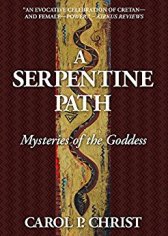
FAR Press Publishes A Serpentine Path: Mysteries of the Goddess by Carol P. Christ

carol-p-christ-photo-michael-bakasThis is a great day for me as I announce the publication of A Serpentine Path: Mysteries of the Goddess. It is the first —but certainly not the last—book from the new FAR Press, directed by Gina Messina and Xochitl Alvizo, two of the founders of www.feminismandreligion.com. The release of my book is the fruit of friendship and collaboration that has been nourished in the blog community. I hope you will join with us in celebrating our joint venture by ordering the book, telling your friends about it, sharing it Facebook and Twitter (links below), reviewing it on Amazon, and letting Gina and Xochitl know if you can review in a magazine, journal, or blog.
Here is an excerpt from the preface to whet your appetite.

*

A Serpentine Path is a story that begins in despair and ends in rebirth and regeneration. It depicts a turning point in my life, a psychological and spiritual breakthrough that opened me to living the rest of my life in grace and joy. Though I am tempted to say it was a journey from darkness to light, that would be inaccurate, for mine was a journey into the darkness and out again. The path of life is never straight or narrow, and the circle of light and darkness is never-ending.

When I began the journey described in A Serpentine Path, I did not feel loved, I did not want to live, I could not write, and I believed the Goddess had betrayed my faith. As I completed the book, I knew I was loved, I wanted to live, I was writing, and I understood that the Goddess had never abandoned me. Though my life has had its ups and downs since then—as all lives do—I have never forgotten that I am loved, I have wanted to live, I have not stopped writing, and I feel the Goddess ever-present in my body, in my breath, and in my connections with the living and the dead. Though my story is deeply personal, my struggles with love and death, trust and control, are widely shared.

A story of finding the Goddess, A Serpentine Path is part of a growing genre that is developing as women explain to themselves and others why they left the patriarchal religions of their origins for a more nourishing spiritual vision that affirms both women and the earth. A Serpentine Path documents the first of the Goddess Pilgrimages to Crete I have been leading twice a year since then. For the women who have traveled with me, it will evoke many memories. For those who have dreamed of a pilgrimage to the Goddess, it offers an opportunity to imagine the journey. I now know a great deal more about ancient Crete, the folklore and customs of traditional Crete, and the rocks, trees and plants of Crete, than I did when I began. But I learned the mystery on my first pilgrimage. Because we are all deeply connected to each other, I know that the path to the mystery I discovered is not mine alone.


a-serpentine-path-amazon-coverBe among the first to order A Serpentine Path, Carol P. Christ’s moving memoir of transformation. Carol’s other new book written with Judith Plaskow is Goddess and God in the World: Conversations in Embodied Theology. Carol also wrote the first Goddess feminist theology, Rebirth of the Goddess.

Join Carol on a Goddess Pilgrimage to Crete in 2017. Save $200.

Read two of the chapters in the book: Mysteries and Dionysian Rites.

Thanks to Judith Shaw for the cover art “Downward Serpent”

Murder at the Rummage Sale: Book Review by Judith Shaw

Judith Shaw photoMurder at the Rummage Sale (Albany, NY: Imagination Fury Arts, 2016) by Elizabeth Cunningham is a mystery novel with a style and depth of thought that offers not only the fun of figuring out “Who Dun It”  but also gorgeous prose and poetic phrasing which is not so commonly found in the mystery genre.

Set in 1960 small town America, the book transports us back to that era with a fine eye to detail. It 9781944190019takes place over a few days in the life of the Church of the Regeneration as the women prepare for their annual rummage sale. Charlotte Crowley, an over bearing kleptomaniac who wraps men around her little finger while antagonizing most of the women, has always led the effort. But with only a few days to go before the sale begins, Charlotte is found dead in the basement, smothered by a plastic dry cleaning bag full of coats.

Though the police declared the death to be accidental, Lucy Way, an older woman with a bit of faery blood and white curls she is very proud of, has her suspicions. Lucy sets out to solve the crime with the help of a cast of characters associated with the church: the Reverend Gerald Bradley, the church minister with a love of drink; Anne Bradley, his wife who doubts the existence of God; Katherine Bradley, their fanciful seven year old daughter; and Katherine’s sworn blood brother, Frankie Lomangino Jr., son of Frankie Lomangino an ex-con who becomes the prime suspect. Continue reading “Murder at the Rummage Sale: Book Review by Judith Shaw”