Feminist Holy Week Vaginal Christology Devotional, Part 1 by Trelawney Grenfell-Muir


Monday:

Thought for the day:

In Matthew 21, Jesus rides a mother donkey, her baby beside her, into Jerusalem in blatant condemnation and contrast to the militaristic entry of Roman military leaders and soldiers on war horses through a different gate. The point of Palm Sunday was activism: a political protest against war and the domination systems of oppression. The symbol Jesus chose for his protest was a mother and child. When the people shouted “Hosannah,” which means “save us,” they were asking to be liberated from the terrible economic and political oppression of imperial injustice. Jesus’ message of egalitarian Common Good and a kin-dom of JustPeace brought people hope and inspiration for a better future of mutual thriving and wellness.

Prayer:

Divine Source, You who Conceive and Birth and Nourish all Creation, open our hearts to the Way of Salvation that will bring liberation and mutual thriving to our Earth today. To honor Christ with Palm branches, may we protect Palm forest habitats for the orangutans who cry “Hosanna! Save us!” To honor the mother donkey and her baby, may we advocate for mothers everywhere, who are the most impoverished people in our society. May we always remember that You are Mother of All, ever ready to embrace us, cradle us, tend our wounds, nourish our spirits, and remind us that we, ourselves, are the Way of Salvation, growing over and over from your Dark Soil to your Light and back, nourished and nourishing, healed and healing, always giving away the Love we receive, and becoming our true, Divine selves through the power of healing Love.

Continue reading “Feminist Holy Week Vaginal Christology Devotional, Part 1 by Trelawney Grenfell-Muir”

Is Authoritarianism a Christian Value? by Esther Nelson


Many Americans described the recent (January 6, 2021) attack on the Capitol in Washington DC as shocking.  I believe the event reflected one of the many times we’ve reaped the fruit of what we’ve sown throughout the course of American history.  Thomas Edsall, in a New York Times article (1/28/21), wrote an excellent piece titled, “The Capitol Insurrection is as Christian Nationalist as it Gets.”  He quotes a variety of experts on religion and other disciplines while contextualizing the incident within a religious narrative—something that is sorely lacking from our news outlets.

I think many people think of religion as something inherently good or at least as a neutral phenomenon belonging for the most part to an unearthly, apolitical realm.  Charles Kimball writes in his book When Religion Becomes Evil: “History clearly shows that religion has often been linked directly to the worst examples of human behavior… more wars have been waged, more people killed…in the name of religion than by any other institutional force in human history.” Continue reading “Is Authoritarianism a Christian Value? by Esther Nelson”

Glimpsing La Vièio ié Danso – “The Untouchable Wild Goddess” – in Jóusè d’Arbaud’s Beast of Vacarés by Joyce Zonana

Nearly a century later, d’Arbaud’s words still have the power to startle and delight, vividly evoking Earth’s sacredness.


Early in Jóusè d’Arbaud’s 1926 Provençal novella, The Beast of Vacarés, the narrator, a 15th century gardian or bull herder, describes how in summer la Vièio ié danso—the Old Dancer— “can be glimpsed on the dazzling salt flats” that surround the Vacarés lagoon in the Camargue region of Southern France.

In a note, d’Arbaud explains that la Vièio is how locals refer to mirages in this liminal landscape where earth, sea, and sky merge. “Mirages are common in the Camargue,” he tells us:

They begin with a vibration in the air, a trembling that runs along the ground and seems to make the images dance; it spreads into the distance in great waves that reflect the dark thickets. How not to see in this mysterious Vièio, dancing in the desert sun, a folk memory of the untouchable wild goddess, ancient power, spirit of solitude, once considered divine, that remains the soul of this great wild land?

The untouchable wild goddess . . . once considered divine . . .”

Nearly a century later, d’Arbaud’s words still have the power to startle and move us, vividly evoking Earth’s sacredness. Here is a man, himself a bull herder in the region he so lovingly describes, who seems to have been a devotee of the Goddess, the “ancient power” he venerates and bring to life for his readers. Indeed, in an early poem, “Esperit de la Terro” — “Spirit of the Earth”— d’Arbaud explicitly dedicates himself to the old gods sleeping below the earth, vowing to “defend” and “aid” them. How extraordinary to discover this writer making such a commitment, well before the rise of our recent feminist spirituality and ecofeminist movements. D’Arbaud speaks directly to our current environmental, theological, social, and political concerns.

Continue reading “Glimpsing La Vièio ié Danso – “The Untouchable Wild Goddess” – in Jóusè d’Arbaud’s Beast of Vacarés by Joyce Zonana”

Poem: In These United States- The Court Supreme By Marie Cartier

We have nine justices usually but one of our most beloved, and notorious,
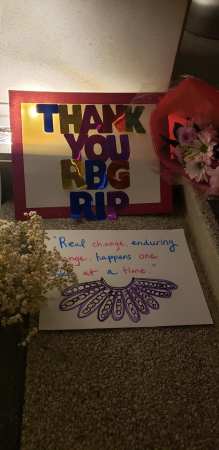
Ruth Bader Ginsberg, RBG, has gone to the Summerland, across

the Rainbow Bridge, to the afterlife—wherever that is for her, she’s

gone there. May her memory be a blessing. May her memory be a revolution.

And we are left with eight, five conservatives and

three liberals. RBG was liberal. Our current Pennsylvania Avenue occupant has already

nominated someone to replace RBG. This someone believes that god

speaks to the wife through her husband, the wife is submissive to the husband in all things,

she must submit in all things to her husband.

Sigh. As someone joked, this someone is walking through and slamming shut,

all the doors that RBG kicked open.

This nominated replacement believes that a woman has no choice in the matter of pregnancy,

and being gay is (once again) a sin in the eyes of the law, as well as her church.

This RBG replacement is Catholic, I guess.

I’m Catholic, too.

Maybe you’ve seen that meme on social media?

“I’m Christian. Oh…classic Jesus or Republican Jesus?”

That’s a joke: Ha. Ha.

Continue reading “Poem: In These United States- The Court Supreme By Marie Cartier”

Judaism or Christianity: Which Tradition Is More Open to Feminist Change? by Carol P. Christ

Jill Hammer’s recent post on midrash surrounding the Biblical figure of Eve (Hava in Hebrew) sparked me to muse again about the fact that, despite its patriarchal roots and overlay, Judaism is a much more flexible tradition than Christianity and, therefore, much more open to feminist change.
Part of this is due to the fact that Judaism is midrashic while Christianity has been and remains a doctrinal tradition. Midrash is a form of Biblical interpretation that includes retelling the story to fill in the blanks and to answer contemporary questions left unanswered in the original text. Jews consider the Torah (the 5 books of Moses) to be the “Word of God” though opinions vary as to what this means. In the rabbinical tradition, the Torah is interpreted through the Talmud which is an extensive collection of discussions and disputes that draw on Biblical texts in relation to contemporary (to the rabbis) questions. Midrash included in the Mishnah (a collection of teachings that preceded the Talmud) and the Talmud are considered part of the “oral Torah.” which is also “the Word of God.”

The Talmud is considered to be authoritative, but it includes conflicting interpretations that were never resolved into a single definitive view. Though different Jewish groups have declared certain views to be normative, other groups have disagreed. There is no central authority (such as a Pope or council) to resolve these disputes. Though some Jewish groups disagree strongly with the beliefs or practices of others, in Judaism as a whole an attitude of “live and let live” leads to inclusion rather than exclusion. Indeed. The Talmud records that in the midst of a particularly vehement dispute between two rabbis, a voice intervened, stating: “These and these are the words of the Living God.” (Quoted by Judith Plaskow in Goddess and God in the World.) Continue reading “Judaism or Christianity: Which Tradition Is More Open to Feminist Change? by Carol P. Christ”

“This World Is Not My Home” by Esther Nelson

I’ve been puzzled for a long time why people, especially conservative Christian people who seem to be decent human beings, enthusiastically support Donald Trump, our current president.  My thinking stems from my own experience of being brought up in an evangelical, fundamentalist space.

I grew up with ultra-conservative, missionary parents in a small community of believers who thought they were the only people who understood “life” properly.  Especially relevant to the theme of this essay is their understanding that political leaders are in power because God willed it.  “Let every soul be subject unto the higher powers. For there is no power but of God: the powers that be are ordained of God” (Romans 13:1).  Nothing happens in the political arena (or anywhere else) outside of God’s will which is perfect even though we may not always understand God’s strategies. Continue reading ““This World Is Not My Home” by Esther Nelson”

#SharetheMicNow: Social Justice and Christianity by Laurel E. Brown and Anjeanette LeBoeuf

In the midst of recent events and protests, a social media campaign entitled #sharethemicnow has emerged.  The campaign asked white people and people of influence to use their platforms, quiet their voices, and highlight, heighten, and listen to their Black counterparts. I have been honored and privileged to be a monthly contributor here at FAR for 5 years. This month’s post will be in participation with the #sharethemicnow campaign. This campaign seeks to keep the momentum for the realization and implementation of equality and just treatment for all peoples – regardless of race, religion, gender, or sexual orientation. I asked a dear friend of mine, whom I had the pleasure of working with at Whittier College, to write this post. Dr. Laurel Brown, whose discipline is in Social Work, shares with us some thoughts on Christianity and Social Justice in midst of our current issues.


Continue reading “#SharetheMicNow: Social Justice and Christianity by Laurel E. Brown and Anjeanette LeBoeuf”

Birthright by Christine Irving

I am a priestess of the divine feminine, ordained in the Fellowship of Isis.  So how did I end up becoming ordained for a second time in the Christian Gnostic tradition?  It seemed to me, that there were several paradoxes inherent in the situation.  My questions and conflictions made me an utter pain to both my mentor and fellow classmates.  Ironically, in the end I was the only one who stayed the course.

I rejected Christianity at thirteen and never looked back.  It took me a long time to say, “I am not a Christian,” aloud.  The first time I made that declaration, I thought I was having a panic attack because my heart was beating so fast.  The next time I felt that kind of fear I was alone in our apartment in Dubai, writing the liturgy for my Gnostic mass – the final requirement for becoming a priest.  Sitting safe and sound, of no interest to anyone, in a country that wasn’t even Christian, I was suddenly swept with the temerity of what I dared to do.  Women have been burned for much smaller crimes and all those ancient memories flared up at once.  The memes that infect us as children stay with us, vocal and insistent at the least opportunity and it may take a long time to manufacture the antibodies our souls need to regain health. Continue reading “Birthright by Christine Irving”

Not My Story Anymore by Esther Nelson

The meaning we derive from stories—especially religious stories we’ve heard and become familiar with since infancy—shape how we perceive and understand the world.  Our beliefs are an amalgam of “my story” (my individual life experience in a specific context) shaped by another story.  Who I am is heavily informed by particular narratives and their (often) codified interpretation.

I was raised on the doctrine of substitutionary atonement.  Doctrine is an interpretation of story, the substance of which is thought of as “truth” by believers.  The story informing substitutionary atonement is a familiar one, especially to those in Christian circles.  Jesus of Nazareth, a Jew living during the Roman occupation of much of the Mediterranean region, was crucified circa 30 C.E.  Jesus was a teacher who attracted many followers and often spoke (according to the writers of the gospels) of a coming Kingdom of God.  This threatened Roman rule so the Romans killed him.

Is the story factually true?  Perhaps.  As with so many narratives that are passed down through generations, there are many versions.  We find meaning (or not) in the story we have at hand.  On one level, Jesus’ crucifixion demonstrates the lengths governments will go to in order to keep themselves in power, showing the oppression, fear, and suffering people endure under despotic rulers.  On another level, substitutionary atonement (Jesus died to pay for humanity’s sins) is an interpretation of that story.  So often the stories we carry with us, along with a specific interpretation (doctrine), become conflated.  Rarely do we stop and unravel the story from the meaning we’ve been given and sometimes appropriated. Continue reading “Not My Story Anymore by Esther Nelson”

The Messy, Wild Mystery that’s Stronger than Wrong by Trelawney Grenfell-Muir

I am an annoying feminist. I annoy pretty much everyone about it, because I’m never NOT applying a feminist lens to every aspect of life: science (looking at you, Larry Summers), politics (Joe Biden is a rapist), art (objectification is NOT empowerment), culture (make-up is a prison), and, of course religion. I’m perhaps most annoying of all when it comes to religion. I annoy Christians by raving about Christ The Cosmic Vagina, and I annoy secularists by raving about feminist Jesus. I especially annoy my church friends and colleagues by refusing to use the (male) word “God” to talk about the Infinite Divine Mystery, much less male pronouns or oppressive symbols such as Lord, King, or Kingdom.

Yep, I’ve been cheerfully annoying the hell out of everyone for decades, drawing vagina art during male-centric worship services, changing lyrics on the fly, slipping female words and symbols into prayers and startling whomever sits near me… I am a feminist. Not the fun kind. Continue reading “The Messy, Wild Mystery that’s Stronger than Wrong by Trelawney Grenfell-Muir”