Legacy of Carol P. Christ: In The News – Global Climate Change

This post was originally posted on Nov. 7th, 2012

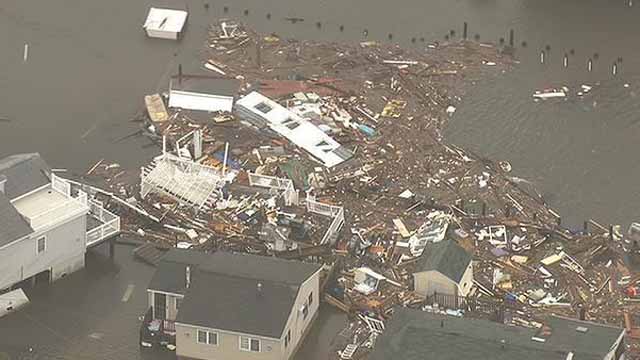
Climate change is in the news again due to the devasting storm known as Hurricane Sandy.  Scientists, activists, journalists, and politicians are telling us that Sandy is not just another “unpredictable event” brought to us by “Mother Nature.”  Will we listen this time?

Hurricane Sandy is a human-made and entirely predictable and sure to be repeated environmental consequence of the use of fossil fuels, especially oil and coal. Burning fossil fuels puts carbon dioxide into the atmosphere. This raises the global temperature in the air, land, and sea. Melting of polar ice caps is a result of the rise in global temperatures. This will cause a 3 foot or more rise in the seas, leading to the permanent flooding of the seacoasts and sea coast constructions, including homes, restaurants and shops, office buildings, and harbors and ports.
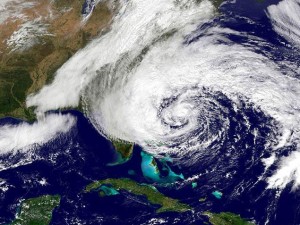
The warming of the seas is also producing extreme weather conditions, including high winds and hurricanes, along with colder winters and hotter summers.  Extreme weather conditions will lead to regular storm-related flooding of rivers and sea coasts, erosion of hills and mountains in winter, followed by catastrophic fires in summer.  Prolonged droughts and unseasonal rains will devastate farms and food production. Wildlife habitats will be destroyed. Places where people live will become too hot, too cold, too wet, and generally unfriendly to life.
Continue reading “Legacy of Carol P. Christ: In The News – Global Climate Change”
From the Archives: Tree of Life: The Festival of the Trees in an Age of Treefall by Jill Hammer

This was originally posted on January 22, 2019

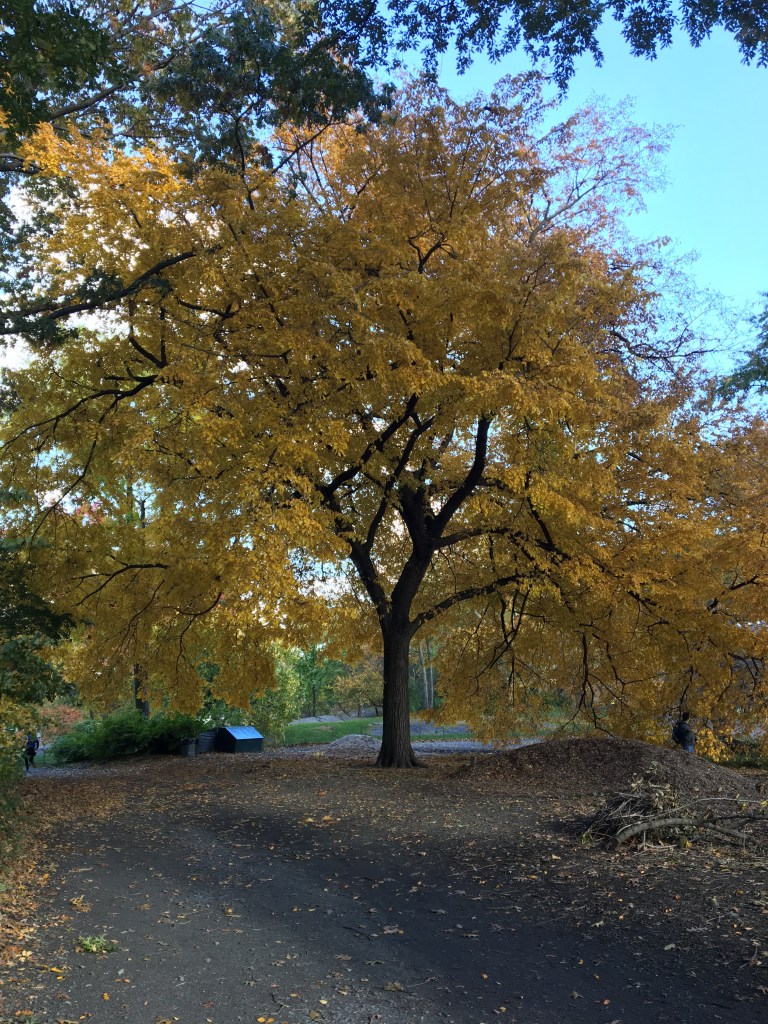
Almost every day, I walk in Central Park.  There are certain trees there I’ve come to know: the gnarled cherry trees by the reservoir, the bending willows and tall bald cypress by the pond, the sycamores that drop their bark each summer, the hawthorn not far from Central Park West.  Lately I’ve been taking photos of the trees to try to capture their essence, their posture in the world.  The trees around me feel like friends, which is what an ancient midrash (interpretation/legend) called Genesis Rabbah says about trees: that they are friends to humankind.  To me, they’ve always been a central manifestation of Mother Earth.

Currently, the national parks in the United States have no staff because of the government shutdown. Some people have taken the opportunity to cut down the rare and endangered Joshua trees in the Joshua Tree National Park—just for fun, I guess, or as a trophy of some kind.  Meanwhile, President Bolsonaro of Brazil recently has indicted that he wants to remove protection for the rainforest, in order to allow development.  It appears that my friends the trees have enemies.  Sometimes the enmity is for personal/corporate gain, and sometimes the enmity seems to have no reason at all.

Continue reading “From the Archives: Tree of Life: The Festival of the Trees in an Age of Treefall by Jill Hammer”

From the Archives: A View from the Chute by Charlene Spretnak

This was originally posted on February 21, 2018

Recently I was hurled across the existential divide that separates the millions of people around the world who have experienced a life-threatening extreme weather event from those who have not. In December 2017 unseasonal Santa Ana winds roared off a California desert across two drought-parched counties, not for the usual 48 hours but for more than a week, blowing a brush fire across 440 square miles. It was named the Thomas fire, the largest in California history.

The two mountain ranges forming the walls of the Ojai Valley were incinerated as the town on the valley floor was evacuated but, in the end, was saved. A month later 23 people were killed in nearby Montecito by mudslides that brought boulders and debris crashing down from the burned out mountainside after only one hour of an unusually intense rainstorm. The ground shook as a thunderous roar arose. The impact of the fast-moving debris flow obliterated many houses, splintering them instantly and sweeping the remains into the growing torrent that ran to the sea.  

Continue reading “From the Archives: A View from the Chute by Charlene Spretnak”

Monarch Magic, by Molly Remer

When my father was a boy in the 1950’s, he had a butterfly collection. His friends would bring him dead butterflies to add his collection and ask him what they were called. He got so many monarchs that his reply would be, “Thanks! That’s a ‘common sicker,’” secretly meaning they were so common he was sick of them. Now, my father is 70 and his grandchildren rarely see a monarch butterfly, the population of them having declined by 85% or even more in just two short decades. This rapid change is one of the most clear and alarming, observable indications of the massive changes wrought by both climate change and industrialized farming in our very own lifetimes.

Each year, I watch for monarchs from my Missouri home, during their migration season that carries them over our heads and on their way to Mexico. Each one I spot feels like a brush with magic on the wing, a testament to endurance and to hope. I watch them careen along in their delicate and determined way across highways and rooftops, across cars and parking lots, across my own house, and across open fields. I watch them alight on thistles, on goldenrod and oak trees, vine and bush. I see one above the Atlantic Ocean at Daytona Beach. I see two above the weeds in the Dollar General parking lot in Alabama. I see one above the sunflowers by the overpass in Kansas City. I see two coming over the Walmart roof and into the Staples parking lot in central Missouri.

Continue reading “Monarch Magic, by Molly Remer”

A Dream House by Judith Shaw

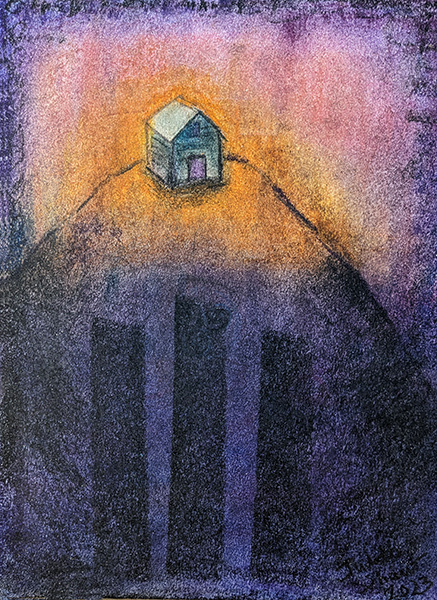
The recent climate disaster, which involved the devastating fire that ravaged Maui and left the historic town of Lahaina in ruins on August 8, 2023, has been weighing heavily on my heart. In the early morning hours of August 12, while on the cusp of wakefulness, an unsettling vision appeared in my dream’s eye. A solitary house sat atop a hill with swirling darkness threatening to engulf it from below and above. A small patch of light surrounded the house, grounding it on the hill.  This persistent mental image, though not what I prefer to harbor in my consciousness, refused to dissipate. So I decided to put pastel chalk to paper, hoping to release myself from its haunting presence.

Continue reading “A Dream House by Judith Shaw”

From the Archives: Every Bird in the Mountains: Wisdom for this Climate Moment by Tallessyn Zawn Grenfell-Lee

This was originally posted on April 17, 2o21

I found a bird’s nest the other day. A perfect, round little nest, with five pale blue speckled eggs. I’ve been working for several years to figure out how to support the birds who share our yard, with bird feeders, leaf litter and better soil for caterpillars and worms to feed the baby birds, yellow LED outdoor lights, and native plantings to attract more insects and pollinators. I knew that songbird populations are struggling, but lately I’ve learned even more about their truly worrying decline, and how we can all create ‘homegrown natural parks’ to help. It’s been a deep source of joy and hope, through the long pandemic, to see the tufted titmice, dapper chickadees, and bright red cardinals at our feeders, and the soft gray juncos hopping about on the ground. When we moved here a few years ago, a bird’s nest appeared right above the floodlight on our deck, and we got to see and hear the wee fledglings that spring, as if they were welcoming us to our common home. We loved those baby birds, and I’ve often wondered whether they are now among the visitors that seem drawn to the window feeder whenever we start to play music.

Continue reading “From the Archives: Every Bird in the Mountains: Wisdom for this Climate Moment by Tallessyn Zawn Grenfell-Lee”

Aviana, 20th Century Crane Goddess by Judith Shaw

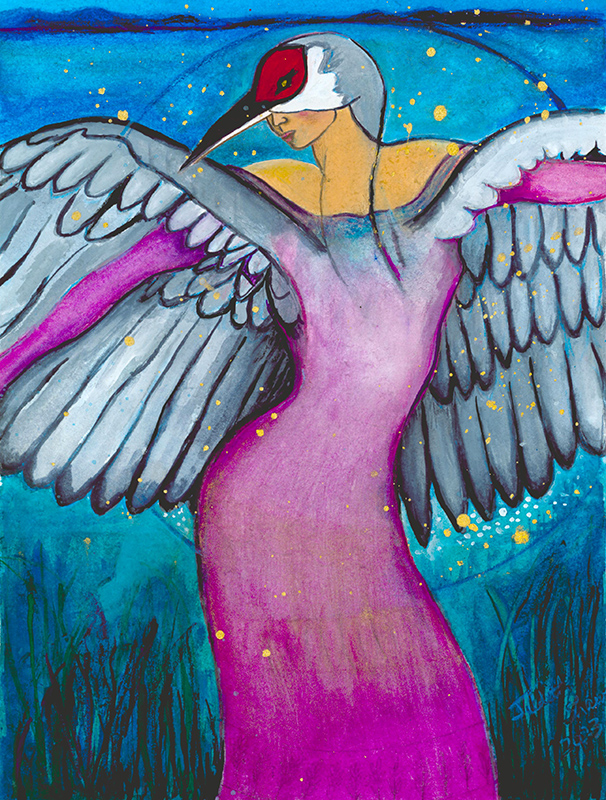
People think that goddesses only came into being long, long ago. People think goddesses are only found in ancient mythology. But people are wrong.  I know because I am Aviana, the Wetlands Crane Goddess who helped create the Bosque del Apache Wildlife Reserve of New Mexico. I first manifest on Earth as an Otherworldly force in the early 1900s. It was the migrating birds and waterfowl, in particular sandhill cranes, who called me into being.  

You see before Euro-Americans arrived in the land of the American Southwest, the Rio Grande was a mighty river which flooded every year bringing life and renewal to the land. These wetlands were a favorite wintering habitat of the Sandhill Cranes. They left their summer nesting grounds of Alaska, Canada and the northern United States and headed south for the winter.  Every year in November hundreds of thousand of cranes arrived in New Mexico. Here they fed on grasses and small animals throughout the short winter days. 

Continue reading “Aviana, 20th Century Crane Goddess by Judith Shaw”

Who Gets to Define What it Means to be Pro-Life? by Janet Maika’i Rudolph

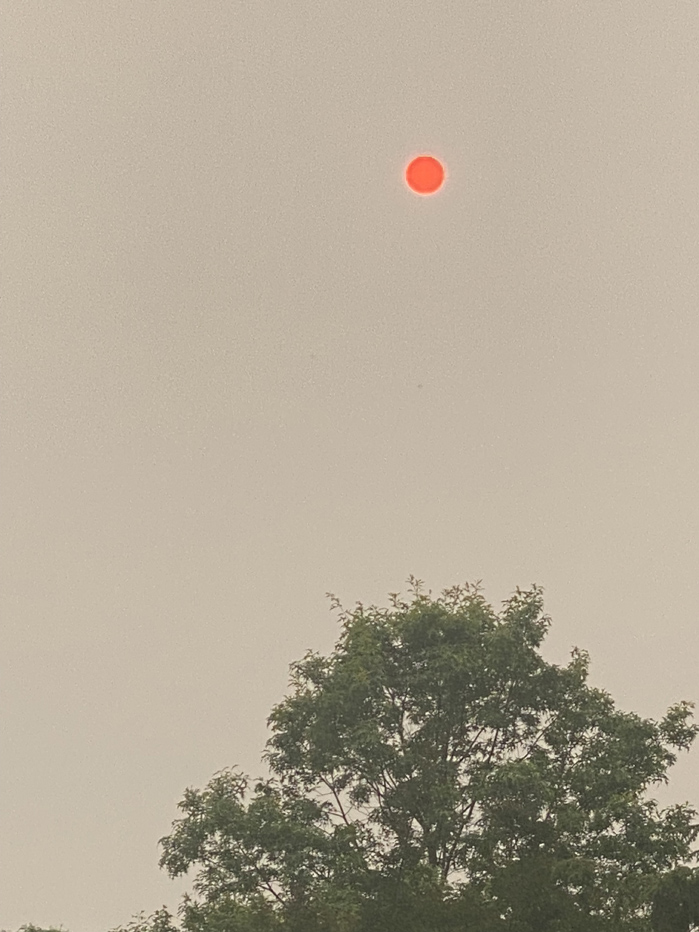
The sky and sun on June 7th in the afternoon on Long Island.

Today I am coughing and choking here on Long Island because of our unhealthy air quality.  The smoke from the wildfires of Canada have reached us. We, here in NY, are not alone in dealing with air so polluted that breathing is at risk. I think of the CA wildfires, the SpaceX rocket that exploded in April, the Ohio train derailment in Feb. No place is safe.

While coughing and thinking about this, two bits of news came into my consciousness, The first was the Supreme Court ruling narrowing the scope of the Clean Water Act.

My first thought was, do they and their children not have to live in this world too?  Do they think they can buy a clean environment for themselves and their families and the rest of us be damned? 

The next report I heard was from a prominent conservative commentator who explained how “prolife” he is and went on to describe his “deep concern” for life.

Continue reading “Who Gets to Define What it Means to be Pro-Life? by Janet Maika’i Rudolph”

Legacy of Carol P. Christ: Mountain Mother, I Hear You Calling

This was originally posted on July 7, 2014

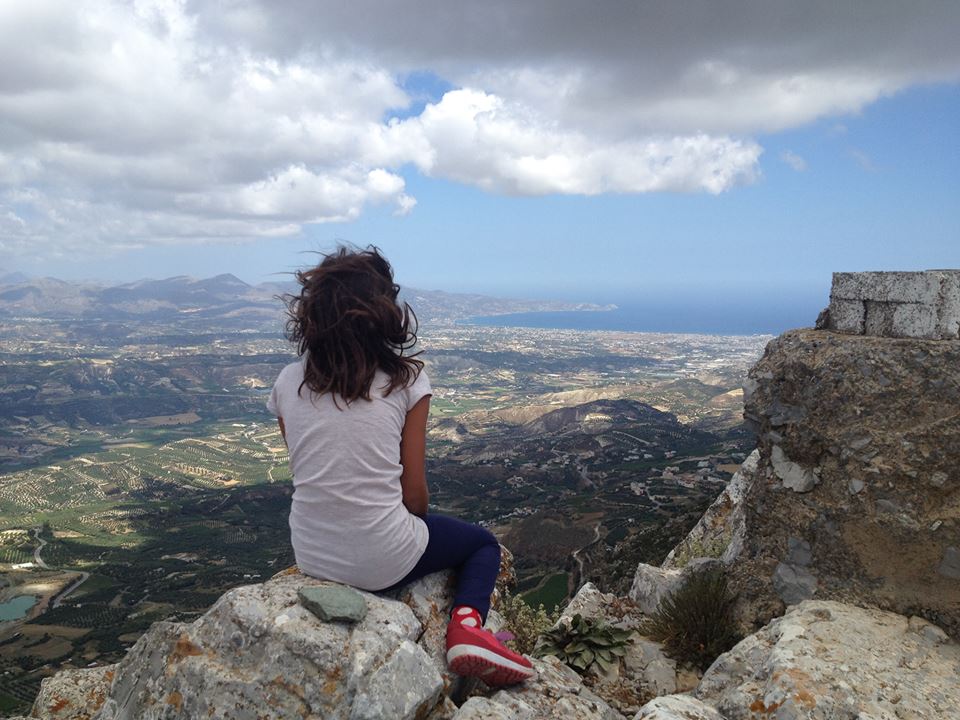
The mountaintop shrines of Mount Juctas in Archanes, Crete are situated on twin peaks, which may have symbolized breasts. Ancient shrines on the northern peak date from 2200 BCE until at least the end of the Ariadnian (Minoan) period in 1450 BCE. A crevice in the rock was filled with offerings of pottery, clay images of women and men in ritual dress, diseased bodies and body parts, sheep and cattle, and other objects. Excavations to a depth of 13 meters did not reach the bottom layers. Many offerings had been burned, suggesting that the objects were first thrown into fire and then dropped into the crevice. People who climbed the mountain for the festivals would have spilled over both peaks and there may have been shrines as well as fires on both of them.

Continue reading “Legacy of Carol P. Christ: Mountain Mother, I Hear You Calling”

Women Who Dig by Trina Moyles – Book Review by Carolyn Lee Boyd

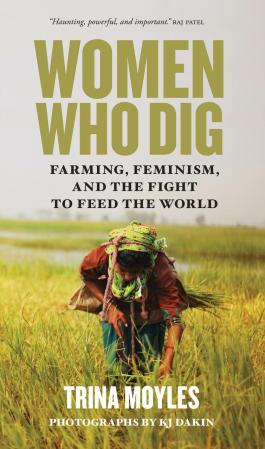
Here in the north, it is harvest time when the deep and ancient relationship between women and farming once again brings forth the food on which life depends. Women have been co-creating with the Earth to feed themselves and their families and communities for many  thousands of years. In fact, the world’s oldest agricultural tool may be a 300,000 year old stick possibly used by women to “harvest wild tubers for food and medicine” (p. xx) according to Women Who Dig: Farming, Feminism, and the Fight to Feed the World by Trina Moyles with photos by KJ Dakin. 

In her beautiful and enlightening book, Trina weaves together stories and stunning color photographs about the lives and work of women small farmers in Uganda, Guatemala, Nicaragua, the United States, Canada, India, the New Congo refugee settlement in Uganda, and Cuba. Together the profiles demonstrate that, despite sometimes overwhelming odds, women are feeding themselves, their families, and their communities through sustainable small farming practices that are good for both our nutrition and well being as well as the planet.

Continue reading “Women Who Dig by Trina Moyles – Book Review by Carolyn Lee Boyd”