“If All Knowledge Must be Reinterpreted, Why Not Religion?” Says Islamic Feminist

xcelina-feminismo.jpg.pagespeed.ic._RyiiQg3TR.jpg

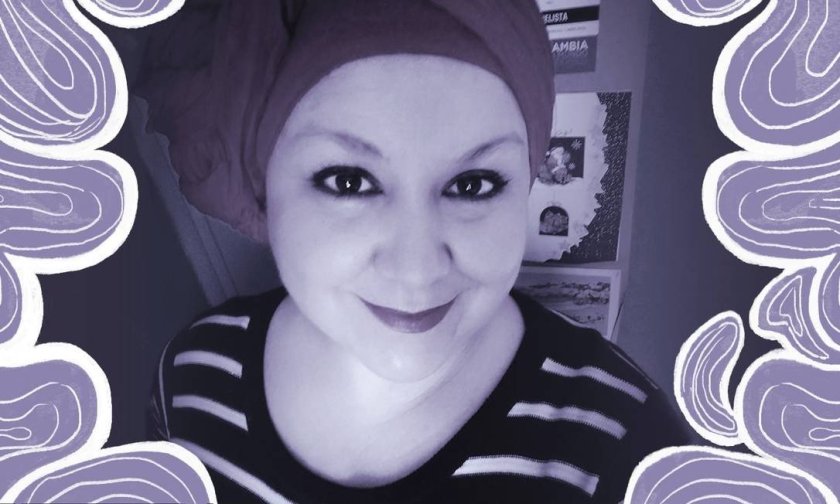
Vanessa Rivera de La Fuente is Muslim, feminist, and a human rights activist
Photo: Personal archive

Background: Journal O ‘Globo, one of the most important newspapers in Brazil, belonging to the transnational media group of the same name, published this interview with Vanessa Rivera de la Fuente on Islamic Feminism. Given its relevance to the discussion on the subject, it was translated by prominent Islamic feminist and scholar Keci Ali to share it with English-speaking readers.

The Muslim women’s movement has different agendas in accordance with the reality of each country. In Latin America, the Muslim Vanessa Rivera fights against prejudice about Islam.

by Isabela Aleixo*

Vanessa Rivera de La Fuente is Chilean and Muslim. Besides being an academic researcher, she’s also an Islamic feminist engaged with questions of gender, human rights, and social development. Vanessa has wide experience in social projects in Latin American countries.

In an interview with CELINA, she discusses the prejudices that Muslim women face in Latin America, explains the movement’s demands, destroys stereotypes, and declares: “I’m a woman and I demand to be treated as a person.”

Do you consider yourself an Islamic feminist? Why?

I consider myself a feminist woman, who lives feminism in all the distinct facets of her life: I’m Muslim; I’m a single mother; I’m a professional woman, an academic; and I’m a women’s rights activist. I’m feminist with all my life experiences. I think being a woman in male-dominated society is itself a political fact, so everything that I am as a woman can be resignified by feminism, including being Muslim. Islam is integrated into my life and my political struggle, which is intersectional. It’s based on the radical idea that all women are people and we deserve equal rights and a world free of violence.

Continue reading ““If All Knowledge Must be Reinterpreted, Why Not Religion?” Says Islamic Feminist”

Gentle Moments in a Violent World by Marcia Mount Shoop

mms headshot 2015“Be gentle with yourself.”

It may be some of the most redemptive guidance I have ever received.  And I share that invitation daily with people in painful situations.

“Be gentle with yourself.”

In a world seemingly hell bent on self-destruction, being gentle even for a moment is a radical act of resistance. A moment of tenderness. A moment of trust. A moment of attentiveness to need.

But really, what good does gentleness do in a world as brutal as ours can be?  How does being gentle provide any kind of answer to the assault of being commodified or objectified or betrayed or assaulted or oppressed or erased or abused or discarded or exploited? Continue reading “Gentle Moments in a Violent World by Marcia Mount Shoop”

Temple Magdalen by Elizabeth Cunningham

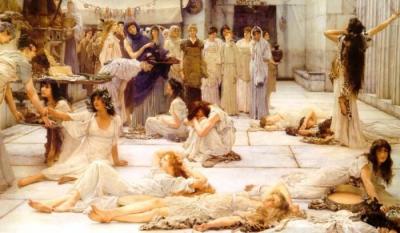
The Women of Amphissa, 1887, by Lawrence Alma-Tadema

Since I began writing for FAR in July 2012, I have written about Mary Magdalen, or excerpted a passage from one of my novels, near or on her July 22 Feast Day. For why I made the controversial choice to depict her as a prostitute, see last year’s post. The below excerpt is from The Passion of Mary Magdalen. I made this selection in remembrance of all the refugees in the world today. In this passage, Judith, a Jewish widow whose family was driven from the land by tax collectors, returns to the place where Maeve (my fictional Celtic Magdalen) and her friends have recently founded a Temple to Isis on the outskirts of Magdala. Maeve has just invited Judith to join them. (Edited for brevity.)

She stared at me, her eyes full of anger and longing.

“I will not be a slave and a whore where I was once a wife, the one who made the challah bread, who said the Sabbath prayers over it. This was our place, my husband’s and mine. We brought the best we had to the temple, the finest oil and wine, the unblemished kid—”

“Goats? You kept goats? You know how to make cheese?”

She sat quietly for a moment before she answered. “How can I live here with you?” she wondered. “I don’t understand.”

Continue reading “Temple Magdalen by Elizabeth Cunningham”

Facing Life Part 1 by Janet Maika’i Rudolph

I remember the first time I killed a living animal for food. I was a college student. I was traveling with other students on a month-long backpacking trip along the Sea of Cortez in Baja, Mexico. It was a very long time ago, yet the experience was so impactful that the memories are etched into my being.

Truth be told, my prey wasn’t all that sexy. It was scallops. There are certain benefits to “hunting” scallops. They have no legs or fins to force someone into a chase, no arms to fight back, and no reproving eyes to haunt dreams. All fairly milquetoast. Or so it appeared to me on the surface.

The way to harvest scallops is straightforward. They are made up of two shells, the lower one is plastered to rocks in the water. The upper one moves up and down by pivoting on a membrane. A diver plunges into the depths of the sea to find them. Then a diver inserts a knife between the two halves of the opened shells in order to cut the membrane at the back. There is delectable meat inside both shell halves. The top shell will come free to be taken to the surface. The meat is cut out of the lower shell, which is immovably attached to the rock.

Continue reading “Facing Life Part 1 by Janet Maika’i Rudolph”

Coming to Terms with Privilege: A Personal Reflection by Elise M. Edwards

elise-edwardsIn my two previous posts, I shared my recent experience talking about privilege at a church near me.  Today, I will wrap up this short series with a more personal reflection about privilege from a Christian perspective.  Last month, I was thinking theologically about what those of us who have privilege should do with it.  But, as feminists and womanists, acknowledging our privilege can be complicated.  Most of us in this FAR community do possess some forms of privilege while, at the same time, we lack other forms of privilege.  Each of us remains the same person wherever we go, yet our status can change when we switch contexts.  As a black woman, I do not have white privilege or male privilege.  But I am privileged when it comes to education and class and physical ability.  I am a Christian who works at a Christian university in a part of Texas that is culturally predominantly Christian. So that’s a form of privilege.  Although as a single woman without children, I don’t fit the cultural norm where I live, my sexual orientation and cis-gendered identity afford me some privilege, too.

Continue reading “Coming to Terms with Privilege: A Personal Reflection by Elise M. Edwards”

We Won’t Go Back by John Erickson

Bottom line: abortion is healthcare. Nearly a fourth of women in America will have an abortion by age 45. Every day, people across the United States make deeply personal decisions about their pregnancies. Those decisions deserve respect.

Someone once asked me: John, why are you a feminist?  It is always a jarring question because I believe all people should be feminists and we should all fight for gender equality no matter what.  I’ve been drawn to Martin Niemöller’s prolific quote:

First they came for the socialists, and I did not speak out—because I was not a socialist.
Then they came for the trade unionists, and I did not speak out— because I was not a trade unionist.
Then they came for the Jews, and I did not speak out—because I was not a Jew.
Then they came for me—and there was no one left to speak for me.

Right now, it seems like a full on frontal assault against all of us.  No matter what community you’re in, you can draw back to an instance of discrimination you’ve faced both pre-2016 as well as after the election of President Trump. Continue reading “We Won’t Go Back by John Erickson”

What If Jesus Is Dead (And It’s A Good Thing)? by Tallessyn Zawn Grenfell-Lee

Bear with me.

I know that most Christians accept some version of the idea that Jesus, the person, died, and then ‘rose from the dead’ in a supernatural, miraculous way – probably the most common definition of what Christians celebrate at Easter. I grew up in progressive Christian churches, where I, too, was taught this idea, which I found fascinating and inspiring. Many people (both Christians and others) still find it healing and inspirational; and I want to state clearly that I think that’s well and good.

Okay.

What I would like to suggest, however, is that this approach may miss the main point of Easter, of resurrection, and of these narratives. Here goes.

Continue reading “What If Jesus Is Dead (And It’s A Good Thing)? by Tallessyn Zawn Grenfell-Lee”

What Can We Do to Weaken Privilege? by Elise M. Edwards

elise-edwardsIn my previous post, I talked about discussing the concept of privilege (male privilege, white privilege, and class privilege) with nuance.  Earlier that week, I had led a workshop at a local church on “Fine-tuning Privilege,” using Peggy McIntosh’s 1989 essay “White Privilege: Unpacking the Invisible Knapsack” as a resource.  (If you are unfamiliar with it, take a few minutes to read it and reflect upon it.)  Part of my talk was about naming and understanding privilege.  Discussion and comprehension are not enough, though.  We must counter it.

One strategy for fighting privilege is making it visible. The recipients of privilege are often unaware that they have to systemic advantage over others. Privilege, used in the context of racism, sexism, heterosexism, classism, and religious dominance, is not something earned on merit alone. In the essay linked above, McIntosh describes it like this: “I have come to see white privilege as an invisible package of unearned assets which I can count on cashing in each day, but about which I was meant to remain oblivious.” These are conditions built into our culture that some groups receive which benefit them to the detriment of others. Making privilege visible means naming it and calling it out. Wage gaps, digital divides, and racial profiling practices exist; ignoring them perpetrates the problems.

Continue reading “What Can We Do to Weaken Privilege? by Elise M. Edwards”

How Can Change Happen If We Can’t Imagine It First? by Darla Graves Palmer

More than one hundred years ago, a small group of women joined together and decided to create their own village, one rooted in relationship and guided by spirit. They weren’t the first such women-led town in the country – there was a web of sister villages throughout America, some formed as early as the seventeenth century – but Chantilly Lace was unique. Rising out of the dust of an abandoned Gold Rush era in the Rocky Mountains of Colorado, a time when many women were abandoned by men seeking further adventures or widowed when husbands lost their lives in the mines, this mostly female community determined its own fate. Now the modern women (and a minority of men) faced new challenges in the twenty-first century: how would they adapt and thrive?

If this had been true, how might things be different now for all of us?

The above sets the stage for a fictional series of books I’ve been writing (the first book is complete). The locale was always going to be a small town in the Rockies (because I’ve lived there), but the broader ideas about the town’s development have been evolving steadily, especially since the last presidential election. I keep asking myself how a culture based upon principles of peace and values of belonging, established firmly upon a spiritual core, might function in our capitalist patriarchy.

How can change happen in real life if we can’t imagine it in fiction? I’m challenging myself to make it happen.

Continue reading “How Can Change Happen If We Can’t Imagine It First? by Darla Graves Palmer”

Photo Essay–Long Beach, California by Marie Cartier

Long Beach Pride 2019
50 YEARS OF PRIDE CELEBRATING
THE STONEWALL REBELLION of 1969!
**All photos by: Marie Cartier**
See the photo essay from last year’s Pride week-end here.
And the photo essay from Pride 2017 here.

Continue reading “Photo Essay–Long Beach, California by Marie Cartier”