Trauma Healing through Communal Dance by Laura Shannon

The last few weeks have been difficult for me. I was already feeling raw from the treatment of refugees in Greece, the upheaval of impending Brexit in the UK, the fires devasting Australia and the Amazon, and so many other tragedies going on in the world. Then on Christmas Day I was thrown completely off balance by someone shouting abuse inches from my face, in a space where I had believed myself safe.
Someone restrained the woman and I made my escape, but the close-up image of her furious screaming face – eyes bulging, spittle flying, chin thrust up, chest thrust out – stayed with me long after the incident.
Like a car accident or other unexpected shock, this scene played back in my memory, night and day. I could not sleep, could not concentrate; I woke with nightmares, burst into frequent tears, suffered a string of migraines, and felt consumed with anxiety and fear.
In the following weeks I tried hard to overcome the trauma and to stop the flashbacks replaying continually in my mind, using all the resources available to me. However, I only really found a cure once I came back to Athens and went with my husband to a night of traditional dance with live music.

Continue reading “Trauma Healing through Communal Dance by Laura Shannon”

Tree Talk: Dr. Susan Simard by Sara Wright

Scientist Susan Simard is a professor of forest ecology at the University in Vancouver, British Columbia, who has been studying the below-ground fungal networks that connect trees and facilitate underground inter-tree communication and interaction. Over a period of more than thirty years this field scientist and her students have learned how fungi networks move water, carbon and nutrients such as nitrogen between and among trees as well as across species. Her research has demonstrated that these complex, symbiotic networks in our forests — at the hub of which stand what she calls the “mother trees” — mimic our own neural and social networks. This groundbreaking work on symbiotic plant communication has far-reaching implications that include developing sustainable ways to ‘manage’ forests, and to improve tree and plant resistance to pathogens. Although much of Simard’s research occurs in forests, she has also studied the underground systems of grasslands, wetlands, tundra and alpine ecosystems.

Under our feet there is a whole world of biological pathways that connect trees and allow them to communicate and share resources and information. Other scientists who study these networks (like Dr. Merlin Sheldrake) agree with Susan who suggests that the forest behaves as though it’s a single cohesive organism. Continue reading “Tree Talk: Dr. Susan Simard by Sara Wright”

Mis(sing)Understanding: Kobe, Pompeo, and a Paper Towel by Marcia Mount Shoop

mms headshot 2015Who knows when each of us first learns that sensation—the sensation of being misunderstood.  My hunch is that it comes early on in our lives, maybe even before our brains are making narrative memory, maybe even before we have begun to understand much of anything about ourselves or the world. But it doesn’t take much for the seed to be planted in us that the world won’t always understand us.

My mom has long told me a story about me as a frustrated toddler trying to be understood. I was sitting in my high chair, the story goes, and I started saying “puppy touw.” My mom was not sure what I wanted, but I became more and more adamant, saying “puppy touw” over and over again.

She brought the dog over thinking I might mean I wanted the dog. She showed me all kinds of toys and nearby objects in an effort to understand and respond to my increasingly urgent request. I became more and more frustrated, kicking the high chair, moving my body in the chair, saying “puppy touw” louder and louder through tears. Continue reading “Mis(sing)Understanding: Kobe, Pompeo, and a Paper Towel by Marcia Mount Shoop”

2020 Women’s March by Marie Cartier

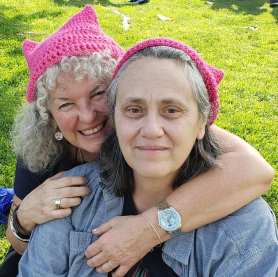
Picture of author, Marie Cartier and her partner, Kimberly.
Photo of the author (left) and her wife Kimberly Esslinger

Here we are at the fourth now annual Women’s March. I have done a photo essay of the March every year for Feminism and Religion (FAR), the first two from the Los Angeles March, and the last two from Orange County.

I’m taking a break this month from the series “In These United States” poems I have been delivering to FAR (back with more poems next month) to showcase some of the activism, commitment, humor, and courage that showed up at the March I attended in Santa Ana in Orange County, California, January 18, 2020.

In this part of these United States the marchers chanted, danced, laughed, and were very serious. Santa Ana is a densely populated city where almost 62% of the population is Mexican. This evidenced itself in the March where for the first time I saw ballet folkloric by a company dressed in traditional folkloric costumes, in suffrage colors. Continue reading “2020 Women’s March by Marie Cartier”

Welcome to the New Year by Natalie Weaver

Welcome to the New Year.

One year ago, on New Year’s eve, I buried my father’s ashes.  It was an incredible experience to orchestrate the funeral and burial of the man who begat me.  He was nowhere near a Hallmark greeting card kind of father.  He was complicated and difficult in ways both minor and severe.  Yet, this was the man I called “Dad,” and I was left to deal with the baggage of his life.  I cried in a way I had not cried before and felt a kind of sadness that, when given over to, seemed fathomless.  There is no real answer to grief like that.  I decided that one must just confront it or become it or traverse it.  And, there were things to do, practical things, such as repurposing clothes and rehoming cats, for which no one, I believe, could ever be totally prepared. I did not resent what I had to do; I just did it.  These things were hard for me.

Yet, despite the pain, something in that loss was deeply freeing.  There was no progenitor in the person of my father to come before me now, so there was suddenly no sense (however falsely constructed it may have been to begin with) that someone stood between me and whatever it is that was and is coming at me.  There is no longer even the false perception of a windbreaker, no frontline, no wise man, no one to shield, no guide.  There is just a naked sense of myself in the world, and though others surely came before me and stand around me now, on an existential level, I am not answering to him any longer.

Continue reading “Welcome to the New Year by Natalie Weaver”

Winter Solstice Drama by Sara Wright

Last year I attended a bonfire on the night of the winter solstice at a friend’s house. As my companion and I walked towards the ledge where the fire had been the year before we were both astonished. Where was everybody? We stood in the dark confused. Minutes passed.

After suggesting we leave, my companion remarked with annoyance, “What the hell is going on here?” A Rhetorical question. I sure didn’t know.

Sudden hooting split the night and some dissonant musical sounds seemed to be coming from out of the bushes below us.

Following the sounds we descended the steep hill and discovered that the fire was at the river’s edge, and that a few people were already gathered there.

Unbeknownst to either of us the location had changed, and from our vantage point on the hill we couldn’t see the fire or hear any sounds. I had been looking forward to this celebratory turning, and liked the idea of sharing it with friends. Yet, now I felt uneasy.

Continue reading “Winter Solstice Drama by Sara Wright”

The Feast of Santo Tomas by Sara Wright

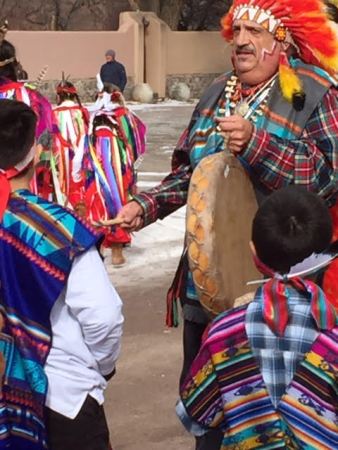
This morning I went up to the village plaza in Abiquiu to watch the dancers parade around the church with their saint who is also honored at this village festival held every year at the end of November.

This is one of the two Native American festivals that is honored each year by the genizaros who are mixed Spanish and American Indian people who embrace and practice the Catholicism that was once forced upon them.

This eclectic community is made up of descendants of Native American slaves. Those captured in warfare were brought here, converted to Catholicism, taught Spanish and held in servitude by New Mexican families. The young women and female children endured the usual atrocities perpetuated on captive females including rape at the hands of their captors. Some New Mexican male genizaros gained their freedom by serving as soldiers to defend frontier villages like Abiquiu from Indian raids. By the late 1700s, genizaros comprised one-third of the population of New Mexico. Ultimately these non – tribal peoples were assimilated into New Mexican culture.

The dances are beautiful to witness with the smallest female children dressed in predominantly white regalia some wearing a rainbow of ribbons, the young girls were dressed in red and white and had red circles of war paint inscribed on their cheeks, some of the older women also wore red, many carried turkey or eagle feathers in their hands. Most wore face paint.

Continue reading “The Feast of Santo Tomas by Sara Wright”

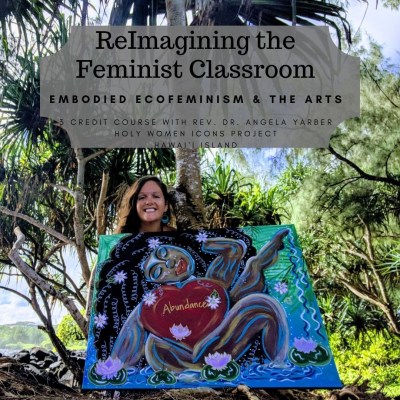
Reimagining the Classroom: Embodied Ecofeminism and the Arts Course on Hawai’i Island by Angela Yarber

“The classroom remains the most radical space of possibility in the academy.”-bell hooks

Like many academics, my “in the box” dream was to be a professor. The full-time, tenured kind. Like many queer feminist academics, I know that such dreams are rarely reality. When you’re also an artist and activist with a strong penchant for wanderlust, these dreams are simply unattainable fairytales. Never one for “in the box” living, I left the traditional academy and traditional church years ago, wandering over the garden’s walls with Lilith as my intrepid guide. I’ve told the story before. My wife and I left our jobs, sold our home, traveled full-time with our toddler, and turned the Holy Women Icons Project into a non-profit while building an off-grid tiny house on the television show Tiny House Nation in Hawai’i. It’s become old news. But since we’ve been doing this for several years now, those faraway dreams are finally starting to become reality. The academic classroom, the activist’s platform, the artist’s studio, the feminist’s megaphone, and the farmer’s orchard are fusing into one creative, life-giving, empowering space for teaching. The Holy Women Icons Project’s first academic course, “Embodied Ecofeminism and the Arts,” is actually happening. Seminarians and doctoral students from Berkeley join us in January. They’re soon followed by undergraduates from New York and seminarians from Atlanta. And I’m reaching out to more and more schools interested in creatively, subversively, and sustainably decolonizing the classroom with us for one week on the Big Island.

Continue reading “Reimagining the Classroom: Embodied Ecofeminism and the Arts Course on Hawai’i Island by Angela Yarber”

Blinded by the White by Marcia Mount Shoop

mms headshot 2015White supremacy culture is on full display day in and day out in America.  You don’t have to strain to see it—the President’s recent comparison of the impeachment proceedings to a lynching is the latest example.

Of course, even such an extreme example is still defended by white people of all shapes and sizes: senators, voters, talking heads, and the offender himself.  The grotesquery of such a distorted perspective is emblematic of a sickness in our country to be sure.

But there are even more sinister forms of white supremacy that afflict our collective lives.  They are harder for many white people to see. And they are, therefore, harder for us to believe. This kind of whiteness is the whiteness that blinds us. This is the whiteness that creates the conditions for the extremes to be mistaken for the whole problem.  But more importantly, this is the kind of whiteness that creates the conditions for whiteness to be even more tenacious in some dangerous and annihilating ways.

Continue reading “Blinded by the White by Marcia Mount Shoop”

Untapped Communal Potential and Yom Kippur by Ivy Helman

imageYom Kippur, the Day of Atonement, was the 9th of October 2019.  On this day, Jews typically attend shul, offer various prayers, and participate in some form of fasting.  The day is meant to be a reflection on the ways in which we, as individuals and as a community, have not been our best selves.  In this reflection, we speak aloud our objectionable behavior and ask for the Divine’s forgiveness.

In some Jewish communities, the ashamnu prayer, which we use to acknowledge our harmful and destructive behavior, has been the same for centuries.  Its particular form and composition is a stylized, alphabetized list of misdeeds. For example, one can find on the list stealing, lying, being rude, disobeying the Torah, participating in abominations, turning away from G-d and so on.  

That being said, many communities have rewritten the prayer to speak to modern-day failings.  For example, one can find concern for racism and anti-Semitism.  Another ashamnu highlights the need to end war.  I even found an ashmanu that was considerably more personal in its reflection.  It problematized self-doubt and supported self-care. Continue reading “Untapped Communal Potential and Yom Kippur by Ivy Helman”