During the last few years I have spent hours listening to the haunting cries of Sandhill cranes, awaiting them at the river, stunned each time as I glimpsed a flock float to the ground, great gray wings extended to break their fall as talons touched earth, attended to enthusiastic family greetings and muted conversations, felt a sense of devastating loss when these birds circled overhead to say goodbye each year before heading north to breed (while I lived in New Mexico), and then discovering to my joy that they live and breed here in Maine. I still experience the same hunger to glimpse families in Fryeburg each October and lose time watching their loving family dynamics. I continue to feel intense grief and loss at crane leave-taking remaining baffled by the intensity of my own responses. In the last week I think I have finally uncovered the roots of the story behind the cranes and me…
These birds are prehistoric in origin and have the strongest family ties. The families never break up and when separated greet each other joyously even after a few hours as small groups fly to different feeding areas. Incredibly poignant. There is always one that stands watch at night, a protector, so the others can sleep in peace, one leg extended, usually in water. I am in love with these birds but until a few days ago did not understand the powerful pull their presence exerts over me.
Find some pine trees and a wide rock in the sun. Settle down and feel gratitude curl around your shoulders. Listen to the wind sense that there is sorrow too in this place, deep and old, threaded through the lines of sun slices of shadows. It tells of what has been lost, what has been stolen, of silenced stories, and of fracturing. Make a vow, silent and sacred, to do what you can, to rebuild the web to reweave the fabric. Lie on your back in the pine needles, feel your body soften into the ground and become still. Allow yourself to feel held, heavy bones and soft skin becoming part of the land. Wonder how many of your ancestors kept other people from becoming ancestors themselves. Watch the sunlight making tiny rainbows through your eyelashes and pines. Find a pretty rock. Don’t take it. Leave it where it belongs, on the land that gave it birth. Go home. Keep your promise.
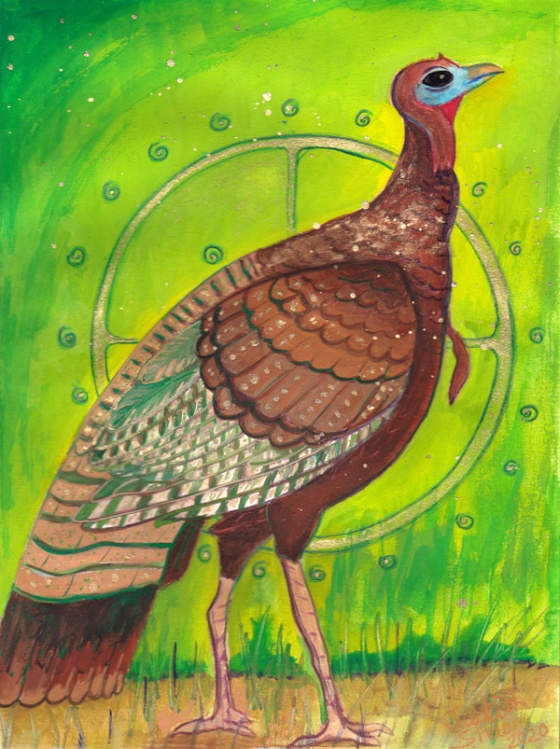
In the United States turkeys are equated with Thanksgiving. But there is so much more to Turkey – a gentle creature who forms strong attachments. Reputed to be dumb, Turkey is in fact quite intelligent and curious, with the ability to solve problems. Turkeys have an excellent understanding of the details of their location which makes them so successful at feeding themselves. They also love to play and to cluck along with music.
photo by Tony Castro
Turkeys, indigenous to North America, evolved over 20 million years ago and share a common ancestor with grouse, pheasants and other fowl. Two species of wild turkey exist today – the wild turkey of eastern and central North America of which there are 5 sub-species and the ocellated wild turkey of the Yucatan.
Yet why is turkey named turkey? Strangely enough it was a mistake. English colonial settlers thought turkeys were a type of guinea fowl which England imported from Turkey – thus the name. The Spanish word for turkey is guajolote which is derived from the Nahuatl (Aztec) name huexolotl.
According to Marija Gimbutas, the religion of Old Europe celebrated the Goddess as the power of birth, death, and regeneration in all of life. Agricultural peoples understand that seeds must be kept in a cold dark place during the winter if they are to sprout when planted in the spring. People who work hard during the long days that begin in spring, peak at midsummer, and continue through the fall, are grateful for the dark times of the year when they can rest their weary bones on long winters’ nights. Long winters’ nights are a time for dreams, a time when people gather around the hearth fire to share songs and stories that express their understanding of the meaning of the cycles of life.
The Indo-Europeans were not an agricultural people. Herders, nomads, and horseback riders, they celebrated the shining Gods of the Sky whose power was reflected in their shining bronze armor and shining bronze weapons. When the Indo-European speaking peoples entered into a Europe, they married their Sun and Sky Gods to the Earth Mother Goddesses of the people they conquered. These were unequal marriages in which the Sun was viewed as superior to the Earth. The unhappy marriage of Hera and Zeus reflects this pattern, as do the many rapes of Goddesses and nymphs recorded in Greek and Roman mythology.
Image from an Egyptian tomb ca. 1314-1200 BCE. Isis is giving nourishment in the form of fruit and drink,
In many cultures of the world, including our own, trees are considered the ancestors of humanity – own our ancestors.
Trees are connected with great goddesses throughout antiquity. We see this in the bible where, as I’ve noted before, the Tree of Life is Eve’s tree for the word Eve means life. It is, in essence, the Tree of Eve. Goddesses in trees feeding humans were common themes in ancient Middle Eastern art. The tree was Hers to give freely of as she wished.
Anthropologist and religious scholar, Mircea Eliade writes extensively about the associations of trees ancestral connection to humans. He calls them both mystical and mythical.[1] His examples include the Miao groups of Southern China and Southeast Asia who “worship the bamboo as their ancestor.” He also notes Australian tribes who view the mimosa as their progenitor. And there is a tribe from Madagascar, called Antaivandrika which means “people of the tree,” who considered themselves descended from the banana tree.
The older I get the more important the forest becomes to me because it is a place where I find inspiration and peace. I also play in the woods! During the month of October and what I call the “Witching Moon” that has just passed I think of all the women healers that lived alone in the forests with their animal and plant ‘familiars’. These women learned that nature instructs those who apprentice themselves to her. Animals and plants spoke to these women through intuition, sensing, feeling, or through their dreams because these women listened to them. Did these women play too? Westerners fear nature because they are so separate from her. Unable to imagine conversation (let alone play) occurring between women animals and plants, even today women who live close to nature are viewed with suspicion. I know because I am one of them.
I spend a lot of time in a 12,300 acre wood that one family has preserved for perpetuity. Recently these generous people have leased the land to the local land trust so it is getting more attention. I am not sure that this is a good thing. I note the amount of motorcycle and four wheeler use has increased dramatically on the roads that run parallel with the forest; some of the once quiet woodland paths are either echoing or saturated with sound.
The effects of “the burning times” are still with us. I can feel this in my own body. As Starhawk put it so vividly, “the smoke of the burned witches still hangs in our nostrils, . . . remind[ing] us to see ourselves as separated. . . in competition with each other, alienated, powerless and alone.”[i] However, she continues, “the struggle also continues.” That struggle is the impulse toward wholeness, healing. That journey toward healing begins with remembering and acknowledging past harms, so that we may better understand who we are and the ways these continue to live in our bodies, psyches, and culture in order to address them.
In South American indigenous cultures, trauma is recognized as susto, or “soul wound,” and it is on that level that healing needs to happen.[ii] To quote Shirley Turcotte, “Healing from trauma is a spiritual matter, a relationship matter, and there are places in recovery that require a precious spiritual response.”[iii] The women’s spirituality movement continues to be one such precious response. The work of Starhawk and others to reclaim the word “witch” and to revive and reimagine a tradition of valuing immanence, the sacredness of the earth, and the ability to change the world for the good has been invaluable in this.[iv] In her examination of the reasons for the persecution of witches, Starhawk names the “war on immanence” as one of three factors.[v] If the spirit was not present in the earth itself, then people had to rely on priests and the Church for access to a transcendent god.
The path leading to the Klapados Waterfall begins at the edge of an open meadow in the pine and oak woodlands of a mountain in the island of Lesbos. After driving several miles on a very rutted dirt track, we parked under an oak tree, crossed the meadow and scrambled down a winding path. After about 20 minutes, it ended at a stream surrounded by plane trees. From there, we climbed over rocks to reach a pool created by the seasonal waterfall.
On the day we visited it, the waterfall was only a trickle of cascading drops that moistened its moss-covered path to the pool. The roots of a plane tree growing at the top of cliff followed the path of the water, weaving a web over the rockface all the way down to the pool.
Throughout these years that I have focused on animals and their spiritual meanings – often in ways that relate to goddesses – I’ve heard from many people about their own encounters with animals. It seemed that for me animals mainly showed up in images and words. But now different animals have been showing up in my life while out in nature.
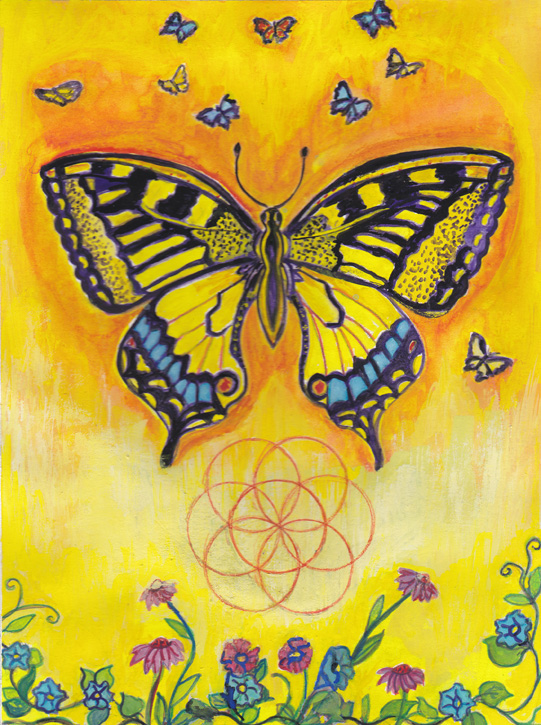
This past summer I was visited by Butterfly. A large Yellow Swallowtail graced my yard for several days on several occasions – a positive sign of ongoing transformation. In September a big colorful swallowtail caterpillar was chomping away at a parsley plant in my herb garden. Not long after a Black Swallowtail appeared with more Butterfly messages of joy and transformation.
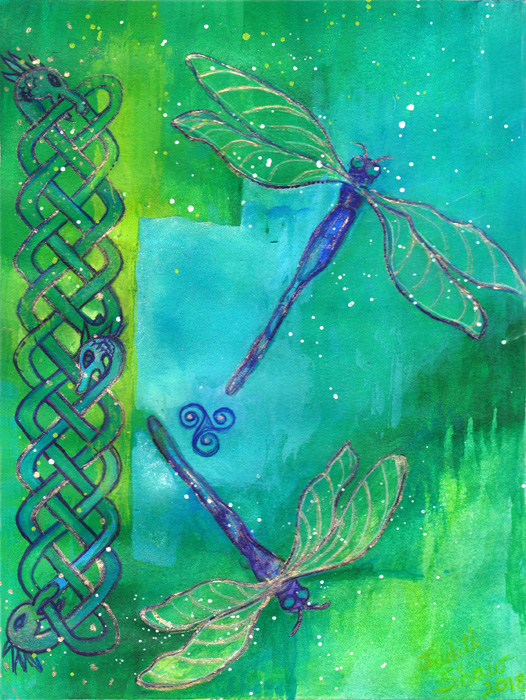
Butterfly – Soul Transformation by Judith Shaw
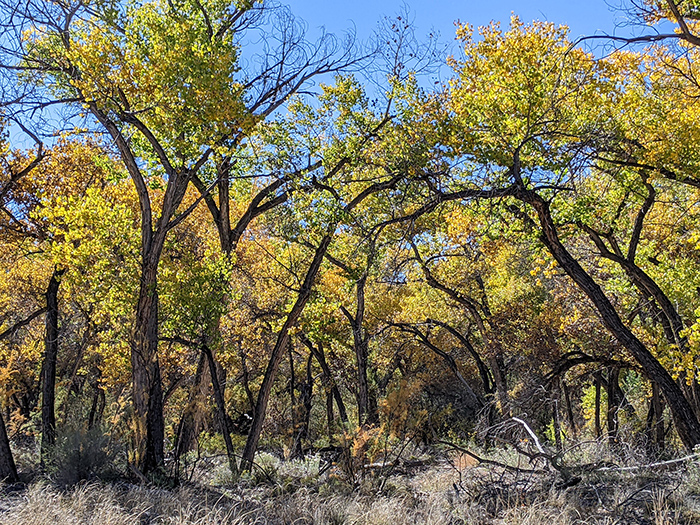
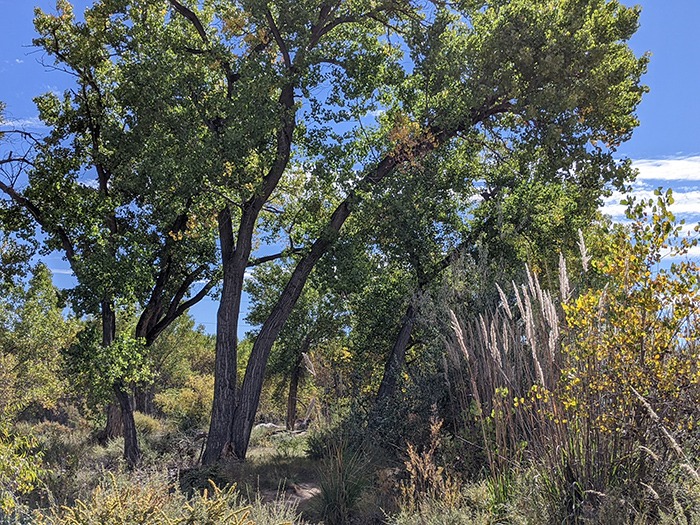
Recently I lost that positive feeling of joy and the promise given by transformation – feeling instead a sense of stagnation, of not having achieved my goals and wondering what I needed, to create change and revitalization. With no answer in sight, I activated my go-to cure for the blues – a bike ride in the Bosque – Albuquerque’s cottonwood forest growing along the Rio Grande.
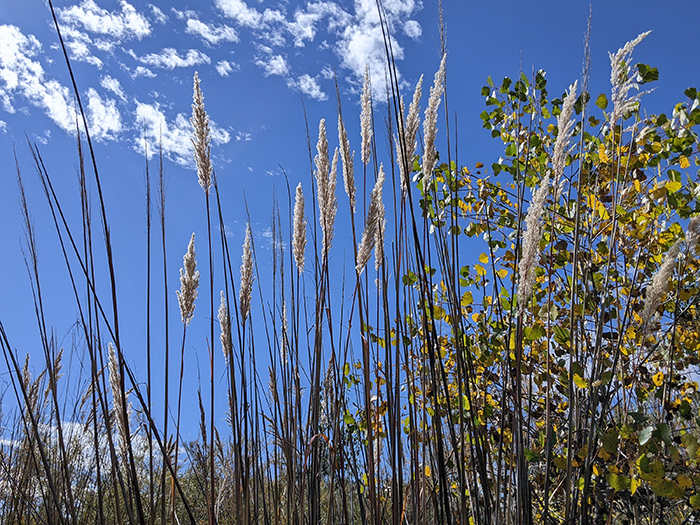
It was a glorious autumn day in the cottonwoods – hues of green turning, turning turning into orange, yellow, gold – sun-white grass heads shimmering in the sun, framed by a deep turquoise blue sky.
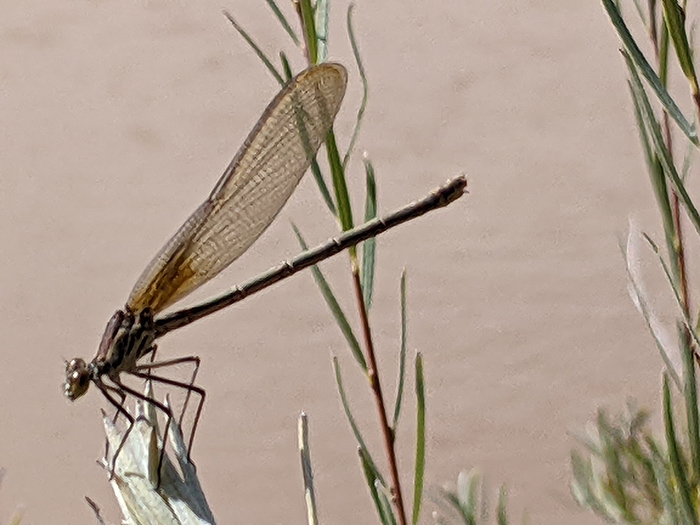
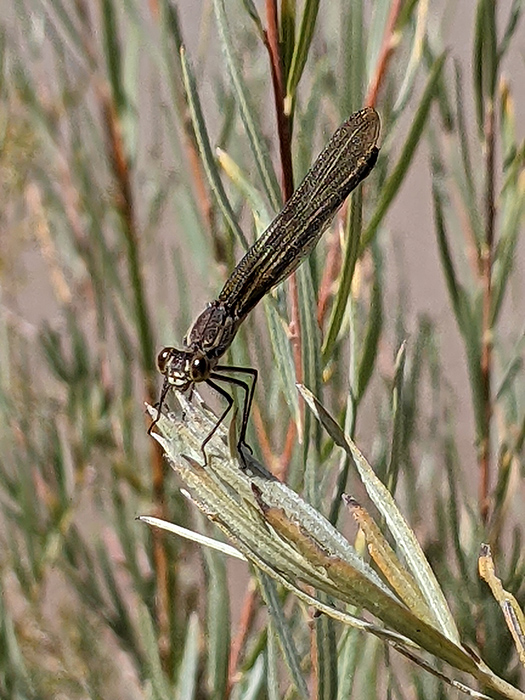
Stopping by the river, Dragonfly lit on a stalk of grass, swaying over the water. It remained. I photographed it – moved in closer. It remained. Breathe… wait…. look…. It remained. Suddenly Dragonfly darted – up, down – left, right – circled round – quickly, quickly and then returned to the stalk. It remained. Same sequence repeated ending on the stalk.
Still it remained. I spoke with Dragonfly while gazing at its huge eyes. Eyes that lead to true sight. “Dragonfly,” I said “Show me the way to a positive transformation, give me a sign. With your true sight lead me to an answer, a resolution to my dilemma.”
I repeated these words several times as Dragonfly remained – a few times flitting about – yet always returning. Dragonfly was still perched on its stalk when I finally moved on.
Returning to the cool shadows under the trees, I trekked along. Arriving at a spot where the trees opened up to the banks of the river was a downed tree – a good spot for a river view.
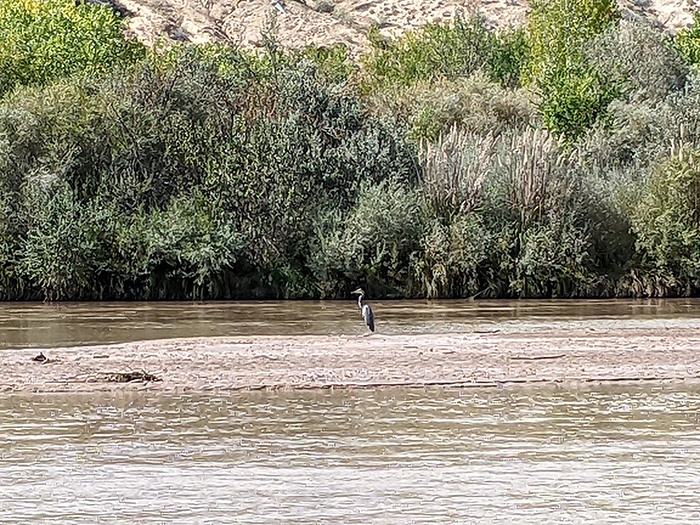
Shortly I noticed a lone bird, standing tall on a small island in the far side of the river It stood and it stood – same position – same spot. It was tall like a crane – many are arriving now. But no, something was different – it wasn’t a crane. It was grayer with fringe-edged feathers around its neck. With the help of my phone camera I discovered it was a Great Blue Heron. I was amazed!
“Ah ha!” I thought. “So this is my sign. Blue Heron has the wisdom I need now”
Not yet having investigated Great Blue Heron I had to wait until I got home to my computer and the wealth of information on the internet. What I discovered was not what I was hoping for.
As I had been struggling with what I needed to instigate the changes wanted, all I could focus on was who to connect with, what action to take, what project to start…. But Great Blue Heron delivered a completely different message.
Blue Heron brings messages of solitude, of standing still and waiting patiently for what you need to come to you. This is how Blue Heron hunts. Blue Heron encourages calm while watching for opportunities to arrive. Blue Heron says that only after calmly waiting, will opportunity arrive – which you must catch quickly or it will disappear.
Dragonfly, embodiment of transformation and true sight, led me to Blue Heron who then informed me that my usual way of doing and fixing and forging ahead would not work. Blue Heron called me to stop, to remain in my solitude and to wait. Now I can only trust that with patience and quiet meditation I will be able to flow with all of the forces active at this time and the path to the realization of my goals will become clear.
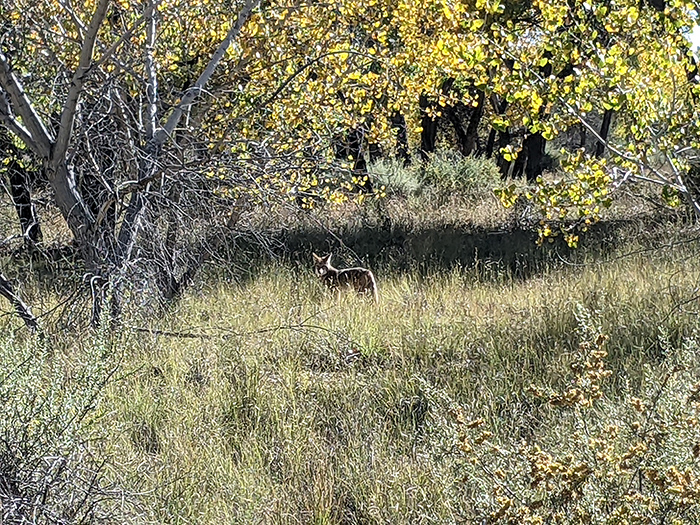
A week later, while on a bike-riding break from working on editing the stories for the Animal Wisdom deck, Coyote popped up in my path a mere 25 feet away before hightailing it across the way. I suppose I should expect the unexpected in this time of calm waiting.
I hope you too can find meaningful messages from the animals that appear in your life – messages that help rediscover the wisdom of our ancestors and support the reemergence of the feminine principle in your life.
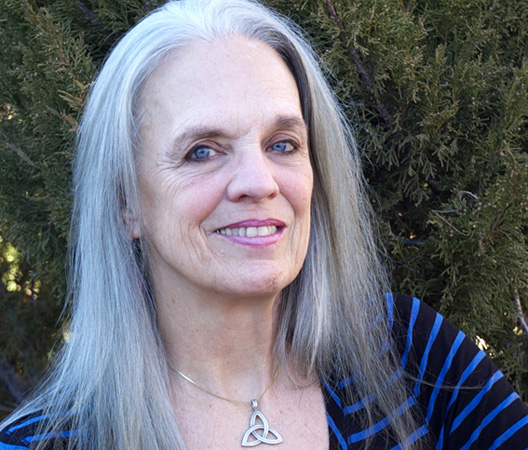
Judith Shaw, a graduate of the San Francisco Art Institute, has been interested in myth, culture and mystical studies all her life. Not long after graduating from SFAI, while living in Greece, Judith began exploring the Goddess in her art. She continues to be inspired by the Goddess in all of Her manifestations. Originally from New Orleans, Judith makes her home in New Mexico, The Land of Enchantment.
Judith is currently in the pre-press stage for her new oracle deck – Animal Wisdom. To learn about a soon-to-come, pre-order special, sign up to receive her newsletter on her website.
The Celtic Goddess Oracle Deck is still available. Order your deck from Judith’s website – click here. Experience the wisdom of the Celtic Goddesses!
Not too long ago I heard someone deride members of a seminar who were building labyrinths in the olive groves of Greece as “a bunch of tree-huggers.” I bristled! I probably first heard of the Chipko tree-hugging movement which is led by women in the 1970s and 1980s. Because I love nature, I naturally assumed hugging trees is a good thing. Originally, I had no idea that the tree-hugging movement was about much more than saving trees from being felled in the interests of short-term profit.
I did not know that the deeper purpose of the movement is to save a way of life based on forest-culture that is being threatened by the imposition of western ideas and practices promoted by colonialism and its successor, the green revolution. Nor did I know that the traditional forest-culture of India is the provenance of women: more than 4000 years of observing and experimenting created a “women’s knowledge” passed down from mother to daughter.







 Feminism and Religion