

 I have never had so much trouble trying to find a topic for blog and to begin writing it as I have this time. It is 6:58 am in Greece, three hours and two minutes before my blog is due to be posted, and I still do not have a topic. It is not that topics have not occurred to me. There is the rape allegation against Donald Trump by E. Jean Carroll. There is the fact that it was ignored by the press—as if it somehow does not matter that the President of the US is or might be a rapist. There is the declaration by Kamala Harris that if elected President she would move to immediately process hundreds of thousands of unprocessed rape kits. There are the new reports of the horrendous conditions in which children, women, and men are being kept in detention at the US border. And this morning there is the President’s racist rant against progressive congresswomen Alexandria Ocasio-Cortez of New York, Ilhan Omar of Minnesota, Rashida Tlaib of Michigan and Ayanna S. Pressley of Massachusetts. Continue reading “Grief, Have I Denied You? by Carol P. Christ”
Category: environment
Trial by Fire, Healing by Water by Carol P. Christ
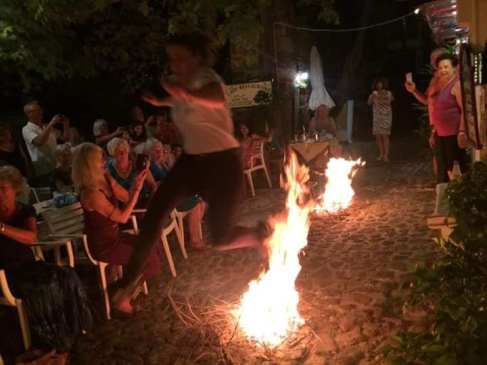
 It wasn’t really fire. I came home to Lesbos from a soulful Goddess Pilgrimage to Crete and a discouraging emergency meeting of the Green Party Greece totally exhausted and wanting nothing more than to rest. It was the hottest June on record and my house with its many windows felt like a furnace. Due to a dispute with the installer, it took eleven days to get the air-conditioning fixed. My little dog who could see when I left for Crete, was blind when I returned. I wondered if I would have to put her down and could not bear the thought. I was so tired and so hot that I could not think straight. It was beyond my capacity to even consider moving to a hotel. I didn’t have the energy to unpack. And I didn’t have a car as the old one had been sold and the new one was still at the dealership in Crete. So I couldn’t escape. Instead I tried to hold back tears.
After the air-conditioning was finally fixed, I was able to unpack, wash my clothes, and repack for my return to Crete. The night before I was to leave, I jumped the St. John’s day (midsummer) fires. The locals say they jump the fires for fertility (jumping fires does warm the nether parts) and health. In the photo I am sitting at a table directly behind the first fire, but I soon got up and jumped all three of them, affirming the powers of birth, death, and regeneration.
 Continue reading “Trial by Fire, Healing by Water by Carol P. Christ”
Coming Home to Spring by Sara Wright

The older I become the more I appreciate Nature as she is, Nature the Creatrix of the Earth. Nature creating without human intervention. The cycles of life and death are so intimately intertwined and never more evident than in the spring when each rotting log becomes home to ants who are feasted upon by black bears (whose primary protein source 93% comes from ants, grubs and larvae). Splintered detritus becomes the rich soil that supports the seedlings of the next generation of trees, even as the ground peppers the moment with the delicate three lobed trillium, lady-slipper, twin flower, partridge berry trailing arbutus, unfurling spirals – the birthing of ferns, and perhaps my favorite, wild lily of the valley soon to fill this forested glade with her intoxicating scent.
Outside my window, diversity reins as Royalty! Maples, ash, oak, beech moose maple, witch hazel, spruce hemlock, fir, balsam converse with one another, above and below ground – their language is made of pulsing vibrations, sound and scent. The naturally fallen white birch logs crisscross each other creating complex and unique patterns apparent to any artistic eye. The brook is wending her serpentine way to the sea, her spongy banks of sphagnum moss are steeped in emerald. The translucent papery thin leaves of the beech tree ripple in the slightest breeze.
Climate Change as a Socio-Spiritual Feminist Issue (Or 10 ways to be a leader in the era of climate change) by Nurete Brenner
 Authorities have observed that climate change is a feminist issue because it disproportionately affects women. Among these, the United Nations has gone further to acknowledge that climate change is a feminist issue because women are on the forefront of adopting climate-change mitigating techniques and technologies. A recent UN report states that “women are key actors in building resilience and responding to climate-related disasters…” But overarching these admittedly important issues is the greater understanding – not mentioned by the UN report – that climate change is a feminist issue on the socio-spiritual level. This side of the issue is often overlooked because the institutions who compile reports are immersed in a masculine way of thinking.
What do I mean by a masculine way of thinking and why do I label it in this seemingly gendered way? Masculine values are those of winning, achieving, proving, succeeding, counting, controlling. pursuit of achievement and status; individual self-reliance; strength and aggression. The UN climate report cited above goes on to say that “Enacting good policies requires quality data, so that we can quantify the issue and measure improvement…” Reports such as this make their points by tabulating numbers and citing statistics, not seeing that these are already masculine ways of expressions and that numbers can only ever tell part of the story. These masculine traits and values are social constructs and not necessarily to be associated with the male biological sex. Both men and women and other-gendered can display masculine values and attributes but they are labeled masculine because society typically associates them with the male gender. Continue reading “Climate Change as a Socio-Spiritual Feminist Issue (Or 10 ways to be a leader in the era of climate change) by Nurete Brenner”
Magical Forests by Judith Shaw
 The forest calls me. I long for her lush coolness, her sheltering trees, her world filled with life.
The Tree as Mother by Mama Donna Henes

Arbor Day, Earth Day, May Day and Mother’s Day are deeply connected conceptually, etymologically, culturally and emotionally.
The tree, with its roots buried deep in the earth and its branches reaching upward toward heaven, spread wide to embrace all of eternity, is a prime symbol of life in many cultures. Trees have long been worshipped as beneficent spirits of bounty. Trees, after all, shade and feed us. Supply and sustain us. Serve us in endless ways. Trees breathe life into our lungs, the source of endless inspiration.
Possessing the potent powers of fertility, growth, resilience and longevity, the tree is widely seen as the progenitor of the world Family Tree. The Tree of Life. The tree goddess was seen as a sylph, an airy tree spirit who resides among the green leaves, sustaining and nurturing the vegetative forces. She is the symbol of the flow of life, a Mother Goddess who is Herself the Tree of Life.
Stopping to Smell the Flowers by Marie Cartier

There is a saying, “Take time to smell the flowers.” Attributed to many different sources, it means among other things– take time and be grateful. Take time and relax. Take time.

In that spirit I am sending along pictures from the amazing “super bloom” California is experiencing this spring. It is the most magnificent we have ever had, I think. It happens once a decade, but we are lucky to have had a super bloom in 2017 and now this year as well. California had an extreme drought last year and then extreme rain this past winter. And now we have flowers…and flowers. Poppies are the state flower of California and they are being celebrated—all over. And people dropping in by helicopter and influencers ruining some of the poppy beds by laying in them for Instagram pics. Yes, it’s been crazy. But, when we were there (my wife and I) on a past Sunday, it felt so magical that so much of Los Angeles it seemed was out to smell the flowers. You can see a picture of folks lined up (my wife at the end in the picture below) photographing the flowers. Flowers suddenly are the new super star!
Continue reading “Stopping to Smell the Flowers by Marie Cartier”
“Calling All Women” to Save the Earth, signed and shared by Carol P. Christ
I contend therefore that we have allowed these chemicals to be used with little or no advanced investigation of their effect on soil, water, wildlife and man himself. Future generations are unlikely to condone our lack of prudent concern for the integrity of the natural world that supports all life. Rachel Carson, Silent Spring
Today we are faced with a challenge that calls for a shift in our thinking, so that humanity stops threatening its life-support system. We are called to assist the Earth to heal her wounds and in the process heal our own – indeed to embrace the whole of creation in all its diversity, beauty and wonder. Wangari Maathai
I want you to feel the fear I feel every day. And then I want you to act. Greta Thunberg

We are calling all women and our allies to come together to save the earth that sustains us all. Is it any wonder that from Rachel Carson to Wangari Maathai to the emerging young leader Greta Thunberg, women have been in the forefront of environmental movements for a century? As daughters, sisters, mothers, grandmothers, and aunts, we have long cared and advocated for the most vulnerable among us, the very young, the very old, the disabled, those who are the first to suffer the consequences of climate catastrophe and the many kinds of pollution that are poisoning the earth we share.
As cooks, gardeners, and small farmers providing sustenance for our families throughout the world, we speak for the soil and the water, the air and the crops that feed us. As Congresswomen, diplomats, lawyers, doctors, CEOs, artists and scientists we are calling for fair and equitable public policies that address the crises we are facing together. As those who create homes and maintain households, we are speaking out for our first and only home, the planet earth we share.
Today as never before we are witnessing the destruction of the intricate and delicate balance, the miraculous conditions on earth on which all life depends. At this moment as a drastically changing climate and a deluge of poisonous substances, from plastic to coal to pesticides threaten the habitats of living creatures world wide, we are confronted by unprecedented loss of species, what some are calling “the sixth extinction,” a tragic loss reflected in the epidemic of disease in our families and communities.
Like indigenous communities and people of color, because women are so often marginalized, as outsiders we have a crucial perspective including valuable insights into what has caused the frightening and destructive events we are witnessing. We see a world too often governed by ruthless attempts to dominate and win, placing profit above every other value, framed by a world view that describes nature as inferior, lacking in intelligence or the inviolable integrity that all living beings possess. In response we call for an ethic of peaceful cooperation with nature and between nations.
Faced with the consequences of heedless, ignorant and ultimately violent policies that threaten our lives and all we love, wild fires burning our forests and homes, floods and mudslides destroying our towns, fierce storms battering our coastline, lakes and rivers becoming too toxic to drink, as our oceans and the fish that swim in them are choked with plastic, as our air becomes heavy with particles that threaten human health, we are calling for women to unite in an effort to recognize and respond to the failures of political, economic and moral vision behind these crises.
As nurses, teachers, waitresses, secretaries, wives, partners, those who respect and nurture life, we understand we are all dependent on each other and every other living being on earth. And we know too that together we have the creative vision to stop the advance of climate change and the sixth extinction, to put an end to the poisoning of our earth, to build societies that, taking inspiration from indigenous cultures, respect nature’s rights and learn from nature’s wisdom. In this light we urge you now to speak out, organize, rally, protest and step up in every way you can to protect the future of life on earth.
Susan Griffin, Vandana Shiva, Alice Walker, Alice Waters, Vijaya Nagarajan, Maxine Hong Kingston, Deirdre English, Ayelet Waldman, Jane Hirshfield, Arlie Hochschild, Joanna Macy, Jodie Evans, Medea Benjamin, Claire Greensfelder, Belvie Rooks, Jennifer Berezan, Ruth Rosen, Elizabeth Rosner, Joyce Jenkins, Nancy Shelby, Anita Barrows, Rebecca Foust, Joan Miura, Carol P. Christ
Here are some actions you can take and organizations you can join and support:
Learn about the environmental issues in your own neighborhood. Educate your community and organize to while demanding an end to pollution and the emission of CO2 in every form. Work to empower our communities to allow us to make decisions that protect the environment and our families and all lives Ask your senators and representatives to support The Green New Deal. Call for and support public transportation. Ask the businesses in your communities and chains such as Trader Joe’s to adopt practices that support the environment and cease those that are destructive, such as the use of plastic. Take action to ban poisons such as Glyphosate found in Monsanto’s Round Up from our communities. Boycott Monsanto and companies that fail to adopt green policies. Ask your governments to stop exporting environmental destruction, in every form including dumping waste, mining, drilling for oil, selling pesticides, altering and patenting seeds, internationally. Oppose war and investments in warfare. As the largest source of pollution on the planet, armed conflict and the manufacture and storage of weapons cause irreparable and vast damage all over the earth.
Below is a list just a few of the organizations working to save our planet that can support your efforts and which you can join and support.
350.org, Bioneers, Black Belt Citizens, Greenpeace, Mothers out Front, Rain Forest Action, Seed Sovereignty, The Nature Conservancy, The Southern Environmental Law Center, Women Earth and Climate Action Network (WECAN), Women’s Environmental Network (WEN), Women’s Environmental Action, Women’s Voices for the Earth, Collaborative on Health and the Environment, CODEPINK.
Call: written by Susan Griffin with Vandana Shiva
Painting: Mother Earth by Jennifer Cortez-Perlmutter
Note from Carol P. Christ: “Women’s knowledge” that we are part of the earth stems from women’s work: caring for the weak and the vulnerable in all cultures and caring for plants and trees in horticultural and forest-cultural societies. This knowledge is available to men as well but only if they are willing to challenge long-standing cultural assumptions about “manhood” based in the separation of men from women and nature.
 Carol P. Christ is an internationally known feminist writer, activist, and educator living in Lasithi, Crete. Carol’s recent book written with Judith Plaskow, Goddess and God in the World: Conversations in Embodied Theology, is on Amazon. A Serpentine Path: Mysteries of the Goddess is on sale for $9.99 on Amazon. Carol has been leading Goddess Pilgrimage to Crete for over twenty years: join her in Crete. Carol’s photo by Michael Honneger.
Listen to Carol’s a-mazing interview with Mary Hynes on CBC’s Tapestry recorded in conjunction with her keynote address to the Parliament of World’s Religions.
Tree-Hugging Is About Trees and So Much More Than Trees by Carol P. Christ
 Not too long ago I heard someone deride members of a seminar who were building labyrinths in the olive groves of Greece as “a bunch of tree-huggers.” I bristled! I probably first heard of the Chipko tree-hugging movement which is led by women in the 1970s and 1980s. Because I love nature, I naturally assumed hugging trees is a good thing. Originally, I had no idea that the tree-hugging movement was about much more than saving trees from being felled in the interests of short-term profit.
I did not know that the deeper purpose of the movement is to save a way of life based on forest-culture that is being threatened by the imposition of western ideas and practices promoted by colonialism and its successor, the green revolution. Nor did I know that the traditional forest-culture of India is the provenance of women: more than 4000 years of observing and experimenting created a “women’s knowledge” passed down from mother to daughter. Continue reading “Tree-Hugging Is About Trees and So Much More Than Trees by Carol P. Christ”
When the Cranes Come by Sara Wright

Departure.
I stood deep
in a toad hole
slinging mud
at twilight
when the sky
turned lemon
and gold.
They arced
over
my head
in pairs,
loose aggregations –
it seemed like thousands
crying out,
crossing
the river.
Ensouled.
Spirits defying
image or word.
A Mighty Migration begins…
I shivered.
Tears rose unbidden
Who calls them North?
I call out “I love you” –
Believing they know.
A crescent moon listens
cradled by nightfall.
To witness
a sky full
of Sandhill
Cranes
dark red heads
ebony eyes
long graceful necks
curved gray wings
dripping black legs
descending out of the blue
to roost
along this
winding Red
Willow River,
gracing fields
of depleted grain
is a Gift
given
at midnight;
the moment
before
departure.
This turning
of the wheel
births
days full of light
and an empty
sky bowl.
Haunting cries
in my ears
ring in the silence
of beloved crane absence
for another year.
Continue reading “When the Cranes Come by Sara Wright”
 Feminism and Religion