LET’S ASK MITT IF MORMON PATRIARCHAL BELIEFS AFFECT HIS VIEWS ON WOMEN’S EQUALITY by Carol P. Christ

Why has Mitt Romney’s Mormon faith mostly been a non-question in his political life?  John Kennedy was asked if he would obey the Pope or make his own decisions, Jimmy Carter was asked how his Baptist faith would affect his Presidency, and Barack Obama was asked if he agreed with the sermons of his preacher.  Why is the press afraid to ask Mitt Romney if he agrees with the patriarchal teachings of his church and if so, if this affects his views on the rights of women?

Like other patriarchal institutions, the Mormon Church believes that women’s place is in the home.  Every Mormon man is a priest and a patriarch in his own home.  Mormon belief teaches that men are to make the final decisions in the family, that only they can be leaders in the church, and that they are the members of the Mormon community who should speak and act in the public (non-home) dimensions of life.  Traditional Mormons believe that “ [The] LDS [woman is] always [to] accept counsel from her husband, and not as just his opinion, but as God-inspired revelation.”  Continue reading “LET’S ASK MITT IF MORMON PATRIARCHAL BELIEFS AFFECT HIS VIEWS ON WOMEN’S EQUALITY by Carol P. Christ”

Is the Republican Party Platform Truly Pro-Life? by Michele Stopera Freyhauf

As many feminists invest their life fighting for women’s rights to be the center of attention – no one could predict the occurrences of this election year.  In my previous post “Rape is Not a Political Platform – Rape is a Violent Crime!” Carol P. Christ made a comment about women’s issues and politics:

 “I have been waiting all my life for women’s issues to become central in an election campaign, but I guess I should have been more specific in my wish: this is not the format I imagined…”

Christ’s reaction is like so many others in the election; no one could have imagined such a bizarre and backwards slide being lobbied against women’s rights.   Issues being bantered around continue to be rooted in a purported pro-life stance.  This ranges from trans-vaginal ultrasounds, definitions of “legitimate” rape, and now using an Ob/Gyn’s “best guess” to define the gestational age of a baby from the time of a woman’s last period.  This is not a game – this is semantics, this is politics, this rhetoric, and frankly, this needs to stop. Continue reading “Is the Republican Party Platform Truly Pro-Life? by Michele Stopera Freyhauf”

Muslim Masculinities: Men Have Gender Too by Kecia Ali

Twenty years ago, when I was an undergraduate, another student in a history seminar casually referred to women as “people of gender.” He was not being ironic. At the time, I felt amused and superior and frustrated: not only did he not get it but he really didn’t get it. Two decades later, my amusement has taken on a rueful tinge: despite the formulaic acknowledgment that masculinity and femininity are reciprocally constructed, “gender” scholarship in my field, Islamic Studies, has focused almost exclusively on women.

That is, until recently. Scholars, especially anthropologists, have begun serious work on Muslim masculinities; increasingly, those of us more historically and textually inclined are joining the party. My own first forays into these waters treated the equivocal masculinity of enslaved males as part of a larger project on marriage in early Muslim law. In my current project on views of Muhammad, the question of masculinity emerges much more centrally, and in strikingly different ways in works by feminists and neo-traditionalists (who lay claim to reproducing the “authentic” tradition even as they are thoroughly modern in many ways). Continue reading “Muslim Masculinities: Men Have Gender Too by Kecia Ali”

Living Liminality: Of Thresholds and Dwelling Places by Marcia W. Mount Shoop

Sometimes I think it happened gradually.  Other times it feels like sudden change.  Either way I find myself in an in-between space that is my life.

With apologies to Victor Turner and his cultural anthropological appropriation of liminality as a threshold space, I have come to view my liminal living as a more permanent dwelling place these days.  Turner’s category of liminality locates subjects in the betwixt and between as they move from one manifestation of identity in community to a new kind of integration or role in community.   I am starting to wonder, however, if the thresholds are actually dwelling places for some of us in this world.

I don’t know if that means I am actually more marginal than I am liminal.  The margins are margins because they remain on the outskirts and they help define the boundaries.  Margins are permanent.  Am I marginalized if I live at the edges of the communities and identities I use to occupy, perhaps never to return to the bosom of the center? I hesitate to make such a claim mostly because I still occupy privileged spaces not the least of which are those constructed from how whiteness grants access and authority in this world. Continue reading “Living Liminality: Of Thresholds and Dwelling Places by Marcia W. Mount Shoop”

The Search for Belonging by Cynthia Garrity-Bond

My life today is a continuation of the desire to belong I felt as a child, only the terrain is now a spiritual homelessness of sorts, the inability to feel welcomed and accepted in what seems to be an oxymoronic state, a feminist woman in the Catholic Church.  

Family vacations in my childhood usually took the form of camping.  This was an era devoid of seat belts and car seats, where we rode unrestrained in the back of our parent’s pickup camper like pieces of discarded luggage.   One trip found us deep in the Baja coast of Mexico.  At that time I was four years old with three older brothers, one younger and one on the way; who in spite of my repeated pleas to the Blessed Virgin Mary, turned out to be yet another brother.  Sandwiched between all this testosterone was me, the only girl child who continually failed to fulfill her parent’s dream of the quiet, sweet, and passive daughter.  This would be one of many family job descriptions at which I would fail. Continue reading “The Search for Belonging by Cynthia Garrity-Bond”

Discrimination, the Catholic Bishops, and Chick-fil-A by Michele Stopera Freyhauf

You may be tired of the controversy about Chick-fil-A, but the events of the last few weeks revealed a big issue in the organization – that of discrimination and the illusion of religious freedom.  However discrimination exists beyond the LGBTIQ community, it applies to Catholics and those “outside” their strict fundamentalist belief system.  However, the hierarchy in the Catholic Church seems to be embracing many of the beliefs put forth by Evangelical Fundamentalists in the political arena.

When it was time for my eldest daughter to get her first job, she applied and was hired to work at Chick-fil-A.  Knowing they were a  Christian organization, I felt that she would be well treated and we could still have family time on Sundays.  Everything started out o.k. but the longer she worked there, problems developed.  First, when I stopped through the drive-thru to show my support as her mother, I received apocalyptic material in my bag talking about the end times, where my soul would go, and inviting me to their church.  I found the material offensive and never returned. Despite the organization’s community support and “Christian” values, I was still fairly naive about their discriminatory practices that many experience on a daily basis.

Continue reading “Discrimination, the Catholic Bishops, and Chick-fil-A by Michele Stopera Freyhauf”

Silencing Miriam: Prophetess, Liberator, and Leader By Michele Stopera Freyhauf

The prophetess Miriam, Aaron’s sister, took a tambourine in her hand, while all the women went out after her with tambourines, dancing; and she led them in the refrain: Sing to the LORD, for he is gloriously triumphant; horse and chariot he has cast into the sea.”(NAB, Exodus 15:20-21)

The Song of Miriam is not a story of death and destruction, but rather liberation.  It is a poetic celebration of God’s liberation of the Israelites from the oppressive Egyptians, which, according to Bernhard W. Anderson in “The Song of Miriam Poetically and Theologically Considered,” marks the beginning of the Israelite tradition (292).  Phyllis Trible in “Bringing Miriam out of the Shadows” states that this act marks the end of the Exodus, which was started by Miriam, not Moses (169, 172).  The act of liberation reveals God’s action in humanity.  Gerald Janzen in Exodus believes this act also moved the Israelites “to fear the LORD and believe in the LORD and in his servant Moses” (109).  The uniqueness of this passage is that the most unlikely person leads – this person is not a man but rather a woman.

This brief passage in the Hebrew Scriptures is revelatory – Miriam is revealed for the first time.  She is a prophetess, Aaron’s sister, and the role of leader of the victory dance to honor the Divine Warrior.

Continue reading “Silencing Miriam: Prophetess, Liberator, and Leader By Michele Stopera Freyhauf”

The Safety of a Mother’s Arms by Gina Messina-Dysert

Earlier this year in May, I was honored to be a speaker at the American Mothers National Convention.  While attending the conference I heard a young mom speak about her own experience of being held hostage as a child and the feeling of total security she felt when embraced in her mother’s arms for the first time following the terrifying ordeal.  Listening to her led me to recall my own experience of feeling that security with my mother.  When I was a child and needed to be comforted, there was no one else who made me feel safe the way my mom did.  However, the safety of my mom’s arms did not end when I became a teenager or an adult.  Up until the day my mom died, I still cuddled with her like a little girl.  I felt spiritually connected to my mother, it was through her loving arms that I found security and felt truly connected to God.

There has been much exploration of the spiritual and emotional bond between mother and child.  Becoming a mother to an adopted toddler, I wondered if my daughter and I would share the same bond that I shared with my mother.  Baby S did not grow in my womb, we did not bond for nine months while she was in utero, and she had a history of multiple foster families before coming home to me and my husband.   Continue reading “The Safety of a Mother’s Arms by Gina Messina-Dysert”

Remembering My Grandmother: Not as a Suffering Servant but as a Devoted and Loving Mother By Michele Stopera Freyhauf

The last week-and-a-half has been probably the most heart wrenching time I remember having in my life.  You see, my grandmother passed from this life June 19th and the void in my heart is huge.  I have to admit that I am lucky that my grandmother was a huge part of my life and the last family funeral I attended was in 1983.  Certainly one expects grandparents to pass away, even when they live a healthy long life.  Nothing prepares you for the time that you must say good-bye.  You yearn for one more conversation, one more hug, one more kiss – the thoughts churn and churn robbing you of sleep or peace.  At some point, a level of acceptance or at least the ability to cope will occur – when is a mystery, but for now I just try to be strong – for my mom, my sister, and my children.

Driving home from vacation, I received the news from my sister, Lisa:

Lisa:    Nanny has lymphoma, which they found in her stomach and invaded her spine, paralyzing her from the hips down.  It is fast moving.

Me:     How long?

Lisa:    2-4 weeks. Hospice was called and is making her comfortable.

The news was jolting, but I did not realize that the initial expectation 3 days earlier was 6-8 weeks.  She had tests for a bleeding ulcer, so this diagnosis was jolting.  Over the last year, we dealt with dementia and health issues.  These either were false alarms or cured thanks to the love of her family, care from the people at the nursing home, and her nurse practitioner and physician.  I wished that this was also a false alarm – but it was not, this time it was real and the end was eminent.

Seeing my mother at Father’s Day celebration, the news was even more grim – Nanny is no longer alert, can no longer open her eyes – they are making her comfortable.  The last time her eyes opened was after her priest gave her last rites.  He turned to leave, she opened her eyes, said “Hi Father,” and went back to sleep.  This was the last time her eyes would open.  My mother tells me that she is not expected to live through the week.

I took my children over to say good-bye.  I know I should be grateful that my girls have a close relationship with their great-grandmother, one that spanned 19 years.  I know I should be grateful that I had her in every facet of my life.  It is no secret that family was important to my grandmother, and she adored all of her children, grandchildren, and great-grandchildren.  This is a trait handed to my mother, my sister, and me.  Something I strive to instill in my children.

The good-byes were difficult as she was essentially unconscious and her breathing was noisy.

My sister called, how is she?

Me:     Breathing is labored and gaps between breaths are getting longer.

Lisa:    Will she be o.k. tomorrow?

Me:     I have no idea.  You may want to visit tonight just in case.

My sister and her husband appeared about 10 minutes later.  Wanting to give her time, I left with my family.  Going home was hard.  I was afraid she may not make it through the night.  I hoped with all my heart that this was not the end.

The next morning I returned to work.  She made it through the night.  I was in my office for a few hours before when I received a call from my dad.

Dad:    I am just calling to tell you Nanny is declining pretty fast.  They are saying minutes to hours – we are all here.  No need for you to come, I just wanted to let you know.
Me:     I am on my way.

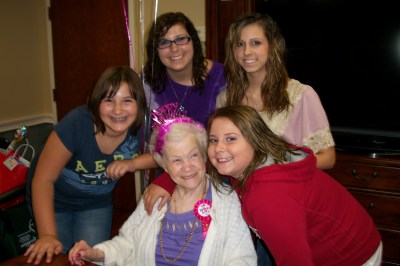
Depending on traffic, I had a 40 – 60 minute drive.  I had to be with the woman that helped care for me and loved me.  The person that I took trips with, would talk hours on the phone with, cook with.  My grandmother was at every event, every family function, every holiday, and every birthday.  She was a huge part of my life and very important to me.  I needed to get there before she took her last breath – thankfully, I did.

The goodbyes continued.  Staff and residents alike came down to say goodbye. She was loved my so many.  Tears flowed for this petite woman with beautiful blue eyes, a contagious smile, and a heart of gold.  Her three children, my father, my sister, a few friends, and I kept vigil by her bedside.  I held her hand, sponged her neck and forehead to help with the fever, and kissed her forehead.  This went on all day and all night.

It was now midnight.  Everyone left the room to have a snack.  It was a long day and we forgot to eat dinner.  The staff was nice enough to provide us with muffins, water, pop, and coffee but this was no longer enough.  Every time someone would leave to use the restroom, you did not know if she would still be there when you came back.  Even running to a fast-food restaurant to grab a few sandwiches was done with angst and concern. Continue reading “Remembering My Grandmother: Not as a Suffering Servant but as a Devoted and Loving Mother By Michele Stopera Freyhauf”

Hagar – Demoted Servant or Egyptian Princess? By Michele Stopera Freyhauf

A socio-political examination of Genesis 16 explores how ancient myth can influence the story of Hagar and Sarai. Socio-political events could have occurred between the Egyptians and King Solomon that influenced the writing of this text.  According to John Currid in Ancient Egypt and the Old Testament, the Egyptians and Hebrews borrowed many things from each other and because of that, an inter-relatedness exists between the languages as well as cultural and religious practices of both kingdoms (26).  It is this inter-relatedness that I wish to explore and ask the question -was Hagar an Egyptian Princess demoted to a lower position of servitude in order to make a political statement of superiority of the Israelites over the Egyptians?  Or is this a story of conflict between two of Solomon’s wives?  Finally, could this story tell us about events that occurred after Solomon’s death since the Biblical texts from the pre-exilic period began to take shape during the reign of David and Solomon?  This is a very brief exploration of these theories.

In Genesis 16, Hagar and Sarai connect Egypt and Israel in a familial relationship, one rooted in strife.  These two women, an Israelite and an Egyptian, are brought together because of Sarai’s barrenness and need to fulfill the covenantal promise. Because of this, Hagar becomes Abram’s secondary wife.  This is not the only time that marriage between an Israelite and Egyptian occurs in the Old Testament.  Joseph marries and an Egyptian, the daughter of a priest of On (Genesis 41:45).  Solomon also has an Egyptian wife who seems to have some importance because she is mentioned six times in the Old Testament (1 Kings 3:1; 7:8, 9:24; 11:1-2; 2 Chronicles 8:11).

Important is the fact that this passage could be rooted in the writings that emerged in that period that portray family strife.  Savina J. Teubal in Ancient Sisterhood: The Lost Traditions of Hagar and Sarah, states these “andocentric writing and editing” of the biblical narratives portray conflicts between women who “vie for the attention of their husbands or sons” (19).  In this case the story really could be a tale of family strife inspired by two of the wives of Solomon, one of which was Egyptian.

Continue reading “Hagar – Demoted Servant or Egyptian Princess? By Michele Stopera Freyhauf”