The Safety of a Mother’s Arms by Gina Messina-Dysert

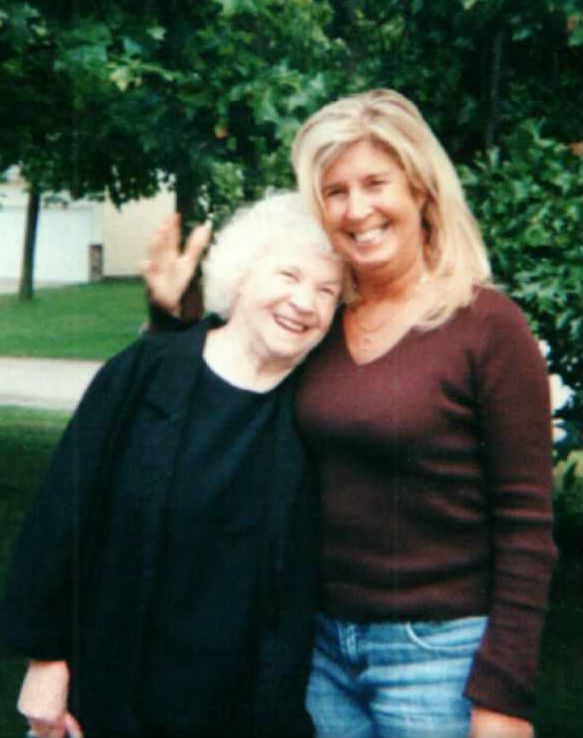
Earlier this year in May, I was honored to be a speaker at the American Mothers National Convention.  While attending the conference I heard a young mom speak about her own experience of being held hostage as a child and the feeling of total security she felt when embraced in her mother’s arms for the first time following the terrifying ordeal.  Listening to her led me to recall my own experience of feeling that security with my mother.  When I was a child and needed to be comforted, there was no one else who made me feel safe the way my mom did.  However, the safety of my mom’s arms did not end when I became a teenager or an adult.  Up until the day my mom died, I still cuddled with her like a little girl.  I felt spiritually connected to my mother, it was through her loving arms that I found security and felt truly connected to God.

There has been much exploration of the spiritual and emotional bond between mother and child.  Becoming a mother to an adopted toddler, I wondered if my daughter and I would share the same bond that I shared with my mother.  Baby S did not grow in my womb, we did not bond for nine months while she was in utero, and she had a history of multiple foster families before coming home to me and my husband.   Continue reading “The Safety of a Mother’s Arms by Gina Messina-Dysert”

Remembering My Grandmother: Not as a Suffering Servant but as a Devoted and Loving Mother By Michele Stopera Freyhauf

The last week-and-a-half has been probably the most heart wrenching time I remember having in my life.  You see, my grandmother passed from this life June 19th and the void in my heart is huge.  I have to admit that I am lucky that my grandmother was a huge part of my life and the last family funeral I attended was in 1983.  Certainly one expects grandparents to pass away, even when they live a healthy long life.  Nothing prepares you for the time that you must say good-bye.  You yearn for one more conversation, one more hug, one more kiss – the thoughts churn and churn robbing you of sleep or peace.  At some point, a level of acceptance or at least the ability to cope will occur – when is a mystery, but for now I just try to be strong – for my mom, my sister, and my children.

Driving home from vacation, I received the news from my sister, Lisa:

Lisa:    Nanny has lymphoma, which they found in her stomach and invaded her spine, paralyzing her from the hips down.  It is fast moving.

Me:     How long?

Lisa:    2-4 weeks. Hospice was called and is making her comfortable.

The news was jolting, but I did not realize that the initial expectation 3 days earlier was 6-8 weeks.  She had tests for a bleeding ulcer, so this diagnosis was jolting.  Over the last year, we dealt with dementia and health issues.  These either were false alarms or cured thanks to the love of her family, care from the people at the nursing home, and her nurse practitioner and physician.  I wished that this was also a false alarm – but it was not, this time it was real and the end was eminent.
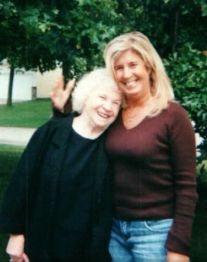
Seeing my mother at Father’s Day celebration, the news was even more grim – Nanny is no longer alert, can no longer open her eyes – they are making her comfortable.  The last time her eyes opened was after her priest gave her last rites.  He turned to leave, she opened her eyes, said “Hi Father,” and went back to sleep.  This was the last time her eyes would open.  My mother tells me that she is not expected to live through the week.

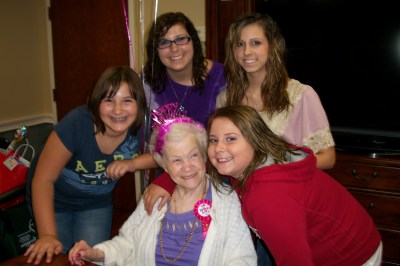
I took my children over to say good-bye.  I know I should be grateful that my girls have a close relationship with their great-grandmother, one that spanned 19 years.  I know I should be grateful that I had her in every facet of my life.  It is no secret that family was important to my grandmother, and she adored all of her children, grandchildren, and great-grandchildren.  This is a trait handed to my mother, my sister, and me.  Something I strive to instill in my children.

The good-byes were difficult as she was essentially unconscious and her breathing was noisy.

My sister called, how is she?

Me:     Breathing is labored and gaps between breaths are getting longer.

Lisa:    Will she be o.k. tomorrow?

Me:     I have no idea.  You may want to visit tonight just in case.

My sister and her husband appeared about 10 minutes later.  Wanting to give her time, I left with my family.  Going home was hard.  I was afraid she may not make it through the night.  I hoped with all my heart that this was not the end.

The next morning I returned to work.  She made it through the night.  I was in my office for a few hours before when I received a call from my dad.

Dad:    I am just calling to tell you Nanny is declining pretty fast.  They are saying minutes to hours – we are all here.  No need for you to come, I just wanted to let you know.
Me:     I am on my way.

Depending on traffic, I had a 40 – 60 minute drive.  I had to be with the woman that helped care for me and loved me.  The person that I took trips with, would talk hours on the phone with, cook with.  My grandmother was at every event, every family function, every holiday, and every birthday.  She was a huge part of my life and very important to me.  I needed to get there before she took her last breath – thankfully, I did.

The goodbyes continued.  Staff and residents alike came down to say goodbye. She was loved my so many.  Tears flowed for this petite woman with beautiful blue eyes, a contagious smile, and a heart of gold.  Her three children, my father, my sister, a few friends, and I kept vigil by her bedside.  I held her hand, sponged her neck and forehead to help with the fever, and kissed her forehead.  This went on all day and all night.

It was now midnight.  Everyone left the room to have a snack.  It was a long day and we forgot to eat dinner.  The staff was nice enough to provide us with muffins, water, pop, and coffee but this was no longer enough.  Every time someone would leave to use the restroom, you did not know if she would still be there when you came back.  Even running to a fast-food restaurant to grab a few sandwiches was done with angst and concern. Continue reading “Remembering My Grandmother: Not as a Suffering Servant but as a Devoted and Loving Mother By Michele Stopera Freyhauf”

Hagar – Demoted Servant or Egyptian Princess? By Michele Stopera Freyhauf

A socio-political examination of Genesis 16 explores how ancient myth can influence the story of Hagar and Sarai. Socio-political events could have occurred between the Egyptians and King Solomon that influenced the writing of this text.  According to John Currid in Ancient Egypt and the Old Testament, the Egyptians and Hebrews borrowed many things from each other and because of that, an inter-relatedness exists between the languages as well as cultural and religious practices of both kingdoms (26).  It is this inter-relatedness that I wish to explore and ask the question -was Hagar an Egyptian Princess demoted to a lower position of servitude in order to make a political statement of superiority of the Israelites over the Egyptians?  Or is this a story of conflict between two of Solomon’s wives?  Finally, could this story tell us about events that occurred after Solomon’s death since the Biblical texts from the pre-exilic period began to take shape during the reign of David and Solomon?  This is a very brief exploration of these theories.

In Genesis 16, Hagar and Sarai connect Egypt and Israel in a familial relationship, one rooted in strife.  These two women, an Israelite and an Egyptian, are brought together because of Sarai’s barrenness and need to fulfill the covenantal promise. Because of this, Hagar becomes Abram’s secondary wife.  This is not the only time that marriage between an Israelite and Egyptian occurs in the Old Testament.  Joseph marries and an Egyptian, the daughter of a priest of On (Genesis 41:45).  Solomon also has an Egyptian wife who seems to have some importance because she is mentioned six times in the Old Testament (1 Kings 3:1; 7:8, 9:24; 11:1-2; 2 Chronicles 8:11).

Important is the fact that this passage could be rooted in the writings that emerged in that period that portray family strife.  Savina J. Teubal in Ancient Sisterhood: The Lost Traditions of Hagar and Sarah, states these “andocentric writing and editing” of the biblical narratives portray conflicts between women who “vie for the attention of their husbands or sons” (19).  In this case the story really could be a tale of family strife inspired by two of the wives of Solomon, one of which was Egyptian.

Continue reading “Hagar – Demoted Servant or Egyptian Princess? By Michele Stopera Freyhauf”

Jewish Weddings: Identity, Desire, and Anxiety by Amy Levin

As a Jewish feminist, I’m often critical of marriage. And, as a 26-year old (this month) who attended Jewish camp, leadership/environmental programs in Israel, and was active in Jewish youth groups growing up, I’ve been frequenting my fair share of Jewish weddings lately. These occasions bring me joy, nostalgia, and an overall reminder in the beautiful power of ritual and ceremony. But they also bring me a piercing sense of anxiety – one that I’m sure I am not alone in experiencing. I see marriage as a heteronormative and ideologically oppressive institution that promotes a hierarchy of relationships – being married as the most desirable form of a relationship, and remaining single as a failure of the female, much like not having children is seen as a failure of womanhood. I see the seventy billion dollar (or more) American wedding industry as representative of the capitalist impulse involved in the planning of weddings, bachelorette parties, and honeymoons, not to mention the violence involved in the so-called “blood diamonds” of so many engagement rings. Continue reading “Jewish Weddings: Identity, Desire, and Anxiety by Amy Levin”

The Crime of Being a Girl Scout: The Sin of Raising Strong Female Leaders by Michele Stopera Freyhauf

Cradle Catholic and Woman

Educated by the U. S. Vowed Religious

Support the U. S. Catholic Sisters

Support, Minister, and Live the Social Gospel

Theologian, Feminist, and Critical Thinker

Former Girl Scout Leader of Three Troops

Former Girl Scout

I am all of these things and more.  By the recent attacks by the hierarchy of the Catholic Church, I am beginning to think I am the problem.  I seem to stand for everything the Vatican and USCCB seek to silence.  Is it because of my organizational ties with the U. S. Vowed Religious and Girl Scouts, or my writings as a Feminist and Theologian?  Maybe the answer is simply – because I am a woman.

According to the criticisms launched by the USCCB and the Vatican, I seem to be part of the problem rather than the solution.  Why is this so?  It was not until I started my journey in ministry that my idealistic “Catholic” bubble popped – not so much by me, but by those in ministry and leadership, by those that did not like laity to pose questions and think critically about their faith beliefs, and by  those that do not like people who do not fit within the preconceived mold of what a “good Catholic” should be.  This ideological construct is difficult enough when you are part of a Church community, but when you begin to embrace leadership as a woman, question teachings, exercise your canonical rights, your peers and even people you thought were your friends, no longer talk or associate with you. The betrayal is vicious and runs deep – it is behavior not becoming of a minister or one who professes the Catholic faith.

If the attack on you is not enough, these same people victimize your children through their words and behavior.  It is a difficult position for anyone to survive spiritually.  For children of the Church who bear witness to this hypocritical behavior, a journey begins – they search for meaning within the spiritual realm and become disgruntled with anything that resembles organized religion.  A place where one seeks community and spiritual nourishment becomes a place of oppression and starvation.  If attacking family is not enough, let’s start attacking groups that promote community – groups like the Girl Scouts of America.

So, what is the USCCB’s problem with the Girl Scouts of America?  Basically, this organization is under fire for suspected deviant thinking and positions that stand opposed to Church teaching. Continue reading “The Crime of Being a Girl Scout: The Sin of Raising Strong Female Leaders by Michele Stopera Freyhauf”

Feminist Family Values by Gina Messina-Dysert

As a new mother, something that is constantly on my mind is how to teach my daughter morals and values.  She just turned three and has a strong awareness of what is going on around her.  Her vocabulary is vast and continues to grow daily.  I know that if I don’t start teaching her values now, I am missing out on an important opportunity.

Although I was raised Catholic and consider myself a “cultural Catholic,” I am uncomfortable with Catholic traditional prayers because of their lack of gender inclusiveness, among other things.  We don’t attend church as we have not yet found a community that we feel is a good fit for our family.

Thus, I have found myself creating new prayers to recite at dinner and bed time; prayers that encompass our family values, are feminist in nature, and are simple enough that our daughter can remember and recite them on her own.   Continue reading “Feminist Family Values by Gina Messina-Dysert”

Why I Failed Feminism 101: Gender, Sexuality, and the Power of Relationships

I forgot, that relationships, like feminism, are not easy, and that it is a conscious and continual effort of renewal to remind yourself everyday why you love the person you love and more importantly, in the case of feminism, why you fight, “the good fight.”

I was once told by my ardent feminist advisor in undergrad to “not put all my proverbial eggs in one man basket” after discussing my relationship with my boyfriend over a cup of coffee.  Thinking my relationship was different and that we were special, I heeded the warning but thought of it no further.  Now, looking back on it three in a half years later, I wish I would have.

Relationships are a powerful tool.  They help to make you feel special.  They help to bring you joy.  They help you discover the reason why a divine presence may have endowed us with the ability to love and most importantly they help you realize and discover things about yourself you may have never taken the time to notice.

Feminism 101 is more than just the pop culture stereotype of a bunch of women advising the younger generation of girls to be weary of men and the pain they can bring.  Feminism, specifically as what I now call Feminism 101, is the transformative ability to listen to your elders, trust yourself, and ultimately, if you happen to trust in the relationship you have built, knowing deep down that it is built on equality, love, and trust. Continue reading “Why I Failed Feminism 101: Gender, Sexuality, and the Power of Relationships”

JUDGES 19: A BRIEF PAUSE FROM JUSTICE-WORK TO BE WITH HER IN THE SILENCE BY IVY HELMAN

Elie Wiesel, Holocaust survivor and renowned Jewish thinker, believes that no one can ever truly understand the profundity and tragedy of the Shoah unless one experienced it.  For him, silence is the best way to express the events since words fail to do justice.  The principle of letting silence speak, when words no longer can, when pain is so real it debilitates and when tears flow more freely than thoughts, is not original to the twentieth century.  The Bible contains many events and personal stories in which this is the case.

Judges 19 begins with two characters: a Levite and his concubine.  The concubine has recently run away to her father’s house, when her husband decides to visit her there trying to win her back.  He seems to have only good intentions in mind.  After leaving her father’s house with his wife, the Levite discusses his future plans with his servant who apparently accompanied him on the journey.  He still has not spoken a word to his wife.

The servant and the Levite decide to spend the night in Gibeah, a Benjaminite city.  The three of them sit in the city’s square waiting for someone to take them in but no one arrives until evening.  At dusk, an old man comes by and offers to take care of the needs of the entire party, including the donkeys, as long as they promised not to spend the night in the city square. Continue reading “JUDGES 19: A BRIEF PAUSE FROM JUSTICE-WORK TO BE WITH HER IN THE SILENCE BY IVY HELMAN”

A MEDITATION ON A MIDRASH: “ABRAHAM’S DAUGHTER” BY ARCADE FIRE by Sara Frykenberg

The wages of the sin of sacrificing our children is their death, whether the sacrifice is to some supposed higher order, to absolute obedience or to appear to be the “good Christians” we are “supposed to be”…

Maybe its because I enjoyed the books more, or because of my sister’s all too expectation-garnering reviews or even, because I’d seen this theme before, in an amazing yet gruesome Japanese movie, Battle Royal, I left the theater unsatisfied after watching The Hunger Games. I did however, LOVE the song that played at the end of the movie, which I downloaded before we left the theater.  I listened to it in the car on the way home.  I listened to it the next day, the day after that and for days after that… I listened and listened, and I found surprise, power, anger, sorrow and a channel for grieving that I had needed in the Midrash “Abraham’s Daughter” by Arcade Fire. 

Abraham took Isaac’s hand and led him to the lonesome hill

While his daughter hid and watched, she dare not breathe

She was so still.

I discovered the practice and potential power of Midrash from my teachers in graduate school.  The idea of an “extra-biblical” story that might help to expound upon Biblical passages that are all too often unexplained or unsatisfactory to (my) feminist consciousness was very appealing to me—and it is still appealing to me.  But I have to admit that the feminist Midrash I read in my classes seemed too positive and did not resonate with me.  The pieces were too much like a tender hug or a mother hen covering my wounds with her wings.  I wanted to hear a story of Bible that could help me make sense of the violence I’d discovered in my childhood religion.  I needed a story of Bible that honored my violent struggle to counter the abuse within it and within me.

Like Isaac, I was too intimate with my abuser: unable to avoid walking hand and hand with him when pushed to do so.  Asked to create a prayer or Midrash for a class once, I wrote about the way I would turn the radio in my car up when I started to hear ‘God’ speak to me.  I didn’t know how to listen and tune out the abusive maxims that played over and over again in my head (maxims that surfaced every time I even thought about the divine).  Continue reading “A MEDITATION ON A MIDRASH: “ABRAHAM’S DAUGHTER” BY ARCADE FIRE by Sara Frykenberg”

Resurrecting Scars by Shelly Rambo

What does it mean to be created through the scars of a (m)other? And what does it mean to be made new—to be recreated—by them?

It is my first Easter without my mother. My sister Jody reminded me of how much my mother loved religious holidays, especially Easter. One of my striking last moments with my mother was in the hospital operating room when the nurse was preparing her for a surgical procedure. As the nurse opened up the back of the hospital gown, she exclaimed: “What beautiful markings you have.” She was referring to the scars on my mother’s back from a previous heart surgery. “It’s like a work of art.” My mother never viewed them like that. Instead, she often kept her multiple scars hidden from us. But there were moments, as a young girl, when I would glimpse them, those in the front between the buttons of her tightly starched blouses, and those on her back when she’d be ironing her Sunday dress in her satin slip. I was both intrigued and scared by these tracks on my mother’s body, just as I was by the ticking of her mechanical heart valve that I could hear when I stood next to her, the traffic in the house at a standstill. Both were reminders to us that her life was sustained yet fragile.

Much of Western literature tells the stories of fathers and son. And the dominant Christian storyline has also been patrilineal. Continue reading “Resurrecting Scars by Shelly Rambo”