I tried a new spiritual practice yesterday. I wore a tallit katan. It is commonly worn by Orthodox, Hasidic and other Ultra Orthodox men and boys from the age of 3 onward and usually not worn by women within these communities. Occasionally, one can see Jews (mostly men) from Conservative shuls wearing these garments and rarely from Reform congregations. They seem to be a marker of a more observant Jewish practice that reads much of the Torah literally. One is commanded to wear fringes (tzitziyot) when wearing four-cornered garments as reminders of the covenant between G-d and the Jews and more specifically of the 613 commandments.
There are a number of reasons women and men from Orthodox and ultra Orthodox communities give for discouraging women from the wearing of tallit katan and tallit gadol. First, women are said to be exempt from time-bound mitzvot, or commandments . Wearing tzitziyot are considered time-bound because the Torah says one should be able to see them which has been interpreted to mean that they be worn during the day. The reason given that women are not held to time-sensitive mitzvot has to do primarily with their childcare responsibilities. Children and fulfilling their needs often requires much time and may not allow one to complete a task within a given time frame. A related ideology says that women are often generally thought to be more spiritually attuned, and therefore do not need such physical reminders to follow the mitzvot. Continue reading “How literal is too literal? My Experience with Tallit Katan. By Ivy Helman”
During July 8-11, 2012 twenty Catholic feminist leaders met in a retreat center near Baltimore to discuss their concerns and hopes in the light of the recent and ongoing attacks of Catholic bishops on women and especially on feminist work in the church. The group consisted of representatives from many sectors of Catholic institutions and movements. There were the founders of a peace and justice movement of the Sisters of Charity and the Institute for Communal Contemplation and Action. There was a pastor and leadership trainer from an alternative parish and a writer for the National Catholic Reporter.
Many in the group were professors of theology or ethics at Catholic, Protestant or state schools. Among them were teachers at Whittier College, Claremont School of Theology, Santa Clara University and San Jose University in California, Loyola University in Chicago, St. Catherine in Minnesota, Drew University in New Jersey and Boston College. Catholic reform movements were well represented, with leaders from Dignity, the Women’s Ordination Conference, Call to Action and RomanCatholicWomenPriests. There was a teacher at Marymount School in New York City, the President of Marymount School in Los Angeles and a doctoral student in theology. Continue reading “Catholic Feminists Meet, Strategize by Rosemary Radford Ruether and Theresa Yugar”
My hair started “going gray” at nineteen. Prophetic, you could say, for a college girl whose life was going the same way.
The gray hair began around my temples, curling around my ears like a vine before following my hairline to the forehead and down the spine of my scalp. I remember calling my mother and telling her between tales of new classes and new boys of my new whiskers. “Oh, and mom, you will not believe it. I found a gray hair. What is that?”
Her laugh vibrated though the phone. “That is normal. I went gray at 19. Your father went gray at 19. Your brother has it coming in, too, nowadays.” She added, “Sorry.” But she didn’t sound it. Continue reading “Girls Gone Gray by Erin Lane”
Once what happened was after people started believing someone around also started believing in this temple and one person kept a statue on their steps. Her Aunty she believed and she is very much interested in small things. So she started decorating it up. And what happened was the statue starting getting bleeding, like monthly monthly. And the dress which the statue wore during those periods was stained with red bleeding. So they asked Guruji about what is this and he said that the shakti has come into the statue. So if you keep this in the home it will turn into a temple so go and leave it outside. This was followed by entry of snakes, king cobras, so what they did was they went and left it in the sea, after which her grandmother had a dream that you have left me in the water but still I am with you. I am the temple opposite here, put a lamp everyday at that place. So they started putting it out there, and now there is an earthen Kali which as come up in that place by nature. –Interview with Premila, March 18, 2008 Continue reading “Through Body and Space: A Glimpse into Women Worshippers of Aadhi Parashakthi by Amy Levin”
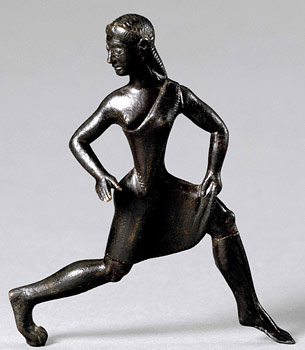
The first “Olympics” were races of girls of various age-groups around a 500 foot stadium in ancient Olympia. The races of girls were held every four years on the new moon of the month of Parthenios (September/October). They were dedicated to Hera Parthenos who renewed her virginity in the river Parthenias. The winners of the races wore olive crowns and feasted on the flesh of Hera’s sacred cow.
These “Olympics” for Hera and for girls came before the more celebrated Olympics for men that were dedicated to Olympian Zeus. The temple of Hera at Olympia is older than the temple for Zeus and the girls’ Olympics were tied to the more ancient lunar calendar.
This year two significant shifts happened inside of me: I realized I was getting older. And I wanted to protect my body/mind. These may seem to be perhaps the same realization– but both of these realizations came from very different incidences.
Realization #1
Let me explain the first realization—realizing I was getting older. I am 56. Perhaps since I am a professor and while I have been getting older, my students stay the same age as each new crop of undergrads greets me in the fall. Perhaps because I have chosen to not have children of my own. Perhaps because I do work out—jogging (albeit slowly). Whatever the reason in my mind I was still not “older,” whatever that is — yet.
And then I went for a long over due eye exam. When my new glasses arrived I admired them in the large mirror across the room. But when I sat at the desk and looked in the mirror directly in front of me, I gasped. “Oh my God!” I exclaimed. “What are those?” I was staring through my new lenses at the wrinkles above my lip. I stared at the eye glass specialist — a fabulous gay man (and partner to my ophthalmologist) who helped me pick out the frames. “Do you see those wrinkles?” I asked. It was only after he said, “Oh, honey, $900 you can fix that– I know someone,” that I realized I was assuming he would say, “What? I don’t see anything.” But you can rest assured a gay male friend will not lie to you about your looks. If that dress make you look fat, he’ll tell you (and help you fix it). In any case, in that moment of corrected vision I saw my wrinkles for the first time. And I hated them. Continue reading “If You’re Lucky You Get Old—Part One by Marie Cartier”
If you have been socialized that fading into the background should be your first concern, cycling can seem like one long experiment in declaring your valuable, irreplaceable, amazing existence in this world.
I love riding my bicycle for many reasons. It clears my head, is convenient, affordable, good for the environment and good for my calf muscles. It no doubt also has its dangers, but most of the time, I love maneuvering through Boston’s busy streets.
I have not always been a bicycle enthusiast. Last week as she was preparing for a sermon, a friend asked if any of us had good stories about “saying yes.” I explained that my “yes” to biking has always seemed to me a story of “saying yes” to one thing and getting something else altogether. Riding my bike has also become a surprising source of insight in this first year of doctoral work in theology, and about how one who identifies as a feminist begins to engage theologically.
Can women have it all? Possibly. Can men ever have it all? Maybe. Regardless of however we put it, the are ills to every good deed in the world and we need to get back to understanding how and why we use each other in order to fully understand that behind every good man might be a good woman but also behind every good women there might also be a good man.
Growing up, my favorite movie was The Associate staring Whoopi Goldberg as a woman at a Wall Street firm attempting to climb her way up the corporate ladder through hard work and dedication. Her character Laurel Ayres does all the work and comes up with the ideas that clients eventually invest in, her partner Frank takes all the credit and eventually surpasses her at work by getting the promotion she had been vying for. In a prodigious scene that I still vividly remember from my childhood, Laurel quits her job and starts an investment firm on her own; betting every cent and piece of property she has on the eventual success of her new business adventure.
In an attempt to break through the proverbial glass ceiling and play with the big boys of Wall Street, Laurel eventually discovers that although she can be (and is) the genius behind many of the great ideas that would save companies millions, she still needs to have her ideas expelled by a man she creates in order to win over clients, which eventually leads her to become successful. However, while Laurel is reaping in the benefits of having Mr. Cutty, her made up business partner, by her side, she eventually learns that no matter what she does she will always be secondary to her male business partner. Continue reading “Why Men (and Women) Can’t Have It All by John Erickson”
Spiritual Power is arguably the most dangerous power of all. In the wrong hands, it gives the power to make judgments even about the eternal fate of another person. It needs a sign on it at all times saying, ‘Handle with extreme care.’ The greater the power a person exercises, the more need there is for checks and balances before it is used and accountability after it is used.” – – Bishop Geoffrey Robinson
May 6th, I addressed the issue of abuse of power in the Catholic Church and how we seem to be unraveling any kind of progress made since Vatican II. Since writing that article, the Leadership of the LCWR met with Vatican Officials and expressed their concerns openly. A dialogue occurred and left no resolution, just information that the leadership will discuss with the community at their August meeting. That meeting will reveal their next step in this controversy – concede and follow the conditions and rules sets forth by the CDF or disband and form a new religious community or maybe there will be another option revealed.
I have to ask though – Was this a meaningful meeting or was it meant to pacify the Sisters and their supporters? Will the Vatican change its stance? Certainly, the U. S. Catholic Sisters have not been
pacified, nor have their supporters. For example, there is a “Nuns on the Bus” tour traveling around the United States, prayer services for the Sisters, #nunjustice and #whatthesistersmeantome campaigns on Twitter. Even the Women’s Ordination Conference delivered a petition containing over 57,000 signatures to the Vatican in support of the Sisters. Certainly, the support for the sisters and their mission is not dwindling, but growing stronger every day.
As for the Vatican, a change in their position is doubtful, but we can continue to pray. I am, however, very discouraged by a statement attributed to Pope Benedict that indicates a desire to have a smaller more faithful Church of Catholics then a large Church of people who do not adhere to Church Teaching – seeking out a small, strong, holy community.
Obviously, it is my hope that this statement was taken out of context, but I have to be honest and say
Women’s Ordination Conference delivering Petition Picture reprinted from WOC’s page on Facebook
that my hope is filled with doubt. This is not the first time I have heard clergy make this statement. Priests have made this statement in my presence – wanting a more faithful flock and dismissing those that do not adhere to their interpretation of Church teaching. This stance does not bear fruit, but is rather a power play – a play that can be called many things – misogynist, arrogant, non-pastoral, cold-hearted, and frankly un-Christian. It also plays with a person’s spiritual fate and in many cases their soul. The psychological impact of something like this is dangerous for some. Some ordained will go so far as to withhold sacraments or even compromise the person’s status in the Church, including their role in ministry, for the sole purpose of inducing compliance – a tactic that dates to the medieval period.
This is a moment we all face—the moment when we slay the enemy, only to realize we have slain ourselves and the enemy is still at large.
In Part I of this blog, I analyzed the themes of power and beauty in the film Snow White and the Huntsman in relation to the character of the Queen. In Part II, I would like to continue exploring these themes in light of Snow White’s character and her relationship with the Queen. That Snow White’s power is her beauty is clear. True, it is stated right up front that Snow White is admired throughout her father’s kingdom “as much for defiant spirit as for her beauty.” However, it is her beauty that grants her agency and power, not her free and defiant spirit. The battle scene in the climax of the film illustrates this connection between power and beauty well—as Snow White drives her dagger into Ravenna’s heart she repeats the mantra: “By fairest blood it is done; by fairest blood it is undone.” After Ravenna breathes her last, we see Snow White looking into the mirror on the wall, the victor, the fairest. Her beauty has allowed her to ascend to power. Her beauty has allowed her to defeat Ravenna. We are left wondering—who has won exactly? Continue reading “A Tale of Power and Beauty, Part II: Snow White by Amanda Kieffer”


 I tried a new spiritual practice yesterday. I wore a tallit katan. It is commonly worn by Orthodox, Hasidic and other Ultra Orthodox men and boys from the age of 3 onward and usually not worn by women within these communities. Occasionally, one can see Jews (mostly men) from Conservative shuls wearing these garments and rarely from Reform congregations. They seem to be a marker of a more observant Jewish practice that reads much of the Torah literally. One is commanded to wear fringes (tzitziyot) when wearing four-cornered garments as reminders of the covenant between G-d and the Jews and more specifically of the 613 commandments.









 Feminism and Religion