Alice Paul & the Women Who Will Keep Marching by Kay Bee

Hedwig Reicher as Columbia on the steps of the Treasury Building in Washington, DC, March 3, 1913.

The day before Woodrow Wilson’s inauguration, the 1913 Women’s Suffrage Parade took place in Washington, D.C. to demand the attention of the incoming administration and advance the cause of suffrage. Organized primarily by Alice Paul, 8,000 women marched on Washington on March 3, 1913.

Alice Paul is an often overlooked figure in American suffragette history. She’s no longer as common a name as Susan B. Anthony or Elizabeth Cady Stanton. Her early feminist contemporaries weren’t always very fond of her, for that matter. Many found her “too radical,” especially after her return from training with the British suffragettes, where she was arrested multiple times. But Alice Paul knew how to get things done. Continue reading “Alice Paul & the Women Who Will Keep Marching by Kay Bee”

The Women’s March on Washington: I’ll Be There in Spirit by Carol P. Christ

womens-march-logoThe Women’s March on Washington has released its statement of vision and principles, and what a stunning testimony to intersectional feminism and collaboration it is! The statement is woman-centered, while at the same time addressing a multitude of issues that affect women’s lives: from access to abortion for all, to an equal rights amendment to the constitution, to the rights of  women as domestic and farm workers, to police reform, and so much more.

I was thrilled to read the list of women honored as foremothers to the march:

Bella Abzug*Corazon Aquino*Ella Baker*Grace Lee Boggs*Berta Caceres*Rachel Carson*Shirley Chisholm*Angela Davis*Miss Major Griffin Gracy*LaDonna Harris*Dorothy I. Height *bell hooks*Dolores Huerta*Marsha P. Johnson*Barbara Jordan*Yuri Kochiyama*Winona LaDuke*Audre Lorde*Wilma Mankiller*Diane Nash*Sylvia Rivera*Barbara Smith*Gloria Steinem*Hannah G. Solomon*Harriet Tubman*Edith Windsor*Malala Yousafza

Many of these women have inspired me, particularly (but not only): Bella Abzug, Rachel Carson, Shirley Chisholm, Malala Yousafza. I have taught books by or about many of them, including: Rachel Carson, bell hooks, Audre Lorde, Harriet Tubman, Barbara Smith.

I hope these names will be read at the beginning of the ceremonies, followed by an invitation to all present to speak, shout, or whisper—all at the same time–the names of all the women, known and unknown, who have inspired their own activism for women’s rights. In this way, no one’s name is left out. We have a similar ritual on the Goddess Pilgrimage to Crete, and it is incredibly powerful.

I first heard the Women’s March on Washington discussed at the meeting of the Feminist Liberation Theology Network held in conjunction with the meetings American Academy of Religion and Society of Biblical Literature ten days after the (so-called) election of Donald Trump. At that time a number of women asked if this march would be a white women’s march. Would women of color feel called or able to come? In the interim, women of color have become leaders of the Women’s March on Washington and it is definitely not “for white women only.” It was suggested that women of color might feel safer at local marches. These have been organized as well: learn about Sister Marches here. At the time of this writing 370 Sister Marches had been organized—in all 50 states and in more than 40 countries.

If, like me, you are feeling weary and despondent these days, the statement of the Women’s March on Washington may help to re-inspire your commitment to all women’s rights:

The Women’s March on Washington is a women-led movement bringing together people of all genders, ages, races, cultures, political affiliations and backgrounds in our nation’s capital on January 21, 2017, to affirm our shared humanity and pronounce our bold message of resistance and self-determination

Recognizing that women have intersecting identities and are therefore impacted by a multitude of social justice and human rights issues, we have outlined a representative vision for a government that is based on the principles of liberty and justice for all. As Dr. King said, “We cannot walk alone. And as we walk, we must make the pledge that we shall always march ahead. We cannot turn back.”

Our liberation is bound in each other’s. The Women’s March on Washington includes leaders of organizations and communities that have been building the foundation for social progress for generations. We welcome vibrant collaboration and honor the legacy of the movements before us – the suffragists and abolitionists, the Civil Rights Movement, the feminist movement, the American Indian Movement, Occupy Wall Street, Marriage Equality, Black Lives Matter, and more – by employing a decentralized, leader-full structure and focusing on an ambitious, fundamental and comprehensive agenda. Read more.

Learn more about the march. Readers of FAR might want to participate in the march with WATER (Women’s Alliance for Theology, Ethics, and Ritual). I’ll be there in spirit from Molivos, Lesbos, Greece.

***

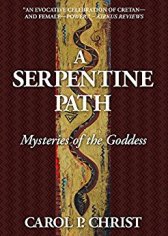
a-serpentine-path-amazon-coverBe among the first to order A Serpentine Path, Carol P. Christ’s moving memoir of transformation. Carol’s other new book written with Judith Plaskow is Goddess and God in the World: Conversations in Embodied Theology. Carol also wrote the first Goddess feminist theology, Rebirth of the Goddess.

Join Carol on a Goddess Pilgrimage to Crete in 2017. Save $200.

Read two of the chapters in the book: Mysteries and Dionysian Rites.

Thanks to Judith Shaw for the cover art “Downward Serpent.”


A Gift Offered in Faith and Love by Elise M. Edwards

elise-edwards“The day begins with the sun and ends with the moon and stars; what you do in between is your gift to the world.” – Reyna Craig

The new year has begun, and many of us take this marking of time as an occasion to set intentions, goals, plans, or resolutions for the year ahead.  For us feminists, the year ahead holds clear challenges.  We know that the bodies, spirits, minds, hearts, and souls of women, racial and ethnic “minorities,” and all sorts of vulnerable people will be attacked.  We know that the protections secured under the law for these bodies, spirits, minds, hearts, and souls have been eroded and continue to be dismantled in the name of… well, what exactly? Justice? Life? Religion?

We’ve seen voting rights eroded in the name of democratic ideals.  We’ve seen challenges to bodily autonomy in the name of life.  We’ve seen state-sanctioned murder in the name of law and order.  We’ve seen a rise in religious intolerance in the name of religious liberty.  Our work in this age must be to continue to expand our collective understandings of these ideals.  This is the gift we offer to the world.

Continue reading “A Gift Offered in Faith and Love by Elise M. Edwards”

As It Might Have Been: Ancestor Stories in the Dreamtime by Carol P. Christ

carol-p-christ-photo-michael-bakasIn the middle of the night in waking sleep, I asked my great-great grandmother Annie Corliss to tell me the story of how she met and married James Inglis. This story came through me in a place I have come to call the Dreamtime. The Aboriginal term feels right. As I understand it, this is not a place where the dead speak to the living but rather a space where boundaries blur as the ancestors speak in us.

Annie Corliss’s Story: As It Might Have Been

My mother decided to come to America after my father died. My brother Hudson was 7 and my brother Hugh was a baby. I was 13. Mother had a little money, and she said we would have a better life in America. We left Ireland on a boat that took us to Liverpool. There we boarded the big ship Continent that took us to America. The trip took about 6 weeks. While we were at sea, first Hudson, and then Hugh died. Their bodies were wrapped in the blankets that had covered them in the filthy cabins on the ship. The priest said a few words of blessing, and they were dumped into the cold angry sea. Every day, another body was thrown overboard, sometimes two. So much grief, so many tears in the night. After Hudson died, Mother wouldn’t let go of Hugh, so afraid was she of losing him. After he died, she would not stop crying. I kept telling her she still had me. She didn’t care anymore. “America is cursed,” she kept repeating. (1) Continue reading “As It Might Have Been: Ancestor Stories in the Dreamtime by Carol P. Christ”

The Importance of Religion for Eco-Feminism by Ivy Helman

untitled.png“Why is religion important to ecofeminism?”  A student, in the Master’s course I teach at Charles University, asked this as we began the class session dedicated to the topic.  Given the overwhelming presence of atheism in the Czech Republic, I wasn’t too surprised by the inquiry.  Nonetheless, the idea has been at the back of my mind ever since: what does religion have to do with ending patriarchy and bolstering the health of the planet?  While I may take the connection as obvious, it is clearly not for many feminists out there.  Here is how I understand it.

First, it is true: many of our inherited religious traditions have been and still are considerably patriarchal.  Because of that, some feminists outright reject religion.  In fact, some feminists even consider religion dangerous and threatening, as it is often utilized to contradict many feminist aims.  Yet, there are many, many feminists who find, within their given or chosen tradition, non-patriarchal elements that can be recovered, remembered and/or (re)created.   Religious feminists work tirelessly to transform religions in life-sustaining and post-patriarchal ways not just for themselves but also for those women and men who belong to the same communities.   Continue reading “The Importance of Religion for Eco-Feminism by Ivy Helman”

Exe(o)rcising the Spirit by Natalie Weaver

Natalie editedWhy bother? It’s a legitimate question.  My oldest son, almost 12, announced that he is depressed.  He’s got good reasons for it, so I don’t try to talk him out of it.  My youngest, almost 8, told me yesterday that life was simpler when he was in my belly.  Now, he says school is torture.  They won’t just teach something and move on.  They have to do “activities,” he says, he’s onto the racket that is known as busy work.

I spoke with an aunt, a cancer survivor, whose progress is steadily monitored.  Life, it seems, has become about watching and waiting rather than living.  There’s not so much to look forward to, she says wistfully, once you get to a certain age.  My friend called in distress.  Not one area of life – not work, not kids, not household, not romance – was untouched by significant stress. She said that she could understand how people are okay with their kids moving out.  There is a time, she observed baldly, when it will be alright to die.  She said, I’m tired.

What do we do with fatigue that becomes soul deep?  In my own case, I used to move it around from one place to another, focusing on what I could do as a remedy for the things I could not change.  What I have come to realize, though, is that we run out of storage space eventually.  There’s no place to hide from this – this question – of meaning or meaninglessness.  When I try to assess and work out what’s on my mind, that is, when I feel the fatigue of meaning, I realize that I am dealing with something spiritual in nature.

It’s plain as day, of course, when you give it a second’s thought.  But, at first blush, it is not always immediately self-evident that the angry person mouthing “bitch” at me in the crowded parking lot or my frustration at my kids not responding to my third request, were and are, at the root, theological problems.  Such things were and are, the things that push the self toward the precipice of spiritual demise.

Why bother, I wonder, when the handsome and seemingly happy couple in line in front of me to see Santa with their little boy turns to me hostilely and threatens me should my own eager child accidentally bump into them again.  As I stand on, dazed, still looking at them with something of a smiling admiration on my face, trying to understand what I have just heard, I am yelled down for the look on my face.  What is this world, I wonder, while my own joy begins to shift into an anger that I am now tasked with suppressing and rationalizing?

The more I recognize myself in this place, especially as a woman, the more I understand that traditional theology, and specifically traditional Christian doctrine of God, has more or less failed to help me here.  It has failed to provide me, specifically as a woman, an adequate way of dealing with the inevitable fatigue of a life lived long enough.  What do I mean by this?  I find that I have internalized a distorted sense of value and more importantly a distorted sense of self in relationship to others.

In particular, the idea of servanthood, even service as leadership, can be an infectious and distorting delusion whereby one inclines oneself simply to be taken advantage of by others.  This happens in family life, work, and even in volunteerism (especially at the Church).  Likewise, the insistence on joy, hope, resurrection, loving the neighbor, the new day yet to come – these can become woefully burdensome, even to the very young, because such spiritual dispositions stifle the capacity to experience–honestly and without self-critique–anger, fear, boredom, and disappointment.

As a woman, I find myself to be particularly susceptible to spiritual instruction about service, docility, duty, and self-gift, in ways that I increasingly come to understand are not genuinely relationally intelligent or spiritually wholesome: they are gendered norms for desirable social being.  Of course, I know all this stuff as theory.  I have for two decades.  But, now, now I know it for myself, in my skin, and that is a heavy transition in the soul.

I’m not sure I agree that religion the opiate of the masses, but I do agree that one of the foremost reasons people create religion as a framework for interpreting life is that they are confronted with the profound task of meaning-making out of what often seems to be the unfathomable reach of meaninglessness.  Theology is a response to that, as is worship.  The older or perhaps wiser or perhaps more reckless I get, the more I understand that is incumbent on each of us to be able to think theologically in ways that are authentic and true to our own experiences and insights.

It is perhaps for these reasons that I have been expanding my own capacity for prayer and ritual by participating in alternative spaces of worship, like the sweat lodge, as well as creating my own, as I have been over the past several on New Year’s Eves, with the invention of a symbolic meal, a structured memorial for the deceased, readings, and a fire ritual at midnight.  I feel at times like a syncretistic pagan wannabe, but I set those self-critiques aside in the knowledge that I am exe(o)rcising the spirit.

That phrase, “exe(o)rcising the spirit,” feels laden, and I have yet to unpack its full import, but I know it means both ridding myself of what does not work and claiming the authority to honor what does in ways that are sacramental and meaningful to me and to those in my community of intimates.

Perhaps the best way that I alternatively theologize is through creative writing, through the beckonings of theopoesis, where I find I can speak without the impositions of structure in the quasi-grammarless realm of experiential knowing.  It is here that I have discovered freedom to disagree and complain as well as to integrate and praise in a voice that talks to God in earnest, as though God were listening.  In preparation, for a solstice sweat, this is what I had to say.

These sides are not

sharp antagonisms

that bring to points

their points of view

but a pond’s surface

under moonlight,

swirling like mercury,

beneath which minnows,

fluid, do

their works of

harmonious disruption.


So, let my prayer be not

please,

for, I fear

I have been

an ungrateful guest.

Sojourning pilgrim,

refugee,

all this life, all will be,

a lesson in how to say

thank you.

Natalie Kertes Weaver, Ph.D.is Chair and Professor of Religious Studies at Ursuline College in Pepper Pike, Ohio. Natalie’s academic books includeMarriage and Family: A Christian Theological Foundation (Anselm, 2009); Christian Thought and Practice: A Primer (Anselm, 2012); and The Theology of Suffering and Death: An Introduction for Caregivers (Routledge, 2013)Natalie’s most recent book is Made in the Image of God: Intersex and the Revisioning of Theological Anthropology (Wipf & Stock, 2014).  Natalie has also authored two art books: Interior Design: Rooms of a Half-Life and Baby’s First Latin.  Natalie’s areas of interest and expertise include: feminist theology; theology of suffering; theology of the family; religion and violence; and (inter)sex and theology.  Natalie is a married mother of two sons, Valentine and Nathan.  For pleasure, Natalie studies classical Hebrew, poetry, piano, and voice.

Life in the Tenements by Carol P. Christ

carol-p-christ-photo-michael-bakasDuring my ancestor research, I have seen the word “tenement”—with the implication of poverty, filth, and disease–handwritten onto more than one death certificate. Last month, I visited the Lower East Side where my Irish 2x great-grandmother Annie Corliss lived in the tenements near the docks with her husband the Scottish seaman James Inglis and their nine children.


Though the tenements where they lived in the vicinity of Cherry Street a block from the East River have been torn down to build public housing, my newly discovered third cousin Hattie Murphy still lives in the area. She arranged for me to visit the “Irish Outsiders” house in the Tenement Museum on nearby Orchard Street in order to gain an understanding the conditions of life in the tenements in the middle of the nineteenth century.

Tenement housing, which was a euphemism for apartment living in crowded and impoverished conditions, was often built on 25 x 100 foot lots that had been intended for single family homes. These several story buildings with four windows on the front of each floor were divided into small three-room apartments eight to a floor, each with one window facing the street or the back alley.

montrose-st-across-from-170
Buildings like this may look charming from the outside, until you imagine living your whole life in a small apartment set behind only one of these windows.

In the apartment we visited, the window was in the sitting room in the front, the bedroom was in the back, and the kitchen was in the center. The kitchen included a coal stove that was the only heating for the house. Laundry hung above the stove, and, as our guide explained, dirty diapers with only “number one” were simply pinned up to dry. Coal dust hung in the air and fell upon everything. Even in the summer when the windows were open, fresh air rarely reached to the kitchen, let alone to the bedroom in the back. Our guide remarked that the smells of cooking, coal, babies, and unwashed bodies would have been overpowering. Despite their poverty, the women purchased pretty dishes, often chipped, at second hand stores, and proudly displayed them.

tenement-museum-irish-house-kitchen-and-bedroom
This photo shows the communal staircase, the open door of the apartment, kitchen and bedroom. The window inside the apartment was added to improve air circulation due to health regulations. Blue Willow pattern dishes on display upper left.

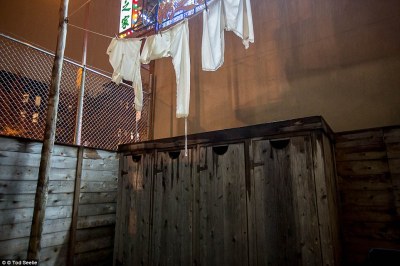
Our visit began in the back “garden” where there were four toilets for twenty-two families. I shuddered to imagine trying to clean them or to run down to use them in the middle of the night. There was a pump for fresh water. The guide handed around a bucket filled with pebbles to give us an idea of the weight the housewives and their children had to lug up flights of stairs numerous times each day. No wonder baths were infrequent. I remember an older Greek friend telling me how they used to wash with a cloth from the waist up one day and from the waist down the next. Annie’s family may not even have managed that.

tenement-museum-toilets-outside
Outdoor toilets in the back “garden” serving twenty-two families.

Our tour included a description of a sick and dying baby and a funeral with the baby’s body laid out in the sitting room. My 2x great-grandmother gave birth to nine children of whom, unusually, the first eight lived to adulthood. Annie must have understood that hygiene is heath. Her days would have been spent fighting to keep her house and her children as clean as she could.

tenement-housing-boy-at-sink
Boy washing in tenement kitchen. The sink doubled as a work space.

The bedroom in the apartment we visited had a small double bed pushed up against two walls, with just enough room to walk past it to get to a small closet and a few trunks crammed in the space against the back wall. When James the seaman was home, this would have been the marital bed, but when he was gone, the younger children slept with their mother, while the older ones wrapped themselves in sheets and blankets near the stove or in the sitting room.

annie-corliss-young
Annie, at the time of her marriage

Anne, age 20, and James “Ingles,” mariner, age 25, husband and wife, living in the area of the docks, appear on the 1855 New York State census. In fact, Annie was perhaps 15, while James was 17. I suspected this was an unusually young age to marry, and research proved me right. The average age for Irish marriages at the time was 20 for the bride and 25 for the groom. Annie would have had every reason to lie about her age for reasons of propriety.

Documents I have only recently found show that Ann “Carless,” age 13 arrived in New York with her mother Mary on January 16, 1854. Her two younger brothers, one 7 and the other an infant, died on the ship. As I could not find Ann’s mother Mary after that, I assume she died soon after arriving, leaving her young daughter on her own.

Annie lived her whole life in America in tenements in the the unsavory area near the docks—filled with bars, drunken sailors, prostitution, and crime. She died at the age of forty-five of a stroke, leaving her husband and eight children. Because of her, I am here.

Also see “The Careless Spirit of Annie Corliss.”

***

a-serpentine-path-amazon-coverBe among the first to order A Serpentine Path, Carol P. Christ’s moving memoir of transformation. Carol’s other new book written with Judith Plaskow is Goddess and God in the World: Conversations in Embodied Theology. Carol also wrote the first Goddess feminist theology, Rebirth of the Goddess.

Join Carol on a Goddess Pilgrimage to Crete in 2017. Save $200.

Read two of the chapters in the book: Mysteries and Dionysian Rites.

Thanks to Judith Shaw for the cover art “Downward Serpent.”


FAR Press Publishes A Serpentine Path: Mysteries of the Goddess by Carol P. Christ

carol-p-christ-photo-michael-bakasThis is a great day for me as I announce the publication of A Serpentine Path: Mysteries of the Goddess. It is the first —but certainly not the last—book from the new FAR Press, directed by Gina Messina and Xochitl Alvizo, two of the founders of www.feminismandreligion.com. The release of my book is the fruit of friendship and collaboration that has been nourished in the blog community. I hope you will join with us in celebrating our joint venture by ordering the book, telling your friends about it, sharing it Facebook and Twitter (links below), reviewing it on Amazon, and letting Gina and Xochitl know if you can review in a magazine, journal, or blog.

Here is an excerpt from the preface to whet your appetite.

*

A Serpentine Path is a story that begins in despair and ends in rebirth and regeneration. It depicts a turning point in my life, a psychological and spiritual breakthrough that opened me to living the rest of my life in grace and joy. Though I am tempted to say it was a journey from darkness to light, that would be inaccurate, for mine was a journey into the darkness and out again. The path of life is never straight or narrow, and the circle of light and darkness is never-ending.

When I began the journey described in A Serpentine Path, I did not feel loved, I did not want to live, I could not write, and I believed the Goddess had betrayed my faith. As I completed the book, I knew I was loved, I wanted to live, I was writing, and I understood that the Goddess had never abandoned me. Though my life has had its ups and downs since then—as all lives do—I have never forgotten that I am loved, I have wanted to live, I have not stopped writing, and I feel the Goddess ever-present in my body, in my breath, and in my connections with the living and the dead. Though my story is deeply personal, my struggles with love and death, trust and control, are widely shared.

A story of finding the Goddess, A Serpentine Path is part of a growing genre that is developing as women explain to themselves and others why they left the patriarchal religions of their origins for a more nourishing spiritual vision that affirms both women and the earth. A Serpentine Path documents the first of the Goddess Pilgrimages to Crete I have been leading twice a year since then. For the women who have traveled with me, it will evoke many memories. For those who have dreamed of a pilgrimage to the Goddess, it offers an opportunity to imagine the journey. I now know a great deal more about ancient Crete, the folklore and customs of traditional Crete, and the rocks, trees and plants of Crete, than I did when I began. But I learned the mystery on my first pilgrimage. Because we are all deeply connected to each other, I know that the path to the mystery I discovered is not mine alone.


a-serpentine-path-amazon-coverBe among the first to order A Serpentine Path, Carol P. Christ’s moving memoir of transformation. Carol’s other new book written with Judith Plaskow is Goddess and God in the World: Conversations in Embodied Theology. Carol also wrote the first Goddess feminist theology, Rebirth of the Goddess.

Join Carol on a Goddess Pilgrimage to Crete in 2017. Save $200.

Read two of the chapters in the book: Mysteries and Dionysian Rites.

Thanks to Judith Shaw for the cover art “Downward Serpent”

Don’t Treat Religious Women Like Second Class Feminists by Gina Messina, Jennifer Zobair, and Amy Levin

ff-editors-001It seems like every few weeks another young, female celebrity proudly and publicly declares she is not a feminist: Shailene Woodley. Katy Perry. Kelly Clarkson. Kendall Jenner. These women often justify their refusal to claim feminism by explaining they do not hate men—speaking to the most intractable and yawn-worthy of the mischaracterizations of feminism—or by insisting they do not personally face inequality.
Nevermind that compelling movie roles for women dry up decades before those for men, or that recently 37-year-old Maggie Gyllenhaal was deemed “too old” to play the love interest of a 55-year-old man. (Thank you, Amy Schumer, for the Last F**kable Day Skit!). Even if we accept these young stars’ claims that they don’t face any discrimination, feminists wonder where the concern is for other, less privileged women.

This question is both frustrating and justifiable. On the one hand, who cares what a reality television star thinks of feminism? On the other, these women tremendous power to influence young women. For them to dismissively say, “I have rights, so who needs feminism,” both dishonors the sacrifices of our foremothers and ignores the reality that women’s rights are still in play.

They are still in play for women seeking equal pay for equal work, for those who want paid maternity leave, and for those who seek access to reproductive health. They are still in play for women of color and for LGBT women.

And they are still in play for women of faith.

Gender continues to be a serious issue in patriarchal religious traditions, and women continue to be denied particular roles because of their genitalia and/or gender expression. However, while mainstream feminists practically beg young celebrities to adopt the “feminist” label, women of faith are mocked for actually claiming a feminist identity and working within our traditions to combat sexism. While mainstream feminism seems desperate to have in its fold a 19-year-old reality television star who is famous in no small part because her older sister’s sex tape went viral, mainstream feminism rejects empowered women of faith.

So why have we become second-class feminists?

We understand the appearance of a disconnect between our faith and our feminism. We acknowledge that our religious traditions suffer from sexist interpretations. We understand why some feminists leave our faiths, and we have been tempted to do the same. But even if every Jewish, Christian and Muslim feminist abandoned her tradition, there would still be many women who stay, women for whom that decision has religious jurisprudential consequences. They will still be subject to Halakhah, Canon law and fatwas. They will still face exclusion from leadership roles. They will still endure pressure from community members who accept women’s lesser status based on the teachings of unenlightened rabbis, priests, and imams.

We acknowledge and concern ourselves with these real world impacts of our faiths. But we also recognize our faiths’ foundational messages for what they are and the ways they’ve been misconstrued. In other words, we refuse to let our traditions be defined by sexist interpretations.

This refusal takes many forms. Jewish, Christian, and Muslim feminist scholars are working within the framework of existing translations of the Torah, Bible, and Qur’an, producing new translations of those texts, and, in some cases, questioning the authenticity and divinity of verses that appear irredeemably sexist. At the same time, female activists are committing radical acts of worship that address longstanding sexism. Anat Hoffman was arrested and strip searched for her activism seeking legal recognition for Jewish women to pray out loud with traditionally male religious garb at the Western Wall in Jerusalem. Kate Kelly was excommunicated after founding the movement Ordain Women and calling for women to take on leadership roles within the Mormon Church. Amina Wadud endured international condemnations and threats of violence when she became the first woman to lead a mixed-gender Muslim prayer in the U.S.

These are dedicated, tenacious women who refuse to abdicate their religions to sexist interpretations. This is what courage looks like. This is what feminism looks like.

And yet, while mainstream feminists pine for young stars to pay lip service to feminism, women of faith who are actually doing brave and difficult work are routinely told they cannot be “true” feminists.

We recognize that many people think it is only a feminist act to leave patriarchal traditions. We contend that it can also be a feminist act to stay, and we look forward to the day when doing so puts neither our faith nor our feminism in question.
___

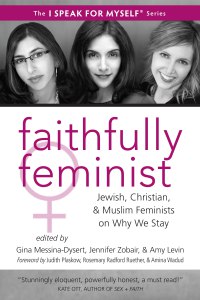
final-cover-faithfully-feministThis piece was co-authored by Jennifer Zobair, Gina-Messina-Dysert, and Amy Levin, the co-editors of Faithfully Feminist: Jewish, Christian, and Muslim Feminists on Why We Stay.

Ancestor Connection in Williamsburg, Brooklyn by Carol P. Christ

carol-p-christ-photo-michael-bakasIn early December 2016 I visited central Williamsburg in Brooklyn, New York, where my 2x great-grandparents Thomas and Anna Maria Christ and their son George and his family, including my father’s father Irving John, lived for over fifty years. I had compiled a list of all the known addresses of the family in Williamsburg from census and death records. The family lived in a several block square area surrounding Most Holy Trinity Roman Catholic Church on Montrose Street for all that time.

Most of the buildings at the addresses where the family lived had been torn down and replaced with housing projects in the mid-twentieth century. Some of the remaining ones are being torn down today, as this area of Williamsburg is being gentrified. Still, enough of the old buildings remain to give a sense of what the neighborhood was like in the 1800s. Continue reading “Ancestor Connection in Williamsburg, Brooklyn by Carol P. Christ”