

Nishanttaliyan07
The way we stand, you can see we have grown up this way together, out of the same soil, with the same rains, leaning in the same way toward the sun. See how we lean together in the same direction. How the dead limbs of one of us rest in the branches of another. How those branches have grown around the limbs. How the two are inseparable. . . . the way we stand, each alone, yet none of us separable .. . . [i]
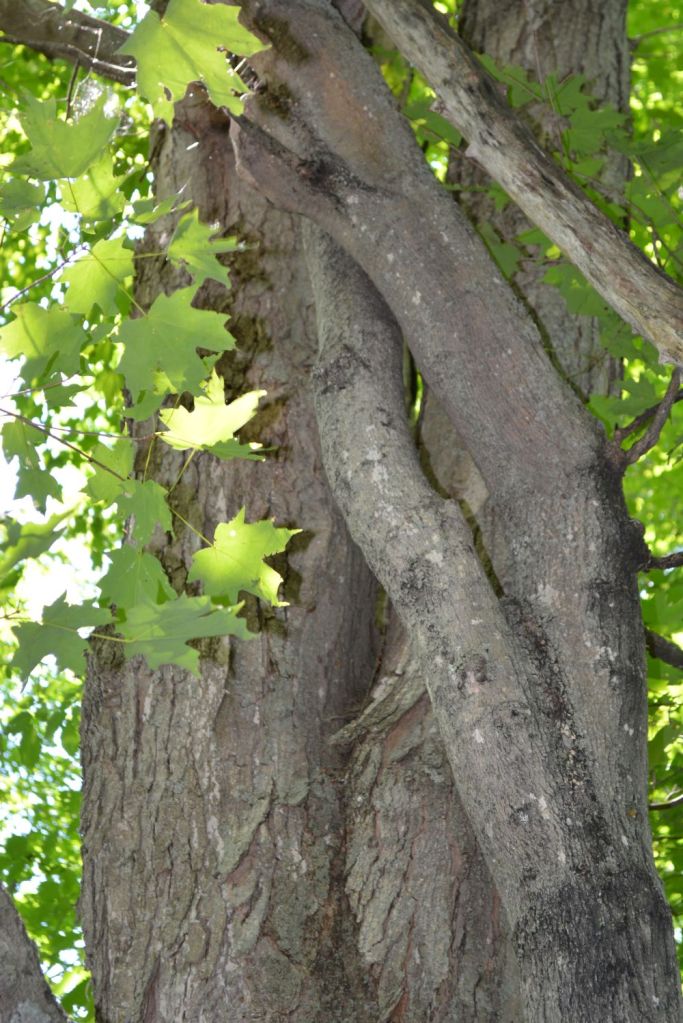
Two maples just outside our home grow intertwined. They are consummate tree huggers. Begun as two trees standing beside each other, they eventually embraced, grew together and became one, and several years later branched out into their individual growth once again. Not withstanding Kahlil Gibran’s thoughts on marriage —
…let there be spaces in your togetherness, . . .
Stand together yet not too near together. . .
For the . . .oak tree and the cypress grow not in each other’s shadow[ii]
— the maples have found a way to grow together and apart, in each other’s shade and sun, thriving. We have much to learn from them.
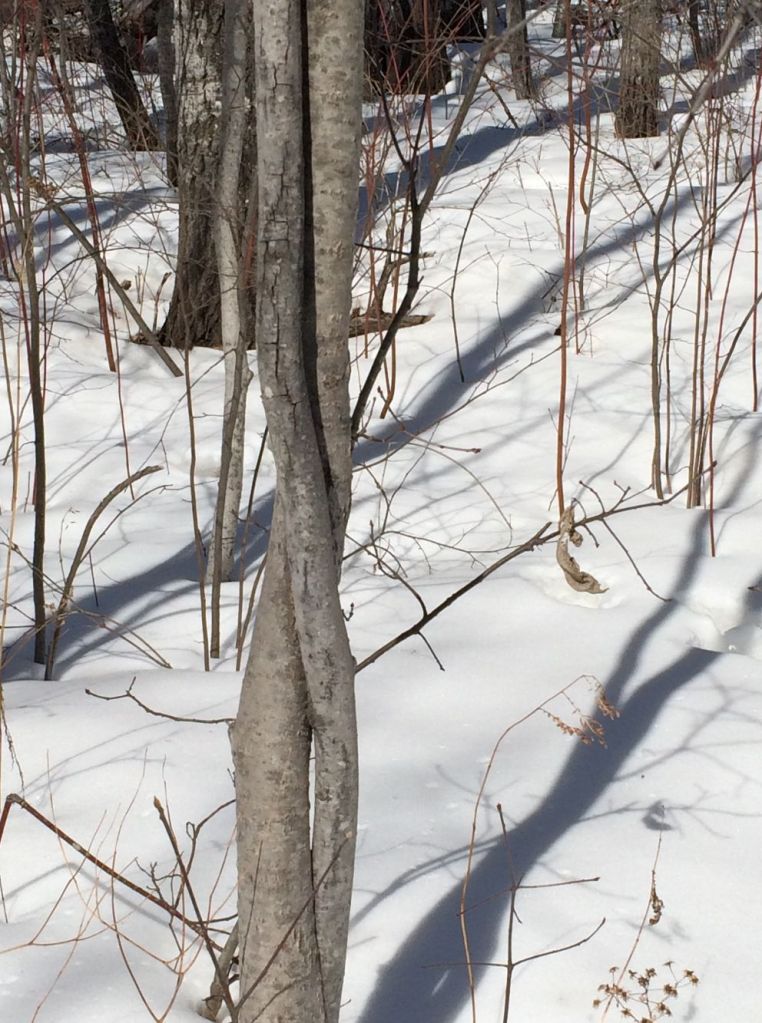
I’ve encountered so many tree huggers in the woods, and each time am thrilled and delighted by the ways in which they embrace and swirl, entangling their lives with each other’s in a dance of life and limb. They know how to lean on each other, supporting each other through the worst of the winds, and sharing the sunshine. They seem to draw strength and sustenance from each other, and as we know from Suzanne Simard’s work, indeed they do, nourishing each other, their roots undoubtedly entangled even more than their trunks and branches – an extended family of trees entwined in the soil underneath.
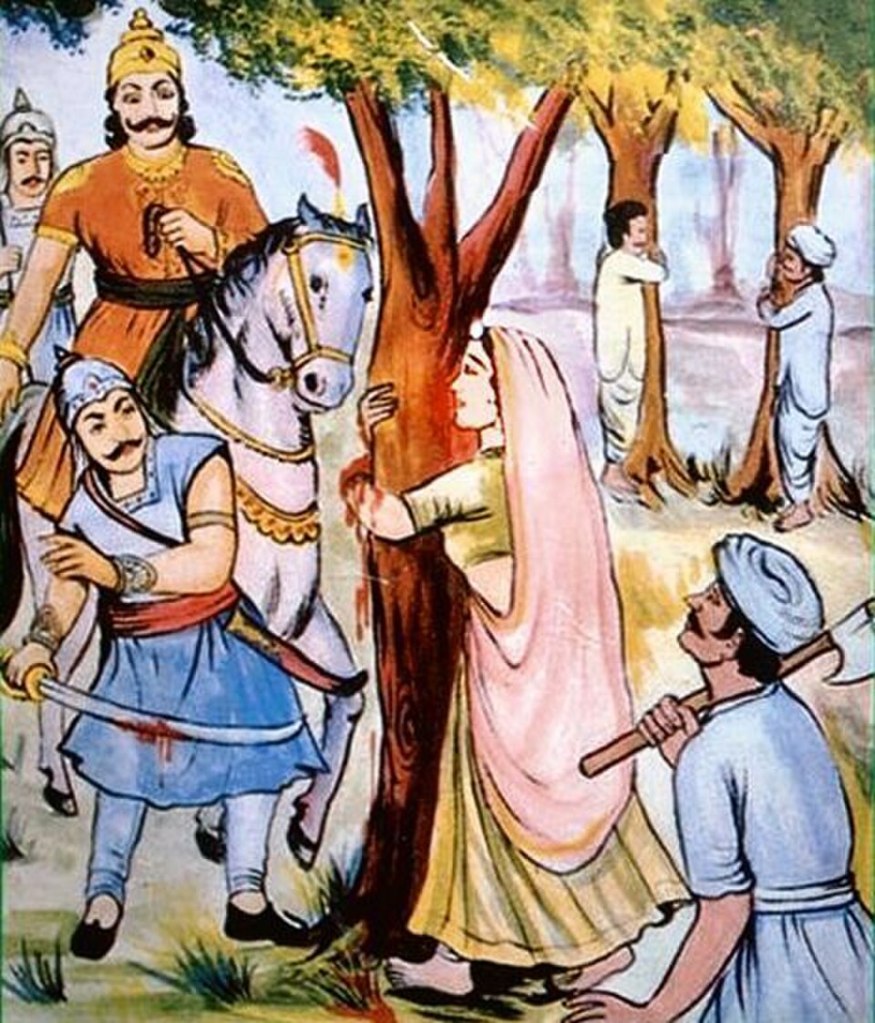
Tree huggers. It’s become a derogatory label flung at environmentalists by those who find our actions to preserve the earth to be frivolous at best, destructive to the extractive economy at worst. Yet it’s a term I proudly embrace, just as the trees embrace each other. It has a venerable heritage. Its roots go back nearly three hundred years to 1730 when Amrita Devi led a movement of the Bishnoi community in Rajasthan, India, to save their sacred khejiri trees by encircling and enfolding them. The maharaja had ordered soldiers to cut the trees for wood to build his palace. Determined to follow orders, the soldiers simply cut through the bodies of those trying to protect the trees. In all, 363 people were killed that day in their efforts to save the trees. When the maharaja learned of what had happened, he ordered that none of the trees near the Bishnoi village ever be cut. The trees, as well as a plaque in honor of the Chipko (meaning “to hug” in Hindi) women and men, stand there to this very day.
Their efforts inspired the contemporary Chipko movement, begun in the 1970s as women of a Himalayan region of India also embraced trees, risking their lives to protect the trees from being cut for commercial gain. As ecofeminist Vandana Shiva said of the Chipko women, the actions of “ordinary women . . . have provided local leadership through extraordinary strength. It is the invisible strength of women like them that is the source of the staying power of Chipko – a movement whose activities in its two decades of evolution have been extended from embracing trees to embracing living mountains and living waters.”[iii] The Chipko movement spread throughout India and has inspired tree huggers around the world – from those like Julia Butterfly Hill who have sat in the redwoods to those like Nobel Peace Prize winner Wangari Matthai, who founded the Green Belt movement in Kenya, in which thousands of women planted millions of trees.
My mother early on taught us the sacredness of trees, undoubtedly inspiring my own tree hugging. The large white pine next to our house was a great climbing tree, the branches perfectly spaced to enable us to climb high into the treetop. My brother and I spent many happy hours climbing it. We’d come in covered in sap, much to my mother’s dismay. Her concern was not so much about the intractability of the sap, or even the fact that her young children had been climbing so high, but rather about the fact that we’d been climbing the white pine again — a tree she held with great reverence – a delicate tree that may have been injured by our climb. She would often tell us of how, after a day of canoeing the Au Sable, she and her campers would bed down for the night in Michigan’s Hartwick Pines, reveling in the sweet smell of the pines and the soft pine needle beds. She shared her love of the towering beech with their smooth grey bark; the arborvitae – “tree of life” – with its sacred gifts of healing and restoration; the paper birch – its white branches striking against the deep blue skies.
I’ve been privileged to have lived a life surrounded by trees, but others are not so fortunate. Millions, mostly poor and people of color, live in urban heat islands where no trees grow. These heat islands exist primarily in areas redlined in the 1930s, a practice which prevented people of color from getting loans in more desirable neighborhoods, resulting in their concentration in neighborhoods considered less desirable. Housing disparities have resulted in health disparities, as those living in these islands suffer poorer health outcomes. In addition to heatstroke itself, extreme heat compromises cardiovascular, kidney, and respiratory disease, and creates higher levels of ground-level ozone pollution, lowering air quality. Nor are those living in treeless neighborhoods afforded the therapeutic and restorative qualities of living among trees.
Planting trees, especially in urban areas, is one of the best ways we have to address climate change and environmental justice.[iv] I’ve planted many trees over the years – spruces, firs, junipers, apple and plum trees. I can hardly think of a more satisfying activity than planting trees — a gift to the earth of replenishing humus, to the air of carbon dioxide, to the birds, squirrels, deer, and other forest creatures of food and shelter.
In the Onondaga “Words That Come Before All Else,” the first expression of gratitude is given to the Earth, “for she gives us everything that we need for life.”[v] In honoring the Anishnaabe code of reciprocity, being a tree hugger — doing everything in our power to protect, nourish, and restore the earth — is the least we can do in return for all the earth does for us.
References
Gibran, Kahlil. The Prophet. New York: Alfred A. Knopf, 1988.
Griffin, Suan. Woman and Nature: The Roaring Inside Her. New York: Harper & Row, 1978.
Historically redlined neighborhoods are warmer than others in the Twin Cities (sahanjournal.com)
Kimmerer, Robin Wall. Braiding Sweetgrass: Indigenous Wisdom, Scientific Knowledge and the Teachings of Plants. Minneapolis: Milkweed, 2013.
Maathai, Wangari. Unbowed: A Memoir. New York: Anchor Books, 2007.
Mies, Maria & Vandana Shiva. Ecofeminism. Halifax, Nova Scotia. Fernwood Publications and London: Zed Books, 1993.
Minneapolis Urban Tree Canopy (UTC) (arcgis.com)
Race and Housing Series: Urban Heat Islands (tchabitat.org)
Shiva, Vandana. Staying Alive: Women, Ecology and Development. London: Zed Books, 1989.
Simard, Suzanne. Finding The Mother Tree: Discovering the Wisdom of the Forest. New York: Knopf, 2021.Urban Heat Islands and Equity – GreenLaw (pace.edu)
[i] Griffin. Woman and Nature. 220-221.
[ii] Gibran. The Prophet. 15-16.
[iii] Shiva and Mies. Ecofeminism.246-247.
[iv] One Tree Planted is just one of the organizations doing the work of restoring trees around the world. To learn more about their work, see One Tree Planted | Tree Planting Nonprofit.
[v] Kimmerer, Braiding Sweetgrass. 108.
Discover more from Feminism and Religion
Subscribe to get the latest posts sent to your email.


