An Experience of the Aphrodisia by Olivia Ciaccia

A warm summer sun smiles down upon the British coastline, the low tide reflecting jewels which are wash up and dispersed upon fine sand. A welcome breeze dances around a gathering of Goddess devotees encircling a small bonfire. Amongst them stands a banner and statue depicting and imitating Botticelli’s Venus and bouquets of roses. Just before the sun sets, those gathered lovingly collect these assembled artifacts, holding them aloft, and begin to process barefoot towards the sea.

Aphrodite-Venus’s banner and sculpted face shines in the low afternoon sunlight. As the procession slowly steps, weaves, and dances, towards the sea to the beat of a drum, the sun reaches further behind the hills, casting a long shadow upon the beach. The Goddess’s image dances with them, banner swaying and statue bobbing with the dance of its carrier. By the time the procession reaches the sea, the sun has dipped behind the now black silhouette of the hills bathing the beach ahead in dusky oranges and brilliant blues. At the shoreline, a priestess steps forward and turns the Goddess’s statue to face the procession, which has now fanning out into a semi-circle.

Continue reading “An Experience of the Aphrodisia by Olivia Ciaccia”

How I Learned to Grow Wings by Marie Cartier

April 2021, Poem

Visibility is

this body opening against itself over and over… an existence moving through fibers was

the one thing I had. When was the time…breathe in? Breathe out.

My existence to myself was the most political act. You can’t erase me. I exist for myself.

I am thirteen. I stand next to my father and say, “Don’t you touch me. Don’t you ever touch me again.” My mother stands by the sink, her hand reaches out and clutches its edge. My father sits and looks up

at me. He opens his mouth and closes it. I turn away, expecting his hand to land across my back.

I imagine me falling. But that doesn’t happen. Not that day.

That day I stood up. Said no, turned my back and walked away. I am a political act.

I am a body with a voice and I heard myself speaking for myself when no one else would, I said no.

No is the most beautiful word in the English language for a woman who learns its power.

The spell of no. I cast it when I was thirteen.


The gaze is

when they saw me. I started to erase myself, I was without fingers first. They kept finding me, so

I erased my hands. They kept seeing me, so I erased my arms. They kept locating me, so I erased my feet and my legs. But they kept finding me. I erased my secret places between my legs—what they most wanted. I erased my belly so I wouldn’t be seen eating, and my breasts so I would not be noticed as

a girl. But they found me anyway. I erased my neck and my head disappeared.

All that was left was my shoulders. I felt the weight of their gaze, and everything they wanted and took. And so, I lifted my shoulders, and I found my wings.

And I flew, and in flight, I let all of my parts come home.

A woman flying was the one thing they never thought to look for. But I found her. And she was me.

Continue reading “How I Learned to Grow Wings by Marie Cartier”

I Heard my Own Siren Song, and Followed It (a poem) by Marie Cartier

They didn’t know I was a mermaid.

               That I had a siren song.

               That I could lure, and I could kill.

               And that I would eventually

               because – I was a mermaid.

When my father tried to throw my brother

down a flight of stairs, I jumped on him.

Six feet tall. I was ten years old.

But I had the tail. He had

nothing. Against. All. I. was.

               I was a sea creature. I was kind,

               but I was still a sea creature. So, when another

               brother asked, who do you think you are?

               I hit him hard so he would know

               he had to listen. If I told him to hide, he had to hide. I

               was a mermaid. I had a tail.

I wouldn’t be there forever.

Continue reading “I Heard my Own Siren Song, and Followed It (a poem) by Marie Cartier”

The Legacy of Wisdom by Karen Leslie Hernandez

My Aunt Sophie passed into another realm last week. Not from COVID, but, from a life well-lived.
At 98, she lived a remarkable life. She wasn’t famous, nor did she ever strive to be, but what she was, was what love should be, can be, and is.

In her 98 years she played trumpet in the high school marching band, she had a mean left hook, and she was a Rosie the Riveter, where she actually worked as a welder on ships being built for WWII in Richmond, CA. More, she was a devoted wife, she was a sister and caretaker, she was an incredible grandmother, and, she was a mother. Not just to her seven children, but to her grandchildren, her great-grandchildren, neighborhood kids, and to my sister and me, her nieces. Continue reading “The Legacy of Wisdom by Karen Leslie Hernandez”

The Mask and the Mirror – Part 2 by Sara Wright


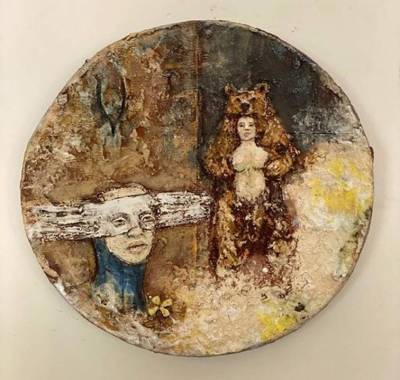
Artist Debra Fritts

When I asked Debra about this circle she said “the circle around the eye is symbolic of the moon, a nightly ritual of seeing the moon.”  Curiously, women as ‘seers’ have an intimate relationship with the moon. Both eyes seem to be able to stare directly through the mask. The woman’s lips are parted; she is breathing but there is no sense that she is about to speak.

The length of the woman’s neck is accentuated by its distinct slate blue tones. This neck seems especially vulnerable – stretched perhaps to endurance. Suddenly it occurs to me that it is also a neck, like a chicken’s neck, that is ready for the chopping block. Has this woman lost her voice? Her ability to breathe? Is there a threat of being separated from her body? The suggestion of a body ends at the woman’s shoulders so we are left wondering…

Since our feelings and emotions reside in our bodies the suggestion here is that this woman may be without access to her body on an instinctual level. If so she is unable to protect herself. Blue is a color that is sometimes associated with death. In some Native traditions, like that of the Zuni and the Lakota Sioux blue is the color of the Underworld. Particularly touching is the pale four petaled flower to the lower right of the left half of the relief, a flower without a stem or root, or is this a wheel of some kind, one that is in motion – whirling – chaos? To my mind a number of aspects of this portrayal speak to the presence of death. Continue reading “The Mask and the Mirror – Part 2 by Sara Wright”

Navigating Meaning in Unchartered Ways by Natalie Weaver


The ideas that here follow are an effort to organize insights from meditation practice over the past several months.  I submit them to FAR not because they are particularly profound or even well-developed but because I am, as everyone is, navigating meaning in unchartered ways during this epoch.  I find my old truths not only no longer fit; they were imposed, inherited, mind-binding patterns that have caused me damage from which I am ready to heal.  I have discovered that rigorous meditation practice is transforming my experience and understanding in ways that very closely align with the outcomes of feminist deconstruction of patriarchal value norms.  Renewed and serious application of this work, in my opinion, has never been more timely, more universally needed, or more psychically therapeutic. 

~~~~

The teaching of impermanence discloses itself in what might be described imperfectly as both the foreground as well as the deep background of human experience.  It is imperfect to use the terms “foreground” and “background” because these words suggest a stacked-dimensional and binary experience in human life, which is, to say the least, inadequate.  I defer to these terms only for the purposes of suggesting different value experiences that the teaching of impermanence meets along the range of aspects of cognition and self-awareness.  Continue reading “Navigating Meaning in Unchartered Ways by Natalie Weaver”

Bringing About the Revolution by Xochitl Alvizo

Happy day friends. It’s Sunday – maybe you have a day off from your income-making labor, maybe you’re home with the kiddos working more than usual since they have no school, or maybe it’s a day you have all to yourself – whatever is before you, I have a word I’d like to share with you today – enjoy being with you.
I say this because it’s the word I have needed for myself for a little while now. I have not enjoyed myself lately – neither being with myself nor being myself. As of late, I had lost touch with the fact that I am, or can be, an enjoyable person to be around. I know that sounds like a funny thing to say, and I don’t mean it in any weird or arrogant way; I just mean that yesterday morning I remembered that I can be quite fun. I can be goofy, loving, encouraging, friendly, attentive, thoughtful, strong, grounded, intellectually engaged…and, because of all this, I make pretty good company—even to myself! Continue reading “Bringing About the Revolution by Xochitl Alvizo”

Birthing a New World by Xochitl Alvizo

Yesterday I “paused” my post and left you with words from a dear friend Edyka Chilomé, a powerful “artivist” invested in the healing of our world. And our world is in need of healing indeed.

Today was another tough day of carrying the pain of our continued inhumanity toward one another: Las Vegas, Puerto Rico, Myanmar…and so many other ongoing tragedies. I find it hard to find words – to know what to offer here on Feminism and Religion. Some days it seems necessary to go on with our work as planned; la lucha is every day and we keep at it. But other days, keeping on as planned just seems absurd.  I think these are precisely the days that Audre Lorde had in mind when she wrote that poetry is not a luxury. Continue reading “Birthing a New World by Xochitl Alvizo”

Shakespeare’s Sister Revisited: A Circle of Female Lineage by Mary Sharratt

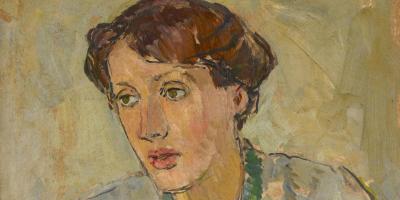
Vanessa Bell’s painting of her sister, Virginia Woolf

What do groundbreaking 17th century poet, Aemilia Bassano Lanier, and 20th century feminist icon, Virginia Woolf, have in common? A lot actually.

In her 1929 essay, “A Room of One’s Own,” Woolf imagines the tragedy of Shakespeare’s brilliant sister, Judith, barred from the grammar school because of her sex and forced to hide her writing from her family. To escape a forced marriage to a man she hates, she runs away to London to seek her fortune in the theatre, only to end up pregnant, abandoned, and destitute. Out of despair, she kills herself. Continue reading “Shakespeare’s Sister Revisited: A Circle of Female Lineage by Mary Sharratt”

Feminism and Buddhism: constructive wave interference by Oxana Poberejnaia

oxanaAlthough it can be said that the Buddhist teaching can benefit all, including feminists, it can also be argued that Feminism has a lot to teach Buddhist practitioners. Rita M. Gross made this point brilliantly in her “Buddhism After Patriarchy: A Feminist History, Analysis, and Reconstruction of Buddhism.”

While Buddhism generally encourages investigation, it is still easy for a Buddhist practitioner to become complacent. This complacency can be caused by the feeling of safety that your particular school of Buddhism provides. How your mind works, how the world works are all explained, all is well, just keep practising in the assigned paradigm, there is no need for thinking outside the box.

However, Buddhists often forget that it is exactly outside the box where the Buddha has been pointing with his every teaching, ever since he got liberated. When a Buddhist practitioner is stuck, the vigour of Feminism can provide inspiration. Feminists simply never stopped, do not intend to stop now.

Continue reading “Feminism and Buddhism: constructive wave interference by Oxana Poberejnaia”