Over the summer, I’ve been writing more than I do during the traditional academic year when other tasks consume the bulk of my workday. I have spent more time experiencing the joy of creative discovery and production, but I’ve also had more time confronting the difficulties of creative work as I’ve wrestled with some of its unique challenges. One of those challenges has been to refine my academic writing voice. I’ve approaches the challenge of developing my voice as both a spiritual and feminist practice and this has helped me find confidence in my work.
“I am the Queen of Sheba and I am not impressed.” This is the first line of one of the monologues from chris wind’s book Thus Saith Eve. This book features 18 stories of biblical women, and a 19th, Lilith, from Jewish mythology. Each monologue offers a new interpretation and gives a voice to the women that we think we know.
In this book the voices and personalities of women such as Noah’s wife, Mary of Bethany, Zipporah, and Vashti are reimagined in an exciting and empowering way. Each of the stories also features an appendix where the reader can learn more about the biblical or mythological context of the woman who is telling her story.
As in her other works, wind uses historical people, events, and understandings to build a truly wonderful source of feminist fiction. In addition to being an extremely enjoyable and thought provoking read, the monologues can also be used for audition and performance pieces. On her website wind explains that two of the monologues, “I am Eve” and “I am Mary” can be performed with specific musical selections in the background. You can find those selections linked to her website above.
My grandmother is a gangster… a spiritual gangster
I recently attended a funeral for a relative-in-law. The grassy patch at the cemetery was filled with many familiar faces as well as unfamiliar. My side of the family was asked to come. My father, mother and even teeny tiny little 4 foot 9 grandmother showed up. I emphasize her height because it has nothing to do with her stature… and this is where my story begins.
My grandmother aka “Mama Shamsey” is from my maternal side. She grew up in Tehran, Iran. She was a young bride to a handsome intellectual who was French educated but a deeply spiritual and passionately religious Iranian Shia Muslim. He truly believed people should never discuss politics or religion. He knew how to be open and compassionate with people of differing opinions than his. They married, had 5 children, my mother was the eldest. When she was just entering her tender teenage years, many of her peers were flocking to Europe to be educated in Germany or France. She however had the dream of going to school in America, so in the 70’s this family of 7 made the great migration over to America.
Freyja, known as “Ancestor Spirit”, is viewed as the timeless, self-renewing energy in the universe. She witnesses and shapes the direction of creation and undoing. She is not the originating, creating Goddess, but rather a conduit for energy and life. Women who learn Seidr become like her, living conduits. Continue reading “Meeting my Disr by Deanne Quarrie”
For over ten years, I’ve been teaching a work of early Jewish mysticism known as Sefer Yetzirah, or the Book of Creation. There are widely differing opinions on the book’s origin and dating, but many scholars date it to the sixth century. Its core concept can be described simply: the Divine used the Hebrew letters as metaphysical channels to create the different aspects of reality: the directions, the elements, the planets, the months of the year, and so forth. Each letter is a channel by which God creates a unique form or entity, and meditating on the letters provides us with a connection to divine creative power. In its discussion of the letters, Sefer Yetzirah shows a strong connection to feminine imagery, and thus helps the later kabbalah develop its own link to the feminine.
Sefer Yetzirah shows influences from Aristotle to Gnosticism, and is often viewed as a work of Jewish philosophy. However, it is also a work of meditation, giving the reader instruction on how to focus and connect to the divine. Scholars such as Richard Hayman and Marla Segol have noted that the book’s structure and content connect it to magical literature: for example, the book has a deep concern with “sealing” the space of the world: letters of the Divine Name are used to seal the six directions of the universe. In a similar way, ceremonial magicians of the ancient world used sealing ritual, including the incantation bowls that were buried in the corners of a home to keep out evil forces. The book, like much ceremonial magic of the region, also discusses the elements. However, Sefer Yetzirah has a three-element system rather than a four or five-element system. The three formative elements are air, water, and fire.
We have been lost to each other for so long. My name means nothing to you. My memory is dust.
This is not your fault or mine. The chain connecting mother to daughter was broken and the word passed into the keeping of men, who had no way of knowing. That is why I became a footnote, my story a brief detour between the well-known history of my father and the celebrated chronicle of my brother.
Anita Diamant, The Red Tent
I am an expat author. My home is everywhere and nowhere. A wanderer, I have lived in many different places, from Minnesota, my birthplace, with its rustling marshes haunted by the cries of redwing blackbirds, to Bavaria with its dark forests and dazzling meadows and pure streams where otter still live, to my present home in the haunted moorlands of Pendle Witch country in Lancashire, England. My entire adult life has been a literal journey of finding myself in the great world.
For as long as I remember, I longed to be a writer. As a novelist I am on a mission to write women back into history. To tell the neglected, unwritten stories of women like my pioneering foremothers who emigrated from Bohemia (now the Czech Republic) in the 1860s to break the prairie soil of southern Minnesota.
To a large extent, women have been written out of history. Their lives and deeds have become lost to us. To uncover their buried truths, we must act as detectives, studying the sparse clues that have been handed down to us. We must learn to read between the lines and fill in the blanks. My heroine’s journey, in other words, is about reclaiming the lost heroines of history. My quest is to give voice to ancestral memory of that lost motherline.
She is the reason BRIDES wear white, swan-like wedding gowns. Brides veil themselves like the Goddess herself, Whom all Bridegrooms honor, until revealing Herself to Her chosen groom. Tiny flowers and shamrocks are said to bloom in Her wake, She brings new life.
BRIDGET BRIGHT by Hedgewytch
She is known as Brigid Bright,
Goddess who shines against the night.
At Cille Dara, at the setting sun,
Her sacred flame is kept by one.
Nineteen times the earth turns round,
As sacred springs come forth the ground.
Twenty times the sun has burned,
And now the Goddess has returned.
Alone she tends her thrice-bright flame,
Born of her heart that bears her name.
The Dagda knows Brigid as Daughter,
Triple Blessed by fire and water.
Poets call her name to inspire.
And healers oft gain from her fire.
Wayland too would know her well
As hammer and anvil ring like a bell.
A sorrowful cry did she give meaning,
When first she brought to Eire keening.
Oh Sacred Fire against darkest night,
Burn for Brigid, for Brigid Bright!
Fire in the head…to quicken us.
Fire in the cauldron…to heal us.
Fire in the forge of the heart…to temper us.
I have always loved to hear these kinds of stories from Carol and other friends, since I lost my own grandmothers before I felt I really knew them. My mother’s mother passed away when I was a young child. My father’s mother lived until I was in my twenties, but Alzheimer’s stripped her of her ability to recognise her family many years before her physical death. How I wish I had known them as an adult and had been able to talk to them, even once, woman to woman. And how I wish I had received the advice, support and unconditional love which Carol describes, and which I have seen other grandmothers offer their grandchildren. This absence has left an aching heart, a raw wound, for my entire adult life.
My daughters came to me after Sunday School one day, concerned about a story they had heard in which God drowned almost everyone on Earth. So I sat down and thought about why a community might want to tell that story, and what valuable wisdom might be lifted from it for my children. Here is what I told them:
God/ess has many faces, which help us understand different things we need to know at different times. Sometimes we think of God/ess as Crone, an old, old woman crowned with silver hair as an emblem of her wisdom, who helps us learn to let go of anything that is holding back the wellness of our community and ourselves. Continue reading “A Feminist Retelling of Noah’s Ark by Trelawney Grenfell-Muir”


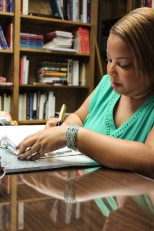 Over the summer, I’ve been writing more than I do during the traditional academic year when other tasks consume the bulk of my workday. I have spent more time experiencing the joy of creative discovery and production, but I’ve also had more time confronting the difficulties of creative work as I’ve wrestled with some of its unique challenges. One of those challenges has been to refine my academic writing voice. I’ve approaches the challenge of developing my voice as both a spiritual and feminist practice and this has helped me find confidence in my work.

 Who are the Dsir?



 Feminism and Religion