Legacy of Carol P. Christ: Forty Years and Counting: Women and Religion in the Academy

This post was originally published on Oct. 21st, 2011

Carol P. Christ is a founding mother in the study of women and religion, feminist theology, women’s spirituality, and the Goddess movement.  She teaches in the Women’s Spirituality program at CIIS and through Ariadne Institute offers Goddess Pilgrimages to Crete. Her books include She Who Changes and Rebirth of the Goddess and the widely used anthologies Womanspirit Rising and Weaving the Visions.

The receipt of an invitation to the Fortieth Anniversary Celebration of the Women’s Caucus in the American Academy of Religion and the Society for Biblical Literature this week, takes me back to the summer of 1971.  At the first meeting of Women Theologians at Alverno College (which was followed up at Grailville in succeeding years), I proposed that we form a feminist caucus in the field of religion, as had already been done by feminists in several other fields.

Since I was one of the few women at Alverno who had attended the annual meetings in the field of religion, I was delegated to call Harry Buck, then director of the AAR, to ask for space on the program. Harry, who continued to support the work of women in the field through lecture series at Wilson College and the magazine Anima which he founded, offered not only space at the meetings, but a print-out of the names and addresses of all of the members of the AAR who were not obviously male. I invited all of them to come to a feminist meeting at the AAR in Atlanta. It is hard to imagine now, but before 1971, the women who attended the AAR in any given year could probably have been counted on one hand. Continue reading “Legacy of Carol P. Christ: Forty Years and Counting: Women and Religion in the Academy”
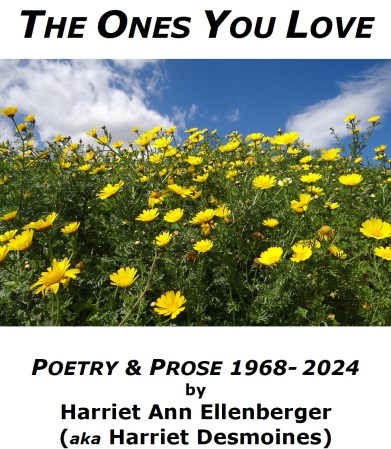
The Ones You Love, Poetry and Prose 1968-2024 by Harriet Ann Ellenberger (aka Harriet Desmoines), Book Review by Carolyn Lee Boyd

The Ones You Love, Poetry and Prose 1968-2024 is a half-century retrospective love letter from Harriet Ann Ellenberger to friends, family, and lovers; lesbian and overall feminism; lesbian feminist literature and theater; Nature; and those who have been victimized by war. Infusing the book is her overarching love of freedom, not only for herself, but for women, for humanity, and for the Earth.  Harriet has been using her authorial and editorial gifts for her entire adult life to move our planet away from extinction into new ways of being, and has now collected her best writings, both prose and poetry, into a single volume. The book is both a brilliant, truthful, unglossed portrait of herself as well as a glimpse into feminism, and lesbian feminism in particular, over decades through one woman’s experience. She often notes in introductions to various pieces that she no longer completely agrees with what she wrote so long ago, but she does not edit out these views, (speaking of her “younger fiery-feminist self,” she says “I’m proud of her courage and proud of the work she undertook” (11)) which offers us a better understanding of both her own progression of thoughts and ideas as well as what issues and points of view were of concern at the time. 

Of her most well-known achievement, she writes, “On July 4, 1976, the 200th anniversary of the American Revolution, Catherine Nicholson and I published the first issue of Sinister Wisdom, which has since become the longest-lived lesbian literature and arts journal in the world” (11). She explains the journal’s expansive perspective: “We exist in the interface between a death culture and the faint beginnings of a culture of — not humans — but life-lovers, a culture that embraces animals, plants, stars and those women who choose the future at the risk of their ‘sanity’ and security” (17). This is a vision she has carried with her ever since. 

Continue reading “The Ones You Love, Poetry and Prose 1968-2024 by Harriet Ann Ellenberger (aka Harriet Desmoines), Book Review by Carolyn Lee Boyd”

Legacy of Carol P. Christ: Do White Feminists Have Ancestors?

This post was originally published on Aug. 12th, 2011

Carol P. Christ is a founding mother in the study of women and religion, feminist theology, women’s spirituality, and the Goddess movement.  She teaches in the Women’s Spirituality program at CIIS and through Ariadne Institute offers Goddess Pilgrimages to Crete. Her books include She Who Changes and Rebirth of the Goddess and the widely used anthologies Womanspirit Rising and Weaving the Visions.

Some years ago when I was speaking on ecofeminism, womanist theologian Karen Baker-Fletcher posed a question that went something like this:  What I am missing in your presentation is reference to ancestors.  For black women, this issue is critical.

Baker-Fletcher’s question provoked a process of thinking that continues to this day.  For example, I began to notice that when black women spoke at the American Academy of Religion, they often began by thanking their foremothers Delores Williams and Katie Cannon for beginning the womanist dialogue.  It is far rarer to hear a white woman thank Valerie Saiving, Mary Daly, Rosemary Radford Ruether, or Marija Gimbutas before her talk.

To the contrary, many white women take great pains to distance themselves from feminist foresisters.  I once heard a white woman Biblical scholar tell women students to do work on women in the Bible or other areas of religion without using the word feminist or placing their work in a female or feminist train of thought– if they wanted to get it published.  She was very proud that she had used this method and succeeded.  In other words, she was following in the footsteps of Mary Daly, Phyllis Trible, and Elisabeth Schüssler Fiorenza but acting as if she had invented the study of women and the Bible herself.  The reason for this, she freely admitted, was that male scholars who held power in her field would not respect her work if she used the “f” word. Continue reading “Legacy of Carol P. Christ: Do White Feminists Have Ancestors?”

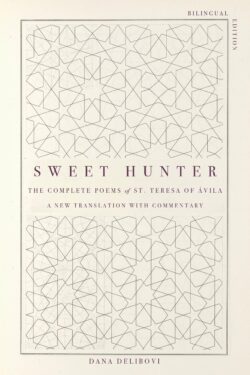
Book Review by Kristen Holt-Browning: Sweet Hunter: The Complete Poems of St. Theresa of Ávila (Bilingual Edition), translated and with commentary by Dana Delibovi

The Catholic mystic women of the medieval and early modern era—such as Hildegard of Bingen, Julian of Norwich, and Theresa of Ávila—can seem unknowable to us now. How did they nurture their fiery love of Christ within the rigid patriarchal (indeed, misogynistic) structure of medieval and early modern European Christianity? How did they find the strength and bravery to write about Jesus as husband, mother, lover? The writing of these mystic women can strike us even now as shocking, given that they often described Christ as their husband, their lover, or even their mother.

In Sweet Hunter: The Complete Poems of St. Theresa of Ávila (Bilingual Edition), poet and professor Dana Delibovi gives us the words of the sixteenth-century proto-feminist in a timbre close enough to our own to help close this gap. As Delibovi notes in her perceptive and illuminating Introduction, she centers Theresa’s balance of the mystical and the practical in her translations. Indeed, Delibovi admits that, “I had to fight the temptation to pretty-up her words and make them seem, well, more saintly.” And yet, it is this precisely this direct language that, paradoxically, heightens the divine fervor behind the writing, as when a shepherd speaks of Mary in “It’s Dawn Already”:

Continue reading “Book Review by Kristen Holt-Browning: Sweet Hunter: The Complete Poems of St. Theresa of Ávila (Bilingual Edition), translated and with commentary by Dana Delibovi”

REMEMBERING THE MAGIC OF MAMA DONNA HENES: 1945-2024 by Diane Saarinen

For those who don’t know who Donna Henes was, her official bio:

Donna Henes is an internationally renowned urban shaman, spiritual teacher, award-winning author, popular speaker and workshop leader whose joyful celebrations of celestial events have introduced ancient traditional rituals and contemporary ceremonies to millions since 1972. More at her Wikipedia page here.

Donna, known affectionately to many as Mama Donna, was so in tune with the seasons (even putting out a quarterly publication for a time called Always in Season), that when her time came to leave this sparkling, stunning incarnation of hers, she left on Autumn Equinox Eve 2024, just two days after her 79th birthday.

Sad news to those she left behind and sad news to the planet. But as we approach Samhain, Halloween and Day of the Dead, what wonderful memories my friend Donna Henes left me with! And “what is remembered, lives.”  So live on, Mama Donna!

                                                                                      *******

Continue reading “REMEMBERING THE MAGIC OF MAMA DONNA HENES: 1945-2024 by Diane Saarinen”

How the Nineteenth-Century Spiritualist Movement Gave Voice to American Women -Part 2 by Theresa Dintino

Moderator’s Note: This post is presented as part of FAR’s co-operation with The Nasty Women Writers Project, a site dedicated to highlighting and amplifying the voices and visions of powerful women. The site was founded by sisters Theresa and Maria Dintino. Part 1 was posted yesterday

Spiritualism began with two young girls, the Fox sisters, hearing knocking sounds in their home near Rochester, N.Y . They determined the knocking to be coming from a man who was murdered and buried under their home. The knocking was soon categorized into an alphabet out of which seances began. In seances groups of people gathered and put their hands on a table while asking questions of ancestors who made themselves known by rapping and knocking in response. Next, mediums in the form of young women speaking the answers of the dead as the bereaved asked them questions, emerged. Instructions were disseminated on how to be a medium and how to run a seance. The movement took off.

The movement was largely white, northern Protestants but other ethnicities were  involved. The Black population may have influenced the arising of these practices with traditions brought with them from West Africa.

Continue reading “How the Nineteenth-Century Spiritualist Movement Gave Voice to American Women -Part 2 by Theresa Dintino”

Sojourner Truth, the photos by Beth Bartlett

Moderator’s Note: We inadvertently left out the photos from Beth’s posts on Sojourner Truth. The photos, all by themselves, pack an emotional punch and so we want to be sure they can be seen. These are Beth’s photos from Sojourner Truth Legacy Plaza in Akron, Ohio

You can see Beth’s posts here. Part 1 and Part 2

close- up of statue

MATILDA JOSLYN GAGE: IN HER NAME, AMERICAN WOMAN WRITER AND ACTIVIST (1826-1898), part 2 by Maria Dintino

part 1 appeared yesterday

Leila Brammer in her book Excluded from Suffrage History: Matilda Joslyn Gage, Nineteenth-Century American Feminist, explains the long-term impact of the dismissal of Gage:

“The loss of Matlida Joslyn Gage from the history of the woman suffrage movement and her ideas from the intellectual history of feminism speaks to the influence of exclusionary processes in social movements as well as their unfortunate consequences…we must remember that Joslyn Gage was intricately involved in the movement, wrote in newspapers and magazines, and published a book, but all these activities and her significant feminist thought had to be re-created and rediscovered nearly a century later”(120).

Continue reading “MATILDA JOSLYN GAGE: IN HER NAME, AMERICAN WOMAN WRITER AND ACTIVIST (1826-1898), part 2 by Maria Dintino”

MATILDA JOSLYN GAGE: IN HER NAME, AMERICAN WOMAN WRITER AND ACTIVIST (1826-1898), part 1 by Maria Dintino

Moderator’s Note: We are pleased to announce that we have formed a co-operation with The Nasty Women Writers Project, a site dedicated to highlighting and amplifying the voices and visions of powerful women. The site was founded by sisters Theresa and Maria Dintino. To quote Theresa, “by doing this work we are expanding our own writer’s web for nourishment and support.” This was originally posted on their site on January 5, 2021. You can see more of their posts here. 

A few weeks back, I came upon a term I had not heard before, the ‘Matilda Effect’. It’s defined as: a bias against acknowledging the achievements of those women scientists whose work is attributed to their male colleagues (Wikipedia). This term was coined by science historian Margaret W. Rossiter in 1993, in her essay The Matthew Matilda Effect in Science.

The Matthew Effect, labeled in 1948 and credited to Robert K Merton, and later to Harriet Zuckerman as well, refers to the way that: eminent scientists will often get more credit than a comparatively unknown researcher, even if their work is similar; it also means that credit will usually be given to researchers who are already famous (Wikipedia).

Continue reading “MATILDA JOSLYN GAGE: IN HER NAME, AMERICAN WOMAN WRITER AND ACTIVIST (1826-1898), part 1 by Maria Dintino”

Sojourner Truth: Part Two: The Speech and the Sojourner Truth Legacy Plaza by Beth Bartlett

Part one was posted yesterday.

Most of us are quite familiar with Sojourner Truth’s “Ain’t I a Woman?” speech as recorded by Frances Gage several years later, with its powerful “ain’t I a woman” refrain.  However, the actual speech as transcribed at the time by Marius Robinson, while similar in content, does not contain the refrain. Rather, Truth simply states that she is “a woman’s rights” woman.[i]  It is unlikely that she spoke in the southern dialect Gage used in her transcription, since Truth grew up knowing only Dutch, eventually learning English as spoken in New York, and probably spoke with a Dutch accent. Much of the content in the Gage version was fabricated – such as the statement that she bore thirteen children, when she only had five children, though she did cry out in a mother’s grief when she learned that her only son, Peter, had been illegally sold south to Alabama.[ii]

Continue reading “Sojourner Truth: Part Two: The Speech and the Sojourner Truth Legacy Plaza by Beth Bartlett”