Lavender Haze and the Struggle for Egalitarian Marriage by Liz Cooledge Jenkins

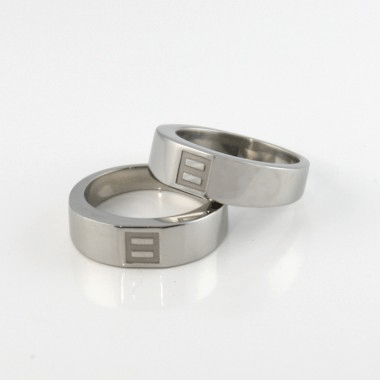
Like most Taylor Swift fans—and anyone who’s tuned into a pop station on the radio recently—I’ve been listening to (and loving) the song Lavender Haze[1] from Swift’s latest album Midnights. The chorus: “I feel the lavender haze creeping up on me / Surreal, I’m damned if I do give a damn what people say / No deal, the 1950s shit they want from me / I just wanna stay in that lavender haze.”

Swift uses the phrase “lavender haze,” as she explains in an Instagram video,[2] to refer to an intense feeling of being in love, complete with an “all-encompassing love glow.” Presumably in contrast with the “1950s shit” people want from the narrator of the song. From the other lyrics, we might assume that this “1950s shit” includes people’s constant barrage of questions about whether or when the narrator is going to become her lover’s bride—because, of course, “The only kind of girl [people] see / is a one night or a wife.” No other options.

Continue reading “Lavender Haze and the Struggle for Egalitarian Marriage by Liz Cooledge Jenkins”

From the Archives: A Feminist Retelling of Noah’s Ark

This was originally posted on May 4, 2018

My daughters came to me after Sunday School one day, concerned about a story they had heard in which God drowned almost everyone on Earth. So I sat down and thought about why a community might want to tell that story, and what valuable wisdom might be lifted from it for my children. Here is what I told them:

God/ess  has  many  faces,  which  help  us  understand  different  things we  need  to  know  at different  times. Sometimes we think of God/ess as Crone, an old, old  woman  crowned with silver hair as  an  emblem of her wisdom, who helps us  learn to let go of anything that is holding back the wellness of our community and ourselves. 

Continue reading “From the Archives: A Feminist Retelling of Noah’s Ark”

From the Archives: Genderqueering by John Erickson

Moderator’s note: Today’s blogpost was originally posted March 24, 2015. You can visit the original post here to see the comments.

This post is a response to a recent blog entry titled “Who is Gender Queer?” on this site from Carol Christ. It was posted yesterday. I want to thank my friend, advocate, and upcoming scholar Martha Ovadia for reasons only she knows!  Stay brave, speak up, be heard!

Leelah Alcorn, Ash Haffner, Aniya Knee Parker, Yaz’min Shancez

It is terrifying to know that something is wrong but not be able to speak truth to power.

Continue reading “From the Archives: Genderqueering by John Erickson”

From the Archives: Buddhist Misogyny Revisited – Part I by Barbara McHugh

Recently, I wrote a novel about the Buddha’s wife disguising herself as a man to join his religious community. When I showed the manuscript to a Buddhist friend, whose knowledge and practice I respect greatly, he expressed apprehension that it violated the basic myth of Buddhism. I assumed he meant that my storyline of gender deception strays too far from the versions of the Buddha’s life as recorded in the traditional canon, which adherents regard as the Buddha’s inviolable teachings. The last thing I wanted to do was to misrepresent these teachings.

What does it mean “to violate a myth”?  If I had portrayed the Buddha as a psycho-killer or wife-beater, I could appreciate this charge, but I had presented an enlightened Buddha whose values were in alignment with standard scripture and the mores of his day. The change I made was to tell the story from a woman’s point of view, and to do so, I modified some of the traditional legends and created new material to make my choices plausible. Predictably, my modifications came up against many of the stories’ misogynistic elements.

For instance, in the canon, the Buddha initially refuses to admit women to the monastic order.  Eventually his attendant Ananda persuades him, but then the Buddha adds 104 extra rules for nuns, eight of which (the Garudammas) clearly put women in an inferior position.  One rule states: “A nun who has been ordained even for a hundred years must greet respectfully, rise up from her seat, salute with joined palms, do proper homage to a monk ordained but that day.” The Buddha also told Ananda that thanks to the admission of women, the Dharma (the teachings and practices of Buddhism) would die out after only 500 years.

Continue reading “From the Archives: Buddhist Misogyny Revisited – Part I by Barbara McHugh”

From the Archives: Women’s Bodies and the Bible by Janet Maika’i Rudolph

Moderator’s note: This marvelous FAR site has been running for 10 years and has had more than 3,600 posts in that time. There are so many treasures that have been posted in this decade that they tend to get lost in the archives. We are beginning this column so that we can all revisit some of these gems. Today’s blogpost was originally posted May 20, 2019. You can click here to see the original comments.

Trigger Alert:  The bible on its face is quite violent to women.

Amidst the ugliness that is American politics in general and abortion politics specifically, I began to look for guidance to understand what is happening. I ended up pulling out two books that I read long ago. The first is Woe to the Women-The Bible Tells Me So by Annie Laurie Gaylor. Gaylor, in turn, was inspired by the work of Elizabeth Cady Stanton in her The Women’s Bible which was originally published in two parts (1895 and 1898).

I had forgotten how inspired I have been by both books. Together, they motivated me to begin looking at how the bible is a foundational paradigm of our culture. I started researching how translations have been altered from original meanings. I have already written a few blogs about how the representations of Eve have been changed to strip Her of the roots of Her original power. Take a look here and here.

Continue reading “From the Archives: Women’s Bodies and the Bible by Janet Maika’i Rudolph”

On Duty and Compassion Towards the Elderly by Vibha Shetiya

At the outset let me state that this post is mostly a collection of musings, rather than having a definite thesis statement.

I’m currently in India. I had to think hard before coming here for many reasons as you can guess. I finally decided to take the risk especially since there’s no telling how long this situation is going to last. After all, I’ve canceled twice and my parents aren’t getting any younger.

My father is 89, mum 79. When you visit on a yearly basis, that which eludes the daily eye becomes quite obvious in terms of reminding one of parents’ mortality. Wrinkles, aches, pains that develop over months and years seem shocking to the interim visitor, and in recent years, I’ve always left with the hope that I get to see them again.

Continue reading “On Duty and Compassion Towards the Elderly by Vibha Shetiya”

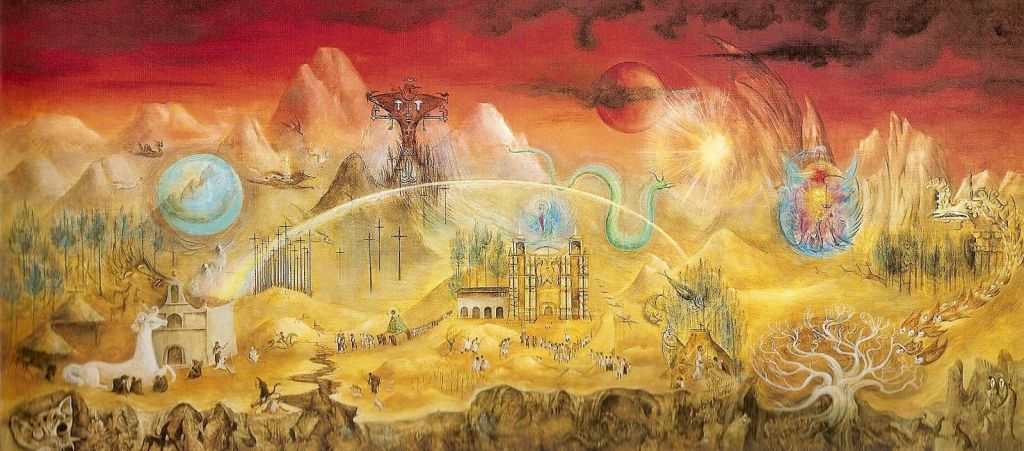
Leonora Carrington’s THE HEARING TRUMPET – Book Review by Sally Abbott

Sally Abbott

Long a fan of Surrealist artist Leonora Carrington, I was initially hesitant when the New York Review of Books reissued her 1974 novel, The Hearing Trumpet.  I didn’t know what to expect when this extraordinary painter picked up a pen.

To my delight and surprise, Carrington shows the same artistry and whimsy in her writing that she does in her painting.  She also reveals herself to be an astute feminist and aficionado of the Goddess, well-versed in arcane lore, with which she accents her fantastical world.  The Hearing Trumpet is full of British humor and eccentricity, set in a finely spun, other-worldly landscape.

The World of the Maya

Her heroine Marian Leatherby is a 92-year-old, who lacks teeth, is hard of hearing, and sports a beard–a whimsical, endearing character who loves cats.  She has been given a hearing trumpet by her great friend Carmella, and thereby learns that her son and his wife plan to send her away to an old folks’ home run by a Dr. Gambit and the Well of Light Brotherhood.

Continue reading “Leonora Carrington’s THE HEARING TRUMPET – Book Review by Sally Abbott”

Shofetim: The Divine Feminine, Magic, and the Role of Gender by Ivy Helman.

This post is dedicated to Carol P. Christ. I knew her first as my professor and then my friend for over 15 years. May her memory be a blessing.

This week’s Torah portion is Shofetim (also spelled Shoftim), or Deutoronomy 16:18-21:9.  I have written about this parshah before.   In that post from August of 2018, I reflect on how the patriarchal elements of the portion should not detract from its larger concern for justice, compassion, and peace. Yet, there is more to the parshah.  In fact, I have recently begun exploring Judaism’s connection to all things magical, and interestingly enough, this parshah fits right into my recent inquiries.   Let me share with you some of what I have learned as it relates to this parshah.  

Where Shofetim and magic meet is idolatry.  There are three instances in Shofetim where idolatry is condemned, punished by stoning to death.  All three of these prohibitions involve polytheism, either directly worshiping other deities or participating in practices associated with the worship of those deities.  What are they?

Continue reading “Shofetim: The Divine Feminine, Magic, and the Role of Gender by Ivy Helman.”

Eruptions of Inanna: Justice, Gender, and Erotic Power by Judy Grahn BOOK REVIEW by Carolyn Lee Boyd

Judy Grahn Eruptions of Inanna

Any new book by Judy Grahn is cause for celebration. For decades, Grahn has been a lyrical and passionate poet, author, mythographer, and cultural theorist whose work  features both goddess wisdom and contemporary culture centering on women and queer people. Nightboat Books has just published her newest book, Eruptions of Inanna: Justice, Gender, and Erotic Power, which offers ancient yet fresh world views with which to approach such issues as injustice, sexuality and gender, climate change, and more just when we need it most. 

In Eruptions of Inanna, she brings what she calls her “poet’s eye” to eight stories featuring the Sumerian goddess Inanna as well as religious practices of those devoted to her. She explores how these have directly influenced our world and, in her words, can continue to “feed our needs and help us take better care of each other and our world.” According to Grahn, Inanna “is a combination of human, creature, erotic and other energetic forces, and civilization. She also inherited very old powers that grew out of women’s rituals” (55).  Her essence engenders sovereignty and self-worth, especially in women and queer people.  She is a goddess of love, espousing passion and the joy of eroticism as integral to both life and society. She practices an expansive justice that creates positive outcomes in response to horrific acts. She creates a civilization of the arts, beautiful and useful crafts, abundance, and a jubilant communal life. She demands respect for nature and ecological sustainability.  

Continue reading “Eruptions of Inanna: Justice, Gender, and Erotic Power by Judy Grahn BOOK REVIEW by Carolyn Lee Boyd”

Buddhist Misogyny Revisited – Part II by Barbara McHugh

Read Part I here first

Webster defines myth as “a usually traditional story of ostensibly historical events that serves to unfold part of the world view of a people or explain a practice, belief, or natural phenomenon,” and in this way myths tell us who we are. Unfortunately, they include stories, from Adam and Eve to Cinderella and Sleeping Beauty, that define women by using criteria such as gullibility, passivity, and the size of their feet.

But today women are shining light on the likes of Circe, Mary Magdalene, and Briseus, the young woman dismissed by Homer as an impediment to Achilles’s higher purposes. These stories counter the traditional narratives that restrict women, as well as men, to roles that rob them of their full humanity. In my novel, Bride of the Buddha, the Buddha’s wife embarks on a spiritual journey of her own. When her quest leads her to the Buddha’s all-male sangha, she disguises herself as a monk, eventually becoming Ananda, who in the scriptures is the Buddha’s attendant, the one who struggles with all the questions unenlightened practitioners face today.  The answers to these questions cannot be stated as propositions; they must be felt and lived. Hopefully, my version of Ananda suggests new possibilities for feeling and living these responses. If this “violates” the myth, it does not violate the Buddha’s fundamental views.

Continue reading “Buddhist Misogyny Revisited – Part II by Barbara McHugh”