Sense8: The Show No One is Talking About, But Everyone Needs to Watch by Anjeanette LeBoeuf

AnjeanetteNetflix released a new Sci-Fi drama series called Sense8 in June. This original series was created, written, and produced by Andy and Lana Wachowski (The Matrix) partnered with J. Michael Straczynski (Babylon 5) to bring to life a world where certain humans were born with the ability to communicate and share through a mental link with other humans. They wanted to attempt to do something that had never been done before in TV, to change the “vocabulary for television production”* , the same way The Matrix became a major influence for action movies.** One of the main goals decided on was exploring the relationship between empathy and evolution in the human race.

The way Sense8 explores empathy and evolution is in the eight main characters, or sensates. All eight span the globe: culturally, religiously, and economically: Sun, Nomi, Riley, Kala, Will, Wolfgang, Lito, and Capheus. Continue reading “Sense8: The Show No One is Talking About, But Everyone Needs to Watch by Anjeanette LeBoeuf”

Hidden Seeds in Laudato Si by Peg Conway

Peg Conway headshot2

The opening two paragraphs of the recent environment encyclical just might be saying even more than the pope intended. Beginning with a quote from the famous Canticle of the Creatures by St. Francis of Assisi, Laudato Si refers to “our sister, Mother Earth,” and compares the earth to “a sister with whom we share our life and a beautiful mother who opens her arms to embrace us”. Sister and mother are seen here as two separate images. But some translations of the Canticle read “Sister Mother Earth” without commas, consistent with the style of the rest of that text, which names Brother Sun and Sister Moon, etc.

Does a little punctuation difference matter? I think it does.

The single term Sister Mother Earth suggests a seamless linkage between all female bodies, whether our sisters, our mothers, our planet. We are brothers and sisters to one another as Christians (and members of the human family), every person has a biological mother, and the earth sustains us all. “Sister Mother Earth” means there are no distinctions among the three; they are one body. This interpretation lends even greater impact to the second paragraph, where the pope speaks of “this sister who now cries out to us” because of abusive treatment:

Continue reading “Hidden Seeds in Laudato Si by Peg Conway”

Caitlyn Jenner is a Friend of Mine

To speak ones truth is oftentimes a difficult and nearly impossible act. However, to live one’s truth, on a day-to-day basis, is an aspect of life that has become so foreign to individuals who have become so comfortable in their own skin that I fear the activist and social justice roots that we all claim to hail from have fallen at the wayside and been replaced by complacency and reductionism.

caitlyn-jenner-transformation-high-cost-surgery-clothes-house-5I’m deeply troubled by some of the anti-trans and anti-queer commentary that has been taking place on some of the comments on this blog in recent months. I’ll never forget when this project first began—talking with the founders about its original purpose: to bring the “F” word back into the mainstream religious discourse and more importantly, to be a place where scholars, young and old, senior or junior, could write, collaborate and eventually converse with across cyberspace.

However, in recent months, I’ve found myself being more of a watchdog rather than a frequent commentator on issues pertaining to feminist religious discourse. I’ve found myself reading comments about issues I may not frankly identify or agree with just to make sure that the cisgendering or anti-trans narratives do not become symbolic of what this blog is now rather than what was supposed to be at the beginning.

When I sat down to write my very first post I was scared. I was terrified that feminists from all communities would see me only as I appeared and not for whom I actually was. I was afraid that all I had worked for throughout my life would be moot with the first bad comment on one of my posts. While all of those fears were real and valid they quickly faded away as I was embraced by this community and many others for my passion rather than my gender; my life’s work rather than my privilege; and more importantly, the personal mission to make the world a safer and better place for women and girls everywhere.

To speak ones truth is oftentimes a difficult and nearly impossible act. However, to live one’s truth, on a day-to-day basis, is an aspect of life that has become so foreign to individuals who have become so comfortable in their own skin that I fear the activist and social justice roots that we all claim to hail from have fallen at the wayside and been replaced by complacency and reductionism.

Caitlyn Jenner’s story is one that many individuals, often not highlighted on this blog, know all too well. Caitlyn Jenner’s story and personal experiences are valid and for members of the feminist community to refer to her as not “feminist” or merely as a man “masquerading” as a woman while still utilizing his privilege from being biologically born as a man is troubling and the root of the problem facing many trans individuals today when they’re negotiating coming out as their true selves.

Trans individuals face a cadre of other horrible social, physical and mental statistics that oftentimes lead them to be more likely to self-harm.   However, as feminists, isn’t it our job to make sure that all groups have access to the same freedoms rather than working towards denying it for certain groups while trolling the comments sections of posts?

Shakespeare said: “To thine own self be true” and for those of us who identify with the Golden Rule, if we no longer treat others as we would like to treat ourselves, then we really have failed as feminists; and if the comments on recent blogs are any indication, we still have a long way to go before all voices can feel welcomed not only on FAR but also in the world at-large.

John Erickson is a Ph.D. Candidate in American Religious History at Claremont Graduate University. He holds a MA in Women’s Studies in Religion; an MA in Applied Women’s Studies; and a BA in Women’s Literature and Women’s Studies. He is a Permanent Contributor to the blog Feminism and Religion, a Non-Fiction Reviewer for Lambda Literary, the leader in LGBT reviews, author interviews, opinions and news since 1989 and the Co-Chair of the Queer Studies in Religion section of the American Academy of Religion’s Western Region, the only regional section of the American Academy of Religion that is dedicated to the exploration of queer studies in religion and other relevant fields in the nation and the President of the University of Wisconsin Oshkosh’s LGBTQA+ Alumni Association. When he is not working on his dissertation, he can be found at West Hollywood City Hall where he is the Community Events Technician and works on policies and special events relating to women, gender, sexuality, and human rights issues that are sponsored or co-sponsored by the City of West Hollywood. He is the author of the blog From Wisconsin, with Love and can be followed on Twitter @JErickson85

Gender Identity, Religious Identity and Performance.

10953174_10152933322533089_8073456879508513260_oWhen I cover my head in respect for the Holy One, it feels right. This act touches on a religious truth of who I am. To me, it not only matches who I am, it also expresses something about who I strive to be and the relationship I want to have with G-d.

Seeing Caitlyn Jenner on the cover of Vanity Fair, I think she’d say something similar about herself. Her outward appearance touches to the very core of who she is and who she has had the strength and courage to become.   Not only that, it feels right.

Sure, there is a wide gulf between the public nature of Jenner’s cover photo and my public head covering, yet, in these two examples, I see a number of connections. First, there is the real possibility of harm and danger. Second, there is a link between outside actions that express something true about the person on the inside. Third, value is placed on the agency and autonomy of the individual carrying out those actions. Finally, there is a performativity connection between religiosity and gender. It is the last point that I find particularly compelling.

I don’t cover my head anymore on a daily basis although I used to before I moved to Europe. Even though it doesn’t feel right, with the rise of anti-Semitism, it seems like the safe and unfortunately prudent thing to do. I also don’t wear any signifying my religion except for a small star of David earring. In 2014, by the Jewish community’s own account, anti-Semitism grew 200% in the Czech Republic alone.  Statistics seems to support my actions.

Jenner too, like so many members of the trans community, now has the real threat of violence against her person. While her public persona may make her somewhat safer, too many trans men and women have been harmed and even murdered just for being themselves. In fact, many trans people live closeted lives because of this danger and the fear of rejection from family, friends and the larger society.

While not minimizing the fear and danger, I want to return to the more theoretical link between gender expression, gender identity and religious identity. In 1990, Judith Butler wrote Gender Trouble: Feminism and the Subversion of Identity. For Butler, what we think of sex and its connections to gender as masculinity and femininity often come down to a person performing gender in a way that is socially recognizable. People wear clothing, do actions, speak words and use body language that marks them as woman or man and therefore individual agents adhere to societal constructions of gender at the same time they reinforce societal expectations for men and women. Butler’s suggestion is that gender performances, that subvert “normal” discourses on gender expression, show the ways in which gender is culturally constructed. They also disrupt what has been seen as somehow inherently natural. In other words, biologically-sexed females acting, dressing, speaking and behaving in ways typically associated with masculinity disrupts what it means to be both a woman and to be masculine. This would be impossible if things were as natural as society thinks they are.

One of Butler’s goal, in my opinion, is not only to expose the culturally constructed nature of sex/gender, but also to open up individual agency to perform gender in ways that would disrupt the power these “natural notions” have over peoples’ lives. Subversive gender performances, for Butler, creates more freedom in society and would hopefully undermine blanket misogyny and disrupt patriarchal power.

Yes, Butler has often been criticized in many ways, including the attempt to erase any notion of substance behind personhood and its gendered expression especially as it relates to transgendered individuals. Butler has spoken to this specific criticism saying on transadvocate.com that, “…others have a strong sense of self bound up with their genders, so to get rid of gender would be to shatter their self-hood. I think we have to accept a wide variety of positions on gender. Some want to be gender-free, but others want to be free really to be a gender that is crucial to who they are.”20150128_132833

In the end, what is essential for Butler is individual autonomy and freedom to be. Performing sex/gender is one possible way to get there. Let me suggest another that builds off Butler’s ideas of performativity. Religiosity is a type of culturally-laden performance. After all, what are kippot, hijabi, nuns’ habits, ministers’ robes, etc.? They are religious markers tied up in gender identity.

Just as masculine women subvert and disrupt social constructions, couldn’t a Jewish lesbian perform gender in a way that she passes for an orthodox man (or woman)? Doesn’t this disrupt what it means to be both lesbian and orthodox? I think so. This passing person also destabilizes the power of orthodox men to define womanhood and women’s sexuality. She defines for herself who she is. She may very well consider herself to be orthodox and masculine, just as masculine women consider their masculinity as part of who they are.  She may connect deeply with Jewish orthodox feminine styles of dress.  Nonetheless, her outward performance expresses something about her commitment to G-d and who she is as a Jew at the same time it subverts received religious notions of gender and sexuality.  Another example is a woman minister who wears priestly attire including the black shirt and white collar.   She too disrupts power relations, gender assumptions and, for some people, the very notion of women and ordination.  Religious performance is powerful stuff.

To go back to the point I made at the beginning. I think expressions of religiosity are similar to expressions of gender. In addition, claiming for one’s self a religious identity subverts patriarchal notions of gender. Yet, most importantly, performing a religious identity often expresses an inner truth. In both of these ways, religious identity performances could create freedom, disrupt power-over and destabilize patriarchy just as Butler hopes gender performativity does.  I would modify Butler’s approach somewhat to say, “I think we have to accept a wide variety of positions on gender [and/or religious identity]. Some want to be gender-free [and/or religion-free], but others want to be free really to be a gender [and/or religious indentity] that is crucial to who they are.”

Aphrodite in Bagram Afghanistan & The ‘Friend of the World’ of the Flower Ornament Scripture by Stuart Dean

Stuart WordPress photo

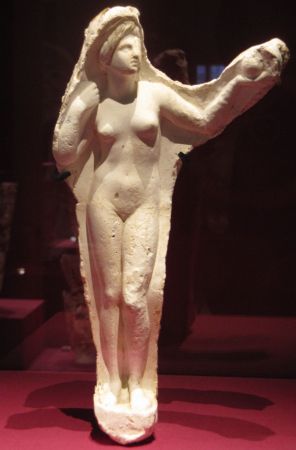
 In the 1930s two ancient storerooms in Afghanistan near what is now the Bagram US Air Base were discovered by French archaeologists and unsealed for the first time in about two thousand years.  They contained artifacts from all over the ancient world, evidencing just how active trade then was along the complex network of routes known collectively as the Silk Road.  Among the artifacts in one of the storerooms was a plaster statuette of Aphrodite (‘Bagram Aphrodite’).

BagramAphroditeThough it is not known what the motivation originally was for acquiring the Bagram Aphrodite, its presence in Afghanistan arguably evinces an interest in female spirituality–if not in the owner of the storerooms then among some of the people in the market for which she may have been destined.  Evidence of such interest among Buddhists is to be found in the Flower Ornament Scripture (FOS), a compendium of sutras dated to approximately the same time (and possibly the same region) as the storeroom containing the Bagram Aphrodite.  Female spiritual figures, both mortal and immortal, some portrayed as having official positions, others without any, are prominent in the final chapter of the FOS, so prominent that one scholar suggests Buddhist women of the time in some way influenced its composition (see Douglas Osto, Power, Women and Wealth in Indian Mahayana Buddhism).

Continue reading “Aphrodite in Bagram Afghanistan & The ‘Friend of the World’ of the Flower Ornament Scripture by Stuart Dean”

The Religiosity of Silence by John Erickson

In a repetitive culture of abuse and silence, is it really shocking to find out that an individual who preached such hate and discontent for others actually perpetuated other forms of heinous abuse against others?

John Erickson, sports, coming out.In 2013, I wrote an article about the then latest reality TV scandal featuring A&E’s Duck Dynasty’s Phil Robertson and his rampant foot-in-mouth disease that caused him to express, in the pages of GQ, his true distaste for the LGBT community and specifically for the sexual proclivities of gay men.

Now, two years later in another reality TV show, TLC’s ’19 Kids and Counting’, it isn’t star Josh Duggar’s anti-LGBT statements getting him into trouble but rather his sexual assault and molestation of 5 girls, including two of his sisters. However, while the Internet explodes with attacks against Josh Duggar and his Quiverfull background, it is vital to remember that the silence that he and his family inflicted upon his victims since 2006 has not only been ongoing since then but is also being reemphasized today with each keystroke focusing on the assailant rather than the victims. Continue reading “The Religiosity of Silence by John Erickson”

Miley Cyrus and the Happy Hippie Foundation by Deanne Quarrie

Deanne Quarrie, D.Min.I almost got in a big fight with my son on Facebook yesterday. I posted a link to an article talking about the work that Miley Cyrus is doing for homeless teenagers. He immediately responded to my post by calling her a “skanky-ho.” Whoa!

I feel I need to do some qualifying here for a moment. I am not always a comfortable when I watch her performances. I am sure it is my age (73) and coming up in a far different time and mindset from what we have now. I feel a bit embarrassed watching some of her movements that have been labeled lewd by many and clearly so by my son on Facebook. I try very hard to not be judgmental or to place negative labels on anyone just because I may not always enjoy what they do. I do recognize that our perceptions are driven by our religious beliefs, our cultural backgrounds and our own inhibitions. I have to confess, I am even a bit jealous that she can be so open with her own sexuality in such a public way. I can tell you, however, I really like her voice and see her as an amazing performer! Continue reading “Miley Cyrus and the Happy Hippie Foundation by Deanne Quarrie”

Thoughts on Nuns and Sisters and Perpetual Indulgence by Marie Cartier

helen prejean
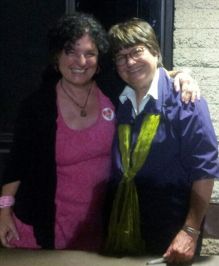
Marie and Sister Helen Prejean

The word “nun” can conjure images from traditional to irreverent in terms of gender. The gender of those who call themselves nuns can range from feminine to masculine, from a woman who looks like a woman dressed as a woman, a contemporary sister or “nun,” who does not wear the traditional black habit, but contemporary female clothing and perhaps a short veil or “wimple” and a cross around her neck; to a man dressed as nun in extremely sexual female garb, a “drag queen” nun; to the traditionally dressed nun, whose habit is a full-length black gown, and full veil covering everything but her face and hands, who means to conceal gender and become something else – a “nun.”

The physical space of “nun” then has opened the realm of gender for women, and recently men, since the creation of the category “nun” was established with the first order of female religious. Cloistered orders of women began in the fifth century, with the more liberated orders of “sisters” forming in the sixteenth century. The Encyclopedia of Catholicism lists approximately twelve Roman Catholic religious orders of sisters, or as they are commonly called, “nuns.” However, this terminology should be amended to allow for the difference between “sisters”- non-cloistered orders, and “nuns”- cloistered orders. Most traditionally the word nun officially refers to Roman Catholic nuns – those who take solemn vows of chastity, poverty and obedience, and live cloistered lives of silence, and prayerful meditation. Choir nuns, such as that of the famous convent headed by Hildegard de Bingen, (1098-1179), German nun, mystic and composer, chant the Liturgy of the Hours daily – consisting of a set order of readings and prayers, including Morning, Evening, Daytime and Night Prayers. Continue reading “Thoughts on Nuns and Sisters and Perpetual Indulgence by Marie Cartier”

Gay Marriage: “Tell me why I shouldn’t hate you…?” asks the straight Christian to the lesbian by Marie Cartier

MarieCartierforKCETa-thumb-300x448-72405This is the third of a series exploring gay marriage as a game changer within religion and politics. I have explored the topic as political animus and earlier as almost fairy tale come to life. Today I am examining it from a very person view.

Consider a gay woman (myself) being asked by a straight attempting to understand the “right” for gay marriage, “What does it matter if I know you’re ‘gay’ if I’m not attracted to you?”[1]

Then consider that another right of “marriage” –or being known as “gay”—is the right to be admitted into the hospital room of a loved one, who is considered one’s primary partner, or “spouse.” Yes, one wants to say to the questioning woman in the above scenario, the rights for marriage include the crucial family relationships which allow one person to be able to take sick leave to care for a partner, or a partner’s child; being able to make critical medical decisions, and the right to be together in crisis situations (such as a hospital emergency room).[2]

Imagine the gay woman speaking to the straight woman and saying, “Because I am more than someone you might or might not be attracted to. I am my own person with my own life. I want to among other things, get into the hospital room of my partner, my loved one, the one I am actually attracted to.” Continue reading “Gay Marriage: “Tell me why I shouldn’t hate you…?” asks the straight Christian to the lesbian by Marie Cartier”

Oh, Yes! On a Sexual Revolution in Islam by Vanessa Rivera de la Fuente

Vanessa Rivera de la Fuente. Sexuality and IslamFor centuries, religions have controlled sexuality. They have defined the legitimate options with regard to gender, sexual orientation, how to make love and its purpose. The religious discourse on sex imposes patriarchy, binarism, marriage, monogamy, motherhood and heterosexuality as sine qua non conditions for a “proper” sexual life. Also, it has caused the invisibility and subordination of female pleasure and has repressed the power of women’s sexuality that allows us multiple orgasms and tireless self sexual satisfaction for a life time.

The modern mainstream Islamic discourse is the continuation of what I already knew in Catholicism about sex: its purpose is to have children, it is lawful only after marriage, the man controls the couple’s sex life and may have more than one partner while women are the exclusive property of their men.

However, it seems that it was not always this way. The biblical book, “The Song of Songs,” for example, describes a sexual encounter with beautiful metaphors and passionate declarations of sexual desire. I insist in this: declarations of sexual desire. Nowhere in this text do the lovers speak of marriage, fidelity, children they will have or who will pay the bills. The “Song of Songs” is a celebration of sexual desire and the desire to have sex just because it is good and pleasant. Pleasure for the sake of pleasure, without normative assumptions, because sexual pleasure is a divine gift and if is shared, is even more divine. Continue reading “Oh, Yes! On a Sexual Revolution in Islam by Vanessa Rivera de la Fuente”