What follows is yet another story of how patriarchy is destroying our culture through the lens of personal narrative. This is a pattern we must uncover, reveal for what it is and refuse to participate. As bell hooks once said, “your silence will not protect you”. Especially from insanity.
I was gone when the U-Haul moved out.
For almost 19 years Ugly neighbor lied, manipulated, tried to steal land, stole my young balsam trees, ignored covenants on our deeds and most recently started to set off explosives.
Six months after moving in here this guy cut down my trees and built a bridge over the brook on my land. It never occurred to me that he did it. Oh, I wasn’t accustomed to this sophisticated level of manipulation. When I approached Ugly neighbor (alias ‘nice guy’ with a fake halloween pumpkin smile) to tell him what I believed someone else had done, I discovered he built the bridge; he cut down my trees. Stunned, it barely registered when he said “I did it for you.” WHAT???
Accustomed to the old fashioned ‘respect your neighbor policy’ I had no frame of reference for the hell that was coming my way.
We have been taught to speak of war and the heroes of war in hushed tones. We have been told that evil Helen’s choice was the cause of the Trojan war. 2600 years ago Sappho, known as the greatest lyric poet of ancient Greece, spoke truth to power and unmasked the lies told at the beginning of western tradition.
*
In a poem addressed to Anactoria, Sappho writes:
Some say a cavalry corps some say infantry, some, again, will maintain that the swift oars of our fleet are the finest sight on dark earth …
Here, Sappho invokes the heroic tradition celebrated in the epic poems of Homer that shaped the values of ancient Greek culture and all the cultures that followed it, including our own. This tradition tells us that to serve in a war and to be remembered as a hero is the highest goal to which a man can aspire. Sappho does not agree:
Jill anointing her daughter. photo by Shoshana Jedwab
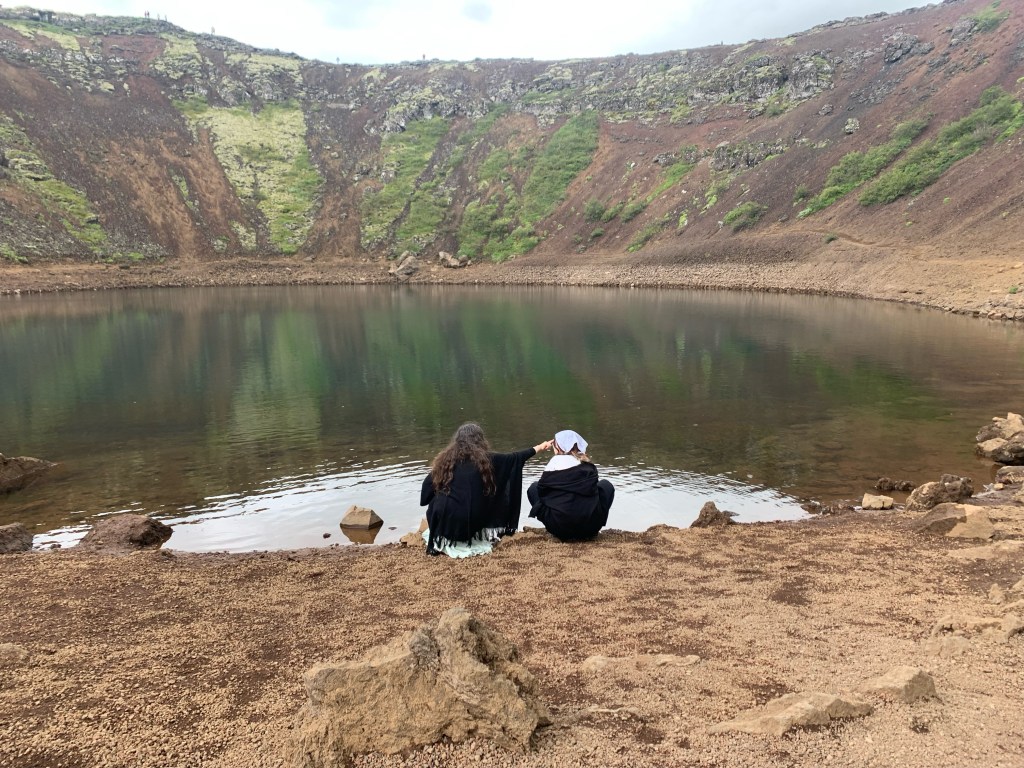
This summer, I visited Iceland, a beautiful and magical land. While I was there, I saw the Kerid Crater, which is a caldera: a volcanic crater with a lake inside. My family and I hiked around the edge of the crater and then down close to the lake. The perfect roundness of the crater-lake gave the impression of a circular container—a jewel-box shaped by some immense hand— or else a massive eye looking up from the earth. My daughter and I sat by the lake’s waters and anointed one another, having the sense we were in a sacred place.
Later that summer, I grappled with a story that reminded me of the crater. In Numbers 27, five sisters—the daughters of a man named Tzelafchad—approach Moses with a question. Their father had daughters, not sons, and it seems this means his family will receive no land allotment in Canaan. The daughters ask that they be given land allotments: “Let our father’s name not be lost to his clan just because he had no son!” (Numbers 27:4). Moses takes their complaint to God and brings back an answer: the daughters have spoken rightly, and will receive a land allotment as they request. However, they must marry men of their own tribe so that the tribal land is not lost— if the women married men of another tribe, their heirs would belong to that other tribe and so the land would change its tribal designation. Thus, patriarchy is mitigated but not ultimately contradicted—the women become heirs to their father, but primarily for their father’s sake, not their own.
I have this image in my mind of standing on one of those moving floors at the carnival. It is hard to get your balance because it is constantly shifting.
The world is constantly shifting at the moment.
It is unsettling.
You think you have found your equilibrium, and then the next experience or conversation occurs. Financial upheaval. Health concerns. People dying.
The fear calls.
Three months officially out of my second marriage, I am still in a transitory period. Juggling as I normally do so many things and people. Which ones will I catch? Which ones will I let go?
Every morning I wake up and stand on my deck with my arms thrown up to the sky in gratitude. I love my deck and my old 1961 home. The deck needs care. I have replaced a couple of boards, but there are many more in need. I wonder if it is even savable at this point.
I let that thought come and go. It is okay for now. It holds my weight.
Nothing lasts forever, and this does not make my top ten list.
The client that I had for seven years on and off is now gone. With my veteran husband gone and now that we have moved to Alabama, I am officially no longer a small Illinois Veteran Owned Business so I will officially no longer be part of their budget.
My main priority right now is finding a job and income. It can be overwhelming. I do not want to sell myself short as I have done the large majority of my life. I also do not want to be in a job that I am struggling. I want to find, like the new relationships in my life, ones that are just the right blend of challenging, interesting and rewarding: ones that fit into the puzzle of my life. The adventure.
At times it seems a high order: especially in the shifting sands of the world at the moment.
Every morning after greeting the sun on my deck, I go into my sunroom and meditate.
The view out of my back window is of crepe myrtles, pines, a maple tree and a corn field. Birds fly past. My cats lie lazily on the chairs. My stones and statues and other precious items surround me.
Isn’t this moment enough?
Isn’t it enough to be happy in this moment?
I start to stress about money or people, overthinking, analyzing and panicking as I am wont to do and then I stop myself.
I remind myself.
It is already here.
The people I want in my life. Who truly see me. Who I see. The ones where we support each other. Allow each other. Touch each other physically and mentally.
They are already here.
The means to pay my bills in ways that fill and align with my soul.
It is already here.
They both just need to catch up with me. Turn a corner, and they will be there. All I need to do is ‘encourage’ the things I want in my life, and let go of the rest.
Step by step. Breath by breath.
The future is already here.
Yesterday I returned from my Land in Appalachian mountains of North Carolina: ten acres of unrestricted land with a bog and a creek on one side and a mountain on the other.
A few days ago, I bought the land. When the check cleared, I was left with $20 in my bank account. I had a momentary panic wondering what I am doing.
But then I left that thought behind as well.
It is the third time that I have been there. It is the first time that I went alone.
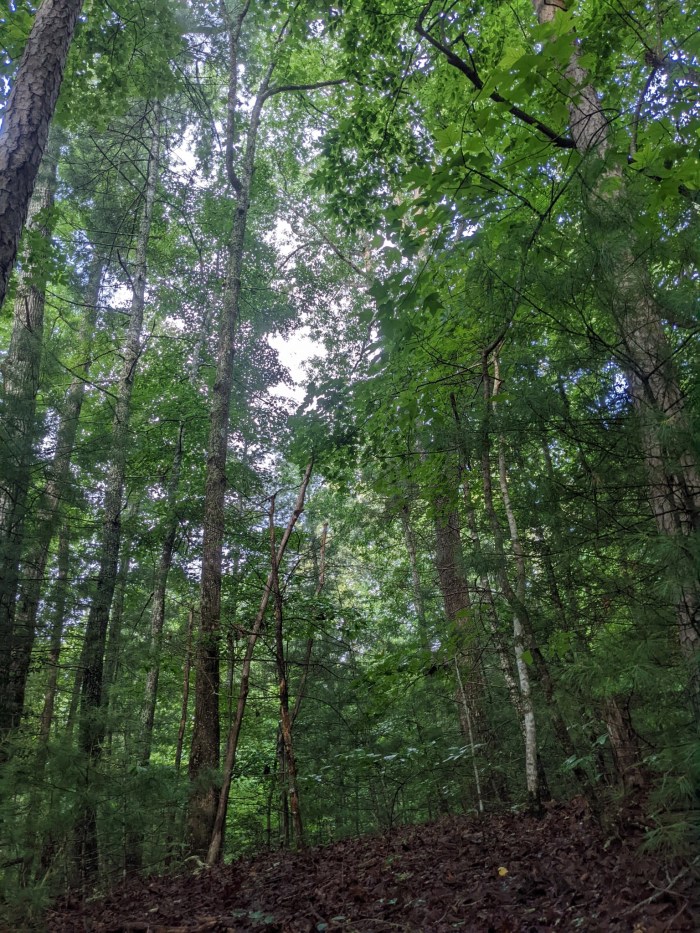
I sat. I listened. I meditated. I got lost in the woods climbing up the small hill and forest that is already beginning to feel like home. I napped in my hammock, took off my clothes, sang, danced, cried, touched myself. Said hello and thank you and I will take care of you. Take care of me.
Almost half of my land on the right side is bog or a wetland: nature protecting itself, impassable and overgrown by invasive porcelain berry plants. The last time I came my friend tried to get to the creek and did not even get close: his feet sinking into the earth a foot, a huge smelly fly ridden animal bed, plants everywhere. The real estate description suggested putting in a pond to drain the bog so that you can use the land.
No. Protect the bog. Protect our earth. I deeply respect that side of my land knowing that it is cradling precious carbon needed to maintain the balance of life. I talk to it and tell it that I just need a small way in to get to the creek so that I can have water and a shower. A small path.
I find another way down a road to the creek. A snake scurries away in the water. The neighbor says good, I see that you have a machete. You will need it. I would suggest a firearm as well.
We shall see. I feel the fear and respect that I carry.
This is the Wild. She is often unforgiving. I get that.
But I believe that we can come to an agreement and a relationship.
It is one of the balls that I am juggling at the moment. To get to the land from Alabama, I drive along the Ocoee River, rushing water and rocks, majestic steep mountains forming a gorge. It leads to my land, out of the gorge, up a small highway, past buildings that nature has reclaimed, no chains, few stores and onto a dirt road.
‘Home’ pops into my mind several times.
Home.
BIO: Caryn MacGrandle is the creator behind the Divine Feminine App which has been connecting and inspiring women [and other genders too] throughout the world since 2016 as a directory to find Sacred Circles, events and resources. Women find the app each and every day, and it currently has almost 8000 users from around the world. Caryn has also hosted Sacred Circles and events for the past nine years and is passionate about the power of a Circle to heal individuals and the world. She has participated in numerous online and location events such as the World Parliament of Religions in September of 2021 in which she presented a workshop on Embodying the Goddess: Creating Rituals with Mind, Body and Soul and just recently a webinar/panel with Dale Allen presenting Dale’s Indie film award winning “In Our Right Minds: Leading Women to Strength as Leaders and Men to Strength without Armor.” Each and every day, Caryn (aka Karen Moon) works tirelessly towards her belief that the most important area to first find equality and balance is the divinity found within yourself.
Because I don’t have the money to fly somewhere else other than …here
Where I can’t get one
I need an abortion and I can’t get one
Because the kid, or the cells of a maybe kid, were put in here by the guy that raped me and if I have to have it, I will kill myself
I need an abortion and I can’t get one
Because I have four kids already and I can’t feed another one
I need an abortion and I can’t get one
Because it’s my dad’s…did you hear me say that? I have never said that. I have never said what he does to me…and now I have to show everyone… if I can’t get this out of me I will…
Moses is an interesting character is in the pantheon of religious leaders. He is such a major personage, considered the founder of Judaism and yet there are no extra-biblical accounts of his life and his deeds. He only exists in the bible. You’d have thought that such a major event as leading a whole class of people away from Egyptian slavers, would have shown up on the radar of other written or mythical accounts from the time. Nothing!
Even his name is interesting. When the Egyptian princess gathered Moses out of the waters she said:
She named him Moses, explaining,
“I drew him out of the water.”
Exodus 2:10
This is one meaning of his name. But there are others. In Egypt, the land where he was born and raised, the M-SH (variations: m-s or m-ss) root simply means “son.” Or it can mean “child” in a non-patriarchal sense. We see this in other Egyptian names Ramses is the child of the sun god Ra. Tutmose is the child of Tut.
Accounts and allegations of sexual harassment, assault, and abuse perpetrated by mostly straight white men in power have flooded the U.S. news cycle for months. Each new revelation confirms that sexual violence is an epidemic fueled by systems of unchecked power and authority, including patriarchy, white supremacy, and Christian supremacy.
After TheWashington Post published the story of Leigh Corfman who recounted the sexual abuse she suffered as a teenager at the hands of Roy Moore, Alabama State Auditor Jim Zeigler came to hisdefense and argued that this would have no political impact since Moore “never had sexual intercourse with any of these girls.”
We all ought know by now that such allegations of sexual abuse, even when the perpetrator admits to them, bear little weight on the electability of white male politicians (see: November 8, 2016). Even so, I was stunned by a poll that revealed that 29% of Alabama voters answered that they are now more likely to vote for Roy Moore since allegations were made against him.
“thea-logy begins in experience” – Rebirth of the Goddess
It is hard to believe that Carol P. Christ – Karolina as she dubbed herself in her beloved Greece—has been gone for a year. She remains such a vivid presence in my life—in all of our lives. I think of her and draw strength from those thoughts daily, the way so many women say they think of and feel close to their deceased mothers. For Karolina was indeed a mother to me—a nurturing spiritual mother who initiated me into the ways of the Goddess she adored and, whom she so beautifully defined as “the power of intelligent love that is the ground of all being.”
I first met Karolina in June of 1995 on a bare hotel rooftop in Athens. I had just flown there from New Orleans to join the Ariadne Institute’s Goddess Pilgrimage Tour, a leap of faith inspired by my reading the previous year of Weaving the Visions: Patterns in Feminist Spirituality, a pioneering anthology edited by Carol and her long-time friend and collaborator, Judith Plaskow. That book, along with Carol’s Diving Deep and Surfacing and Judith’s Standing Again at Sinai had spoken to me more deeply than anything I had ever read before. I had grown up in a Middle Eastern Orthodox Jewish family. drawn to spirituality, I had never able to find a place for myself in the deeply patriarchal structures of synagogue or even family rituals … Carol and Judith offered me a way in, and I wanted immediately to embark on the paths they were clearing. I wanted to meet them, to know them, to learn from them, to share with them. Boldly, I decided to join the Pilgrimage, signing up for my first trip overseas trip, the most costly vacation I had ever granted myself. How could I have known that it would transform my life and bless me with a miraculous, deep friendship?
I have a poster on my wall: UPPITY WOMEN UNITE. In big, red, capital letters. I don’t remember where I got this poster, but I know I’ve had it since the late 70s or early 80s. I’m sure it comes from the raggedy late 60s, when second-wave feminism got up a head of steam and uppity women began getting our attention. That’s when Betty Friedan said being a proper 50s housewife was like having a mental illness. It’s when Gloria Steinem founded Ms. Magazine, which (oh, horrors!) did not give us recipes or home-making tips and did not tell us how to dress to lure our men into bed. It’s when Mary Daly started giving us a whole new, original take on the English language. Ahhh, yes, those were the good ol’ days. And the bad ol’ days, too, when the Equal Rights Amendment was not ratified.
“Uppity” can be a troublesome word. In the olden days, if someone called you uppity, it means you were inferior to them and weren’t staying in what they thought was your proper place. If you were a black person, for example, and if you didn’t step off the sidewalk when white men were coming, you were uppity. If you were a woman who wanted equal pay for doing the same work a man did, you were uppity. Those women in the 1980 movie, 9 to 5, were majorly uppity. And they won the battle.
During the past week I attended a Los Angeles premiere of a new documentaryAnita: Speaking Truth to Power (Dir: Freida Lee Mock USA, 2013). The screening was sold out and I had great seats saved for me– sitting with a friend who works at Samuel Goldwyn, the distributor of this fine film.
In 1991, Anita Hill provided testimony she hoped would serve to dissemble the nomination of Clarence Thomas as a Supreme Court justice. Although the vote would end up being close (52-48) Hill’s testimony did not serve to dissuade the decision — Clarence Thomas’ nomination was confirmed and he was appointed to a life term on the Supreme Court four days after Hill’s testimony concluded. Here is an outline of the debate.
I remember watching the hearings in 1991 at a friend’s house in Sacramento, CA where I was couch-surfing with another friend while we were in Sacramento from Los Angeles to protest for gay rights—to speak our truth to power. I remember being amazed that she was doing this—and that it was being televised. We were glued to the set before we went off to the protest we were attending.






 Feminism and Religion