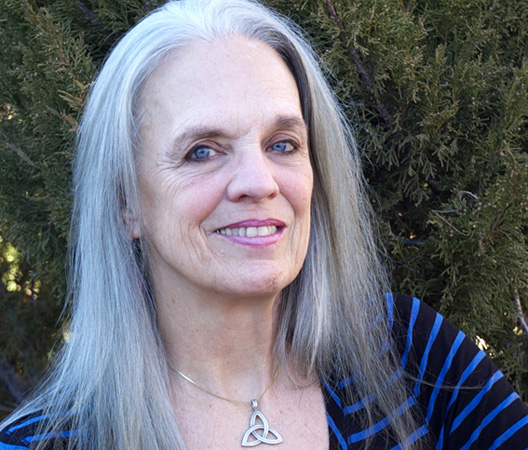
I have been asked numerous times by numerous people over the years to write about feminist issues, especially regarding teaching kids about consent, pornography, and healthy sexuality. The reason I have not tackled this project yet is that I know full well most people—even people who think they want to know what I have to say, who think they probably agree with me to a large degree—will find what I have to say too overwhelming, depressing, and painful to handle.
People have interesting perceptions of me, which shape their expectations of what I will say. I am generally cheerful and affirming to be around. I frequently advocate for justice issues by speaking with passion and blunt honesty in ways people find uncomfortable or comforting, depending on where they stand on that particular issue. People want to feel safe and affirmed by me personally, but they also want me to keep speaking out about justice—so long as I do not make them too uncomfortable.
Many questions are asked of us as a community, but the answers which are so complex that we should be commended for even attempting to answer, are heard- if they are not interrupted- but rarely understood. As a Black mother and wife, I have accepted the fact that no one will understand my struggle outside of other Black mothers and wives. After being asked questions about how my community relates to slavery, I am convinced that no one outside of my Black American community will ever understand how slavery has impacted our lives, identities, family structures, trauma, and deaths. Furthermore, it has yet to be understood how the past of slavery continues to impact these areas as a people.
Firstly, although slavery has left an immense imprint on our racial memory, the Black community is not stuck in slavery simply because we bring it up. It is brought up because it is a part of our story and we should not be made to feel ashamed of it. Just because you are tired of hearing about it or uncomfortable does not mean that Black Americans should be made to feel as though should avoid speaking of our history. Some many pro-Black groups and movements emphasize and celebrate the achievements of Black Americans before, during, after, and despite slavery. However, these movements threaten the dominant culture, and much of their achievements are ignored or perceived as threats and terrorism. It is hard to educate ourselves and our children about our ancestor pre-enslavement because our legacy, history, sacred knowledge, and culture were destroyed and our memories were erased and replaced with the bible and colonialist interpretations of scripture. Many of these scriptures are interpreted to justify slavery and are still used to justify police brutality, mass incarceration, and psychological warfare on Black Americans. Nevertheless, we do what we can to celebrate ourselves and our heritage. In doing so, we cannot ever forget slavery.
When I was invited to create this post, a number of topics came to mind. But I decided to start our conversation with my response to the question: why do I write?
I am a Colombian woman designer who promotes venture projects in a region in which it is difficult to grow a business. In my daily work life, I ask entrepreneurs why they do what they do; why do they take the risk of possible failure? Usually, once we know the why, finding the how is much easier.
Today (May 5) on Feminism and Religion, we have a post by new contributor Laura Casasbuenas. She is our third new contributor from Colombia, the land from where Laura Montoya, our current FAR intern, also hails. But news in Colombia are not good today; I take a minute then to ask you to consider taking an action of transnational solidarity.
Friends presently living in Colombia are sending first-hand reports of the violence imposed by the president and his military. The situation has escalated over the last three days. Protests originally began in objection to the proposed Tax Reform that would disproportionately impact poor and working poor families in Colombia. But the protests have continued due to the growing violence with which the demonstrators – most of them teens and early twenty-year-old’s – are treated.
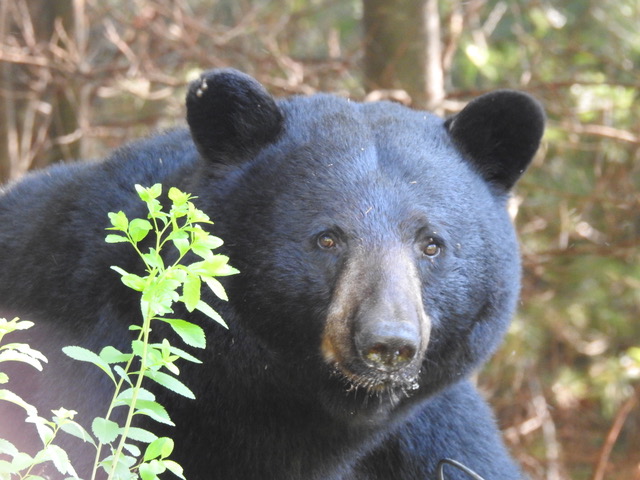
As an eco feminist I am deeply concerned with the loss of the animals I love. One of these is the Black bear whose visits are becoming more and more scarce as the forest around me disappears. The bear in this poem is unlike the bears I used to know in that he is terrified of me. When I first fell in love with bears it was because they embodied the soul and body of the Great Mother in a way that was meaningful to me. It is no accident that Black bears were honored as great healers by Indigenous peoples around the globe. The first images of them appeared on cave walls approximately 50,000 years ago.
Visionary Night
A furry shadow – ever dimming vision – did I imagine him? The woods are needled – Bare twigs stick out, pine spears behind Her. Mother Tree – She who sheltered his kin. He thinks rough elephantine arms will provide protection from his greatest threat – human supremacy. I cry out in desperation: “I am not one of them”. (this woman who loves bears)
Yesterday was Greek Easter and as Greece was still on lockdown, friends brought a lovely meal of roast chicken and vegetables, scalloped potatoes, green salad, and pineapple upside down cake, which we ate together on my balcony. Still I could not help remembering Easters past.This blog was originally published in 2013.
Though I am not a Christian any more, I don’t want to sit home alone on Easter Day. Besides being a Christian ritual, Greek Easter is a time to eat lamb with family and friends, and to celebrate the coming of spring by feasting out-of-doors in flowering fields or in a garden filled with flowers, bees, butterflies, and birds. Such rituals have been celebrated from time immemorial.
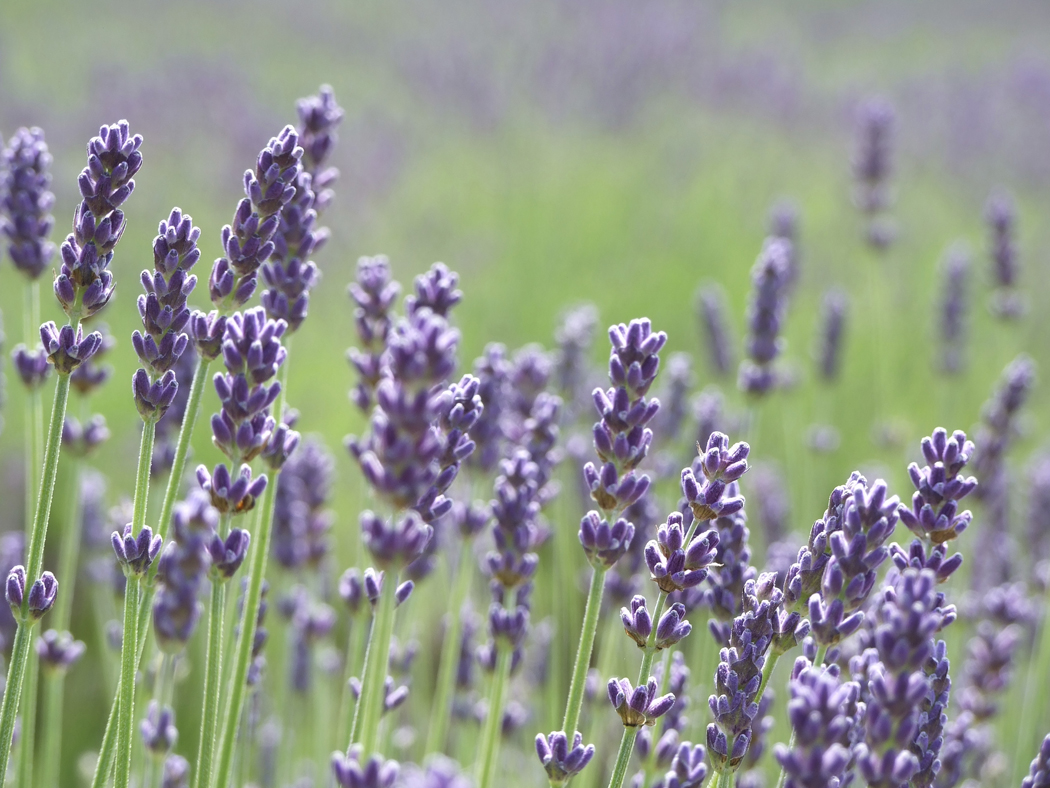
Greek Easter came late this year, only yesterday, May 5. I prepared for an Easter party in my garden for weeks. My garden is planted with herbs and aromatics—lavender, thyme, oregano, rosemary, curry plant, rue, sage, cistus, rose-scented geranium, sweet william, cat mint and several other kinds of mint, bee balm, and roses and fruit trees, including lemon, bitter orange, pomegranate, olive, quince, and cherry. Everything blossoms in spring, attracting bees and butterflies.
I began weeding and pruning about 6 weeks ago. This year I had to remove many overgrown lavender plants. For the last 3 weeks in addition to ongoing weeding and pruning, I have been replanting lavender which I have promised myself to prune “way back” in the fall, along with purple sage, blue daisies, and thyme. Though there is bare ground in some parts of the garden, in other parts mature plants and trees are in full flower.
I have my breakfast in the early morning on a terrace from which I can see the garden and the sea. I love to” just sit” in the garden at this time of year. My thoughts cease as I enjoy the flowers, new ones every few days, and watch birds, butterflies, bees, and my two tortoises. Then my eyes come to rest on a task that needs doing, and I work for an hour or more as the sun comes into the garden.
There is a flowing fountain in the center of my garden that attracts birds. This year as in other years, there is a nest of great tits in a hole in an old locust tree. This tree is an import from America favored by the Ottomans, planted decades ago by someone whose name I do not know. One morning in early spring a migrating hoopoe landed above my head in the other locust tree. A hoopoe is a magnificent rust-colored bird with a black and white wings, a crown that can be opened or closed like a fan, and a long down-curved bill. Its arrival–a garden first– felt like a blessing. This spring I have seen blue tits, sparrows, collared doves, chaffinches, goldfinches, and for the first time a pair of black-eared wheatears drinking and cavorting in the fountain.
With the old lavender bushes gone, I have been able to see the tortoises with whom I share the garden more clearly. They wake up about ten as the sun begins to shine on the stone paths in the garden. They warm themselves for a while, and then start searching for food. Last year they “weeded” the garden for me—though they didn’t care for the bermuda and other invasive grasses. This year I feed them greens and vegetables. When the first rose petals fell to the ground, I remembered that, like us, they have a “sweet tooth”—besides flower petals, they like tomatoes and other fruit. They don’t actually have teeth, but rather hard gums, which are quite effective for munching and sometimes gobbling down food. After eating, they wander around the garden and usually have sex at least once (they are both boys), before they crawl under the bushes to wait out the hottest part of the day. They wake up again in the late afternoon.
I find it amazing to be sharing my garden with two reptiles whose ancestors perfected their evolution 200 million years ago when Pangaea was a single continent. I marvel at the agility they have despite their heavy shells. They push themselves up low steps and slide back down. They can get from one side of the garden to the other quite quickly when they want to.
All of my garden preparation culminates at Easter when I make a party for my friends. I order the lamb early in the week and make a pilgrimage with one or two others to a mountain village to pick it up. Along the way we stop to admire migrating birds in the wetlands of Kalloni and the wildflowers in the fields and on the hillsides. In the village we also buy braided sweet Easter bread called tsoureki, cooked with a red Easter egg in its center, and tiny Greek sweets called baklava and kataiifi, made of thin pastry, nuts, and honey. We lunch at a favorite taverna in the village, before returning home.
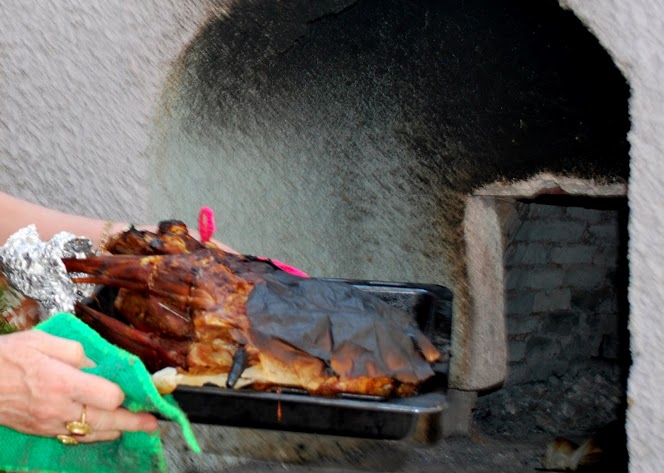
My house, which is over a hundred years old, originally had its kitchen in the garden: the old brick oven and an open fireplace remain. I use the oven only on Easter to roast a lamb that cooks all night long and into the morning. I save tree prunings, rosemary and lavender clippings, and collect driftwood for the fire. It must burn fast and hot. I wait until midnight to light it.
In the evening, I prepare the rice as the Greeks once did in Smyrna with orange and lemon juice, black currants, golden raisins, pine nuts, mint, parsley, and onions. I use it to stuff the lamb. I make tzatziki with yogurt, cucumber, and garlic, garnishing it with mint from the garden. The next day friends will bring potato salad (as my Grandma made it) and a green salad to which I will add mint, dill, and bee balm from the garden.
At midnight the church bells peal announcing “Christos anesti,” “Christ is risen.” The village rings with the sounds of firecrackers and the sky is lit by fireworks. This is the moment I choose to light my fire. I revel in the feeling of danger within and without. The fire burns wildly for at least an hour “until the bricks turn white.” Then I push the flaming wood to the sides of the oven, watch the embers burn down until they are small glowing coals, insert the lamb, shut the oven door, and go inside. I am always too excited to fall asleep immediately.
When I wake, I check to be sure the lamb is cooked, but don’t open the oven door again until my guests arrive. I take my time setting up folding tables next to the marble table with stone seats in the secluded area that used to be a kitchen. I think of the generations of women and girls who used the oven where the lamb awaits, as I bring the taverna chairs and cushions out storage. I spread out tablecloths from Crete and set out ceramic dishes from Skyros–painted with birds, flowers, mermaids, sailing ships, and people in traditional dress–pink wine glasses, pink and blue cloth napkins. Like the garden, my table is a feast of color.
Before the guests arrive, I sit in the garden and wait. A song of thanksgiving reverberates in my mind:
This is my Mother’s world,
And to my listening ears,
All Nature sings,
And ‘round me rings,
The m-u-s-i-c of the spheres.
Easter lamb stuffing Smyrna style
2 cups white long grain rice
2 T black currants
2 T golden raisins
2 T pine nuts
2 T olive oil
1/4 cup chopped fresh mint
1/2 cup chopped parsley
2 onions chopped
juice of one orange (and/or lemon)
salt and pepper to taste
(you can also add the liver, cooked and chopped)
Cook the onions in the olive oil, add the rice and orange juice, cook lightly, add the other ingredients stir.
Spoon into the cavity of a cleaned lamb carcass with the legs but without the head.
Can also be used for chicken. If not used as stuffing, add enough water to cook rice. Amounts of ingredients can be varied.
*Smyrna is the Greek name for Izmir, a city where Greeks lived for many centuries, until 1922, the year of the “great catastrophe” when many of them fled to Lesbos, Chios, and Samos, while others ended up in Athens.
Rest awhile, Dear Reader, and dream along with me. We’re standing on a corner, call it Main Street, Any City, USA. We’re chatting, passing the time of day, being happy we can stand among other people without the fear of a giant virus jumping out of someone’s breath and attacking us. It’s a nice day here on the street. Not much traffic.
Oh, look—there’s a huge box in the middle of the intersection. It’s shabby, looks to be made of old, thin wood loosely clamped together. The box starts shaking, rocking back and forth. What’s in there? Something is obviously trying to get out. As we watch, an orange mist starts seeping out through the cracks in the box. More shaking. Now the box seems to be jumping. More orange mist. And the box shatters. An orange form—is it human? It’s fat. It’s shaking an iPhone. Or is that a golf club? The orange one speaks. “Do you miss me yet?” “Stand back and stand by.” “I’ll be baa-ack.”
Today, May 1, we celebrate Beltane, the Celtic festival between the Spring Equinox and the Summer Solstice. Starting tonight, we also celebrate Greek Easter, with its ritual drama of life and death.
In the Western Church, Easter never falls as late as May, but in the Orthodox calendar, Easter and Beltane more or less co-incide every few years. It’s a reminder of connections between Christian and pre-Christian traditions, both in the archetypal cycle of life, death, and regeneration, and in links between the Christian Mary and the pre-Christian Goddess in her various names and forms.
Like so many others, I learned this jingle, actually the opening of a lovely poem by Joseph Parry, during a brief stint in the Girl Scouts when I was nine or ten. I’m not sure I understood it then—what was wine, after all? what did it mean for it to “mellow and refine”?—but the words stayed with me, echoing unbidden through the years and shaping many of my choices.
Make new friends, but keep the old;
Those are silver, these are gold.
New-made friendships, like new wine,
Age will mellow and refine.
Like so many others, I learned this little jingle, actually the opening of a lovely poem by Joseph Parry, during a brief stint in the Girl Scouts when I was nine or ten. I’m not sure I understood it then—what was wine, after all? what did it mean for it to “mellow and refine”?—but the words stayed with me, echoing unbidden through the years and shaping many of my choices.
I’m sure it was thanks to these words that, three years ago, I found myself dancing at the wedding of my childhood best friend. Deb lives in Southern California; I live in New York. Yet I never had the slightest hesitation about saying “yes,” I’d attend. This was to be her second marriage, after a painfully failed first. For years she’d sworn she would never remarry; the wonderful man she’d been living with for two decades finally persuaded her. Clearly, a moment to celebrate. And although we’d missed all the other milestones in each other’s lives, I knew I had to be there for this one.
At Deb’s San Diego wedding, 2018
I’ve known Deb since we were seven; we’re now both in our seventies. For nearly forty years we had no contact—different cities, different lifestyles, different choices. But when Deb sought me out after Hurricane Katrina (I’d been living in New Orleans and somehow she knew that); when she came to see me in New York and we revisited our childhood haunts; when she took to phoning me regularly on Jewish holidays—I was irresistibly drawn back into this relationship that linked me not only with her but with my own self over time. (“For ’mid old friends, tried and true / Once more we our youth renew.”)