A Nurturing Environment is Not a Luxury by Elisabeth Schilling

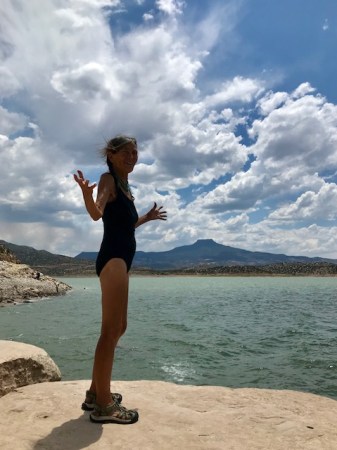
There are two tarot card decks that have accompanied me on my trip overseas this summer: Alana Fairchild’s Rumi Oracle and Lee Bursten’s Tarot of Dreams. In recent readings, I have been presented with messages of place, thus the topic of my post.

But first, Seneca, Stoic philosopher born around the time of Jesus, cautions that people traveling to escape their difficulties are sometimes no better when they have arrived to a distant land because they have not become rid of themselves. Likewise, zen philosophy suggests that it is not our circumstances that matter so much as the peace and calm we create in our inner landscape. Nhat Thich Hanh or Ram Dass or Pema Chödrön (maybe all 3) have a metaphor for the tumultuous ocean – that the sea is often rocky, but it is always calm in the deep beneath. Yet, I see all this as a reminder to be mindful about the added layers of suffering we can create and advice for difficult times when we can’t leave yet. Regardless, I think any wisdom cannot discount the need for a nurturing, healing space when at all possible.

Continue reading “A Nurturing Environment is Not a Luxury by Elisabeth Schilling”

Wild Snail Festivals by Molly Remer

“It’s a wild snail festival out here!”
—Tanner (age 3)

This spring we took a family mini vacation to Table Rock Lake, about three hours away from home.

At its best, working and schooling from home with our family of six feels like a beautifully seamless integration of work and life—there is no need to compartmentalize or draw distinctions between “life” and “work,” because it is ALL just life and living. At its worst, it feels like the work bleeds into everything else in an all-consuming way and the to-do list just never ends and something or someone is always getting overlooked or shortchanged. We find that it is helpful for us all sometimes to just all step away and be somewhere else, while the to-do list stays at home! We try to take at least five family adventures/trips a year (some of them small and some more involved).

Continue reading “Wild Snail Festivals by Molly Remer”

When “Interfaith” Started Losing its Luster for Me by Valentina Khan

Interfaith, a wonderful term that brings only happiness to my mind. So many days spent sitting and planning out events at the local coffee shop (shout out to The Lost Bean in Tustin, CA. which was one of the first small businesses to support “interfaith work”)  and attending many meetings at various houses of worship. We worked year after year to promote one another. To get to know each other, to promote peace, and community building. I sat in living rooms, hearing different faith perspectives from many voices, from the young up to the old and wise. Each time it was refreshing to see the dedication and respect the participants had.

But, after 10 years of advocating for interfaith work, my light dimmed. For me in particular, Islamaphobia was on the rise. Terrorist attacks were plentiful, and I was out of excuses. How many times could I say “this isn’t Islam. These aren’t Muslims, this is not what the religion teaches, I would not be a part of a religion that promoted violence.” I was getting tired of showing up, explaining, defending, and leaving wondering if I made a difference or if another terrorist attack would simply negate everything I just said?  Eventually, I retreated into the cocoon of motherhood, and building my career. My days of community service within the interfaith context were done. I had no more mojo, encouragement or inspiration. I really didn’t. I was just done. My last speaking engagement was over a year ago to a group of Catholic moms, such a great talk but I didn’t feel the urge to go back and talk more. It’s like a flower that wilted. Petals fell off, and nothing was left to blossom.

Continue reading “When “Interfaith” Started Losing its Luster for Me by Valentina Khan”

Finding Heavenly Mother with Rachel Hunt Steenblik by Caryn D. Riswold

Feminist theologies are filled with queries and questions about the divine feminine. Whether women need the Goddess. If She really is. Where herchurch might flourish. I have my own complicated views about the subject, and continue to be enriched by those who seek and find. Rachel Hunt Steenblik is the newest voice calling to and from the divine feminine, singing in a distinctively Mormon key.

If you read Mother’s Milk: Poems in Search of Heavenly Mother from front to back, you encounter what seem like scratches of verse and fragments of wisdom from a young mother catching time to write in the midst of her graced obligation to feed and sustain tiny bodies. If you read it back to front, you encounter a wealth and depth of engagement with Christian sacraments, feminist theology, sacred texts, Mormon history, modern philosophy, and children’s books and movies. This cacophony of source material and influence is distilled into sparse poems whose brevity bely decades of the author’s feminist engagement with vast religious history, philosophy, and theology.

In my review of Mormon Feminism: Essential Writings, edited by Steenblik along with Joanna Brooks and Hannah Wheelwright, I noted that feminists in many religious traditions “have had to document their history, make their theological case, and engage their scriptures as robustly as any conservative traditionalist would.” In Mother’s Milk, Steenblik offers us her contribution to the reconstruction of religious tradition. The words of her introduction state plainly: “These are the poems that I could write with my questions, my hurt, my hope, and my reading. Others could write other poems with theirs. I hope they will. We need them all.”

Continue reading “Finding Heavenly Mother with Rachel Hunt Steenblik by Caryn D. Riswold”

On Guilt and G-d, the Parent by Ivy Helman.

29662350_10155723099993089_8391051315166448776_oSometimes, being overwhelmed with guilt makes one unable to act.  Other times, guilt manipulates and attempts to control.  It might offer a sense of responsibility and concern. More often than not, guilt comes bundled in small doses of should-haves and could-haves.

For example, when you feel guilty for skipping exercise and instead lay in front of the television binge-watching your new favorite show.  It’s not the end of the world, but you really should have gone and exercised.  Or, when you feel bad for getting into a fight with a friend and saying something mean when you could have done otherwise.  In general, I think there is such a thing as a healthy amount of guilt which spurs right actions, sincere apologies, forgiveness and knowledge of the good.

Jewish tradition generally agrees with me that a measured amount of guilt is often quite helpful.  Guilt instructs us in right and wrong and guides us to be more responsible, more mature individuals.  Indeed, it even clues us into a better understanding of G-d.   Continue reading “On Guilt and G-d, the Parent by Ivy Helman.”

A Short History of Maligned Women by Mary Sharratt


Women who stand out and dare to seize their power have been maligned throughout history. Even today many people are uncomfortable about the very idea of a powerful woman. Witness how Hillary Clinton was demonized in the 2016 presidential campaign. What other U.S. presidential candidate has been called “nasty” by their opponent or had their opponent literally looming over them during a live televised debate? Even women who would never dream of running for political office face every day misogyny and threats of violence for daring to speak out on the internet. It doesn’t matter what the woman has to say—the fact that she has spoken out at all has made her a target.  

I certainly encountered the “such a nasty woman” phenomenon while researching Alma Schindler Mahler, the protagonist of my new novel Ecstasy. Born in Vienna in 1879, Alma Maria Schindler was an accomplished pianist and aspiring composer who gave up her own music as a condition for her marriage to the great composer, Gustav Mahler. Later, after a marital crisis, she returned to composing and published three collections of her songs. She was married to—or had affairs with—some of the greatest creative geniuses of her time, including Gustav Klimt, Walter Gropius, Oskar Kokoschka, and Franz Werfel. She was also a pioneer in the field we now call artistic management and her networking skills benefited the men she loved. But one would hardly know about her talents and gifts to read the biographies written about her.

Continue reading “A Short History of Maligned Women by Mary Sharratt”

Celebrating Pride: Honoring the Spiritualities of Queer Holy Women of Color by Angela Yarber

With rainbow colors erupting from even the big box stores, I find my super queer-feminist-self scratching my head at the way Pride has transformed into a capital enterprise. I mean, I’m pretty stoked that the cultural climate seems to be slightly more affirming of queer people, but as queer culture is commodified, I cannot help but think of what is being lost or forgotten. And I want to shout from the rooftops that the rich spiritual history of Pride rests firmly on the shoulders of queer women of color who have marched and meditated, prayed and protested long before rainbow Pride headbands were available at chain stores across the land. It is for this reason that, in honor of Pride Month, the Holy Women Icons Project (HWIP) has launched a 7-Day Online Queer Spirituality Retreat that celebrates seven different queer holy women of color.

HWIP’s 7-Day Online Queer Spirituality Retreat is an opportunity to subversively queer your spirituality, and for the LGBTQ+ community to celebrate our spirituality without having to translate it through the lens of heteronormativity. Open to everyone, the Queer Spirituality Retreat features seven different queer women of color: Pauli Murray, Frida Kahlo, Perpetua and Felicity, the Shulamite, Marsha P Johnson, Guanyin, and Gloria Anzaldúa. Each retreat day takes about 20 minutes and includes an inspirational quote, an icon image, a reflective essay, a guided writing exercise, a ritual exercise, and a closing blessing. The most important part of the retreat is, of course, the revolutionary queer women who make it possible. So, allow me to briefly introduce you to seven queer women of color who should make us all proud…

Continue reading “Celebrating Pride: Honoring the Spiritualities of Queer Holy Women of Color by Angela Yarber”

Four Worlds Poem by Sara Wright

They came from

Life giving Waters,

emerging from a Lake

at the Beginning of time.

Avanyu –

Serpent,

Spirit of the River

pecked into stone

or painted

on canyon walls

embodies their story.


The Tewa settled above

the Great River Banks.

Roaring water flowed

through tributaries

mountain gorges.

The People gave thanks.

  Water meant Life.

Each village was the center

of the Tewa’s First world.


Bound together by

Women who tended

holy household shrines,

prayed for rain,

created fires,

gathered seed,

ground food,

grew babies,

dug clay to shape

earthen pots.

This was the Second world

of the Tewa.

Continue reading “Four Worlds Poem by Sara Wright”

Toil and Trouble (Part 4) by Barbara Ardinger

Read Part 1, Part 2, and Part 3.

When the Amazons land in the capital city, they find themselves standing on the wide lawn in front of the Golden Tower in which El Presidente lives and rules. And look—El Presidente is still talking. Not having noticed the disappearance of twenty-seven princess, he’s still strutting, still emphatically gesturing, still addressing the fifty-four handsome, charming princes, who make up what he considers to be his people. (His fan club?)

Hippolyta, the Queen of the Amazons, adjusts her armor and walks across the sidewalk into the empty street. Her warriors follow her. “Now what?” she asks the air around her.

They hear a voice. “Greetings, Sisters! And be welcome! We haven’t met in many years. I’m glad to see you again.” Hippolyta looks a bit confused. “Don’t you remember Brunhilda?” the voice asks. Continue reading “Toil and Trouble (Part 4) by Barbara Ardinger”

Religious Practice and Epistemic Justice by Vanessa Rivera de la Fuente

feeling-measured-on-faith

One of the topics that has captured my deep interest during the last year is Epistemic Justice – and its absence, epistemic injustice – a concept which I reflect on often, since it has become a backbone idea in the approach of my work, my activism, my diagnosis of the situation of women in the global south and my vision of the world in which I would like to live. These reflections that I share with you do not intend to articulate a strictly academic presentation. They are my “thinking aloud” and don´t pretend to be completely right nor to establish a truth; rather they express the progress of a personal searching.

I speak as a Muslim feminist who loves to read and write about Feminism and Islam, but is not an academic nor aspires to be recognized as such in this field, although she writes papers and offers lectures in her own capacity on that matters. I speak as a community educator and social entrepreneur, who believes in feminism and spirituality as liberation tools. Since I accepted Islam, I took the experience gained in my work for the political empowerment of grass roots women to nourish an activism in the field of religion and gender justice. Continue reading “Religious Practice and Epistemic Justice by Vanessa Rivera de la Fuente”