One Small Red Leaf by Deanne Quarrie

Deanne QuarrieIt seems to me that the goal of most people is to be happy. We seek it ourselves and hope that those we love find it as well. Happy is an elusive state. At best it is hard to define – what is happy anyway?

As young adults we may seek happiness in alcohol and parties, perhaps even in drugs. We hope to find it in our careers and certainly in the unions we make and partners we choose. Happy is to be pleased, or glad, over a particular thing. The dictionary associates a state of happiness with contentment as well as with the experience of joy. And it also says that happiness is associated with good fortune or luck. Continue reading “One Small Red Leaf by Deanne Quarrie”

Ecofeminism is in the House (at the AAR) by Grace Yia-Hei Kao

Grace Yia-Hei KaoMy social media accounts have recently been ablaze with announcements of meetings, sessions, and receptions to attend for those of us who study or work in religion/theology in the U.S. Some 12,000-15,000 scholars and students will descend upon San Diego this weekend for the annual American Academy of Religion/Society of Biblical Literature (AAR/SBL) conference.

While as a theological and philosophical ethicist I attend this gathering every year regardless of venue or conference theme, I’m particularly excited about this year’s focus on climate change.

Sessions devoted to the topic include a panel on the release of the Public Religion Research Institute/AAR National Survey on Religion, Values, and Climate Change (Sat, 9-11:30am, CC-20D) presentations by the Intergovernmental Panel on Climate Change (IPCC) (Sat, 11:45-12:45, CC-20D), a talk by environmentalist Bil McKibben (Sat, 7:30-8:30pm, CC-20D),  the AAR Presidential Address by Laurie Zoloth (an eminent bioethics and Jewish Studies scholar; Sun 11:45-12:45,CC-20D), and remarks by former president Jimmy Carter on “The Role of Religion in Mediating Conflicts and Imagining Futures: The Cases of Climate Change and Equality for Women” (Mon, 4-5:30pm, CC-20) among others.

Ecofeminism

Beyond that, I’m especially excited about the number of sessions I see devoted to discussing ecofeminism–the scholarly and activist movement that takes seriously the interconnections between the oppression of women and the exploitation of nature. Let me enumerate a few of these (n.b. the following is a non-exhaustive list):

– On Friday, 1:30-3:30pm (CC-14A), the Women’s Lounge Roundtable will entail a pre-conference luncheon on “Ecofeminism and Earth Healing” featuring emerging scholars from Claremont Graduate University.

– On Sunday, 9-11:30am (CC-3), the Feminist Theory and Religious Reflection Group will feature a panel of papers on “ecological, epistemological, and ethical habitations.”

– On Sunday, 1-2:30pm (CC-30A), the Feminist Theory & Religious Reflection Group will sponsor another session tied to the conference theme: “Strategic Negotiations with Feminism on the Borders: Rhetoric in American Homiletics, ‘On the Move’ Ethics in Ecofeminism.”

– On Sunday, 3-4:30pm (CC-26), the Womanist Approaches to Religion and Society Group will convene a session entitled “Ecowomanism 101: A Roundtable Discussing Vital Themes and Trajectories.”

I’m looking forward to this conference and wish all AAR/SBL attendees an enriching and eventful time as well!

Climate change (Polar Bear on Melting Ice)

Grace Yia-Hei Kao is Associate Professor of Ethics and co-director of the Center for Sexuality, Gender, and Religion at Claremont School of TheologyShe is the author of Grounding Human Rights in a Pluralist World (Georgetown University Press, 2011), has a forthcoming co-edited anthology with Ilsup Ahn on Asian American Christian Ethics (Baylor University Press), and is working with Rebecca Todd Peters on anthology of women’s theological lives. Read more about her work on her website.

The God of Love by amina wadud

amina 2014 - croppedI admit I had the fortune of loving my father, the late Reverend Teasley, and feeling loved by him.  I also date my fascination with the divine back to my father.  There are many ways this fascination could have taken shape, but for me it led to the experience of religious diversity as an element of the global community of human beings that has never abated.
Like others, you might ask: if I feel so akin to diversity, why am I a devotee to only one of them: Islam? Some question this by way of offense to Islam. Others are genuinely curious. This curiosity takes two forms.  Either they are interested in my personal location within Islam, as in why are you Muslim? Or they are interested in why stop my quest for diversity and get stuck where I am clearly busy detangling the manifestations of Islam from their patriarchal moorings?

My answer is quite simple. Islamic thought brought me peace of mind, especially about the greater workings of the universe and my tiny, tiny part within it.  Islamic thought gave me the language to understand (a/my) reality.  Quite a handy facility if you think about how long humans have pondered the great existential questions: Who am I; Why am I here; and What is the purpose of life? Continue reading “The God of Love by amina wadud”

So You’re Going to the AAR/SBL Annual Meeting by Kecia Ali

Kecia Ali Bio pic officeTen thousand people descend on San Diego this weekend for the American Academy of Religion and Society of Biblical Literature joint Annual Meeting. We will present papers, interview and be interviewed, shop for books, and network busily. Many will feel overwhelmed, lost, and/or hungry – convention center food somehow always manages to be lousy and expensive.

I have attended nearly every AAR Annual Meeting since 1999. I have presented papers, spoken on panels, responded to sessions, led tables at pre-conference workshops, and presided at business meetings. I have served on program unit steering committees and chaired a Section. I have gone to editorial board breakfasts and AAR committee meetings.  I have had coffee with editors with whom I’ve gone on to publish books. I have served as a mentor at the Women’s Mentoring Lunch. Though I never used the Employment Center as a job candidate, I have put in cubicle time as part of two search committees.

In other words, I know something about the Annual Meeting. Continue reading “So You’re Going to the AAR/SBL Annual Meeting by Kecia Ali”

Belonging to the Land by Carol P. Christ

Carol Christ in LesbosI believe that we can restore our hope in a world that transcends race by building communities where self-esteem comes from not feeling superior to any group, but from one’s relationship to the land, to the people, to the place, wherever that may be.—bell hooks

In these words from her poignant memoir-reflection-analysis Belonging, bell hooks suggests that rather than creating identity by comparing ourselves to others, whether in the academy, in communities, or in the larger society, we would do better to root our identity in the land.

Hooks “left home” in rural Appalachia in order to pursue “higher” (why do we call it that?) education including a Ph.D. which enabled her to teach at prestigious universities in the urban north. Despite her considerable success as an academic and a black feminist, hooks suffered persistent depression in the cities where she taught. Eventually she diagnosed her dis-ease as a longing for the home she had left behind, specifically as a need to connect with the traditions of her ancestors, the mountains, and the land that had sustained them since the end of slavery. Continue reading “Belonging to the Land by Carol P. Christ”

Mark Driscoll and Toxic Christian Masculinity by Kate Davis

Kate DavisMars Hill Church in Seattle has been a large-scale experiment to shape the future of the Evangelical Movement, for good or ill. In recent months the controversy surrounding the Mars Hill founder, Mark Driscoll, gained national attention. Driscoll’s version of radical conservatism wherein he advocates a return to more conservative and traditional faith (with a particular emphasis on gender and gender roles), has long drawn criticism from more mainstream Evangelical factions, but it endeared him to many young Evangelicals.
Recently, Driscoll has been involved in a controversy regarding plagiarism within many of his books, resulting in a flurry of accusations against him (and against the leadership at Mars Hill), spanning everything from attempting to game the New York Times Bestsellers list to misuse of church funds to bullying his fellow pastors at Mars Hill into signing non-compete clauses (which would, ostensibly, prevent them from ministering at any church within 10 miles of Mars Hill in Seattle). Continue reading “Mark Driscoll and Toxic Christian Masculinity by Kate Davis”

Responding to Human Suffering by Elise M. Edwards

Elise EdwardsIn the past few weeks, there have been renewed debates throughout the US about death with dignity laws and the role of government is providing or securing access to health care. The tragic story of Brittany Maynard and the incessant election-year politicking about the Affordable Care Act (Obamacare) have made issues about human suffering more visible and volatile than usual. These are topics I deal with in two courses I am teaching this semester–one about Christian ethics and the other about bioethics.

I truly admire those who work in the presence of suffering daily by caring for others.   It’s difficult to even talk about suffering in the classroom day after day. My intention behind doing so is for my students to resist simplistic responses by either valorizing human pain and suffering or retreating to escapism. I caution them about using religion to legitimize suffering when it accompanies from evil, yet encourage them to see the meaning in suffering as well. We try to maintain the fine line of affirming the experiences of those who claim to gain strength or some other good from their pain without crossing into discourse that names the pain itself as something good. We debate whether there can be any way of discussing suffering as redemptive. We discuss disparities in medical treatment and health care along economic, racial, gendered, cultural, and international divides and what the responses of clergy, medical providers, and everyday people to remedy them.

Through these heavy debates, I’ve gained more clarity about the ways that suffering is often a result of human injustice and I’m deeply saddened by it. Continue reading “Responding to Human Suffering by Elise M. Edwards”

I Look To The Sky by Martha Cecilia Ovadia

I was10298689_10104523891581853_7256973903379376739_n formed by traditions. I was formed by religious rituals. I was a part of a religious community.

I no longer have traditions. I no longer have religious rituals. I am no longer part of a religious community.

I constantly have to tell myself the “no longers” when I feel the echos and ghosts of my past creeping up behind me, reminding me of not only who I was, but who I no longer am.

I sometimes whisper to my husband, “I sleep with ghosts…”

I do not just sleep with ghosts. I wake with ghosts. I sometimes even feel like a ghost. Why?

For me, the act of being Catholic was very much a part of my be-ing. To no longer have Catholicism as part of my be-ing leaves me feeling haunted.

My normal schedule when I was 21 looked like this:

6:00 am: Morning Prayer (Liturgy of the Hours)
7:oo am: Daily Mass, rosary
12:00 pm: Meet people at our church hall (the youth room) to then go to lunch (where we would do midday prayers before eating)
5 pm: sometimes mass again
7 pm: adoration, rosary, and then evening prayer with praise and worship

If it was Saturday or Sunday, it was even more intense (because I was not in classes).

When I was an active Catholic, I had a very distinct language for everything. I had a ritual for all occasions. I was an integral part of a community with very defined roles. I do not have these things anymore and navigating without them has been exhilarating but terrifying. Continue reading “I Look To The Sky by Martha Cecilia Ovadia”

Has the Phaistos Disk Been Cracked? by Carol P. Christ

Carol Christ in LesbosRecent headlines in the international press announced that the enigmatic language of the ancient Cretan “Phaistos Disk” has been translated—in part—by the Welch-Cretan scholar Gareth Owens. Owens states that the Phaistos Disk records an ancient hymn to a Mother Goddess. More specifically he claims that one side is dedicated to a Pregnant Goddess and the other to a Birth-Giving Goddess.

All of this is very exciting, but is he right? Continue reading “Has the Phaistos Disk Been Cracked? by Carol P. Christ”

Painting “Unknown” Holy Women: Commissions, Gifts, and the Unsung Stories of “Ordinary” Women by Angela Yarber

angelaEach month on Feminism and Religion, I feature a Holy Women Icon with a folk feminist twist. The painting is accompanied by an essay describing the holy woman’s life and the ways she stood for justice and peace, the ways in which she embodied feminism. Thus far, we have explored the stories of holy women that are well-known, perhaps not by the wider public, but by feminists seeking to uncover the forgotten truths of holy women throughout history. They are goddesses, saints, artists, dancers, scholars, clergy, and pillars of the faith: Virginia Woolf , the Shulamite, Mary Daly, Baby Suggs, Pachamama and Gaia, Frida Kahlo, Salome, Guadalupe and Mary, Fatima, Sojourner Truth, Saraswati, Jarena Lee, Isadora Duncan, Miriam, Lilith, Georgia O’Keeffe, Guanyin, Dorothy Day, Sappho, Jephthah’s daughter, Anna Julia Cooper, the Holy Woman Icon archetype, Maya Angelou, Martha Graham, Pauli Murray, La Negrita, Tiamat/tehom, and Mother Teresa, just to name a few.
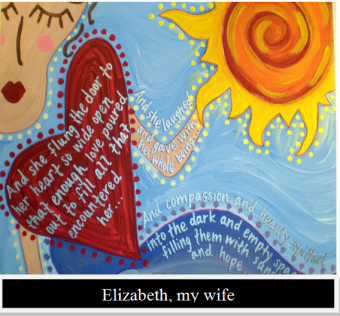
We tell their stories in our classrooms. Other artists paint them. Many have biographies or autobiographies recounting their lives. Their stories embolden us to stay strong, and continue working for justice and equality. But what of the women whose songs really are unsung, whose stories never grace the pages of our textbooks? What about the “unknown” women who have, indeed, emboldened us, paved the way for us to be who we are, but who most people have never heard of? Many such women are also holy, thus deserving of canonization as Holy Woman Icons.

ElizabethI would like to dedicate this post to all the holy women who fill our lives, yet whose stories we never hear. Because it is not only these seemingly famous women—these heroines of feminism—who are holy and whose stories matter.   Continue reading “Painting “Unknown” Holy Women: Commissions, Gifts, and the Unsung Stories of “Ordinary” Women by Angela Yarber”