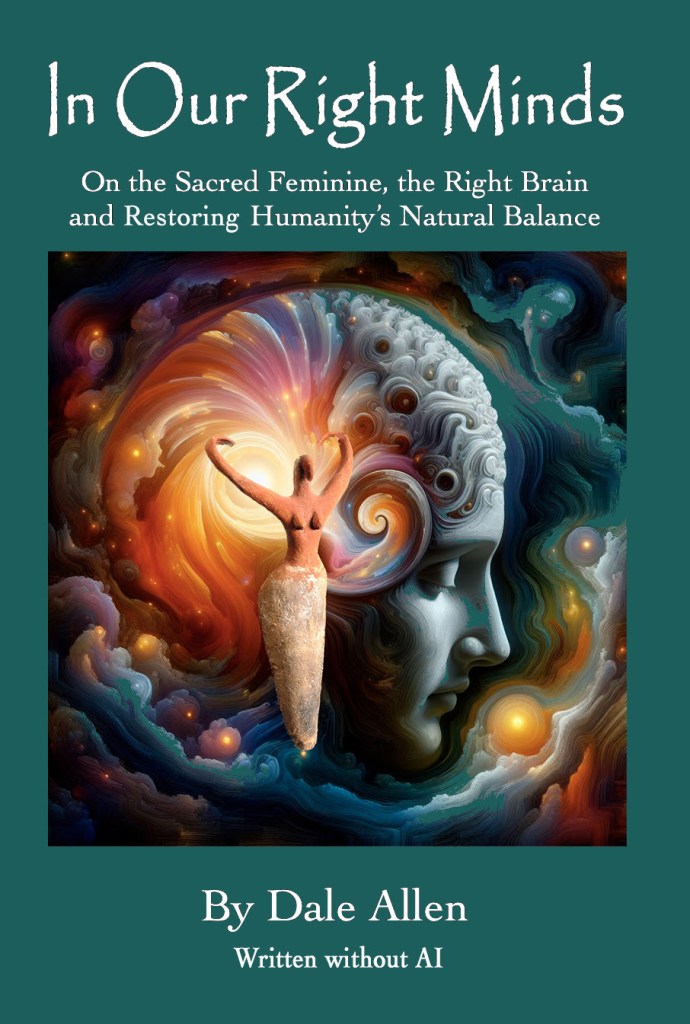
In Our Right Minds: On the Sacred Feminine, the Right Brain and Restoring Humanity’s Natural Balance by Dale Allen

TODAY •  BOOK LAUNCH ON AMAZON!  Launch Discounts underway now!

There’s something about a book. I make a lot of things: podcasts, videos, a film, a musical production, paintings, lots of articles for publications, but this… this feels huge to me. A book. A book that represents 25 years of my life as a spokesperson and champion of the feminine side of humanity – a part of all us.

Here’s the official Press Release:

Veteran of corporate and commercial communications, host, interviewer, and filmmaker Dale Allen has now released her new book, In Our Right Minds. This new book is an in-depth exploration of the sacred feminine and its power to heal humanity as a whole. Sharing her profound journey of exploring the goddess archetype, the author combines science, art, and history for a transcendent literary journey.

Continue reading “In Our Right Minds: On the Sacred Feminine, the Right Brain and Restoring Humanity’s Natural Balance by Dale Allen”

From the Archives: A Feminist Retelling of Noah’s Ark

This was originally posted on May 4, 2018

My daughters came to me after Sunday School one day, concerned about a story they had heard in which God drowned almost everyone on Earth. So I sat down and thought about why a community might want to tell that story, and what valuable wisdom might be lifted from it for my children. Here is what I told them:

God/ess  has  many  faces,  which  help  us  understand  different  things we  need  to  know  at different  times. Sometimes we think of God/ess as Crone, an old, old  woman  crowned with silver hair as  an  emblem of her wisdom, who helps us  learn to let go of anything that is holding back the wellness of our community and ourselves. 

Continue reading “From the Archives: A Feminist Retelling of Noah’s Ark”

God’s Womb by Joyce Zonana

The first time I came across the phrase, I thought I must be making a mistake. “Que Dieu l’enveloppe dans sa matrice,” the passage read in French, “May God’s womb enfold her.” or possibly, “May God enfold her in His womb.” His womb?

Joyce Zonana
The first time I came across the phrase, I thought I must be making a mistake. “Que Dieu l’enveloppe dans sa matrice,” the passage read in French, “May God’s womb enfold her,” or possibly, “May God enfold her in His womb.” His womb?

I’d just started translating Ce pays qui te ressemble [A Land Like You], Tobie Nathan’s remarkable novel of Egypt’s Jews in the first half of the twentieth-century, and I couldn’t be sure I was correct in thinking that “womb” was the proper rendering for “matrice.” But a quick search confirmed my hunch. Matrice (from the Latin matrix < mater) might be translated as “matrix” or “mould,” but that made no sense here. “Uterus or womb” was the anatomical meaning, and it was the first meaning listed in my French dictionary.

The phrase, or something very like it, kept turning up, always after a dead person was named:  

Que Dieu accueille son âme en sa matrice.

Que Dieu l’enveloppe dans sa matrice.

Que Dieu la berce dans sa matrice. 

May God’s womb welcome his soul.

May God’s womb enfold him.

May God’s womb cradle her.

In all, “God’s womb” is mentioned seven times in this novel set in Cairo’s ancient Jewish quarter, Haret al-Yahud. Each time, it’s part of a ritual prayer, a formulaic wish for the wellbeing of a departed soul. But what extraordinary wellbeing is wished for here, what a remarkable envisioning of God as the possessor of a welcoming, warm womb. Continue reading “God’s Womb by Joyce Zonana”

The Messy, Wild Mystery that’s Stronger than Wrong by Trelawney Grenfell-Muir

I am an annoying feminist. I annoy pretty much everyone about it, because I’m never NOT applying a feminist lens to every aspect of life: science (looking at you, Larry Summers), politics (Joe Biden is a rapist), art (objectification is NOT empowerment), culture (make-up is a prison), and, of course religion. I’m perhaps most annoying of all when it comes to religion. I annoy Christians by raving about Christ The Cosmic Vagina, and I annoy secularists by raving about feminist Jesus. I especially annoy my church friends and colleagues by refusing to use the (male) word “God” to talk about the Infinite Divine Mystery, much less male pronouns or oppressive symbols such as Lord, King, or Kingdom.

Yep, I’ve been cheerfully annoying the hell out of everyone for decades, drawing vagina art during male-centric worship services, changing lyrics on the fly, slipping female words and symbols into prayers and startling whomever sits near me… I am a feminist. Not the fun kind. Continue reading “The Messy, Wild Mystery that’s Stronger than Wrong by Trelawney Grenfell-Muir”

A Feminist Retelling of Noah’s Ark by Trelawney Grenfell-Muir

My daughters came to me after Sunday School one day, concerned about a story they had heard in which God drowned almost everyone on Earth. So I sat down and thought about why a community might want to tell that story, and what valuable wisdom might be lifted from it for my children. Here is what I told them:
God/ess  has  many  faces,  which  help  us  understand  different  things we  need  to  know  at different  times.  Sometimes we think of God/ess  as  Crone,  an  old,  old  woman  crowned  with  silver  hair  as  an  emblem  of  her  wisdom,  who helps  us  learn  to  let  go  of  anything  that  is  holding  back  the  wellness  of  our  community  and ourselves.  Continue reading “A Feminist Retelling of Noah’s Ark by Trelawney Grenfell-Muir”

A Feminist Retelling of Cain and Abel by Trelawney Grenfell-Muir

Eve and Adam had many children. Two of them, the sisters Cain and Abel, were best friends. When they grew up, Cain became a farmer, and Abel became a shepherd. In their community, people shared what they had with each other. They shared this way in order to help the community be strong, and to practice gratitude. They shared with each other in sacred, holy ceremonies, in which they put their communal offerings onto an altar for Sister God/ess, to be blessed. One day, both Cain and Abel brought an offering to their community. Cain brought some food she had grown, and Abel brought a sheep. The community gathered for the ceremony. They prayed prayers of gratitude and blessing, and thanked the Earth for its abundance. They each laid hands on the sheep and thanked her for her life, blessed her spirit that it might journey peacefully and joyfully to reunite with Sister God/ess, and praised her for giving her body to feed the community.  Then they killed the sheep, as quickly and carefully as they could, and set the meat in the sacred fire to cook. Abel was glad that she could help her community be fed and healthy with the sheep she had given.

Continue reading “A Feminist Retelling of Cain and Abel by Trelawney Grenfell-Muir”

Notes from A Goddess Pilgrimage by Joyce Zonana

JZ HEADSHOT

The solar eclipse has had me sensing deep alignment with earth, sea, and sky, with my sisters and brothers and Self. This, then, from my 1995 journal of my first Goddess Pilgrimage to Crete with Carol Christ, a trip still engraved in my heart:

June 3  – Yesterday, anointing us with rose, lavender, or olive oil, Jana said, “Your journey has begun.” But for me it is this morning, with the purchase of this journal at the biblio on the square across from the hotel, where I sit now in the lobby, traffic noise outside, our group gathering, preparing for our journey . . . happy to be here . . .

Bleeding at the home of the Panagia, the all holy, the sacred mother, sacred myrtle, ancient tree of Aphrodite, Mary, black-bent nuns: we tie ribbons to the tree, sing, “all manner of things shall be well. Blessed be, walk in beauty.” And I am utterly in tears as I walk on the grounds of this ancient place, the birds singing everywhere, yet there is quiet, stillness, an ancient peace . . . A pilgrimage, a shrine, a very holy place.

Continue reading “Notes from A Goddess Pilgrimage by Joyce Zonana”

A Midwinter Ritual by Barbara Ardinger

Midwinter, the winter solstice (December 21), is the shortest day and longest night of the year. I like to think of Yule, an old pagan name for the solstice season, as a time when we get to take a nice, long, peaceful nap between all those holiday parties. For this ritual, you need two candles (silver and gold), a blanket, and a small gift for yourself.

santaSanta Claus is really a shaman. He wears red and white and black (the three sacred colors of the so-called ancient triple goddess) and he’s fat because he’s well-fed. (A traditional shaman once told me never to trust a skinny shaman; if his people don’t provide for him, he’s not doing his job.) Santa flies from the frozen north, where the Saami (or Lapp) shamans still wield their full traditional powers. He’s drawn through the air by magical reindeer whose antlers symbolize the surging force of life. The Christmas tree is the world pole. From Mongolia to the American Southwest, shamans traditionally ascend the world pole to make their astral journeys. Santa knows everything, especially if we’ve been good or bad, and like karma itself, he brings us our just desserts. His gifts are the gifts of the spirit made material. His attendants, the toy-making elves, are the Old Ones who help the deserving and play tricks on the undeserving. Santa is not a god, but let’s honor him along with the solar gods and goddesses in our midwinter ritual. Continue reading “A Midwinter Ritual by Barbara Ardinger”

Maiden, Mother, Crone: Ancient Tradition or New Creative Synthesis? by Carol P. Christ

Carol P. Christ by Michael Bakas high resoultionThe image of the Goddess as Maiden, Mother, Crone is widespread in contemporary Goddess Spirituality. The Triple Goddess honors three ages of women, in contrast to the wider culture that: affirms young women as sex objects while shaming them as sluts; celebrates mothers on Mother’s Day, while providing few legal and economic protections for mothers; and ignores older women.

Though Goddess feminists have created rituals for menstruation and birth, I suspect that a greater number of rituals have celebrated “croning.” The reasons for this are twofold. One is that women have time and space to reflect on the meaning of life in middle age. The other is that aging women are not honored and respected in the wider culture–creating a need for rituals that do just that. Many women I know have spoken of the empowerment they felt in their croning rituals.

On the other hand, many women I know have not been particularly interested in a croning ritual. Continue reading “Maiden, Mother, Crone: Ancient Tradition or New Creative Synthesis? by Carol P. Christ”

The Tension of Opposites: Love, Chaos, & the Wild Vortex by Chris Ash

“Perhaps it shouldn’t be surprising that a high tolerance for ambiguity, ambivalence, and a tendency to think in opposites are characteristics researchers have found common among creative people in many different fields. But professional creators… come to understand that in order to be creative, they need to give themselves to sensations of ‘knowing but not knowing,’ inadequacy, uncertainty, awkwardness, awe, joy, horror, being out of control, and appreciating the nonlinear, metamorphosing features of reality and their own thought processes — the many faces of creative chaos.”

– John Briggs and F. David Peat, Seven Life Lessons of Chaos

Christy CroftAs someone whose interfaith, nature-based spirituality regularly draws inspiration from science, I experienced my recent read of the book Seven Life Lessons of Chaos as both an affirmation and a challenge. Throughout the book, one theme emerged over and over, each time in a different context: the creative impulse – that which generates nature and space, planets and stars, love and rage – emerges from within the tension of opposites.

Creation doesn’t burst forth from one opposite overtaking another, but rather as the direct outcome of the unending push-pull swirl of outward and inward, boldness and fear, light and dark. Living in creative authenticity regularly leaves me stewing in a mix of often-contradictory feelings, and while it’s easy for me to revel in my confidence when I’m feeling bold or in my wordy wit when I’m feeling brilliant, it’s far more difficult for me to sit with wonder in times when I feel rejected, unlovable, unaccomplished, insecure, or ugly. My inner dialogue frequently finds me alternating between the opposites that pull at my heart, mind, and way of being in the world.

Really, this is where many of us often find ourselves – be smart but not too intelligent, be beautiful but not vain, be sexy but not sexual. Madonna-whore, virgin-slut – choose a side, but know that once you do you will be judged. We are asked to choose between equally restrictive and caricatured forms that have been pre-fabricated for us by years of cultural control and legal oppression – forms that emphasize who we are in relationship to others, to men, and to our religious laws, rather than honoring who we are to ourselves, to our gods, and in our chaotic brilliance. Continue reading “The Tension of Opposites: Love, Chaos, & the Wild Vortex by Chris Ash”