Rest awhile, Dear Reader, and dream along with me. We’re standing on a corner, call it Main Street, Any City, USA. We’re chatting, passing the time of day, being happy we can stand among other people without the fear of a giant virus jumping out of someone’s breath and attacking us. It’s a nice day here on the street. Not much traffic.
Oh, look—there’s a huge box in the middle of the intersection. It’s shabby, looks to be made of old, thin wood loosely clamped together. The box starts shaking, rocking back and forth. What’s in there? Something is obviously trying to get out. As we watch, an orange mist starts seeping out through the cracks in the box. More shaking. Now the box seems to be jumping. More orange mist. And the box shatters. An orange form—is it human? It’s fat. It’s shaking an iPhone. Or is that a golf club? The orange one speaks. “Do you miss me yet?” “Stand back and stand by.” “I’ll be baa-ack.”
Many years ago I participated in seasonal, Goddess-focused celebrations featuring handmade decorations, including some by enormously talented artists who attended. One year, our spring fete was graced with gorgeous paintings, intricately woven and colorful fabric art, sensuous sculptures, and exquisitely painted eggs. I brought a Peeps diorama depicting the reunion of Demeter and Persephone. (For anyone wondering, Peeps are brightly colored marshmallows in the shape of bunnies, chicks and other shapes and are sometimes made into dioramas for contests in schools and libraries.) The reason I brought the diorama was partly because, though my own artistic talent is somewhere between extremely questionable and non-existent, I thought people might enjoy a little bit of whimsy to honor spring’s exuberance. In addition, however, I was also going through a time of great personal and professional stress and my soul deeply needed to be creative with just a little outrageous fun.
To recap the story, Persephone had been abducted by Hades and taken to the Underworld. Her mother, Demeter, made the Earth barren until the gods agreed to Persephone’s release. Demeter is the purple Peep and Persephone is yellow, and they are about to be reunited. Hades is pinkly enraged as he stands at the gateway to Hades. Gummi bears are romping while green humans dance in a circle. Snow is on the trees to show that winter is giving way to spring as Demeter returns abundance to the world.
This blogpost is about biblical verses and uncovering the magic and spirit behind its words. Why, you might ask, is this a project that belongs on a blog dedicated to feminism?
I believe it does because it helps us to strip away the many layers of patriarchy with its attempts to hide and/or change original teachings. Remember; these stories were originally oral wisdom teachings of the “folk.” They weren’t written down until the Babylonian exile, hundreds if not thousands of years removed from their origins. And who was doing the writing? Priests, scribes, and prophets, all with their own agenda. Even the earliest writings we have, the Dead Sea Scrolls, were still written in patriarchal times.
I was intrigued by the discussions of Jung and Jungian motifs, such as the sacred marriage, that sprang up in response to Mary Sharratt’s wonderful post “The Via Feminina: Revisioning the Heroine’s Journey,” partly based on Maureen Murdock’s book. Carol Christ pointed out the problematical nature of the whole notion of the sacred marriage, relying as it does on our stereotypes of the masculine and feminine.
Sara Wright reported that her sense of the dangers of Jungian thought led her to change her profession; she had once been a Jungian analyst. Barbara McHugh put forward a well-thought out and articulate version of the Heroine’s Journey, corrected for sexist thought.
A high priestess became pregnant in a manner that was forbidden in her society. She gave birth to a baby boy. Fearing for her child’s life, she fashioned a basket of rushes and cast him into a river. He was retrieved by a man named Akki whose name means “the drawer of water.” Akki raised the boy.
A son was born to a young princess who had been forced to keep her pregnancy a secret because it was forbidden. When her son was born, she placed him in a basket and floated him down the river. He was found and raised by foster parents. He grew up to become a noted warrior, speaker and eventually a king.
A young boy accidentally ingested some drops of star-studded wisdom from the cauldron of a goddess and, in this manner, was suddenly awakened to divine knowledge. The goddess grew furious that her divine wisdom was stolen. Desperate to escape her life-threatening wrath, a wild chase ensued. The boy turned himself into a rabbit, but the goddess turned herself into a dog to chase him down. The boy turned himself into a fish to swim away but the goddess became an otter to continue the chase. The boy then turned himself into a bird, but the goddess became a hawk. Finally, the boy turned himself into a seed and hid in a large pile of grain. The goddess turned herself into a hen and ate up all the grain including the boy-as-seed. In this manner she found herself pregnant. She planned to kill the baby when he was born, but when she saw him, he was so beautiful that she fell in love and she could not bring herself to do so. The goddess sewed the baby into a leather sack and threw him into the river. He was retrieved by a man named Elphin who renamed and raised him.
A woman of the priestly caste of her tribe gave birth to a baby boy. At the time, all boys born to her tribe were under a decree of death. To save her son’s life, she created a basket of reeds and floated him down the river. He was found by a royal princess who retrieved him from the water, gave him a new name and raised him to adulthood.
The first time I came across the phrase, I thought I must be making a mistake. “Que Dieu l’enveloppe dans sa matrice,” the passage read in French, “May God’s womb enfold her.” or possibly, “May God enfold her in His womb.” His womb?
The first time I came across the phrase, I thought I must be making a mistake. “Que Dieu l’enveloppe dans sa matrice,” the passage read in French, “May God’s womb enfold her,” or possibly, “May God enfold her in His womb.” His womb?
I’d just started translating Ce pays qui te ressemble [A Land Like You], Tobie Nathan’s remarkable novel of Egypt’s Jews in the first half of the twentieth-century, and I couldn’t be sure I was correct in thinking that “womb” was the proper rendering for “matrice.” But a quick search confirmed my hunch. Matrice (from the Latin matrix < mater) might be translated as “matrix” or “mould,” but that made no sense here. “Uterus or womb” was the anatomical meaning, and it was the first meaning listed in my French dictionary.
The phrase, or something very like it, kept turning up, always after a dead person was named:
Que Dieu accueille son âme en sa matrice.
Que Dieu l’enveloppe dans sa matrice.
Que Dieu la berce dans sa matrice.
May God’s womb welcome his soul.
May God’s womb enfold him.
May God’s womb cradle her.
In all, “God’s womb” is mentioned seven times in this novel set in Cairo’s ancient Jewish quarter, Haret al-Yahud. Each time, it’s part of a ritual prayer, a formulaic wish for the wellbeing of a departed soul. But what extraordinary wellbeing is wished for here, what a remarkable envisioning of God as the possessor of a welcoming, warm womb. Continue reading “God’s Womb by Joyce Zonana”
The end of winter is near in the northern hemisphere. Though the cold persists the days slowly grow longer. If you’re lucky you might soon see a skein of geese flying overheard on their way to their northern nesting grounds – a beautiful reminder of our world’s ongoing cycles of change.
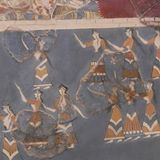
If we begin from the hypothesis ancient Crete was matriarchal, matrifocal, and matrilineal, what would we expect to be the central focus of the its religion?* Harriet Boyd Hawes and her colleague Blanche E. Williams presented an incipiently feminist, woman-centered, analysis of the religion of ancient Crete in Gournia, the book describing their excavation of a Minoan village at the beginning of the twentieth century. Boyd Hawes argued that the archaeological evidence showed not only the pre-eminence of the Goddess, a conclusion with which Williams agreed, but also the strength and independence of women in a culture she defined as matriarchal and matrilineal, centered around the Mother family. If ancient Crete was matrilineal, matrifocal, and matriarchal, we should expect to find evidence that women were not only strong and independent, but also that they had leadership roles in religion and culture. Williams noted the presence of priestesses. The miniature frescoes from Knossos show a group of older women sitting in the place of honor and a group of women performing a ritual dance. Where evidence concerning leadership roles is lacking, it should not be assumed that leadership must have been in the hands of men.
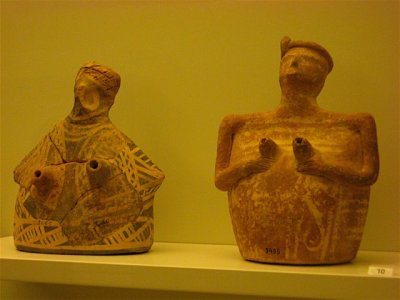
We should not be surprised to find the Goddess or mother earth to be at the center of rituals and ceremonies in ancient Crete. However, to say that the Goddess is central begs the question of what we mean when we say Goddess. In the west, deity is understood to be transcendent of the world, imaged as a dominant male other, and as the judge of the living and the dead. Citing the Oxford English Dictionary, archaeologist Colin Renfrew bases his discussion of Minoan religion on the idea of divine transcendence. But if we accept Marija Gimbutas’ insight that the Goddess represents the powers of birth, death, and regeneration in all forms of life, a different picture emerges. The Goddess is immanent in, rather than transcendent of the world. She is the enlivening force in human beings and all of nature. She is not the judge of the living and the dead, for the dead are returned to her body. Unlike later Greek deities, the Goddesses of Old Europe and ancient Crete are not generally portrayed as idealized human beings. Though they often have eyes, breasts, and sacred triangles, they also have beaks and wings, are shaped like mountains, and decorated with flowing lines symbolizing rivers or streams. These hybrid forms suggest that all of life is in the image of divinity and that humans are not higher, better, or separate from other life forms. Hybrid images celebrate the connection of all beings in the web of life and call human beings to participate in and enjoy this world, not to seek to escape or rise above it. A religion centered around gratitude for life in this world is very different from one that centers around fear and judgment and a longing for life after death. Jacquetta Hawkes’ insight that the religion of ancient Crete celebrated “the grace of life” is exactly right.
Is the Old European or Minoan Goddess one or many? Monotheists have insisted that there can be only one God, yet polytheists revere a plurality of images, while animists celebrate the spirits of (perceived) living beings such as rivers and trees, mountains and caves. The terms monotheism and polytheism are not neutral. Both were developed by monotheists: monotheism describes the correct beliefs of the self; polytheism, the false beliefs of the other. I find theologian and liturgist Marcia Falk’s distinction between exclusive and inclusive monotheism helpful in resolving the question of the one and the many. According to Falk, inclusive monotheism is an intuition of the unity of being within the diversity of the world: celebrating the unity of being, it welcomes a plurality of images to represent diversity and difference in the world. From this point of view, the boundaries between monotheism and polytheism are porous. When Gimbutas spoke of the powers of birth, death, and regeneration in all of life, she was referring to the unity of being underlying the diversity of life forms, including plants, animals, and human beings. Similarly, when indigenous peoples speak of mother earth as the giver of all and all beings as relatives, they recognize that all life is sustained by a single source. The fact that ancient Cretans imaged divinity in different ways and with different characteristics does not require the conclusion that they worshipped many discrete deities as some archaeologists argue: I suggest that they intuited a unity of being while celebrating the diversity of life. This appears to have been the conclusion of Williams who wrote of “the prominence of a goddess under various aspects.”
If matrilineal, matrifocal, and matriarchal cultures tend to view the earth as a great and giving mother, we can expect this insight to be expressed in rituals and ceremonies. Gratitude is the appropriate response to gifts freely given. I suggest that gratitude for the gift and gifts of life was not only a focus, but the central focus, of religion in ancient Crete. If this is so, we should expect to find rituals celebrating the gift of life in the birth of babies, the coming-of-age of girls, as well as in as well as in death rituals honoring the ancestors. We can also expect to find rituals honoring the mother line and expressing gratitude for the wisdom of ancestors. Many of these rituals would have taken place in the matrilineal House as archaeologist Jan Driessen suggests. Rituals for the ancestors might also have taken place in cemeteries. We should also expect to find rituals expressing gratitude for the food that sustains life, for example, in offerings of first fruits to mother earth and in the pouring of libations that are absorbed back into her body. If, women invented agriculture, and if as Gimbutas argued, Old European religion celebrated the processes of birth, death, and regeneration in all of life, we should find rituals focused on planting, harvesting, and storing seeds. Some of these rituals might have taken place in the matrilineal Houses, while others surely took place in nature and in the fields. If pottery-making and weaving were understood to be mysteries of transformation involving birth, death, and regeneration, we might find evidence of rituals associated with these activities in the Houses or in workshops. It is known that rites in ancient Crete involved trees, mountains, and caves, as well as water sources. We must ask if and how such ceremonies expressed gratitude to the mother earth, the source of life, and the cycles of birth, death, and regeneration.
*These musings are part of an early draft of the methodological prologue to an essay I have been asked to write on Religion in a Minoan Village to be published in the archaeological report on recent excavations at Gournia. In the preceding part of the prologue, I discuss the theories about matriarchal, matrifocal, and matrilineal cultures of Harriet Boyd Hawes, Blanche E. Williams, Marija Gimbutas, Heide Goettner-Abendroth, and others.
Even though I was a late-comer to the Netflix series The Crown, when I did watch it, I was riveted. Lots of thoughts ran through my mind at this picture of royalty. The concept of royalty in human history is vast and multi-faceted, however in this blogpost I am only pulling on a few threads that tugged at me as I watched this show.
I laughed as people greeted the Queen and said, “your highness.” Does that make the rest of us lownesses? And where did all this pomp come from anyway? And why is the British monarch the head of the Church of England which is a bible-based Christian religion?
Monarchy, religion and war have always seemed so connected in our culture. Indeed, during the coronation of Queen Elizabeth, she was handed “the sword of state” as if she would actually be using it. (I looked it up, true to the ceremony). Continue reading “Musings on The Crown by Janet MaiKa’i Rudolph”
This morning, I walked around the field and discovered three soft white breast feathers of an unknown bird, two earthstar mushrooms, sinking quietly back into the soil, one tiny snail shell, curled in spiral perfection, and the fire of my own spirit burning in my belly, rekindled by elemental magic of the everyday kind, the small and precious gifts of an ordinary day.
Every January, we rent a house on Dauphin Island and spend the month at the beach with our kids. Usually, we pack our business along with us and work from the rental house, though this year my sister kept it running from our home studio in Missouri instead. My husband describes this month away as the “weekend of the year,” and this is, in fact, how it feels, except for unlike most normal weekends, we walk five miles by 8:30 a.m. each morning. We joke that this is one of the best ways to know we’re on “vacation.” During one month of walking, we will log more than 300,000 steps together, this time away from home allowing us to pare back the layers of to-dos that build up each year, to re-prioritize our goals, to re-sync ourselves with what we most value, and to breathe deeply back into ourselves again—our hearts, our hopes, our dreams—after the hectic holiday season. Since we are self-employed, we never wake to an alarm clock at home, but while on our sojourn away, always motivated by the prospect of finding good shells, we set the alarm for 5:00 a.m., rising to the voice of Kellianna singing “I Walk with the Goddess” as we set off in the darkness to the uninhabited beach down the road. This year, due to hurricane damage and the resultant road work and beach restoration work in progress, the only way to reach our favorite walking spot is to rise before the road crews do and get out and back before the access road is closed to traffic for the work day.
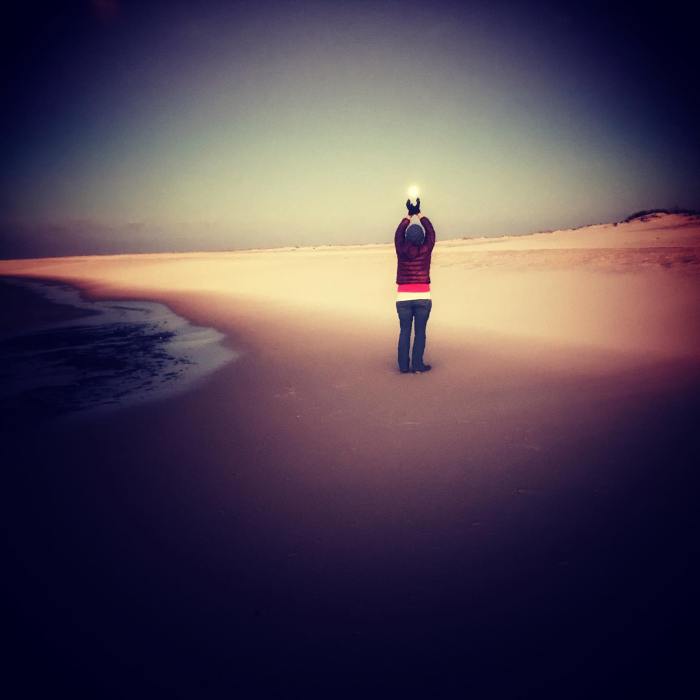
We walk before dawn, our faces glimmering palely beneath a full moon. Our shell finding has been slender on this trip, the beach often swept clean by waves, but on this day, lit only by full moonlight, I finally catch sight of a big brown moon snail shell, half-buried in the sand. My favorite type of shell and, discovered on a full moon, no less! My husband’s foot comes down upon it as I grab his arm to stop him, but then I seize it with glee, undamaged and smooth in my hand. Though I have previously written that I expect no reward for devotion, sometimes it is, in fact, delightful to receive a reward anyway, especially on a dark beach with only moonlight as my guide. We spot two glowing eyes a few feet away and a fox keeps pace with us, pausing to sit and watch as we make our steady way along the shore. The sky lightens to rainbow stripes as the first flares of dawn begin to glow with eastern fire. I stand with my arms extended, the fingertips of one hand reaching for the moon while the other hand reaches for the sun, the waves lapping at the shore, the wind at my back. I feel held, suspended in eternity, small and rapturous, balanced at a centerpoint of time, inhabiting the liminal, poised within a living strip of space between land and sea, earth and sky, wind and sand, dawn and dusk, motion and stillness. Behind me, the fox moves swiftly away across the sand under a rainbow sky.
I reflect as I continue to walk, murmuring the Charge of the Goddess below the moon, that these are my favorite kinds of rituals, the most powerful kinds of ceremonies, the truest expression of magic in my life and days.
On the winter solstice this past year, I carried a blanket out to the field in front of our house. I brought along my Womanrunes cards so I could do an annual oracle card layout for the year. I carried my journals and my planner and some of our small goddess figurines. Rather than sit on the blanket and dream about the year to come, busily scribbling notes and ideas in my planners as I had envisioned, instead I lie flat on my back on gazing at the sky. I became aware as I was lying there, breath slow in my belly, that I could see the moon on my right hand side and I could see the sun getting closer to setting on my left hand side. Then, I became aware that the birds were at my feet at our bird feeder by the studio building. Next, I became I aware of the cedar trees above my head, at the far side of the field. Lying there, feeling the earth beneath me, the sensation struck: I’m surrounded by the elements. I’m surrounded by all these aspects of magic, right now, no elaborate solstice ritual required. Though I made sun bread with my children and we held our traditional candle lit winter solstice ceremony and spiral walk, these moments lying on my back in the field were my ritual, my ceremony, the fullest expression of a living spirituality for me. Magic need not need to be fancier or more elaborate or more planned out than this, I think. It can mean lying on your back in a field and feeling the presence of the living elements around you, carrying you, holding you, supporting, nourishing, restoring, revitalizing, and, in a way, rebirthing you into awareness.
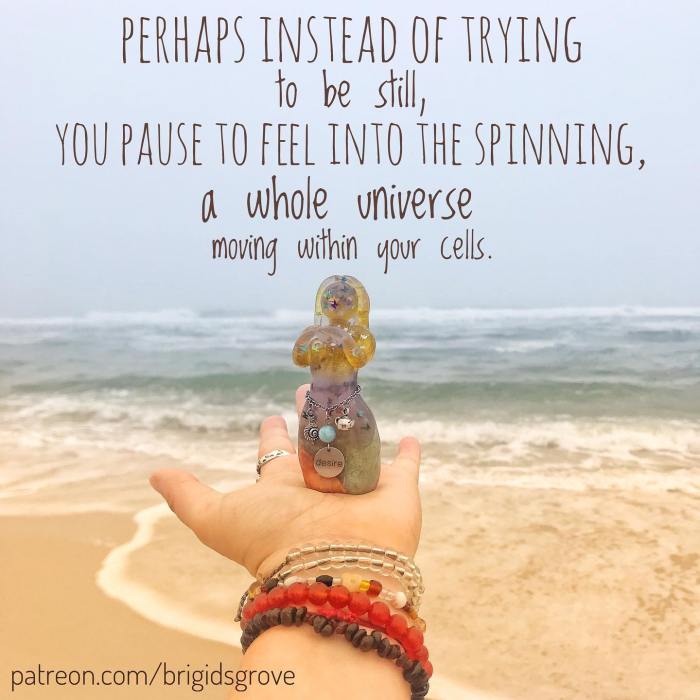
When I rose from my blanket to work on my plans, I noticed the way the rapidly setting sun was peeking through the trees and I decided to take a picture of one of my goddesses there with the last rays of the solstice sun shining behind her. As I squatted down to take the picture, I saw that one of the sunrays was extending through the trees in such a way that it was literally pointing exactly at my blanket, right at my little pile of books and my little plans, an affirmation of sorts: this is where you need to be, this is what you need to be doing. Since it was the Winter Solstice, of course this ray of light reminded me of light coming through Stonehenge and striking the exact right point, and it thrilled me to know that if I hadn’t decided to be outside exactly at this exact moment with the sun at this position, I never would have seen the ray of light illuminating my blanket. I’m not suggesting that the sun did that for me, it was rather that I allowed myself to witness what was already there, as if the ceremony was in place, it was unfolding, it was taking place, whether I was going to step into it or not, whether I was going to notice it or not, whether I was even aware of it or not. While this may not sound like a ceremony or a ritual in the way that many people describe ceremony and ritual, for me, it was one of the most powerful rituals I experienced that year.
Ceremonies of earth and being are unfolding around us all the time and we can either be present for them or not.
I could not have planned or designed that solstice or the full moon, fox-accompanied beach walk. I could not have planned or designed these rituals of living. I stepped out into the world instead and saw what ceremony was already underway, and then took part in it. Perhaps this sounds too simple or too small. There are many books with plans and outlines, ceremonies and correspondences, the right colors of candle and the right invocations to choose. And, those things are all wonderful too. I love setting up a fulfilling ritual space and creating a ritual atmosphere for people. I love candles and singing and choosing just the right words. I write today to remind us that there are many rituals of the everyday, there are many ceremonies of everyday magic, natural magic, that are already unfolding around you. I invite you to consider stepping into them and receiving them as a gift rather than trying to harness the elements or shape the setting to your own will. I encourage you to savor and see the unplanned, small magics of living unfold as they will. These elements of the holy, these sacred sites, can be alive, within you, beneath your feet, and around you every day, waiting (or not waiting) for you to notice that they’re here, carrying you along.
May you celebrate, savor, and sink into the magic of your life right where you are.
Sometimes, the world creates ceremonies for us and we just have to show up for them.







 If we begin from the hypothesis ancient Crete was matriarchal, matrifocal, and matrilineal, what would we expect to be the central focus of the its religion?* Harriet Boyd Hawes and her colleague Blanche E. Williams presented an incipiently feminist, woman-centered, analysis of the religion of ancient Crete in Gournia, the book describing their excavation of a Minoan village at the beginning of the twentieth century. Boyd Hawes argued that the archaeological evidence showed not only the pre-eminence of the Goddess, a conclusion with which Williams agreed, but also the strength and independence of women in a culture she defined as matriarchal and matrilineal, centered around the Mother family. If ancient Crete was matrilineal, matrifocal, and matriarchal, we should expect to find evidence that women were not only strong and independent, but also that they had leadership roles in religion and culture. Williams noted the presence of priestesses. The miniature frescoes from Knossos show a group of older women sitting in the place of honor and a group of women performing a ritual dance. Where evidence concerning leadership roles is lacking, it should not be assumed that leadership must have been in the hands of men.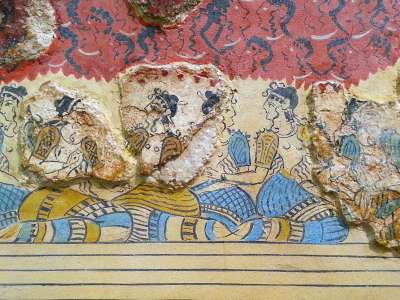

 Feminism and Religion