How the Dark Fairy Carabosse Found the Light by Barbara Ardinger

Barbara ArdingerThe dark fairy Carabosse was in a snit. “Here I am,” she fumed, “the smartest, most literate, least mischievous fairy in any world, and no one will listen to me. I’m the best of all possible fairies in the best of all possible worlds. And do I receive my due respect? Why am I not Goddess of the Sun?”

“Hush, dear,” said Carabosse’s amanuensis. “There’s already a sun god. There can’t ever be a sun goddess. The sun shoots out masculine energy—that’s what the mortals say. The moon absorbs and reflects the masculine energy. The moon is the feminine planet.”

“Well, I’m tired of reflecting men’s power. I’m also tired of being ruled by the phases of the moon. I demand to be a sun goddess so I can rule the moon! Grimmella, what’s the moon phase today?”

Grimmella looked at her handy pocket calculator. “It’s eleven percent waning, Almost dark. Which might explain your mood.” As Carabosse sniffed and glared at her, she added, “You can’t be a sun goddess. It’s just not done!”

“Oh, Grimmella,” the dark fairy exclaimed, “don’t be so old-fashioned! Wake up! We’re done with all that reflected light business. I want to be the source of light. Besides, it’s a new century! Even for the mortals. And I’ve done so much for them—for us fairies, too—that I deserve a reward. I deserve to the Goddess of the Sun.” When Grimmella laid her pen down and frowned, the dark fairy went on with her rant. “Do you know who that hubristic Apollo really is?” Continue reading “How the Dark Fairy Carabosse Found the Light by Barbara Ardinger”

Good Theology is Feminist Theology by Carol P. Christ

carol christJudith Plaskow and I are just now completing the draft of the manuscript of the book we have been working on for the past 2 ½ years. It has a new title: Two Views of Goddess and God for Our Time.* I have been thinking of little else for the past few weeks. An editor who is considering our book said that she was hoping we could address our book to an audience larger than the feminist theology community. Thinking about this, a light dawned: if feminist theology is right that traditional theology denies the full humanity of women, then good theology must be feminist theology. Our work is not tangential to the theological mainstream, but is at its center.

We have revised the Introduction and Conclusion to the book with the assumption that our work should appeal not just to other feminists, but to a wide range of intelligent readers and thinkers. The fact that we were asked to participate in a dialogue about the nature of God in Tikkun magazine’s Summer 2014 inspires us to hope that we are right that feminist theology is becoming part of the progressive theological mainstream.

We began our new book because – though we agree about many things – we disagree about God and Goddess. After working together for decades with shared commitments to feminism, justice, the environment, and the flourishing of life, it was a bit of a shock to come face to face with our differences on such a major theological issue as the nature of divinity. We began our discussion with a shared critique of the God of Biblical traditions as a dominating male other. We agreed that this God has justified not only male domination of women, but other forms of domination as well, including myriad forms of injustice and war. We questioned the theological doctrine of divine omnipotence in light of the holocaust, the on-going domination of one half of the human race, and other oppressions including slavery, colonialism, and war.

But as we articulated our own views of divinity in light of this critique, our views diverged: Judith concluded that God is an impersonal power of creativity that is the ground of all being and becoming, including all good and all evil. Carol understands Goddess as the intelligent embodied love that is the ground of all being and becoming, a personal presence who cares about the world and all individuals it, but who does not have the power to intervene with a mighty arm to set things straight.

We both can give reasons for our views, and in the course of our theological discussion in our book, we give many. Our different views of Goddess and God are significant both theologically and personally. Is God or Goddess good? Or does the divine power include both good and evil? Does Goddess or God care about the fate of the world and our individual lives? Or are love, care, and understanding qualities that are not appropriately attributed to divinity? Is there someone listening to us when we worship, pray, or meditate? Or is addressing Goddess or God a metaphoric way of speaking that inspires feeling in individuals and communities but not in a divine individual? Is the notion that Goddess is love likely to inspire us to love the world more deeply and to promote its flourishing? Or does the notion that God includes both good and evil remind us more clearly of our own capacities to do both?

The fact that we could not agree about the nature of Goddess or God despite our many attempts to persuade each other with rational arguments, led us to conclude that the philosophical, theological, and moral reasons we give in justification of our views are only part of the story. All of these reasons are situated in our individual bodies and in communities and histories. We do not believe there is any simple link between experience and theological views. On the other hand, our experiences form the matrix from which we all begin to think theologically. As we develop our theological views, we constantly test them against our experiences, asking if they ring true, if they help us make sense of our personal, communal, and social lives.

In the first chapters of our book Judith and I locate our theologies in the contexts of our lives. We not only articulate our views of Goddess and God, but also situate them in community. Judith is committed the feminist transformation of Judaism, while I am one of the early voices of the feminist Goddess movement. In the concluding chapters we probe and query each other’s views–from experiential, rational, and moral perspectives. We are hoping to model the kind of feminist dialogue we would like to see more of—one that crosses religious boundaries and is not afraid to probe the differences in standpoints and theological views.

We also hope that our book will inspire a lively feminist–and wider–dialogue about the nature of divinity—something that has been oddly missing heretofore in feminist theology. Engaging in a thoroughly open and honest theological debate is not always easy—even among friends. But we can both testify that doing so has not only illuminated important issues in feminist theology, but also has strengthened our friendship.

*Much this essay is adapted from a draft of the book.

Carol P. Christ is looking forward to the fall Goddess Pilgrimage to Crete which she leads through Ariadne Institute.   Space available.  Carol can be heard in a recent interviews on Voices of the Sacred Feminine, Goddess Alive Radio, and Voices of Women.  Carol is a founding voice in feminism and religion and Goddess spirituality. Her books include She Who Changes and Rebirth of the Goddess and with Judith Plaskow, the widely-used anthologies Womanspirit Rising and Weaving the Visions.  Follow Carol on GoddessCrete on Twitter.

Almighty Isis by Elizabeth Cunningham

Elizabeth Cunningham headshot jpegWhen the press began using I.S.I.S. as a perhaps inaccurate and now obsolete acronym for the Islamic State of Iraq and Syria, diverse groups made a connection with the Egyptian goddess who was once worshiped all over the Greco- Roman empire. A pagan organization protested the appropriation of the goddess’s name. Others took it as a sign that the self-declared Islamic State represented the anti-Christ or confirmed a conspiracy by the Illuminati. (Divinity of any kind seems to attract human projection.)

When I was doing research for my novel, The Passion of Mary Magdalen, Isis found a special place in my heart. A lover and mother goddess, later associated with both Mary Magdalen and the Virgin Mary, Isis appealed to people from all classes and cultures, especially to women, respectable Roman matrons and prostitutes alike. Continue reading “Almighty Isis by Elizabeth Cunningham”

Dog Days, Holly, Spears and Swords by Deanne Quarrie

Deanne QuarrieWe are little more than midway in what are called the “dog days” of summer. Imagine that the ancients thought that Sirius (one of the dog constellations) was the cause of the extra hot and sultry days of summer  because that star rose with the sun each day during this time and they actually thought we received heat from it.  But no, there is no heat from Sirius, only the tilt of the earth, giving us more heat during. Continue reading “Dog Days, Holly, Spears and Swords by Deanne Quarrie”

JUSTICE AND PREJUDICE IN THE “PROPHETIC TRADITION” by Carol P. Christ

carol christBesides being advocates of social justice, the prophets of Israel were advocates of “exclusive monotheism,” exclusively “male monotheism,” “religious othering,” and “religious prejudice.” 

Many progressive Jews and Christians find inspiration in prophets because of their insistence that their God cares about the poor and “the widow at the gate.” For progressive Christians, Jesus stands in the prophetic tradition, and the core of his message is “concern for the poor.” For progressive Jews the prophetic tradition is the root of their concern for human rights.

Those who locate their spirituality and concern for social justice in the prophets can point proudly to Martin Luther King and the many priests, ministers, and rabbis, as well as ordinary Christians and Jews who marched with him as exemplars of the prophetic tradition.

But the prophetic tradition also has a nasty underside. Continue reading “JUSTICE AND PREJUDICE IN THE “PROPHETIC TRADITION” by Carol P. Christ”

“THE OLD RELIGION” OR A “NEW CREATIVE SYNTHESIS”? by Carol P. Christ

carol christIs Goddess feminism an old religion or a new creative synthesis? Can it be both?  Goddess feminism draws on the feminist affirmation of women’s experiences, women’s bodies, and women’s connection to nature; the feminist critique of transcendent male monotheism as the symbolic expression of male domination of women and nature; and 19th and early 20th century discussions of Goddesses and matriarchy.

Most Goddess and other spiritual feminists have experienced Wiccan rituals, which are often simply called Goddess rituals.  For many of us, elements of Wiccan practice strike a chord of knowing, while other aspects seem odd or strange or even just plain weird.  What are the roots of Wiccan ritual?

In their syntheses of women’s experiences, ancient Goddess religions, and feminism, Z Budapest and Starhawk drew upon the earlier creative synthesis of the Englishman Gerald Gardner which he variously called “the Old Religion,” “Witchcraft,” and “Wicca.” Continue reading ““THE OLD RELIGION” OR A “NEW CREATIVE SYNTHESIS”? by Carol P. Christ”

Painting Martha Graham by Angela Yarber

angela

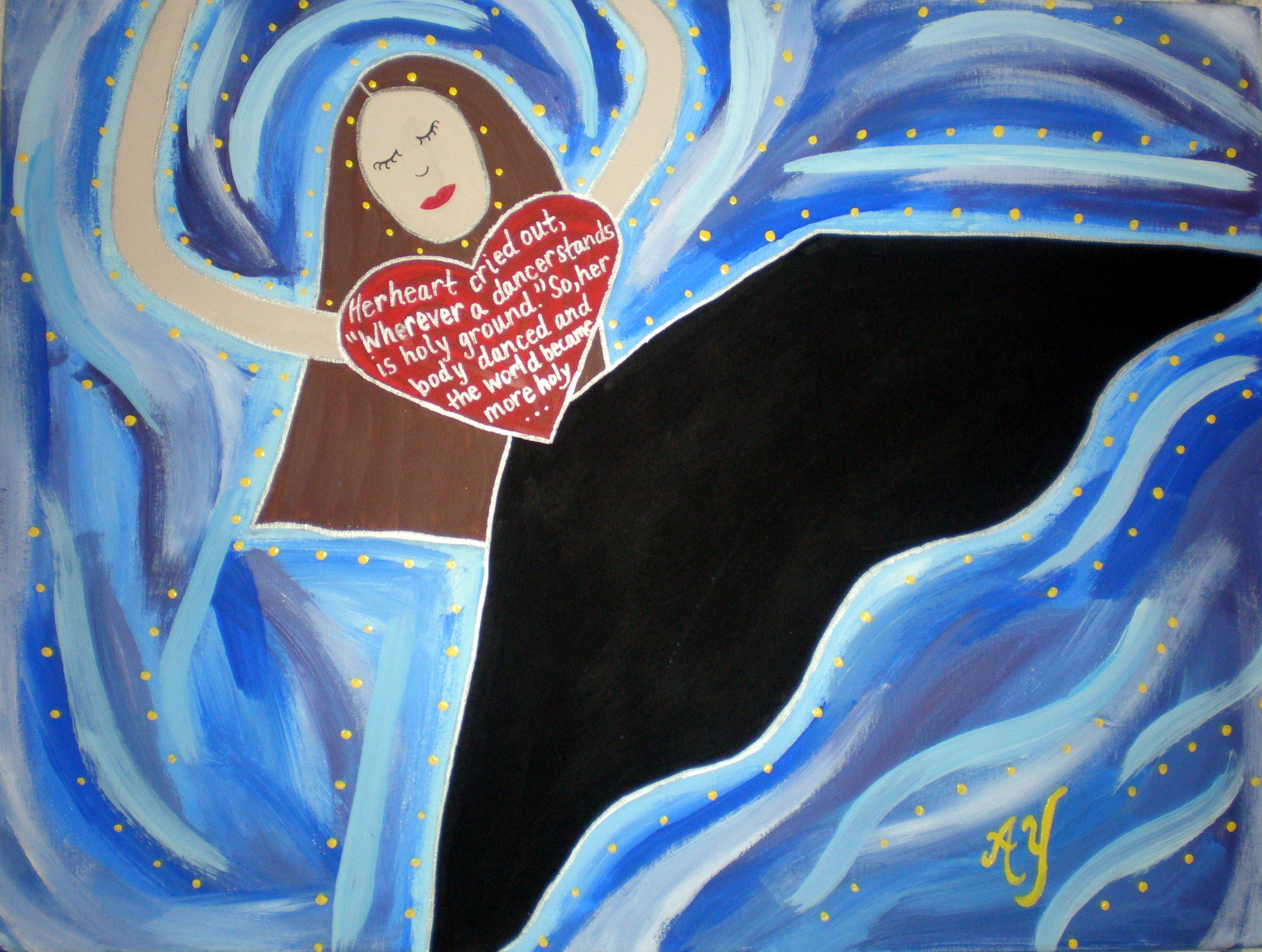
Joining Virginia Woolf , the Shulamite, Mary Daly, Baby Suggs, Pachamama and Gaia, Frida Kahlo, Salome, Guadalupe and Mary, Fatima, Sojourner Truth, Saraswati, Jarena Lee, Isadora Duncan, Miriam, Lilith, Georgia O’Keeffe, Guanyin, Dorothy Day, Sappho, Jephthah’s daughter, Anna Julia Cooper, the Holy Woman Icon archetype, Maya Angelou, and all my other Holy Women Icons with a folk feminist twist  is the dancing revolutionary Martha Graham. So, as the contemporary and modern dancers on So You Think You Can Dance continue to amaze us this summer, let us remember from whence they came.

Martha Graham’s contribution to the world of dance cannot be overestimated. She is regaled as the Picasso of the dance world, revolutionizing it by introducing an entirely new quality of movement known as modern dance. Not only did Graham revolutionize the dance world, like Isadora Duncan before her, she also made great contributions to feminist spirituality. One of her most famous statements may well have been “wherever a dancer stands is holy ground.” Like most dancers who are so in tune with their bodies, Graham new the holiness therein, the ways in which the body can express the ineffable when words alone simply cannot. “The body never lies,” she famously reminds us.

Martha Graham Continue reading “Painting Martha Graham by Angela Yarber”

The Outraged Ancestral Mother by Molly


crop027During the fifth week of the Rise Up and Call Her Name curriculum by Elizabeth Fisher, “We honor the Outraged Ancestral Mother and the belief that the sacred and secular are one.” When I priestessed this session for my women’s circle, I was caught by the idea of the Outraged Ancestral Mother and we spent some time discussing her and the degree to which humanity has hurt our planet. The next morning while I was practicing yoga, snippets of a poem came floating to my mind. I had the distinct feeling that the Outraged Ancestral Mother was ready to speak to me. I went down to the woods to listen to what she had to say.

Continue reading “The Outraged Ancestral Mother by Molly”

Redefining Spirituality, One Church for All by Andreea Nica

Andreea Nica, pentecostalismAs a former lover of Christ and ex-Pentecostalist, I had countless visions and dreams that one day I would be a spiritual leader. While growing up in the charismatic church, it was even prophesied that one day I would become one.

Nearly ten years after leaving the church, I carried a distrust in religion’s relationship with women and its barrier to free thought. My work as a freelance journalist led me to discover a spiritual women’s retreat held in North Bend, Washington. Inspired to experience a non-religious, spiritual gathering, I registered for the retreat held by Center for Spiritual Living (CSL) in Seattle.

CSL is described as a:

“Trans-denominational, inter-generational, not-your-usual church, that was started in 1921. A safe place for ‘the rest of us’ who are looking to connect with God/Higher Power/Universal Presence, but don’t really fit in with any one religion.”

The spiritual center’s core teaching philosophy derives from “Science of Mind” or Religious Science, a New Thought spiritual, philosophical, and metaphysical movement founded by practical mystic Ernest Holmes. The spiritual principles rely on the laws of physical science in establishing its core beliefs. Continue reading “Redefining Spirituality, One Church for All by Andreea Nica”

Tis Babos: The Dance of the One Who Gives Life by Laura Shannon

Laura Shannon

The one who gives life, the one who gives birth: this was the original image of the Creator. Not God but the Goddess, both mother and midwife to the world. Throughout Eastern Europe, Asia Minor, North Africa and beyond, Goddess worship laid the foundation for European culture. Thousands of years later, a deep reverence for the woman who gives life – the midwife – survives in Greek and Balkan dance rituals which still echo from the distant past.1

The mamí (from mámmo, grandmother) or bábo (old woman) was a respected woman, usually older, with the wisdom and experience of age. The midwife is publicly honoured on Midwivesʼ Day, January 8th. Known as Babinden in Bulgaria, Tis Babos in Greece, this women-only celebration is an important holiday in Bulgaria and in numerous villages of displaced Thracians now relocated in Greek Macedonia. One such village is Kitros, whose inhabitants originally came from Bana, on the Black Sea coast of northern Thrace (today Bulgaria). A hundred years have passed since they left, but the womenʼs festive costumes still indicate their old Bana neighbourhoods; traditional foods, songs, dance, and other customs are kept alive despite decades of brutal loss and change. Continue reading “Tis Babos: The Dance of the One Who Gives Life by Laura Shannon”