As we move deeper and deeper into full autocratic rule, the timeless themes found in mythology help me find my way.
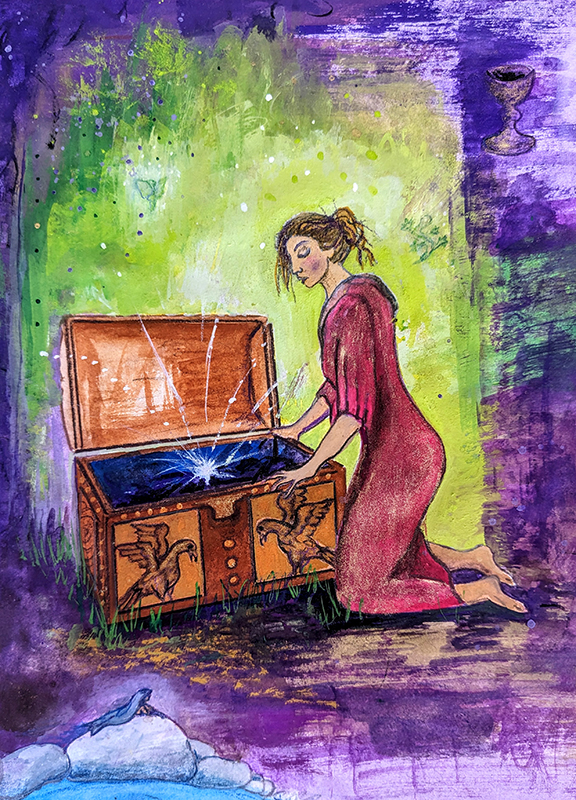
My first thought for these days was of Pandora, whose story in the myth of Pandora’s Box serves as a powerful metaphor for the complexities of human choice—relevant today by the choice of many to elect Trump, resulting in multiple destructive consequences.
This post was originally published on Aug. 13th, 2012
While I would not wish to argue that Greek Orthodoxy is in any way a “feminist” tradition, the shadow of the Goddess falls long over the two great festivals of spring and midsummer.
In Greek Othodox tradition, there are two major spiritual holidays– Easter in the spring and the Dormition/Assumption of the Virgin at midsummer. The Panagia, She Who is All Holy, also known as Mother of God, Virgin, and Mary, is a central figure in people’s faith–dethroned neither by the Reformation nor by Vatican II. Indeed when I speak of the need for the “rebirth of the Goddess” in Greece, I am often told, “the Panagia is our Goddess.” This may not be theological orthodoxy, but it expresses a truth of practice. Continue reading “Legacy of Carol P. Christ: Shadows Of The Goddess In Greek Orthodox Tradition: Easter And The Dormition Of The Virgin”
On the eve of my 50th birthday, I found myself longing for my mother. She’d been dead thirty years—so long that I’d forgotten the sound of her voice or the temperature of her skin. And yet I missed her. Desperately. Shamefully.
The shape of that missing had something to do with the fact that I was nearing the age she’d been when she died. As a child, I’d watched my mother dress for a night of dancing with my father, lining her lips with red and stringing her neck with beads—sure signs she knew the secrets of being a woman: self-possessed; striding through the world with confidence and self-assurance; a real badass!
By now, I’d expected to feel that same sense of largesse. But the truth was that I still felt like the nineteen-year-old version of myself who had lost her mother, a child still waiting for someone to show me the way.
~*~
I wasn’t alone. My whole country seemed to have lost our way. We were surrounded by images of the feminine—pop icons and underwear models, feminists and porn stars, soccer moms and saints—all of them flashing large but pointing in different directions, unglued from whatever architecture might give them a coherent narrative: A blueprint that might hold us through the waters of our deepest anxieties. A guide who might answer our deepest questions: Who am I? Am I part of something larger than my own life? And if so, how do I fit within it?
This post was originally published on Nov. 11th, 2013
“The mystery of God in feminist theological discourse” is the subtitle of Elizabeth Johnson’s widely read She Who Is.The notion that God is “a mystery” is rarely questioned in feminist theologies. But maybe it should be.
Although it is true that the finite cannot encompass the infinite, and that all knowledge is rooted in particular standpoints, I do not agree that the first and last thing to be said about the divine power is that it is “a mystery.” Indeed as I will argue here, speaking about God as “a mystery” obscures more than it “reveals.”
The notion that Goddess or God is “a mystery” is rooted in notions of “a God out there” that most spiritual feminists reject. Goddess or God “in” the world is, I suggest, not unknown, but known, not hidden, but revealed–in the beauty of the world and in ordinary acts of love and generosity.
In the origin stories of the Greek deities the overarching importance of water, which surrounds their domain, is undeniable. Water held the power of life, death and renewal.
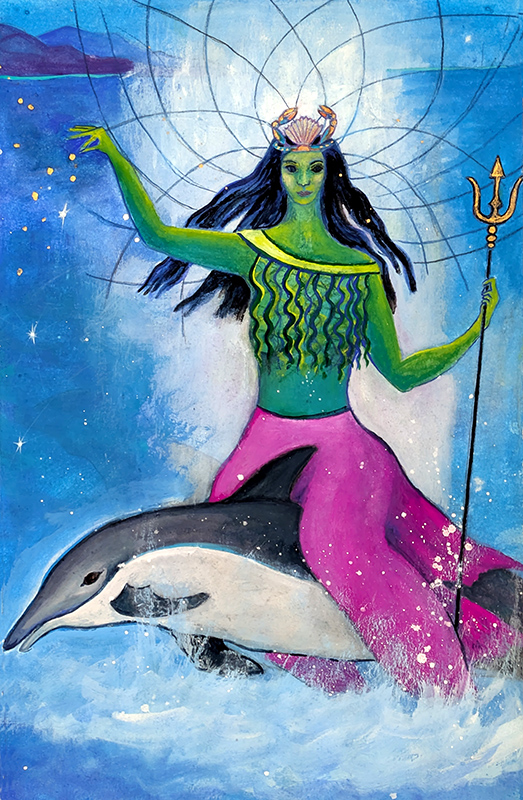
In each successive pantheon of Greek goddesses and gods — the Primordials, the Titans, and the Olympians — a goddess and a god ruled the seas together. During the time of the Primordial deities, it was Thalassa and Pontus, followed by the Titans, Thetys and Oceanus, and Doris and Nereu, and finally by the Olympians, Amphitrite and Poseidon.
“Amphitrite, Greek Sea Goddess,” gouache on paper, 11″ x 17″ by Judith Shaw
It was a class that changed the course of a personal history. Mine. The year was 2001. I had arrived in the United States a couple of years earlier to study journalism. In my last term – after four semesters of trying hard to navigate the American education system, what with its confusing terminology of credit hours, electives, majors, minors, I decided to venture out of my comfort zone (this was my Breaking Bad moment) – and took a 3-credit grad course, Religion in China, as an elective (that word again; and oh, when I first arrived, I thought 3 credit hours meant dedication to a grand total of three hours of coursework over the entire semester; you get to choose when).
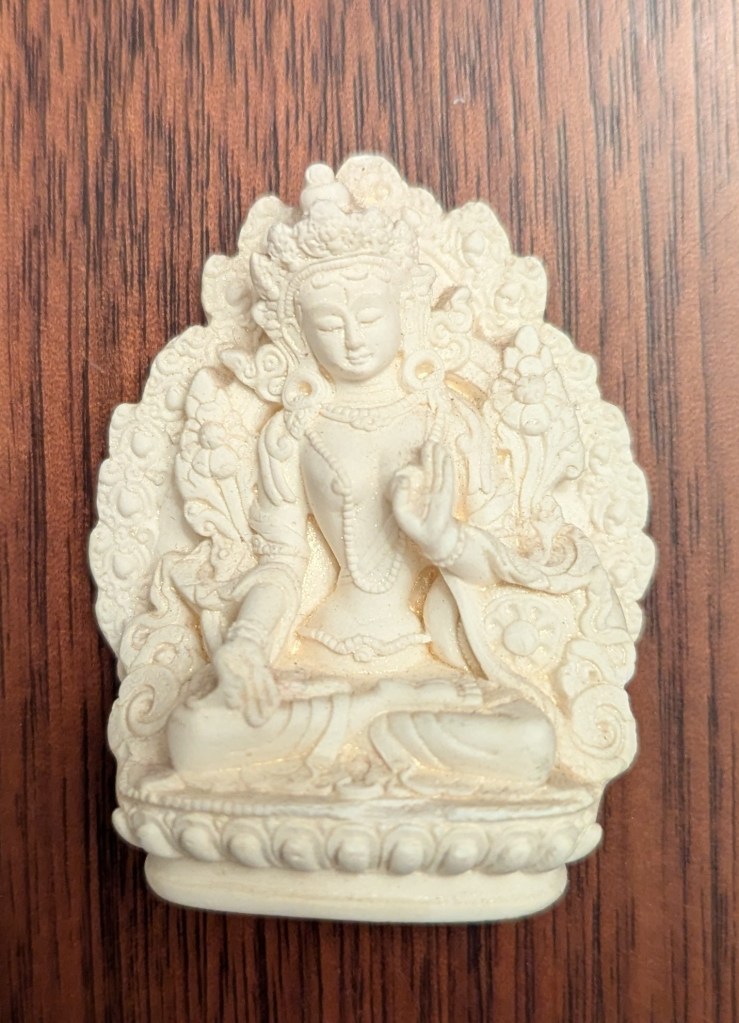
Goddess Tara. Personal collection.
It was in this class I was first introduced to Guanyin, the Chinese goddess of Infinite Compassion and Mercy. Guanyin, a bodhisattva[i] who rushes to the aid of her devotees upon hearing their cries, herself has quite an interesting history. She arrived in China from India as Avalokiteshvara or “the lord who gazed down at the world” as a male. Little wonder then that this gender fluidity makes her a popular deity among members of the LGBTQ community. Somewhere along the journey, Avalokiteshvara transforms into Tara. Apparently, so moved was Avalokiteshwara by the suffering of those trapped in samsara[ii] that he wept copiously, his tears creating a lotus from which sprang the goddess Tara.
Moderator’s note: This marvelous FAR site has been running for 10 years and has had more than 3,600 posts in that time. There are so many treasures that have been posted in this decade that they tend to get lost in the archives. We have created this column so that we can all revisit some of these gems. Today’s blogpost was originally posted December 25, 2015. You can visit it here to see the original comments.
Marie bringing in Elen of the Ways photo by Tony Mierzwicki
One of my colleagues at Feminism and Religion recently wrote of Xmas and Feminine Wisdom. My blog, for Christmas Day continues this exploration.
Elen of the Ways is a figure primarily studied by scholar, Carolyn Wise. She wrote two core articles available on the web here and here. Wise writes that in order to “track” and find Elen of the Ways she had to peel back the layers:
…to the earliest track ways, the migratory tracks of the Reindeer and Elk. Elen moves across vast tracts of time, and land, cloaked and masked appropriately for each age.
The exact day of the Winter Solstice ushers in what I think of as the Winter Solstice Season — a ten day period when, in the northern hemisphere, the sun barely moves from it’s most southerly position in the sky. The days are very short and the nights are long, long, long.
At this time of year I embrace the worldview of my Celtic ancestors who relished the darkness in a way that is foreign to us today. Every day began at dusk not dawn. The new year began on October 31, as the cold set in and the world turned toward the dark. The harvest was in, thanks were given, and nature was moving into its period of death. I find an inherent wisdom in this counting of time.
In this moment, my connection to trees feels especially profound. I find such beauty in the winter trees, naked of their green and golden finery, etching stark lines in the sky. As we drew near to the solstice, I felt compelled to create a new painting that expresses my love for winter trees and the Winter Solstice.
With this season of the festivals of light upon us (Hanukkah, Christmas, Solstice, Kwanzaa), I wanted to focus on the more joyful aspects of our lives. For that, I have been diving into passages about joy and singing in the bible.
Sometimes when I write these posts, they take me in directions I never thought to go. This post is one of them. The surprise direction I found is in the Psalm below:
Sing unto him, sing psalms unto him: talk ye of all his wondrous works. Glory ye in his holy name: let the heart of them rejoice that seek the LORD. Psalm 105:2-3 KJV
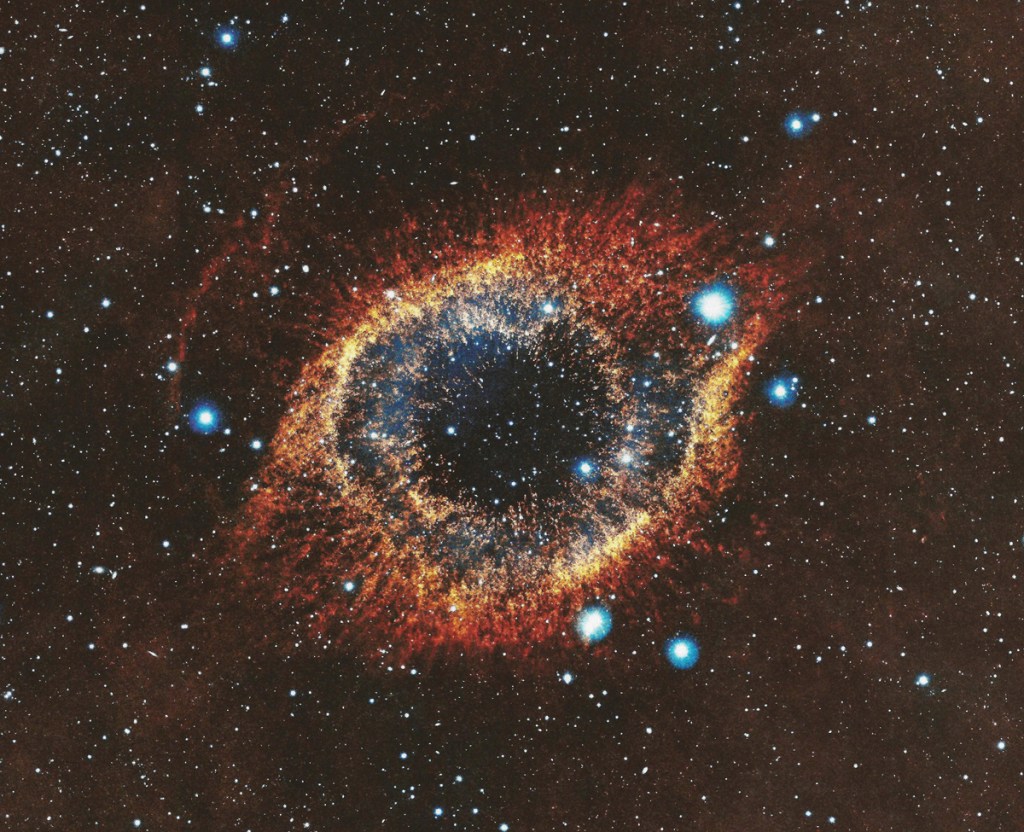
It was when I was studying to become a Witch that I first encountered the phrase ‘As Above, So Below,’ which I now know to be a paraphrase of a ninth century Hermetic text from an Arabic source. I liked this phrase from the beginning as it expressed something I believed but had struggled to articulate so elegantly. I believe that there is a sacred connection between our earthy human existence and the grandeur of the cosmos—our very bodies are composed of star dust.
Helix Nebula from the Hubble Telescope
I was delighted to discover a more specific description of that connection in the Journey of the Universe, by cosmologist Brian Swimme & Mary Tucker, founder of the Forum on Religion & Ecology at Yale. They discuss the creation of the universe in terms of natural cycles of expansion and contraction, which they also refer to as ‘attraction,’ or gravity. They write “All of space and time and mass and energy began as a ‘single point’ that was trillions of degrees hot and that instantly rushed apart. (p. 4)” That expansion is on-going, billions of years later.