Carol P. Christ A Symposium in Celebration of Her Spiritual-Feminist Activism and Women’s Spirituality Scholarship
“The Goddess is the intelligent embodied love that is in all being.” ~ Carol P. Christ
Free Symposium via Zoom hosted by Women’s Spirituality Graduate Studies ProgramCalifornia Institute of Integral Studies October 22, 2021. 10:00 am to 4:00 pm
Call for papers focusing on Carol P. Christ’s scholarship and activism in the key areas of Women’s Spirituality, Goddess Studies, Ecofeminism, and Women and Religion.*
Please speak to what you think and feel are Carol P. Christ’s most important contributions to one of the academic fields listed below, and then also, to how her writings are important to you personally. We will arrange papers into the following six panels of 3-4 presenters.
Ecofeminist Philosophy and Activism
Goddess Studies and Egalitarian Matriarchal Studies
Spiritual Feminism and Peace Activism
Spiritual Feminist Literary Criticism
Women and Religion
Women’s Spiritual Pilgrimage
Please send an abstract of your proposed paper (in 300 words or less) to Mara Lynn Keller at mkeller@ciis.edu, by Wednesday, September 16, 2021. Acceptances will be sent out Friday-Monday, 9/24-27/2021. Papers are to be 12 minutes in length.
*Primary Sources include:
Diving Deep and Surfacing: Women Writers on Spiritual Quest (1986)
Woman Spirit Rising: A Feminist Reader in Religion, anthology co-edited with Judith Plaskow (1992)
Odyssey with the Goddess: A Spiritual Quest in Crete (1995)
Weaving the Visions: New Patterns in Feminist Spirituality. Anthology co-edited with Judith Plaskow (1989)
Laughter of Aphrodite: Reflections on a Journey to the Goddess (1987)
Rebirth of the Goddess: Finding Meaning in Feminist Spirituality (1998)
She Who Changes: Re-imaging the Divine in the World (2004)
Goddess and God in the World: Conversations in Embodied Theology. Co-authored with Judith Plaskow (2016)
In addition to the panels, the Symposium will include: In Memoriam: Ritual Honoring Carol’s Life and Death (1946-2021) Circle of Remembrance: Personal reminiscences and reflections on Carol’s life and work.
Our sister friend, Laura Shannon, emailed us early in the morning to share the news that “Carol passed peacefully in her sleep last night at 12.11 am on July 14th. Alexis (Masters) was with her.” Carol died in the company of friends.
The community of Feminism and Religion (FAR) grieves the death of Carol P. Christ.
Our sister friend, Laura Shannon, emailed us early in the morning to share the news that “Carol passed peacefully in her sleep last night at 12.11 am on July 14th. Alexis (Masters) was with her.” Carol died in the company of friends.
Her writings here on FAR have been a gift to countless many of us for years. She recently emailed me to let me know that she would need to step back from writing her weekly FAR post for the foreseeable future, and, that if she could pull it off, she would send in her swan song soon. That moment didn’t come and that’s ok. There is no finale for a person such as Carol. We are changed and blessed because of her presence in our lives. Her legacy will be long and enduring.
I invite you all who would like to share a short tribute in honor of Carol Christ to send it here to FAR so it can be published as part of this post. This will serve as a running tribute that we can keep adding to. It will be a space to share, to grieve, and to celebrate her life. Send in your reflections to feminismandreligionblog@gmail.com. You may also share in comments below as well.
No single one of us can capture all that Carol has meant to us and to the world –– it is only right to hear from the many voices as we celebrate this most brilliant friend and teacher of ours.
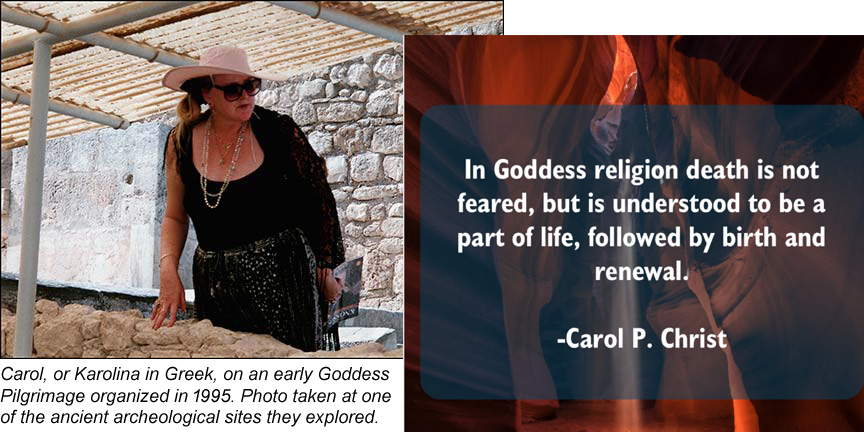
“In Goddess religion death is not feared, but is understood to be a part of life, followed by birth and renewal.” — Carol P. Christ
Carol married intellect with heart centering –– she had a formidable intellect but always spoke from her heart.
In view of learning of Carol’s death I find these words from Janet’s post today inspiring:
“Who is she that shines through like the morning star, beautiful as the moon, radiant as the sun awe-inspiring as a cascade of starlight?”
On a personal level, Carol’s words were essential on my journey away from god by way of the Goddess. Her courage required me to dig deep to embrace my own version of the “hubris” exhibited by male “god makers” and “system builders.” Carol’s quote below inspired many us to take on the two-fold task of unearthing the patriarchal symbol system woven into the fabric of our socialization and of replacing it with words of truth, communities of support, ceremonies of meaning, and images of the goddess, all inspired by stories of the very beginning when the divine was imagined as female.
The reason for the continuing effects of religious symbols is that the mind is uncomfortable with a vacuum. Symbol systems cannot simply be rejected, they must be replaced. Where there is no replacement, the mind will revert to familiar structures at times of crisis, bafflement, or defeat. (Carol Christ, Womanspirit Rising)
–– Patricia Lynn Reilly, Author of A God Who Looks Like Me
Carol was a wonderful friend and colleague. She loved to read my work in progress (brilliantly, often several times in a row before she wrote back to me) and I hers.
Her essay on patriarchy was the best I have ever read. I asked her to contribute it to the anthology, Foremothers of the Women’s Spirituality Movement: Elders and Visionaries. The day after she sent it to me, I found that the essays fir the book had to be personal. I felt terrible. I emailed her to tell her, and she said it wasn’t a problem. The next day she had a new, wonderful, perfect essay for me.
Although I knew she didn’t have many months to live, I am still stunned by this loss.
–– Miriam Robbins Dexter
Carol was and will remain one of the foremothers and most brilliant voices of the Women’s Spirituality movement. At the conference on “The Great Goddess Re-Emerging” at the University of California at Santa Cruz in the spring of 1978, Carol delivered the keynote address, “Why Women Need the Goddess: Phenomenological, Psychological, and Political Reflections.” Christ proposed four compelling reasons why women might turn to the Goddess: the affirmation and legitimation of female power as beneficent; affirmation of the female body and its life cycles; affirmation of women’s will; and affirmation of women’s bonds with one another and their positive female heritage (Christ 1979).
In her most recent article, for the Encyclopedia of Women in World Religion: Faith and Culture, Christ wrote about the Goddess religion and culture of her beloved island of Crete, and the roles women played in that “egalitarian matriarchal” civilization. Her eloquent words speak not only to the Goddess religion of ancient Crete, but also to the spirituality and ethical values she also cherished, which are much needed in our own culture today.
As discerners and guardians of the mysteries, women created rituals to celebrate the Source of Life and to pass the secrets of agriculture, pottery, and weaving down through the generations. The major rituals of the agricultural cycle involved blessing the seeds before planting, offering the first fruits of the harvest to the Goddess, and sharing the bounty of the harvest in communal feasts. These rituals establish that life is a gift of the Goddess and institute gift-giving as a cultural practice. As women controlled the secrets of agriculture, it makes sense that land was held by maternal clans, that kinship and inheritance passed through the maternal line, and that governance and decision-making for the group were in the hands of the elders of the maternal clan. In this context, the intelligence, love, and generosity of mothers and clan mothers would have been understood to reflect the intelligence, love, and generosity of the Goddess.*
Honor, blessing, and gratitude to you for your life, Carol. You told us many times you did not fear death. You did not speculate on what comes after. Whatever goddess is, surely you reman in her embrace.
A wise woman committed to the spiritual freedom of women and a teacher of life and struggle has set out to meet the infinite. I thank life for giving me the joy of walking part of the way in this world, in the company and wisdom of women like her.
Thanks for everything my dear Carol. For the ideas and enthusiasm with which you always supported my work. For creating community and safe spaces For lovingly and intensely vindicating the transcendence of the humanity of women
Blessed journey our woman, teacher and guide. May the divine that you found in all women receive you today in her loving arms.
That was Karolina’s last message to me, on June 18th, 2021. I like to think it was also her last message to the universe, as she climbed back into the lap of the Goddess early on the morning of July 14th.
I’d sent her a selfie of me with a new haircut, a few inches shorter, as she’d suggested some time earlier. “Yessssss” was her immediate, characteristic reply. Two days later I forwarded an even better photo. It was surprising not to hear back from her, and I should have been concerned. Instead, I let two weeks go by before reaching out again. And then it was too late.
“Yessssss” was Karolina’s full-hearted response to life, and part of how she nurtured her friends and acquaintances. I will carry that “yessssss” with me till the end of my days, always grateful to have known and been nurtured so generously, so unfailingly by her. Her soft voice, her gentle laugh, her quiet glamor, her deep engagement with all the details of life … I could talk with her about my cats, my husband, my writing, my childhood, my haircut. Nothing was too small or too large, nothing too complex or too simple.
“Intelligent embodied love” is how Karolina described the ground of being, and intelligent embodied love was what she herself embodied and radiated, even as she suffered through her cancer and its treatment. For this past year, she devoted herself to making her new home as beautiful as possible. The last room she finished was the “guest room study,” and how I would have liked to have joined her there. Instead I will simply carry her “yessssss” in my heart.
Rabena yer’hamou – Que Dieu la berce dans sa matrice – “May she be cradled in the womb of the Goddess.” Blessed be.
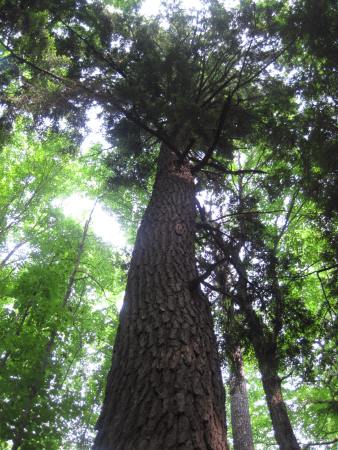
Carol was my second cousin. In 2016, we spent about 10 days in France and Germany tracking down places where our ancestors lived. Like her Feminism and Religion research and writings she was a meticulous in her ancestry research and fearless about meeting strangers and asking questions. One of the places where are relatives came from was Saarland St Nikolaus-Rosbruk. We were having lunch by the river when she saw this tree that she wanted to embrace. Here is a picture of her by the tree. I love her expression.
Best to all, Bill Christ
I’ve been so honored to blog with Carol here at FAR over the last seven or so years and doubly honored that she wrote an endorsement for my new book just last month.
Carol was a tremendous role model and influence for me and she will be deeply missed. She impacted so many lives with her work and her depth of purpose and strength of character were so palaple, even across many miles. When I first read “Why Women Need the Goddess” it touched a chord within me that continues to reverberate through this day. Her work and writing shaped my own thealogy profoundly. In her honor, I chose one of her books off my shelf—She Who Changes—and randomly opened to a page, which, fittingly, was about how death is a part of life:
“For process philosophy, the whole universe is alive and changing, continually co-creating new possibilities of life. Every living individual is born, grows, and then dies. The world is a web of changing individuals interacting with, affecting, and changing each other. The body is the locus of changing life. Not to be embodied, not to change, is not to be alive…” –Carol P. Christ. (She Who Changes: Re-imagining the Divine in the World, p. 45)
I read this quote aloud during a small women’s circle the same day Carol died, a circle that, in some way, may not have existed without the gift of her presence in this world.
–– Molly Remer
Remembering Carol P. Christ
I am so grateful and glad that a circle of Carol’s friends and colleagues champion her accomplishments and celebrate her life.
I might be her oldest friend in this group, definitely more a personal friend than a professional colleague. We were in the same freshman dormitory on the same dorm corridor that was made into a social group at Stanford. Both of us felt a bit out of place, she—at the time–a political conservative from Orange County California, and I one of 17 Asians in a class of 1,200 from the small town of Gilroy, California.
Never her academic peer, we still spent time together studying, finding our way, and hanging on to our independent thinking. And we stayed in touch when we both relocated to the East Coast, she to Yale and I to New York City. I have attached a photo of Carol at her wedding in 1979 when she was living in northern California. Much later I met her family when her mother died and I knew of the family static that she worked to understand and make peace with. We stayed in touch through all these decades. I visited twice in Lesbos with my mother, sister and best friend, and she visited here in Oakland.
I saw Carol not through her scholarly achievements but from what I saw as her kind of priestess bearing. Always her forthright sense of what would make the world a better place, calling out the wrongs but being understanding, always with her oar in the water. I also saw her as a warm friend who could laugh about the foibles, not worry about binging on good television, enjoy a good meal with friends, and tend to her garden and pets.
Carol should not have suffered the pain of conflicts, even if those experiences sharpened her mind. She should not have suffered from debilitating illness. . .and she died too young. She told me once that she stayed in Greece because it was the most beautiful place she had ever been. Though I never liked having good friends so far away, it seemed that gave her joy and solace.
We will miss her.
–– Gail Kong
I was profoundly influenced by the keynote address Carol gave in 1978 at the Great Goddess Re-Emerging Conference in Santa Cruz, CA. I was one of the 500 women listening to her words “Why Women Need the Goddess”. The impact of her observation about the power of symbol systems on each of us individually and the influence symbol systems have on all of us collectively, helped guide my own life.
We met in the fall of 2017 when I was one of ten women on the Goddess Pilgrimage. Carol described herself as a “feminist and ecofeminist writer, activist, and educator”. Please view this eighteen minute video of Carol speaking at the Harvard Divinity School where she spoke about her life. This was the 2014 Religion and the Feminist Movement Conference: https://www.youtube.com/watch?v=YwYygffNCAg.
I’m always moved by women speaking on their own behalf about their lives with no intermediary to interpret their life from afar. You will certainly gain a sense of who Carol was in her world.
My lesbian partner, Jeanne Neath, and I had reservations to join the 2021 Pilgrimage. To ease my grief at Carol’s death, I’ve gathered ten more candid photos of Karolina on some of the earlier Pilgrimages. You can see those photos on my blog http://paulamariedaughter.com/. Carol put incredible energy into each day of those two weeks she escorted us around the various sites that linked us to the ancestors.
Carol dared to examine the deeply embedded beliefs of our patriarchal institutions including academia and religion. She invented a new life for herself. She ‘shed the skin’ of an academic. Karolina was determined to reach other women like herself willing to look beyond the familiar goddesses of the patriarchy to discover the much more ancient Earth Goddess of our Neolithic and Paleolithic ancestors.
Many of us now acknowledge Carol/Karolina as a beloved ancestor.
Blessed Be, Paula Mariedaughter
One of Carol Christ’s books early on, in 1980, that impressed me deeply was Diving Deep and Surfacing – Women Writers on Spiritual Quest, published by Beacon Press. It helped me rediscover my spiritual path. I actually incorporated the phrase “diving deep and surfacing” in a process of self-understanding and awareness. — feeling grateful.
When I first learnt how patriarchy plotted and schemed to write the Goddess out of existence and by extension, the history of all women; not stopping at the written word, using violence and the threat of violence too; I was furious. This was the first time I experienced rage. Not fully knowing our history means we exist in a world of numb. To discover is to feel. To feel is to be alive. This is why Carol’s work is so important – because it links women to their collective past and to their collective future. The anger has subsided and now I ride a wave of certainty, connected to an international movement of powerful women. Understanding our story is empowering. Empowerment is Carol’s legacy.” – Claire Dorey
I met Karolina in 2018, when I was in Lesvos working as a volunteer with refugee organisations, so ours was a very short friendship by comparison with most of her other friends. We kept in touch when I went back to Sydney, and then picked up again where we had left off when I returned to Lesvos in early 2020 for another few months of volunteer work, before the Covid pandemic intervened. After that we kept in touch via Skype.
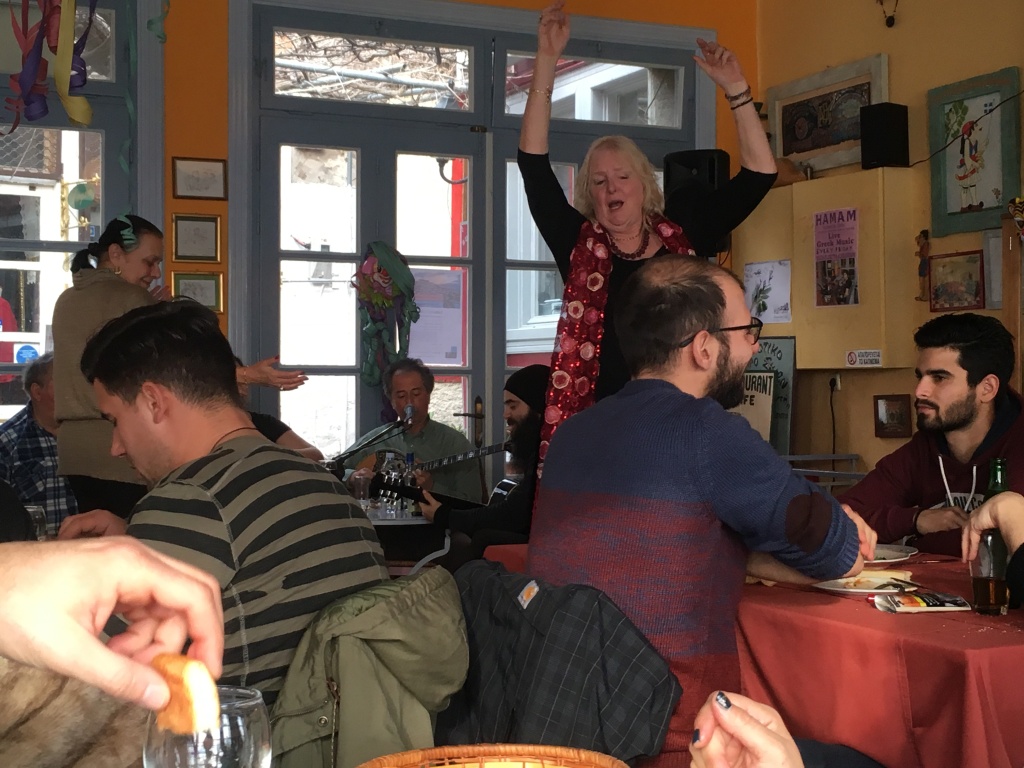
I was a bit younger than Karolina, but we shared the same feminist background and had a broadly similar outlook on life. In the short time that we spent together we shared a lot of long lunches with copious amounts of red wine. It was great for me, because Karolina could order meals in Greek, so we always ate interesting local food. She loved to dance, so if there was music she would be on the dance floor! Karolina knew a lot about Greek Orthodoxy and local customs. I spent a memorable “Clean Monday” with her in 2018, when she donned a tutu as part of a dance troupe, and then danced the afternoon away in Maria’s Taverna… (Clean Monday is the start of the 40 days of Lent in the Greek Orthodox Church).
Even though we didn’t know each other for very long, I think that we both valued our friendship, perhaps for different reasons. From my perspective, I loved staying in Karolina’s beautiful old house in Molyvos at weekends, bird watching in the salt marshes at Kalloni, and going to out-of-the-way places to eat. As well as intellectual stimulation she also provided some relief from the intensity of my refugee work, which was very welcome!
I thought it was incredibly brave of Karolina to leave Lesvos and move to Crete, and I’m glad that she got to enjoy her new apartment in Heraklion, however briefly. I would love to have visited her there, but Covid and her illness meant that was not to be. I will miss her.
Most people know Portugal as a deeply Catholic country with a rich Islamic past and an ancient Sephardic Jewish heritage reaching back to Roman Lusitania. But what about the country’s pre-Roman, pre-Abrahamic Goddess cultures?
Like many foreigners, I moved to Portugal knowing nothing about Portugal’s Goddess heritage.
Then I met Luiza Frazão, Priestess, author, and independent scholar who studied at the Glastonbury Goddess Temple in England with Kathy Jones. After years of training and steeping herself in the lore of the Celtic Goddesses of the Avalonian Tradition, Luiza returned to her native Portugal to research the rich Goddess lore of her country. Intrigued and eager to learn more about her research, I met up with Luiza in the medieval town of Óbidos.
For millennia, people have struggled for gender and many other kinds of equality, with progress achingly slow and sometimes regressing. Egalitarian societies have existed and do exist, such as those described by Marija Gimbutas and Heide Goettner-Abendroth and others. So why does a 21st century egalitarian world seem so far away? Sometimes looking at challenges from a fresh perspective can be illuminating as well as inspiring for the long journey ahead. So, what if we envision equality as a tree, those wondrous beings that make life on earth possible and symbolize our world in so many cultures? What are the roots, the source truths which lead to all forms of equality and, if embraced by everyone, would make equality an assumed fact of life? What is the trunk where the roots manifest as positive supports for equality work? What are the branches, our acts reaching up towards our greatest aspirations for a truly equal society?
Let’s start with the roots, the basic statement from which all forms of equality grow. To me it is “All participate in the essential life force of the universe and are therefore inherently, completely, and infinitely valuable.” “Essential life force of the universal” may or may not refer to a deity, depending on individual beliefs, but it does have a spiritual element in that it relates our individual existence to that universal essence which gave us life, connects us to all other beings, and is beyond any personal characteristics. You may have a different root statement but I think that any root statement is more powerful with a spiritual element.
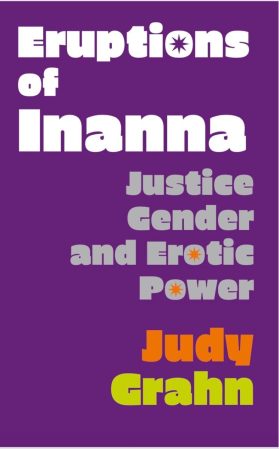
Any new book by Judy Grahn is cause for celebration. For decades, Grahn has been a lyrical and passionate poet, author, mythographer, and cultural theorist whose work features both goddess wisdom and contemporary culture centering on women and queer people. Nightboat Books has just published her newest book, Eruptions of Inanna: Justice, Gender, and Erotic Power, which offers ancient yet fresh world views with which to approach such issues as injustice, sexuality and gender, climate change, and more just when we need it most.
In Eruptions of Inanna, she brings what she calls her “poet’s eye” to eight stories featuring the Sumerian goddess Inanna as well as religious practices of those devoted to her. She explores how these have directly influenced our world and, in her words, can continue to “feed our needs and help us take better care of each other and our world.” According to Grahn, Inanna “is a combination of human, creature, erotic and other energetic forces, and civilization. She also inherited very old powers that grew out of women’s rituals” (55). Her essence engenders sovereignty and self-worth, especially in women and queer people. She is a goddess of love, espousing passion and the joy of eroticism as integral to both life and society. She practices an expansive justice that creates positive outcomes in response to horrific acts. She creates a civilization of the arts, beautiful and useful crafts, abundance, and a jubilant communal life. She demands respect for nature and ecological sustainability.
Rest awhile, Dear Reader, and dream along with me. We’re standing on a corner, call it Main Street, Any City, USA. We’re chatting, passing the time of day, being happy we can stand among other people without the fear of a giant virus jumping out of someone’s breath and attacking us. It’s a nice day here on the street. Not much traffic.
Oh, look—there’s a huge box in the middle of the intersection. It’s shabby, looks to be made of old, thin wood loosely clamped together. The box starts shaking, rocking back and forth. What’s in there? Something is obviously trying to get out. As we watch, an orange mist starts seeping out through the cracks in the box. More shaking. Now the box seems to be jumping. More orange mist. And the box shatters. An orange form—is it human? It’s fat. It’s shaking an iPhone. Or is that a golf club? The orange one speaks. “Do you miss me yet?” “Stand back and stand by.” “I’ll be baa-ack.”
This blogpost is about biblical verses and uncovering the magic and spirit behind its words. Why, you might ask, is this a project that belongs on a blog dedicated to feminism?
I believe it does because it helps us to strip away the many layers of patriarchy with its attempts to hide and/or change original teachings. Remember; these stories were originally oral wisdom teachings of the “folk.” They weren’t written down until the Babylonian exile, hundreds if not thousands of years removed from their origins. And who was doing the writing? Priests, scribes, and prophets, all with their own agenda. Even the earliest writings we have, the Dead Sea Scrolls, were still written in patriarchal times.
A high priestess became pregnant in a manner that was forbidden in her society. She gave birth to a baby boy. Fearing for her child’s life, she fashioned a basket of rushes and cast him into a river. He was retrieved by a man named Akki whose name means “the drawer of water.” Akki raised the boy.
A son was born to a young princess who had been forced to keep her pregnancy a secret because it was forbidden. When her son was born, she placed him in a basket and floated him down the river. He was found and raised by foster parents. He grew up to become a noted warrior, speaker and eventually a king.
A young boy accidentally ingested some drops of star-studded wisdom from the cauldron of a goddess and, in this manner, was suddenly awakened to divine knowledge. The goddess grew furious that her divine wisdom was stolen. Desperate to escape her life-threatening wrath, a wild chase ensued. The boy turned himself into a rabbit, but the goddess turned herself into a dog to chase him down. The boy turned himself into a fish to swim away but the goddess became an otter to continue the chase. The boy then turned himself into a bird, but the goddess became a hawk. Finally, the boy turned himself into a seed and hid in a large pile of grain. The goddess turned herself into a hen and ate up all the grain including the boy-as-seed. In this manner she found herself pregnant. She planned to kill the baby when he was born, but when she saw him, he was so beautiful that she fell in love and she could not bring herself to do so. The goddess sewed the baby into a leather sack and threw him into the river. He was retrieved by a man named Elphin who renamed and raised him.
A woman of the priestly caste of her tribe gave birth to a baby boy. At the time, all boys born to her tribe were under a decree of death. To save her son’s life, she created a basket of reeds and floated him down the river. He was found by a royal princess who retrieved him from the water, gave him a new name and raised him to adulthood.
*This post includes a call for stories at the end.
In my previous blogpost, I wrote about the Biblical tale of Samson and Delilah and why it was likely written in a manner to hide older pagan mythos. You can read it here: Delilah Lost. I promised to share my own myth about the story and tell it as best as I can. Here it is:
Samson was known as one of the strongest forces in the galaxy, a shining light in the sky. Humans would one day recognize his rays of light as his hair. In the infinity of time, his attention was drawn to movement in the star system known as Sorek. Looking more closely, he saw a woman dancing in dazzling motion while draped in star dust and star light. He could hear the slight tinkle of bells as she shimmered. It was as if the heavens themselves were shouting ha-la-hu-ya at her beauty. She noticed his gaze and winked back at him, tempting him with her swirls and her sparkling eyes. He was enthralled. Continue reading “Delilah Reclaimed by Janet Maika’i Rudolph”
Delilah is a beautiful name on its own merits. As a biblical personage Delilah is forever connected to Samson for their tales are intertwined. As it is told in Judges, Samson is the clear hero of the tale and Delilah is merely the temptress who betrays him. But as in all spiritual accounts there is more here than meets the eye. A spiritual journey is never a linear affair. When reading the story of Samson and Delilah, it immediately becomes clear that something mythical is afoot. The root of Samson’s name is the same as the word shamash, the Hebrew word for sun. The root of Delilah is lila, meaning night. Right away we understand that this story contains apparent opposites, heavenly aspects, the sun and the night, light and dark . . . Continue reading “Delilah, Lost by Janet Maika’i Rudolph”










 *This post includes a call for stories at the end.
 Feminism and Religion