The power of the divine feminine taps into the power of life. The power is accessible to everyone as the equal opportunity energy surrounding and connecting all living things. The power is ancient, and meditative practices such as yoga, which in Sanskrit means linking to the divine, can connect us to this power. When we make the connection, we find the balance we need to realize our highest selves, and through that balance we can realize the highest self of the larger society. To reclaim the divine feminine, we need only remember, and as more and more of us remember, we heal first ourselves, and ultimately the planet.
1. She is the route back to the self.
In her mother aspect the divine feminine offers a route back to the self and She is all-inclusive. She embraces all of creation, men, women and nature, and we find Her when we reach back far enough into history and our own consciousness. She was there from our very beginning, through the Paleolithic and the Neolithic, when we celebrated her in carved figurines. She was there when we made the shift to agriculture, clear as the full moon, the goddess with her circular all encompassing worldview, birth, life, death and birth again. The goddess as mother, the goddess whose body is the earth which nurtures us all. She is there now in your deepest consciousness, you need only remember, and when you do, She will guide you back to yourself.
Despite the chocolate bunnies, eggs and toy chickens in the shops along with the coaxing to buy and celebrate Easter at this time in Australia, it is not Spring: Earth here does not seem to co-operate with the Consumer Faith, built as it is around the Northern Hemisphere and dominant Christian calendar. In the Southern Hemisphere it is Autumn, the dark part of the day is lengthening.
On March 20th at 4:30 UT Earth will be perfectly poised in balance for a moment: it is a global moment of Equinox – one of the annual two. Humans have celebrated it for millennia, perhaps for many tens of thousands of years, in ways appropriate to various regions, in both the South and the North of the Planet. The light and dark parts of the day in the South and in the North of our planet, are of equal length at this time. In the Northern Hemisphere it is Spring, and Easter is commonly celebrated: with those of Earth-based tradition celebrating the moment and season of Equinox with the name of Eostar. Continue reading “It’s Autumn in the Southern Hemisphere – not Spring/Eostar by Glenys Livingstone”
Caroline Schelling (‘Caroline’) wrote the fourth letter of hers that survives (the ‘4th Letter’) on October 7, 1778, shortly after she had turned 15, to a girl she met at boarding school who was to become her lifelong friend (Luise). The intensity of her friendship with Luise is evident already in the 4th Letter, for she tells Luise that in writing to her she “portrays her entire soul.” What prompted such depth of feeling for this letter relates not just to a significant moment in Caroline’s life but in every person’s life. In the second paragraph she refers to what was most likely her first sexual relationship. Given that context, Caroline demonstrates remarkable emotional maturity and intellectual sophistication in how she expresses herself.
She begins by referring to the “sensations of my heart,” telling Luise how she struggles to find “adequate words” to express them. She is not, she proudly insists, an “enthusiast” who simply gives into feelings, insisting instead on the importance of “going over” (Überlegung) them herself. Though Caroline was not taught Latin, it seems as if she had been taught the relevance to German of aLatin treatise from the 4th century CE on the method for defining words. Caroline’s ‘going over’ her feelings before writing Luise is consistent with its methodology: first, to confront the question of whether something even exists (an sit, Existenz) and then determining, to the extent possible, what it is (quid sit, Wesen) and what its qualities are (quale sit, Eigenschaften)–i.e., its relationship to other words (grammar) and hence how it can be communicated.
This methodology, which is applicable to a wide range of disciplines (e.g., legal argumentation, psychiatric diagnosis), is also analogous to a language theory Charles Segal argued is implicit in what remains of the writings of the 5th century BCE Sicilian Gorgias, a theory Segal related to Sappho’s poetry. That is relevant, because given the failed sexual relationship about which Caroline writes to Luise, the 4th Letter bears comparison to two poems by Sappho (S. 31 andS. 1) that Caroline surely then knew in translation. Caroline’s “sensations of my heart” is directly comparable to the palpitations of the heart Sappho refers to in the second stanza of S. 31. The immediate effects are comparable; Sappho cannot speak and Caroline cannot find “adequate words.” Though S. 31 appears to break off, S. 1 can be read as a continuation of it. There Sappho prays for divine intervention (Aphrodite) to deal with a failed sexual relationship; the closing prayer of its final stanza is analogous to the last sentence of the 4th Letter’s first paragraph: “Lord, you who know my heart . . . fulfill no wishes that are not pleasing to you, I am depending on you!”
In each case it would seem the answer is anticipated to be one that is not heard or read but rather felt in the heart, intuitively understood as the center point of all bodily feelings. That would be not an abstraction from the senses but an inward intensification of them. Such intensification becomes the basis for its outward expression not just in words, but in all forms of art.
Caroline grew up during a time of renewed interest in ancient Greek art and particularly nude sculpture, which rightly can be taken to symbolize the belief in the sacredness of the entire human body (a belief that correlates with heart centeredness). It is notable that the floruit of such sculpture predates Plato by almost a century and quite literally embodies principles utterly antithetical to his philosophy. It is also analogous to another art form that predates him and that he disparaged: reciting poetry (whether or not incorporated into a theatrical production). Poetic recitation requires fully identifying with the poet and poem to such a degree that it can be thought of as internalized sculpting.
The principles underlying sculpture and recitation are thus similar and of general applicability. Caroline, who enjoyed (and was appreciated for) reciting poetry, makes the point in a review she wrote of a book of essays on artistic appreciation (the “Review”). To judge art, she says, it is necessary to penetrate “deeply into the meaning and sensibility of both it and its initiator . . . surrendering oneself in quiet reflection to a disposition of loving, receptive observation . . . [to be] transpose[d] . . . into the world of the poet or artist.” She defends the book’s use of a fictional friar to voice religious reverence for art, effectively equating artistic appreciation with religious devotion, since it is only from feeling the divine within (i.e., internalizing god as the artist) that the divine outside is to be understood.
This was not something new for Caroline, as is evident from the 4th Letter that was written nearly twenty years before the Review. Not only does she seem to have internalized Sappho, but the opening line of S. 31 (a man, “equal to the gods”) and the closing line of S. 1 (“my comrade,” the goddess) arguably encouraged her transition in the 4th Letter’s first paragraph from describing her feelings to Luise (psychology) to praying to God (theology). That transition anticipates the identification of psychology with theology Caroline articulates in the Review.
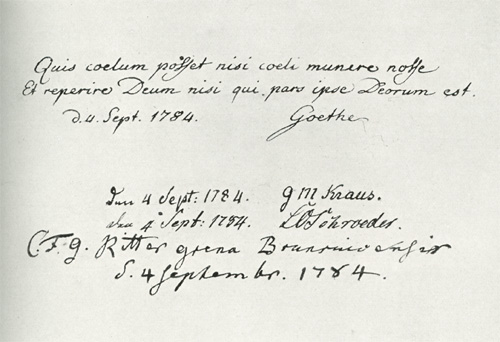
The remote antiquity of this identification and its association with goddess worship to which Sappho attests, as well as the recognition of it by Caroline at such a young age deserve attention, for it has quite a history, especially in German culture. Goethe quoted two lines of a 1st century CE Latin poem on astrology that essentially echo it in theguestbook atop Mount Brocken on September 4, 1784: who is able to know heaven except by a gift from heaven, who finds god unless a part of the godsis within them. It is not known when Caroline met Goethe; it has been speculated that he was the father of her first daughter, Auguste, born April 28, 1785. In August 1784 Caroline was living in a mining town not far from Brocken.
The opening paragraph of an essay published by Caroline’s third husband in 1809, only months before her death, contains a reference to the principle of knowing the god outside from the god within, correctly noting that its connection with Empedocles proves it predates Plato. In 1936 Heidegger characterized that essay as “one of the most profound works” of Western philosophy. In my next post(s) I hope to show that its profundity relates to a critique of Plato (and other philosophers) that derives from Caroline and her appreciation of ancient Greek female spirituality, and not to glorifying supermen.
Stuart Dean has a B.A. (Tulane, 1976) and J.D. (Cornell, 1995) and is currently an independent researcher and writer living in New York City. He has studied, practiced and taught Tai Chi, Yoga and related disciplines for over forty years. Stuart has a blog on Sappho and the implications of her poetry for understanding the past, present and future: http://studysappho.blogspot.com/
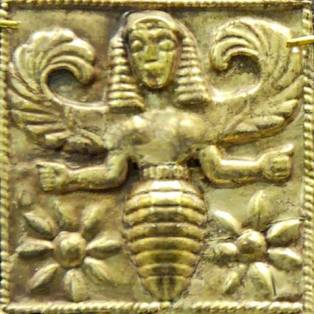
The Association for the Study of Women & Mythology (ASWM) will be hosting this year’s Conference, “Seeking Harbor in Our Histories: Lights in the Darkness” at the Boston Marriot Burlington Hotel on 1-2 April 2016.
ASWM conferences strive to support the scholarship, artistry, & practice of those who explore and engage the sacred feminine through study and creativity. Offering keynote presentations at this year’s conference are Dr. Elinor Gadon, Dr. Margaret Bruchac, and Dr. Lucia Ciavola Birnbaum.
On Friday night, there will be a plenary session and book-signing moderated by Miriam Robbins Dexter and Vicki Noble and featuring Max Dashu, Starr Goode, Mama Donna Henes, Donna Read, Genevieve Vaughan, Cristina Biaggi, Lydia Ruyle, Miranda Shaw, Elinor Gadon, and Susun Weed. They will be sharing stories from the anthology, Foremothers of the Women’s Spirituality Movement: Elders and Visionaries. FAR contributor Carol P. Christ has a chapter in the book.
FAR is excited to share that three of our contributors are on this year’s conference schedule!
Nancy Vedder-Shults will be joining the “Artists, Activists, & Scientists and the Lineage of the Goddess” panel with her presentation, Science and Divination: The Blurring Lines between the Secular and the Sacred.
Jill Hammer will present The King and the Priestess: Mythic Motifs and Motives in the Tale of Judah and Tamar as part of the “Male-Female Relationships in the Hebrew Texts: Three Feminist Analyses” panel.
Kate Brunner will be participating in the “Women’s Spirituality, Transformative Scholarship and Personal Quest” panel with Rhiannon, Great Queen of the Mabinogi: Ancient Mythology in Modern Context. She will also be offering her meditative writing workshop, Becoming Branwen the Peaceweaver.
In addition to the main conference, there will be a Matriarchal Studies Day seminar and celebration, in the same location the day before (31 Mar). Hosted by Vicki Noble and Lydia Ruyle, the program looks to be a great addition to the weekend. Dr. Heide Goettner-Abendroth, founder of Modern Matriarchal Studies will present via Skype. Other presenters will include Max Dashu, Polly Wood, Beverly Little Thunder, and Genevieve Vaughan, exploring woman-centered arts, themes of motherhood, and the gift economy. There will be a keynote presentation by Lucia Chiavola Birnbaum, and evening entertainment by folksinger, Julie Felix.
Feminism & Religion Project contributors past, present, & future interested in connecting with FAR at the conference, are encouraged to get in touch with Kate Brunner at feminismandreligionblog@gmail.com. If there is enough interest, we may be able to organize meeting up for a meal together some time during the weekend.
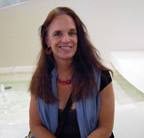
Arduinna, Gaulish Goddess of Forests and Hunting is one of the many Celtic Goddesses who is associated with a particular region or body of water. She was worshipped in the heavily forested regions of the Ardennes, located in what is current day Belgium and Luxembourg with small portions found in France and Germany. She was also associated with the Forest of Arden in England. Her name has its roots in the Gaulish word “arduo” meaning “height”.
If you ever eavesdrop on a conversation between my husband and me around the clamor of our four children’s voices, you will probably hear me making a tired lament: “All I want is a broad swath of uninterrupted time.” In listening to Elizabeth Gilbert’s newest book, Big Magic, on audio book I was interested by her mention that many creative people lament not having long stretches of uninterrupted time available in which to work. She quotes a letter from Herman Melville to Nathaniel Hawthorne, lamenting his lack of time and how he is always pulled “hither and thither by circumstances.” Melville said that he longed for a wide-open stretch of time in which to write. She says he called it, “the calm, the coolness, the silent grass-growing mood in which a man ought always to compose.”
…I do not know of any artist (successful or unsuccessful, amateur or pro) who does not long for that kind of time. I do not know of any creative soul who does not dream of calm, cool, grass-growing days in which to work with- out interruption. Somehow, though, nobody ever seems to achieve it. Or if they do achieve it (through a grant, for in- stance, or a friend’s generosity, or an artist’s residency), that idyll is just temporary—and then life will inevitably rush back in. Even the most successful creative people I know complain that they never seem to get all the hours they need in order to engage in dreamy, pressure-free, creative exploration. Reality’s demands are constantly pounding on the door and disturbing them. On some other planet, in some other lifetime, perhaps that sort of peaceful Edenic work environment does exist, but it rarely exists here on earth. Melville never got that kind of environment, for instance. But he still somehow managed to write Moby-Dick, anyhow.
When I create a new sculpture, I am most often creating something that I need to remember or want to learn. The original figures for my Centered Mama sculpture and my Meditation Goddess sculpture were both created while at a friend’s house for a weekend work exchange as my baby toddled around. While I love making figures of mothers and babies, I was feeling a strong urge to make a goddess representation complete unto herself. It felt like a reclaiming of my non-maternal identity and a declaration of self-sovereignty. She turned out a little bigger than some of my other figures, strong and secure and independent. Then, the baby crawled over and knocked off one of her breasts, knocked her over on the tray, smashing the side of her head. I came close to crying. I felt annoyed with my husband who’d “let” him come over and destroy my work rather than noticing him doing it and stopping him. I was frustrated, dismayed, and my feelings felt hurt in a sense. First I felt like, Argh! This is a metaphor for life! And, then I realized it was not just a metaphor for life, it is my actual life! I pouted a bit and said I was just going to smash her and give up and I made some bitter faces at my husband and some long-suffering huffs and signs, but then the baby fell asleep in the Ergo, held close against my chest. I kissed his soft hair and I took my clay and started again. I reclaimed her from the smashed parts and she sat stronger and taller than ever.
She reminds me not to give up and that beautiful work can come from struggle, but also of interdependence (not just the independence I was going for!), co-creation, and tenacity. When the finished version of her, cast from the original sculpt, sits by my bed at night or overlooks my dinner preparations, she reminds me that I am strong and that persistence is worthwhile. She also tries to remind me to be calm and steady, centered and Zen, even though I more often feel like a whirlwind.
That same Saturday at my friend’s house, as my baby tentatively toddled around the kitchen, chewed on a piece of watermelon, and snoozed on my chest, I felt moved to begin creating a new Centered Mama sculpture. I had been going through an emotional rough patch, feeling buffeted by variable emotions and erratic and unpredictable in my enthusiasm and confidence. I was also feeling impatient, snappy, and irritable.
“I will be gentle with myself. I will be tender with my heart. I will hold my heart like a newborn baby child.”
This song by Karen Drucker replayed in my mind as I sculpted. The baby woke, the watermelon got dragged along the floor collecting dust, and it was time for our collaborative dinner, so I had to put her away unfinished. When we got back to our own home, I was compelled to finish her, working feverishly as the baby pulled on my legs and I said, “just a few more minutes!” to the older kids who were trying to play with him to let me work. Again and again I re-rolled the clay baby’s head, trying to make it “perfect,” and worked to lay down the strands of her hair, against of the backdrop of this often-chaotic, noisy, home-based life we’ve consciously and intentionally created together. She was created to represent holding my own center in the midst of motherhood. I will be tender with my heart. I don’t create sculptures like this because I AM so “Zen” and have life all figured out, I make them to remind me what is possible if I listen to my soul.
As I do extensive rearranging, construction, and reconstruction on my slowly ongoing dissertation project, I typed out a quote from the book Priestess: Woman as Sacred Celebrant by Pamela Eakins about her past life memories of making clay goddess figures as a temple priestess:
…to me it brought a continuation of the energy of the sacred objects of the grandmothers. I contained this energy in a new form in the dolls that would be placed upon the altars and in the graves of the daughters living now and the daughters to come…
I felt this process made my own clay stronger, too. Some of the pieces cracked in the fire because of the added ‘impurities’…but, in this case, I felt the impurities were the purest of pure and I worshipped each crack knowing the crack contained the wisdom of the priestesses who had occupied the doll-making table for more moons than I could even imagine. It contained too, the devotional energy of every grandmother who had held it in her hands or placed it on her altar. Sometimes ‘impurities’ sanctify further that which is holy to begin with.
While I tend to have a knee-jerk skepticism about past-life memories, there is something in Eakins’ words that I know at a bone-deep level as I do my own work with goddesscraft:
…Each goddess was imprinted with the sound of sacred life coursing through the Universe. I changed with the priestesses as the figures came through my hands. Each doll received the sacred vibration of life…For seventy-seven moons I made the dolls at the long table with the young Sisters of Nun. My hands were so fast. I made thousands of figures: beautiful little faces, etched collars of gold plates, pubic hair swirled into tiny rows of connecting spirals. They were so precious. At the end of the day, my baked clay shelves were covered with little women.
The clay goddesses healed…
This is how I apprenticed. I learned, in this manner, the art of healing. I learned that to heal means to make whole, and that becoming whole involves learning many levels of purification, balance, and reformation” (p. 32-33).
In Anne Key’s marvelous priestess memoir, Desert Priestess, she makes this important point: “It is of course no small wonder why graven images are so tightly controlled by religious traditions.” (p. 52) Sometimes I feel like this is what I’m tapping into when I make my own goddess sculptures—a resistance to tight control over graven images and over personalization of divinity as male.
I occasionally get requests to make bigger goddesses–-people ask about figures that are large altar pieces 12-18 inches tall or taller. The goddesses I make are all about three inches tall and there’s a reason for that: they fit in the palm of my hand. When I create them, I feel as if I’m part of an unbroken lineage stretching back 30,000 years to the person who carved the Goddess of Willendorf. I feel connected to the priestesses of the Mesopotamian temples who sculpted hundreds upon hundreds of tiny clay goddesses. Someone commented on my sculptures once saying, “echoes of Mesopotamia.” And, I said, “exactly.” I feel the connection between the clay in my hand and the clay in their hands, running through the ripples and eddies of time.
I’ve been inspired recently to re-read Starhawk’s The Spiral Dance, finding new bits of wisdom from it that speak to something different in me than they did the first time I read it. She writes of the attempts to discredit Goddess religion by invalidating the historical narratives or archaeological evidence: “The idea seems to be that if they can disprove our origin story, they can invalidate our spirituality…Is Buddhism invalid if we cannot find archaeological evidence of Buddha’s existence? Are Christ’s teachings unimportant if we cannot find his birth certificate or death warrant?…the truth of our experience is valid whether it has roots thousands of years old or thirty minutes old…a mythic truth whose proof is shown not through references and footnotes but in the way it engages strong emotions, mobilizes deep life energies, and gives us a sense of history, purpose, and place in the world. What gives the Goddess tradition validity is how it works for us now, in the moment, not whether or not someone else worshipped this particular image in the past” (p. 4).
The ancestry of my goddess sculptures may not be the same energy that raised temples and built monuments (or walls), it is the energy that carried a baby on one hip and a basket of supplies on the other and needed a goddess just the right size to tuck down the front of a shirt…
Sometimes I describe my life in the woods as being held in the hand of the goddess. And, I make goddesses that I hold in my hand. Am I in the palm of her hand or is she in the palm of mine? The answer is both.
(One of my all-time favorite fan photos–a rainy day traveling goddess picture, taken by my friend/SIL (this one is only an inch tall, but look how she calls in the waters of the world!)
Molly has been “gathering the women” to circle, sing, celebrate, and share since 2008. She plans and facilitates women’s circles, seasonal retreats and rituals, mother-daughter circles, family ceremonies, and red tent circles in rural Missouri. She is an priestess who holds MSW and M.Div degrees and she is finishing her dissertation about contemporary priestessing in the U.S. Molly’s roots are in birth work and in domestic violence activism. She has worked with groups of women since 1996 and teaches college courses in group dynamics and human services. Molly is the author of Womanrunes: a guide to their use and interpretation, Earthprayer, Birthprayer, Lifeprayer, Womanprayer, and The Red Tent Resource Kit, as well as three social service oriented booklets and a miscarriage memoir. She has maintained her Talk Birth blog since 2007 and writes about thealogy, nature, practical priestessing, and the goddess at her Woodspriestess blog. Molly and her husband Mark co-create original birth art, goddess sculptures, ceremony kits, and pendants at Brigid’s Grove.
“Light and Darkness” is a song written and arranged to one of the oldest known European melodies by Ariadne Institute founding Co-Director Jana Ruble, following her first Goddess Pilgrimage to Crete. Every year since then, we have sung it in the caves of Crete during our rituals. A pilgrim told us that she learned it at the (Christian) Re-Imagining Conference. Last spring another pilgrim said that she knew it because her choral group sings it. You can listen to “Light and Darkness” and see pictures of an altar in a cave on a new video created by Goddess pilgrim PJ Livingstone after the 2015 spring tour.
Candlemas / Imbolc, the midway point between the winter solstice and spring equinox brings with it (in the northern hemisphere) the first signs of awakening spring. Here in Canterbury, southeast England, where I am living this year, the birds are already starting to sing for mates and build their nests. In Celtic pre-Christian religion, Imbolc is associated with the Goddess Brigid / Bride (and the Christian Saint Brigid), but today I suggest we pay a visit to Brigid’s Slavic sister, the Goddess Mokosh / Mokoš, who is also powerfully associated with emerging fertility in the woman, the land and the year.
As well as fertility, Mokosh and Brigid bless and protect women’s crafts and women’s work, and share attributes of healing, motherhood and midwifery. They are both Goddesses of Fate and of destiny: spinning the thread of creation, giving life and cutting the thread, like the Three Fates of Greek tradition. Both have a special connection with sheep, wool, and weaving, and of course with textiles: Brighde is honoured through the tying of cloths or ‘clooties’ at sacred wells, while a favourite offering to Mokosh was a hank of spun wool dropped into a well. In the Slavic lands, Mokosh is a key figure on embroidered ritual cloths.
Mokosh, like Brigid, is associated with wells, springs and moisture; the name Mokosh comes from the root ‘mol’ meaning ‘moisture’, and is connected with the Slavic words mokry and moknut (‘wet’ and ‘to get wet’) . Mokosh brings the water of life and protects the life-giving waters on which human and animal existence depend. In this way Mokosh gives life to plants and animals, and is often portrayed with them. She is an important Slavic Mother Goddess, embodying fertility, femininity, prosperity, protection, health, good luck, abundance, and a successful future.
Mokosh is also a warrior goddess, in her fierce aspect as a goddess of protection. One of her epithets is ‘She who strikes with her wings’. The fact that she is a winged Goddess indicates her power and that which she grants to her priestesses and devotees, to travel between the worlds in trance, dream, and vision, for blessing and for healing on behalf of the community and all who are in need. Mokosh is also connected to butterflies, symbols of transformation, and bees, symbols of priestesses in antiquity. The beautiful Slavic embroideries shown here depict some of her typical manifestations as a tree/flower/goddess figure with branches/arms/wings/wheat ears, sometimes all at once.
Slavic Goddess Embroidery
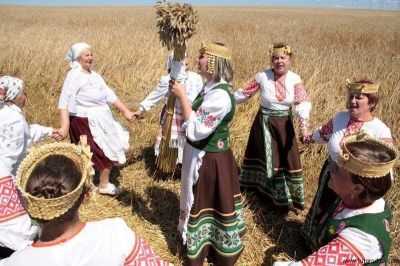
Mokosh is a Slavic sister in the same lineage of water-loving fertility deities who were so important in ancient Greece, the Nymphs and Muses. Mokosh features centrally on women’s aprons, directly over the life-giving place of the womb, on sacred cloths for the icon corner in the home, or on cloth and clothing tied to birch or willow trees in Russia and the Ukraine. All over Europe, these elements of the Goddess and the divine fertile feminine can be found, disguised but discernible, in embroideries, dances, songs, fairy tales, ritual breads and other seasonal customs.
In the Christian era Mokosh continued to be worshipped in the form of the Virgin Mary, and more specifically was transformed into St. Petka / Paraskeva / Paraskevi, ‘Saint Friday’, which links her with the Norse Goddess Freya. Friday is the holy day of both Brigid and Mokosh.
Late winter/early spring, the time of Imbolc, is one of her sacred seasons. Whether you call her Brigid or Mokosh, or by another name or none, now is an opportune time to ask her help and invoke her presence. By lighting a sacred flame, tying a cloth to a tree in a fertile place, honouring the waters of Earth which give life to all, spinning and weaving threads of creation and creativity – literally or metaphorically – we too can connect once again with the source of all, and open ourselves to receiving Her blessings.
We may not be able to see what this year will bring, but we do know that the waters of the earth, the birds, bees and animals, the food sources which nourish all life, and the women of the human family, all need blessing and protection. Brigid and Mokosh can help with this. Reconnecting with these and other Goddesses also helps reawaken the Old European worldview as articulated by Marija Gimbutas, Carol P. Christ, and others: cooperation and community, respect for nature and shared resources, an understanding of our mutual interdependence, the value of craft and creative expression, and the need for social justice to protect what is precious.
As the spring returns, may we all both receive and give abundant blessings of new life and rebirth on every level.
Russian women in ceremony
*****
I will be teaching dances from Greece and Eastern Europe which honour Mokosh and the nymphs and muses at my workshops this year in Greece, Austria, Germany, Morocco and the UK. For details of these dance events, please visit www.laurashannon.net
I thank Sylwia Geelhaar, who researched Mokosh for us in my most recent 2-year training group in Women’s Ritual Dances in Lebensgarten, Germany, and gathered together many of the images shared here.
Further reading: Barber, Elizabeth Wayland (2013). The dancing goddesses. W. W. Norton & Co.
Gimbutas, Marija (1989). The language of the goddess. San Francisco: Harper & Row.
Kelly, Mary B. (1989). Goddess embroideries of Eastern Europe. McLean, New York: StudioBooks.
Rigoglioso, Marguerite (2010). Virgin mother goddesses of antiquity. New York: Palgrave Macmillan.
Shannon, Laura (2011). ‘Women’s Ritual Dances: an Ancient Source of Healing in Our Time.’ In: J. Leseho and S. McMaster, eds., Dancing on the Earth: Women’s Stories of Healing Through Dance. Forres: Findhorn Press.
*****
Laura Shannon has been researching and teaching traditional women’s ritual dances since 1987. She is considered one of the ‘grandmothers’ of the worldwide Sacred / Circle Dance movement and gives workshops regularly in over twenty countries worldwide. Laura holds an honours degree in Intercultural Studies (1986) and a diploma in Dance Movement Therapy (1990). She has also dedicated much time to primary research in Balkan and Greek villages, learning songs, dances, rituals and textile patterns which have been passed down for many generations, and which embody an age-old worldview of sustainability, community, and reverence for the earth. Laura’s essay ‘Women’s Ritual Dances: An Ancient Source of Healing in Our Times’, was published in Dancing on the Earth. Laura lives partly in Greece and partly in the Findhorn ecological community in Scotland.
I spent 2015 teaching an Intentional Creativity program ‘Wisdom of the Goddess”to an intimate tribe of women creatives from our local community. In December we held an end of Year Art Gala displaying a portion of the work which saw over 100 paintings of Goddesses created over a 10-moon period.
The program was divided into the cycles of Creation, Transformation and Celebration, as inspired by Hallie Inglehard’s book “The Heart of the Goddess”. Each month, through ritual, visioning and painting, we explored a Goddess that represented these cycles; Eve, Anjea, Demeter, Cerridwen, Kali, Persephone, Aphrodite, Ochun and finally, our Inner Goddess.
It took great courage for the artists to display their paintings in public. It is often hard to explain this work because it requires such deep and thoughtful exploration of one’s inner world along with a commitment to a creative practice that favours personal growth and discovery over outcome. It can be difficult finding the language to elucidate on this process that is not just about the act of painting.
It is painting to grow and heal.
It is sacred.
It honours and empowers women.
It inspires authentic creative expression.
It unites one with self.
It connects one back to the earth.
It transforms.
It reveals.
The show was a great success. A gallery full of Goddesses was surely a sight to behold! It was a humbling experience to be out and proud about our creative work in our regional, agricultural, largely conservative community. I feel it is imperative for the restoration of female empowerment to be remembering and re-imagining the Goddess by way of image and it was through Her that these astounding women artists found the courage to put their heart and soul on the wall for all to see.
The influence that image has is far-reaching and cannot be under-estimated. Image is a universal language that evokes emotion and can go as far as mobilising the masses and even change the course of history. The famous photo of ‘Phan Thi Kim Phuc’ running naked down a road after a napalm attack during the Vietnam War is but one outstanding example.
As I reflected on the years work however, I was reminded that while these paintings carry with them incredible insights and powerful messages of change, growth, discovery and transformation, the Goddess is so much more than just an image; and certainly more than just an image to mass-produce and sell. While “the strength and independence of female power can be intuited by contemplating ancient and modern images of the Goddess” (Carol P. Christ in ‘Why Women Need the Goddess’), it cannot be forgotten that She is the sacred made immanent in the natural world, expressed in the diversity of all forms of life and death. We seek Her, sometimes even travelling to the ends of the earth to find Her, forgetting that She is everywhere. She is you and me and Her sacred sites are found in our own backyards.
With this in mind I recently returned to some creative investigations I had begun a few years ago exploring woman in nature and the Goddess as the body of the earth through paint. The earth speaks and I am listening to Her stories and bringing them to the canvas to re-affirm my sense of wonder and respect for nature. My aim is to awaken an ancient memory of the sacred relationship between human and nature, for now, more than ever, it is critical that this relationship be restored. In doing so, the earth may once again be seen and valued as a living, breathing body that sustains and nourishes all life rather than being merely a commodity to be devastated and destroyed in the name of capitalism and greed. Further, these images are reminders of the interconnectedness of all life; we are not separate from the earth, but part of its’ intricate web.
The following image was inspired in part by Terry Tempest Williams ‘When Women Were Birds’ but is also an image born from a revelation I had many, many years ago when I first starting seeing woman in nature, especially in the body of trees.
“We are the birds eggs. Birds eggs, flowers, butterflies, rabbits, cows, sheep; we are caterpillars; we are leaves of ivy and sprigs of wallflower. We are women. We rise from the wave. We are gazelle and doe, elephant and whale, lilies and roses and peach, we are air, we are flame, we are oyster and pearl, we are girls. We are woman and nature. And he says he cannot hear us speak.
Jassy Watson, who lives on the sub-tropical coast of Queensland Australia, is a Mother of four, passionate organic gardener, Intuitive/Visionary Artist, Intentional Creativity Coach and a student of Ancient History and Religion at Macquarie University, Sydney. She is the Creatress of Goddesses Garden Studio & Gallery; a small school for the Sacred Creative Arts. Jassy teaches regular painting workshops in person, nationally, internationally, and online based around themes that explore myth, history, earth connection and the Goddess. Her latest SOULSCAPES (TM) exploring woman in nature will be on show at ‘Dreaming Into Being’, Percolator Gallery, Paddington, Brisbane April 5th-11th. You can see her work at http://www.goddessesgardenandstudio.co
When Flint, Michigan’s water supply was poisoned by lead through a policy decision— as has been widely reported, especially by Rachel Maddow — LeeAnne Walters and Melissa Mays started an organization called Water You Fighting For in protest, emphasizing their roles as mothers of children suffering from lead poisoning. Despite continual ridicule from state and local officials, Walters, Mays and others, including Flint’s new mayor, a woman, refused to give up until their voices were heard.
According to Ms. Magazine, it is largely due to Walters and Mays’s efforts that the source of the water, which had been changed to save money from fresh lake water to river water that corroded the city’s pipes, was switched back. Unfortunately, it is too late for the 100,000 residents of Flint, including babies and small children, who have already been exposed to the lead that can cause permanent and irreversible brain damage and other health problems. Lead poisoning is continuing because the pipes have suffered irreparable damage.
“Mother’s movements” have proven to be extremely powerful agents of change for decades. Mothers Against Drunk Drivers and Moms Demand Action for Gun Sense in America in the US and Mothers of the Plaza de Mayo in Argentina are just some of the many movements organized by women who relate their activism to being mothers. While the instinct to protect children is deeply ingrained in the human soul, could it be that another important reason that these mother’s movements are so powerful is because they tap into a sense of the sacredness of the Great Mother, the Creatrix of the universe who has been envisioned as a mother since the beginning of human history? Continue reading “The Great Mother Calls Us to Action by Carolyn Lee Boyd”


 (Spoiler alert: She’s already here)
 Despite the chocolate bunnies, eggs and toy chickens in the shops along with the coaxing to buy and celebrate Easter at this time in Australia, it is not Spring: Earth here does not seem to co-operate with the Consumer Faith, built as it is around the Northern Hemisphere and dominant Christian calendar. In the Southern Hemisphere it is Autumn, the dark part of the day is lengthening.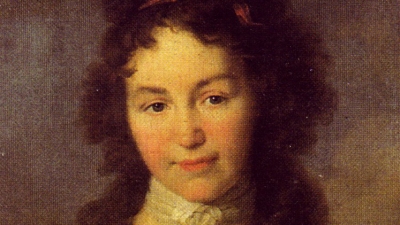
 Stuart Dean has a B.A. (Tulane, 1976) and J.D. (Cornell, 1995) and is currently an independent researcher and writer living in New York City. He has studied, practiced and taught Tai Chi, Yoga and related disciplines for over forty years. Stuart has a blog on Sappho and the implications of her poetry for understanding the past, present and future:
  The Association for the Study of Women & Mythology
 Arduinna, Gaulish Goddess of Forests and Hunting is one of the many Celtic Goddesses who is associated with a particular region or body of water. She was worshipped in the heavily forested regions of the Ardennes, located in what is current day Belgium and Luxembourg with small portions found in France and Germany. She was also associated with the Forest of Arden in England. Her name has its roots in the Gaulish word “arduo” meaning “height”.
 “If there is one chant in the universe it is to create.”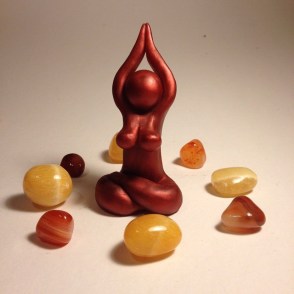
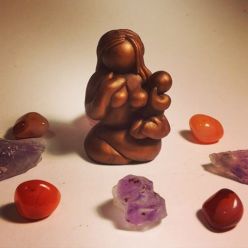
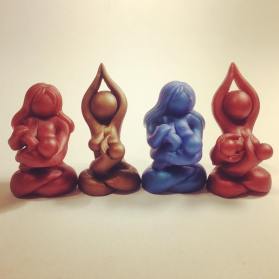
 inches tall or taller. The goddesses I make are all about three inches tall and there’s a reason for that: they fit in the palm of my hand. When I create them, I feel as if I’m part of an unbroken lineage stretching back 30,000 years to the person who carved the Goddess of Willendorf. I feel connected to the priestesses of the Mesopotamian temples who sculpted hundreds upon hundreds of tiny clay goddesses. Someone commented on my sculptures once saying, “
 “Light and Darkness” is a song written and arranged to one of the oldest known European melodies by Ariadne Institute founding Co-Director Jana Ruble, following her first Goddess Pilgrimage to Crete. Every year since then, we have sung it in the caves of Crete during our rituals. A pilgrim told us that she learned it at the (Christian)
  Candlemas / Imbolc, the midway point between the winter solstice and spring equinox brings with it (in the northern hemisphere) the first signs of awakening spring. Here in Canterbury, southeast England, where I am living this year, the birds are already starting to sing for mates and build their nests. In Celtic pre-Christian religion, Imbolc is associated with the Goddess Brigid / Bride (and the Christian Saint Brigid), but today I suggest we pay a visit to Brigid’s Slavic sister, the Goddess Mokosh / Mokoš, who is also powerfully associated with emerging fertility in the woman, the land and the year.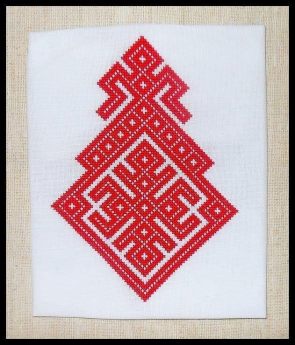
 I spent 2015 teaching an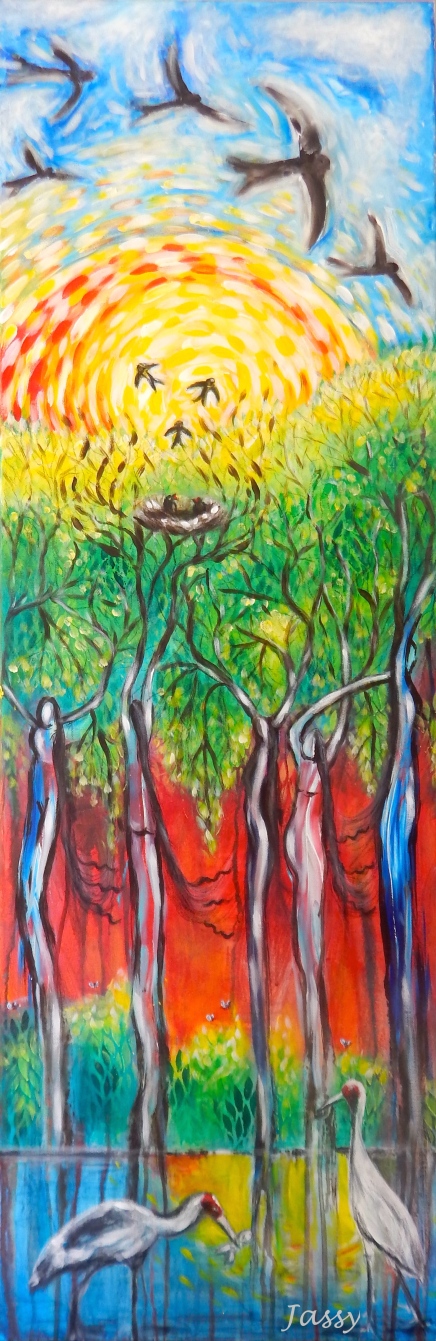
 When Flint, Michigan’s water supply was poisoned by lead through a policy decision— as has been widely reported, especially by
  Feminism and Religion