Out with the Old: In with the New by Carol P. Christ

A few days ago, a Greek friend told me she was going to bring holy water from a church so that we could bless my house. Ever since I moved to my new apartment in Heraklion, I have intended to do a house blessing, following rituals I learned from Z Budapest. But with unpacking and settling in interrupted by illness, I never got around to it. I did burn frankincense early on to clear out vibes left by the previous inhabitants of my space, but nothing more. I have slowly made the house a home, but I have been waiting for the renovations to be finished before doing a final blessing. As I still anticipate remodeling the kitchen island, I did not proceed.

Before my friend arrived, I incensed the house again, musing that now that I have finished my chemotherapy and am on the road to recovery, it is high time to clear out all the lingering feelings and memories of the time I was very ill. When my friend arrived bearing a small plastic bag filled with water from a church spring, she asked if she could water the plants on my balcony. I had watered them the day before, but I didn’t mention that.

Announcing that she loved to play with water, she doused the plants, then hosed the balcony tiles and sprayed the windows which were covered with dust following a recent dirty rain. As there are balconies surrounding all of my rooms, that completed the cleansing. Watering the plants signaled the renewal of life.

Continue reading “Out with the Old: In with the New by Carol P. Christ”

Wings by Sara Wright


Early in January I discovered a chickadee with a broken wing floundering in the snow. I rescued him, providing him with a safe haven in the house, hoping he might recover use of his wing. For the first couple of days we conversed at the edge of the mesh that covered the sides of his cage and he seemed pleased to be with me. I named him Blue.

On the third morning, a solitary chickadee chirped just behind me outside the window. I immediately suspected it was his mate because Blue became almost frantic jumping back and forth on the mesh that faced the window.

After that incident, things changed radically. Blue bit me hard whenever I changed his water. He tried to escape repeatedly. I knew that to let him go was to consign him to death because sub-zero temperatures were the norm for this time of year. I resisted. It took a few more days to face the truth. I could feel and sense it. I had to let him go although I knew he would die. Continue reading “Wings by Sara Wright”

God’s Womb by Joyce Zonana

The first time I came across the phrase, I thought I must be making a mistake. “Que Dieu l’enveloppe dans sa matrice,” the passage read in French, “May God’s womb enfold her.” or possibly, “May God enfold her in His womb.” His womb?

Joyce Zonana
The first time I came across the phrase, I thought I must be making a mistake. “Que Dieu l’enveloppe dans sa matrice,” the passage read in French, “May God’s womb enfold her,” or possibly, “May God enfold her in His womb.” His womb?

I’d just started translating Ce pays qui te ressemble [A Land Like You], Tobie Nathan’s remarkable novel of Egypt’s Jews in the first half of the twentieth-century, and I couldn’t be sure I was correct in thinking that “womb” was the proper rendering for “matrice.” But a quick search confirmed my hunch. Matrice (from the Latin matrix < mater) might be translated as “matrix” or “mould,” but that made no sense here. “Uterus or womb” was the anatomical meaning, and it was the first meaning listed in my French dictionary.

The phrase, or something very like it, kept turning up, always after a dead person was named:  

Que Dieu accueille son âme en sa matrice.

Que Dieu l’enveloppe dans sa matrice.

Que Dieu la berce dans sa matrice. 

May God’s womb welcome his soul.

May God’s womb enfold him.

May God’s womb cradle her.

In all, “God’s womb” is mentioned seven times in this novel set in Cairo’s ancient Jewish quarter, Haret al-Yahud. Each time, it’s part of a ritual prayer, a formulaic wish for the wellbeing of a departed soul. But what extraordinary wellbeing is wished for here, what a remarkable envisioning of God as the possessor of a welcoming, warm womb. Continue reading “God’s Womb by Joyce Zonana”

How I Learned to Love Snakes (a poem) by Marie Cartier


Can I recall a time when my resilience surprised me?

My mother always said, “If you feel bad, go out into the garden and eat worms.” Sigh. We didn’t have a garden. My resilience. My head hits the counter, as my father’s hand slams into the back of my head. I am locked in a closet. I am. That would be my mother as I grew up. Kicked up. Weeds grow. They do. What is surprising to me at sixty is not my resilience, but the fact that I never leaned back. Stopped. Being resilient is the inside and out of my blood type—moving through all of my veins. I am surprised if I cut myself there is blood left. But there is. I still bleed.

This is resilience.

Can I recall a time when resistance was the only option?

My father. I am twelve. My best friend is over. I go in the other room with him. I have to. She hears this, my best friend. I resist shame like a knife blade I hold. I leave the room with the blade held out. Shame then holds out a cloak promising me something. A space to hide maybe. I resist. I am in a cold fever. My best friend and I sit; we are watching a documentary on TV. My mother sits behind us. She says to no one, “Things happen at everyone’s house. I bet things happen at your house, too.” My best friend and I say nothing. I resist feeling. On the TV are flamingoes and I will hate flamingoes for the rest of my life.

This is resistance. Continue reading “How I Learned to Love Snakes (a poem) by Marie Cartier”

A Handy Spiritual Practice By Barbara Ardinger

Here’s a simple spiritual practice that I’ve been doing for longer than I can remember. During the regime of the Orange T. Rex, I started doing it at bedtime to calm my mind so I could go to sleep. We’re hopefully living in a more optimistic and peaceable time now, but that’s no reason not to add a new spiritual practice to our lives. I hope you’ll like this one and will try it for yourself.

We’re accustomed to seeing people praying with rosaries or reciting mantras and counting repetitions with strings of beads. We can do that, too. But how about using a simpler “tool” to keep track of our mantras and affirmations—our own hands?

How to use your hand? Make a fist and extend each finger as you say its affirmation. If you’re seated, lay your hand on the arm of the chair or in your lap and tap one finger at a time. Or just find your own way to keep track.

In the next paragraphs, I interpret what the affirmations in the illustration mean to me.

Thumb: All seems well. Yes, this is ambiguous, but consider what we’ve been living through since 2016, especially in 2020 with the pandemic and the election. Perhaps things have improved now. Perhaps some things do seem well. This ambiguity is the baseline upon which the rest of the handy practice is built.

Pointer finger: All things shall be well. This and the next finger are my paraphrases of the writing of Dame Julian of Norwich (ca. 1314-1416), a medieval English anchorite. Dame Julian lived through the Black Death and the Peasants Revolt and was the author of Revelations of Divine Love, https://en.wikipedia.org/wiki/Revelations_of_Divine_Love which is the first surviving book in the English language written by a woman. An interesting note about the conjugation of English verbs: the declarative (everyday) mood is I/we shall, you will, he/she/it/they will. Note that when the “shall” and the “will” are reversed—I/we will, you shall, he/she/it/they shall—we get the imperative mood. It’s emphatic. “All things shall be well” means that’s how it’s gonna be. When you say this affirmation (aloud or silently), say it emphatically.

Long finger: All manner of things shall be well. Again, my paraphrase. (What she really wrote is what she heard Jesus say in a vision: “All shall be well, and all shall be well, and all manner of thing shall be well.”) Let’s look more closely at my version. “All manner of things”: not just a few things, but many things. What do you see as “all manner of things”? Your own welfare? The welfare of your family and friends? What’s happening in your neighborhood, city, state, nation? Think as personally or as generally as you want to when you say this. (You can of course change what things shall be well every time you repeat this affirmation.) Emphasize “all manner” as you think about what you want to be well. Then also emphasize “shall be well.” We’re not giving orders to the universe, of course, but we can shout if we want to.

Ring finger: All can only be well. A typical metaphysical affirmation. As you repeat it, see it as a universal goal. Try saying it five times, stressing each word in turn. ALL can only…. All CAN only…. All can ONLY…. Et cetera.

Pinkie finger: Om tare tuttare ture soha. Because I took refuge with Green Tara during a weekend workshop taught by Dagmola Jamyang Sakya many years ago, I use the Tara mantra. Translation: “I prostrate to the Liberator, Mother of all the Victorious Ones.” (Well, I don’t do the proper Tibetan prostrations. It takes me forever to get up off the floor.) Another goddess mantra is Vishwa Shakti Avaham. Translation: “Universal energy of the Divine Mother [Shakti], be present in my life.”

You can of course make other choices for your pinkie finger affirmation. Here are half a dozen ideas. Use them and/or make up new ones. Let your littlest finger be strong enough to hold a big intention.

  1. Deena Metzger’s Goddess Chant: “Isis Astarte Diana Hecate Demeter Kali Inanna.” You’re invoking seven powerful goddesses into your life.
  2. “We are the flow, we are the ebb. We are the weavers, we are the web.” (Probably composed by Shekinah Mountainwater.) We are active parts of the benevolent universe.
  3. A Beatitude. Here’s one I like: “Blessed are the merciful, for they shall obtain mercy.” I have long believed that if Christians paid more attention to the Sermon on the Mount there would be less conflict in religious discussions.
  4. The opening line of a Psalm. Here’s Psalm 19 (AV): “The heavens declare the glory of God; and the firmament sheweth his handywork.” Open your own Bible and select the Psalm that speaks to your heart.
  5. These lines spoken by the exiled Duke in the Forest of Arden in Shakespeare’s As You Like It: “And this our life…/ Finds tongues in trees, books in the running brooks,/ Sermons in stones, and good in everything./ I would not change it” (II, 1, 562-65). As we’ve seen in many posts by the FAR community, we can find much good in and learn much from Mother Nature.
  6. The first line of this Jerry Herman song from La Cage aux Folles: “The best of times is now.” Here’s the whole song from the 2010 Tony awards broadcast https://www.youtube.com/watch?v=PBZLCnF4KC0 as sung by Douglas Hodge (who won the Tony that year) and the whole cast. It’s enormous fun to watch. (Those are the Cagelles dancing in the aisles.) For a cheery and inspiring conclusion to your handy spiritual practice, learn and sing the whole song.

[Note: Many thanks to Jennifer Ardinger for turning my sketch of the hand into real art. Many thanks to Meloney Hudson for teaching me the Shakti mantra.]

Barbara Ardinger, Ph.D. (www.barbaraardinger.com), is a published author and freelance editor. Her newest book is Secret Lives, a novel about grandmothers who do magic.  Her earlier nonfiction books include the daybook Pagan Every DayFinding New Goddesses (a pun-filled parody of goddess encyclopedias), and Goddess Meditations.  When she can get away from the computer, she goes to the theater as often as possible—she loves musical theater and movies in which people sing and dance. She is also an active CERT (Community Emergency Rescue Team) volunteer and a member (and occasional secretary pro-tem) of a neighborhood organization that focuses on code enforcement and safety for citizens. She has been an AIDS emotional support volunteer and a literacy volunteer. She is an active member of the Neopagan community and is well known for the rituals she creates and leads.

The Sacred Face of Death by Eirini Delaki

The archetype of the Weaver is being widely activated. Thousands of women and men come forth to incarnate it by creating webs of spiritual awakening, by honoring ancestral ways of being, and by promoting practical and sustainable ways of living and thriving.

However, many of these efforts collapse due to a lack of genuine communication inside the group.  How can we direct our intentions into grounding a vision that is broader than ourselves? How can we weave together in such a way that each feels heard and, at the same time, willing to deeply listen and feel into, not only the group as a set of individuals, but also to what is making its way into birth out of the group as a unit?

Although it seems easy, group synchronization is not a light task and, in order for this to happen at a substantial level, one has to start from oneself.  It is necessary for a kind of initiation to take place, an initiation called “soul individuation.” Soul individuation is a deep dive into one´s own underworld in order to unearth and liberate experiences that have caused one´s soul to fragment. Until this is achieved, one can communicate only from that broken place, not from a place of wholeness and authenticity.  Journeying to the underworld is not a pleasant process but, it is a necessary step towards balance and integrity. Continue reading “The Sacred Face of Death by Eirini Delaki”

First Light: Brigid and the Bear by Sara Wright

Winter light pauses so briefly. Now Chickadees are chirping and wild doves are pairing up. Birds are starting to sing love songs to the earth as she turns towards the light. By early February light is streaming into the house with more warmth and for longer hours. It is no longer dark at 5 PM.

Each morning I stand at the window to glimpse a golden orb rising through the cracks of bare tree branches. Some days the sky is infused with deep rose, bittersweet orange or scarlet. When the sun star appears I watch what the light will do – will it reflect on the still open water of the brook, or turn night frozen branches into star-like crystals? Some days the sun has to climb out of the hooded clouds to rise into blue. Amazingly, this star at the center of our solar system literally transforms parts of its body into light every second, an astonishing thought that speaks more to sun as process than to an actual entity… First Light is upon us. Continue reading “First Light: Brigid and the Bear by Sara Wright”

Homebound by Joyce Zonana

When my parents left Egypt, they left behind everything they’d grown up with, all the objects that carried their deepest associations and memories. They taught me to scorn such “things”—what others value as mementos or souvenirs—rightly reasoning they can be lost in a moment. But while we have them, it is lovely, I’m learning, to let the spirits embedded within them, the memories and feelings they evoke, surround and comfort us. As I move through this house, I feel bound to my own and others’ histories, embedded in a rich and complex life that nurtures and sustains me. And as I sit still and knit, I sense that I am knitting (knotting) up the by now long, loose threads of my own life, shaping them into a coherent and satisfying whole.

Joyce ZonanaWhen I was growing up, home was the last place I wanted to be. It’s not that ours was an abusive or angry household: both parents loved me and my mother labored to create a calm, clean space to contain us all. It’s just that I felt suffocated.

Part of the problem was that we were immigrants. My parents were struggling to find their way in an alien culture, and, with little else to hold onto, they clung to their customs and traditions. I wanted to be “American,” to mingle with classmates, to venture into the vastness (New York City!) just beyond our door. The Middle Eastern culture from which we hailed had strict rules for women and girls, and my mother expected me to follow them. She herself was an excellent cook, a creative seamstress and scrupulous housekeeper, a devoted and dutiful wife. I rejected all of it, refusing to cook, ripping out seams, balking at my weekly chores of dusting and vacuuming and ironing. Instead I dreamt of life as a writer, a renegade, an outlaw. My role models were hobos and witches and gypsies; more than anything, I yearned to be free, longing to “walk at all risks,” like Elizabeth Barrett Browning’s Aurora Leigh.

Continue reading “Homebound by Joyce Zonana”

Gratitude and Hope: With a  Lot of Help from My Friends by Carol P. Christ

Last Friday my oncologist gave me the best birthday present I could have imagined. (My birthday was 7:30 pm last night December 20, California time.) Without going into details, my latest CT scan was so much more positive than the last one that it feels like a miracle. I have reason to hope.

Today I am full of gratitude. I am grateful to my doctor Dimitrios Mavroudis who is the head of Oncology at the University of Crete and at the Pagni Hospital in Heraklion. I am grateful to medical science for the chemotherapy that is healing my body.

I am grateful for the national health system of Greece that is covering the cost of my treatment because I am a Greek citizen even though I never contributed to the national health insurance.

I am grateful to the nurses at the Pagni hospital who are unfailingly kind as they take my blood and regulate my chemotherapy.

I am grateful to Vera Dervesi, my cleaning lady and now friend, who with her husband Eddie, took me to the hospital where I was diagnosed, and who has helped me finish unpacking and moving in to my new apartment, and for her sweet presence in my home that soothes my soul. Continue reading “Gratitude and Hope: With a  Lot of Help from My Friends by Carol P. Christ”

Altars Everywhere, Part 1 by Carol P. Christ

In a recent blog, Carolyn Boyd invited us to reflect on how our women’s spiritual power is activated through symbols that help us to remember and manifest the “deep well” of our inner knowing. According to historian of religion Mircea Eliade, the sacred and the profane were not separated in premodern cultures because all of life was considered to be sacred. Many in the Women’s Spirituality and Goddess communities have advocated this earlier more wholistic understanding. Although it is not always easy to overcome the dualism between sacred and profane, we attempt to do so.

One of the symptoms of my chemotherapy is neurasthenia or partial numbness in my right foot. When it first occurred, I fell three times in my apartment because I was not lifting my foot automatically. I became afraid to move without holding onto the walls or furniture. I resisted my friends’ advice to get a walker, but finally agreed that I needed some form of physical support. I arranged for my friend Eirini Kouraki to have a rubber tip added to the shepherd’s cane I sometimes use walking in the mountains. When she brought it too me, I decorated it with three ribbons I saved from rituals at the Holy Myrtle Tree at the Paliani monastery in Crete. The most recent were brown, the color of the earth, and red, the strong energy I will need to heal. I added a light green-blue ribbon, representing the calm and clear optimism I feel as I face a crisis of life and death. The ribbons remind me of the healing power of the Holy Tree that I have called upon many times, turning a symbol of my infirmity into a symbol of healing and hope.

In the past weeks as my cancer treatment continues, I have been feeling strong enough to finish unpacking (with the help of Vera, my cleaning lady) and organizing my new home in Crete. As I rediscover sacred objects, I create altars. Altars are physical reminders of our spiritual beliefs. Creating and tending them helps to create the embodied knowing that brings the spirit into our daily lives.

The living area of my new apartment has 3 glass shelving units. In one of them, I created a triple altar with images of the Goddess and female power from ancient Crete. Because the apartment is sleek and modern yet welcoming to my antique furniture, I kept the altar minimal.
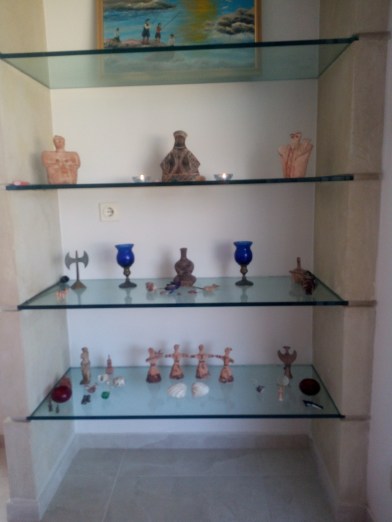
On the top shelf I placed three pre-palatial “pitcher” Goddesses, two with breasts from which liquid pours and one that is holding a water jug from which liquid can also be poured. These images, dated before 2000 BCE, express the Old European insight that the Goddess represents the powers of birth, death, and regeneration in all of life. Though they have human qualities, they are more than human. The Goddess from Malia who sits in the center of this altar has a beaked face and wings and her triangular shape evokes the mountains from which water flows to villages and fields. These images remind me that the Goddess is the Source of Life, provider of gift of life that is our embodied being and the gifts of life—including food and water–that nourish us daily.
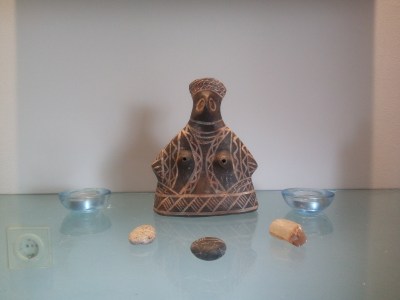
The second shelf holds one of the oldest images from ancient Crete, the Neolithic Goddess from Ierapetra. She is seated on massive buttocks, securely rooted in the earth. Her face is beaked, symbolizing her connection to the birds that fly in the air. Her body is decorated with lines identified by archaeologist Marija Gimbutas as the flowing water that nourishes all of life. Her body too is shaped like the mountain. She represents the never-ending powers of birth, death, and regeneration in all of nature.

In front of the Neolithic Goddess I placed a twig from Paliani with a dark blue ribbon reminding me that my friend Tina Nevans is sending the healing energy of the Blue Buddha to me in her daily meditations, as well as several handsewn triangles holding leaves from the Holy Myrtle tree, and a crystal extracted from the Trapeza Cave, found on the path outside of it. To Her right is a small image of the long-necked turtle Goddess from Myrtos who holds a pitcher recalling women’s daily visits to water sources, and a small copy of a Kamares ware pitcher used to pour libations in the Sacred Centers. To the left are a bronze copy of a labrys, originally the double sacred female triangle transformed into wings and also a happy little bull who reminds us that animals experience the joy of life.
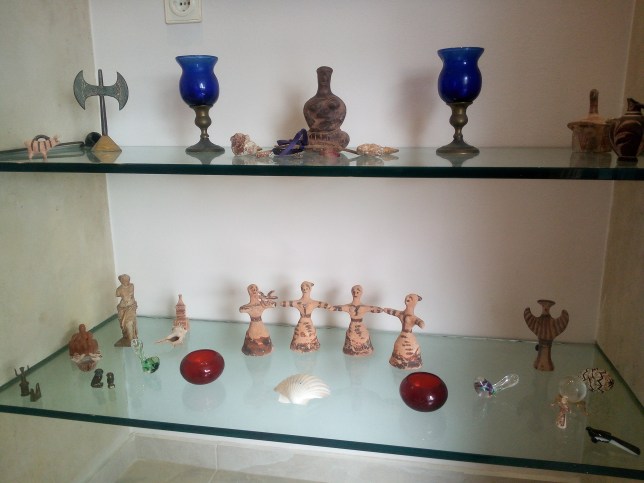
On the lower shelf, copies of dancing women from post-Minoan Paliakastro symbolize the transmission of Old European values of community, lack of hierarchy, and most of all, celebration of the joy of life as Laura Shannon has written. The dancing women are surrounded by images of later Mycenaean Goddesses and of Aphrodite who was worshiped at the Minoan site of Kato Symi in classical times, and a small reproduction of the Neolithic Goddess from Catal Huyuk, who reminds us that Crete was settled c.7000 BCE by farmers from Anatolia.

In the hallway I placed a copy of a drawing of the Holy Myrtle Tree of the monastery of Paliani created by one of the nuns. According to the story told, the area where the monastery was later built was burned in a fire but a small myrtle bush survived. It was watered by girls who saw the image of the Panagia (Mary the Mother of Jesus) in its charred branches. So, the monastery which was known as ancient in 668 CE was built. The monastery is a sacred place for the surrounding villages. The sacred tree and the icon of the Panagia in the church are said to have performed many miracles. Below the drawing of the Sacred Myrle Tree is a small image of a face in a twig from tree given to me by German artist Carla Randel.

On a small table under the drawing, I placed an image of Aphrodite who was earlier associated with myrtle trees, along with a candle, a star, a blue glass paperweight, and a triton shell, symbolizing Aphrodite as the morning and evening star, and her relation to the sea.

When I light candles in translucent glass holders on the altar with the pitcher Goddesses as the day dawns and in the evening as day turns to night, and when I gaze at my other altars, I remember that I am always surrounded by the nurturing love of the Goddess. This love takes root in my body, and I am inspired to share it with others.

To be continued.