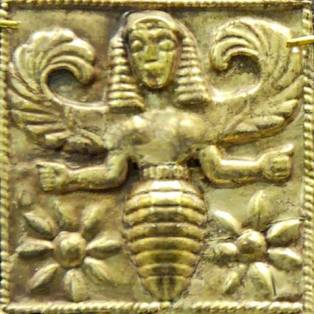
The Association for the Study of Women & Mythology (ASWM) will be hosting this year’s Conference, “Seeking Harbor in Our Histories: Lights in the Darkness” at the Boston Marriot Burlington Hotel on 1-2 April 2016.
ASWM conferences strive to support the scholarship, artistry, & practice of those who explore and engage the sacred feminine through study and creativity. Offering keynote presentations at this year’s conference are Dr. Elinor Gadon, Dr. Margaret Bruchac, and Dr. Lucia Ciavola Birnbaum.
On Friday night, there will be a plenary session and book-signing moderated by Miriam Robbins Dexter and Vicki Noble and featuring Max Dashu, Starr Goode, Mama Donna Henes, Donna Read, Genevieve Vaughan, Cristina Biaggi, Lydia Ruyle, Miranda Shaw, Elinor Gadon, and Susun Weed. They will be sharing stories from the anthology, Foremothers of the Women’s Spirituality Movement: Elders and Visionaries. FAR contributor Carol P. Christ has a chapter in the book.
FAR is excited to share that three of our contributors are on this year’s conference schedule!
Nancy Vedder-Shults will be joining the “Artists, Activists, & Scientists and the Lineage of the Goddess” panel with her presentation, Science and Divination: The Blurring Lines between the Secular and the Sacred.
Jill Hammer will present The King and the Priestess: Mythic Motifs and Motives in the Tale of Judah and Tamar as part of the “Male-Female Relationships in the Hebrew Texts: Three Feminist Analyses” panel.
Kate Brunner will be participating in the “Women’s Spirituality, Transformative Scholarship and Personal Quest” panel with Rhiannon, Great Queen of the Mabinogi: Ancient Mythology in Modern Context. She will also be offering her meditative writing workshop, Becoming Branwen the Peaceweaver.
In addition to the main conference, there will be a Matriarchal Studies Day seminar and celebration, in the same location the day before (31 Mar). Hosted by Vicki Noble and Lydia Ruyle, the program looks to be a great addition to the weekend. Dr. Heide Goettner-Abendroth, founder of Modern Matriarchal Studies will present via Skype. Other presenters will include Max Dashu, Polly Wood, Beverly Little Thunder, and Genevieve Vaughan, exploring woman-centered arts, themes of motherhood, and the gift economy. There will be a keynote presentation by Lucia Chiavola Birnbaum, and evening entertainment by folksinger, Julie Felix.
Feminism & Religion Project contributors past, present, & future interested in connecting with FAR at the conference, are encouraged to get in touch with Kate Brunner at feminismandreligionblog@gmail.com. If there is enough interest, we may be able to organize meeting up for a meal together some time during the weekend.
If you ever eavesdrop on a conversation between my husband and me around the clamor of our four children’s voices, you will probably hear me making a tired lament: “All I want is a broad swath of uninterrupted time.” In listening to Elizabeth Gilbert’s newest book, Big Magic, on audio book I was interested by her mention that many creative people lament not having long stretches of uninterrupted time available in which to work. She quotes a letter from Herman Melville to Nathaniel Hawthorne, lamenting his lack of time and how he is always pulled “hither and thither by circumstances.” Melville said that he longed for a wide-open stretch of time in which to write. She says he called it, “the calm, the coolness, the silent grass-growing mood in which a man ought always to compose.”
…I do not know of any artist (successful or unsuccessful, amateur or pro) who does not long for that kind of time. I do not know of any creative soul who does not dream of calm, cool, grass-growing days in which to work with- out interruption. Somehow, though, nobody ever seems to achieve it. Or if they do achieve it (through a grant, for in- stance, or a friend’s generosity, or an artist’s residency), that idyll is just temporary—and then life will inevitably rush back in. Even the most successful creative people I know complain that they never seem to get all the hours they need in order to engage in dreamy, pressure-free, creative exploration. Reality’s demands are constantly pounding on the door and disturbing them. On some other planet, in some other lifetime, perhaps that sort of peaceful Edenic work environment does exist, but it rarely exists here on earth. Melville never got that kind of environment, for instance. But he still somehow managed to write Moby-Dick, anyhow.
When I create a new sculpture, I am most often creating something that I need to remember or want to learn. The original figures for my Centered Mama sculpture and my Meditation Goddess sculpture were both created while at a friend’s house for a weekend work exchange as my baby toddled around. While I love making figures of mothers and babies, I was feeling a strong urge to make a goddess representation complete unto herself. It felt like a reclaiming of my non-maternal identity and a declaration of self-sovereignty. She turned out a little bigger than some of my other figures, strong and secure and independent. Then, the baby crawled over and knocked off one of her breasts, knocked her over on the tray, smashing the side of her head. I came close to crying. I felt annoyed with my husband who’d “let” him come over and destroy my work rather than noticing him doing it and stopping him. I was frustrated, dismayed, and my feelings felt hurt in a sense. First I felt like, Argh! This is a metaphor for life! And, then I realized it was not just a metaphor for life, it is my actual life! I pouted a bit and said I was just going to smash her and give up and I made some bitter faces at my husband and some long-suffering huffs and signs, but then the baby fell asleep in the Ergo, held close against my chest. I kissed his soft hair and I took my clay and started again. I reclaimed her from the smashed parts and she sat stronger and taller than ever.
She reminds me not to give up and that beautiful work can come from struggle, but also of interdependence (not just the independence I was going for!), co-creation, and tenacity. When the finished version of her, cast from the original sculpt, sits by my bed at night or overlooks my dinner preparations, she reminds me that I am strong and that persistence is worthwhile. She also tries to remind me to be calm and steady, centered and Zen, even though I more often feel like a whirlwind.
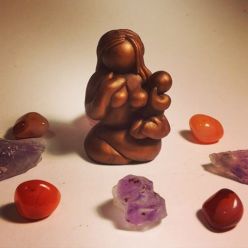
That same Saturday at my friend’s house, as my baby tentatively toddled around the kitchen, chewed on a piece of watermelon, and snoozed on my chest, I felt moved to begin creating a new Centered Mama sculpture. I had been going through an emotional rough patch, feeling buffeted by variable emotions and erratic and unpredictable in my enthusiasm and confidence. I was also feeling impatient, snappy, and irritable.
“I will be gentle with myself. I will be tender with my heart. I will hold my heart like a newborn baby child.”
This song by Karen Drucker replayed in my mind as I sculpted. The baby woke, the watermelon got dragged along the floor collecting dust, and it was time for our collaborative dinner, so I had to put her away unfinished. When we got back to our own home, I was compelled to finish her, working feverishly as the baby pulled on my legs and I said, “just a few more minutes!” to the older kids who were trying to play with him to let me work. Again and again I re-rolled the clay baby’s head, trying to make it “perfect,” and worked to lay down the strands of her hair, against of the backdrop of this often-chaotic, noisy, home-based life we’ve consciously and intentionally created together. She was created to represent holding my own center in the midst of motherhood. I will be tender with my heart. I don’t create sculptures like this because I AM so “Zen” and have life all figured out, I make them to remind me what is possible if I listen to my soul.
As I do extensive rearranging, construction, and reconstruction on my slowly ongoing dissertation project, I typed out a quote from the book Priestess: Woman as Sacred Celebrant by Pamela Eakins about her past life memories of making clay goddess figures as a temple priestess:
…to me it brought a continuation of the energy of the sacred objects of the grandmothers. I contained this energy in a new form in the dolls that would be placed upon the altars and in the graves of the daughters living now and the daughters to come…
I felt this process made my own clay stronger, too. Some of the pieces cracked in the fire because of the added ‘impurities’…but, in this case, I felt the impurities were the purest of pure and I worshipped each crack knowing the crack contained the wisdom of the priestesses who had occupied the doll-making table for more moons than I could even imagine. It contained too, the devotional energy of every grandmother who had held it in her hands or placed it on her altar. Sometimes ‘impurities’ sanctify further that which is holy to begin with.
While I tend to have a knee-jerk skepticism about past-life memories, there is something in Eakins’ words that I know at a bone-deep level as I do my own work with goddesscraft:
…Each goddess was imprinted with the sound of sacred life coursing through the Universe. I changed with the priestesses as the figures came through my hands. Each doll received the sacred vibration of life…For seventy-seven moons I made the dolls at the long table with the young Sisters of Nun. My hands were so fast. I made thousands of figures: beautiful little faces, etched collars of gold plates, pubic hair swirled into tiny rows of connecting spirals. They were so precious. At the end of the day, my baked clay shelves were covered with little women.
The clay goddesses healed…
This is how I apprenticed. I learned, in this manner, the art of healing. I learned that to heal means to make whole, and that becoming whole involves learning many levels of purification, balance, and reformation” (p. 32-33).
In Anne Key’s marvelous priestess memoir, Desert Priestess, she makes this important point: “It is of course no small wonder why graven images are so tightly controlled by religious traditions.” (p. 52) Sometimes I feel like this is what I’m tapping into when I make my own goddess sculptures—a resistance to tight control over graven images and over personalization of divinity as male.
I occasionally get requests to make bigger goddesses–-people ask about figures that are large altar pieces 12-18 inches tall or taller. The goddesses I make are all about three inches tall and there’s a reason for that: they fit in the palm of my hand. When I create them, I feel as if I’m part of an unbroken lineage stretching back 30,000 years to the person who carved the Goddess of Willendorf. I feel connected to the priestesses of the Mesopotamian temples who sculpted hundreds upon hundreds of tiny clay goddesses. Someone commented on my sculptures once saying, “echoes of Mesopotamia.” And, I said, “exactly.” I feel the connection between the clay in my hand and the clay in their hands, running through the ripples and eddies of time.
I’ve been inspired recently to re-read Starhawk’s The Spiral Dance, finding new bits of wisdom from it that speak to something different in me than they did the first time I read it. She writes of the attempts to discredit Goddess religion by invalidating the historical narratives or archaeological evidence: “The idea seems to be that if they can disprove our origin story, they can invalidate our spirituality…Is Buddhism invalid if we cannot find archaeological evidence of Buddha’s existence? Are Christ’s teachings unimportant if we cannot find his birth certificate or death warrant?…the truth of our experience is valid whether it has roots thousands of years old or thirty minutes old…a mythic truth whose proof is shown not through references and footnotes but in the way it engages strong emotions, mobilizes deep life energies, and gives us a sense of history, purpose, and place in the world. What gives the Goddess tradition validity is how it works for us now, in the moment, not whether or not someone else worshipped this particular image in the past” (p. 4).
The ancestry of my goddess sculptures may not be the same energy that raised temples and built monuments (or walls), it is the energy that carried a baby on one hip and a basket of supplies on the other and needed a goddess just the right size to tuck down the front of a shirt…
Sometimes I describe my life in the woods as being held in the hand of the goddess. And, I make goddesses that I hold in my hand. Am I in the palm of her hand or is she in the palm of mine? The answer is both.
(One of my all-time favorite fan photos–a rainy day traveling goddess picture, taken by my friend/SIL (this one is only an inch tall, but look how she calls in the waters of the world!)
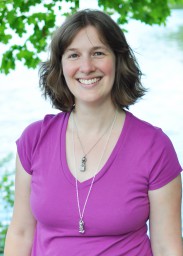
Molly has been “gathering the women” to circle, sing, celebrate, and share since 2008. She plans and facilitates women’s circles, seasonal retreats and rituals, mother-daughter circles, family ceremonies, and red tent circles in rural Missouri. She is an priestess who holds MSW and M.Div degrees and she is finishing her dissertation about contemporary priestessing in the U.S. Molly’s roots are in birth work and in domestic violence activism. She has worked with groups of women since 1996 and teaches college courses in group dynamics and human services. Molly is the author of Womanrunes: a guide to their use and interpretation, Earthprayer, Birthprayer, Lifeprayer, Womanprayer, and The Red Tent Resource Kit, as well as three social service oriented booklets and a miscarriage memoir. She has maintained her Talk Birth blog since 2007 and writes about thealogy, nature, practical priestessing, and the goddess at her Woodspriestess blog. Molly and her husband Mark co-create original birth art, goddess sculptures, ceremony kits, and pendants at Brigid’s Grove.
Coloring is a fast growing trend among over-stressed adults. “Soothing coloring pages” are a top Google search item. There are coloring books featuring mandalas, garden scenes, inspirational quotes, and even curse words written in fancy calligraphy sprouting branches, flowers, and swirls eager to be illuminated with colored pencils toted by hipsters, young professionals, retirees, clergy, and other adults searching for artistic ways to tap their creative spirit and sooth their jangled nerves. Articles—popular and academic—whose authors range from psychologist to spiritual director purport the power of coloring to calm anxiety, relieve stress, and provide a creative and spiritual outlet. Is this a feminist issue? I’d say so.
There are, indeed, feminist coloring books and goddess coloring books, though I’ve seen very little that fuses together both feminism and religion. In order to fill this gap, while also seeking to expand my own creative expression, I have finally completed the drawings for my forthcoming Holy Women Icons Contemplative Coloring Book. Continue reading “Coloring Holy Women by Angela Yarber”
Fragment of an Ancient Greek Statue (Acropolis Museum, Athens)
The first performance of the play Antigone was in Athens around 440 BCE. It is possible that Phaenarete, the mother of Socrates, was in the audience. By then she was certainly practicing medicine and perhaps had been doing so for a decade or more. Given the nature of her practice she would have had any number of connections that might have led to an invitation to attend (including from Sophocles himself, who was roughly the same age as she was and who is known to have been married and to have had children).
The much debated issue over whether Athenian women were even allowed to attend theatrical performances should not turn attention away from the fact that even if Phaenarete did not actually view the performance of Antigone she surely would have had a ‘view’ about it. The basic elements of what today seems merely the myth on which it is based but which, for her, was effectively history (and thus concerned with what a woman actually said and did) would have been known to her quite apart from the play itself. Phaenarete’s interest particularly in Antigone would have derived from its relationship of burial to the womb–literally and symbolically–and how that could readily be associated with her medical practice.Continue reading “The First Performance of Antigone: Phaenarete’s View by Stuart Dean”
I have recently been looking at the Goddess Ananke. Ananke and Her consort Khronos, were primal energies emerging from chaos, producing the world egg and then wrapping themselves around it causing it to burst. Out of that egg came the world and all that it contains. Just imagine, the world being formed by two energies – those of Inevitability or Necessity and by Time. How simple and yet how complex.
The story of Ananke and Khronos is large. Those ancients who held onto this story were not speaking of small things. This is the creation of a Universe. And yet, in the theory of “as above – so below”, we can look and see Ananke and Khronos at work in our lives all the time.
Time and Inevitability – perhaps everything can be broken down into these two principles. With Time and Inevitability, we are born, we age and we die. A life is led, perhaps filled with love, perhaps many things. As children we play and learn and eventually become adults. We marry. We have children. Some step into careers and choose not to procreate, rather putting their energies into work and other kinds of relationships, still creating, just not procreating. Also, it is possible that some of those lives will follow a darker path into poverty, criminality, envy and greed. It is hard to know at birth, the path that will be followed by a child. And yet there is a certain amount of inevitability that when a child is born into a life containing a dark poverty of spirit, that the child may not thrive in healthy wholesome ways in adulthood. Continue reading “Ananke’s Promise by Deanne Quarrie”
As an artist and author, my time is often divided between painting and writing, with my interests in religion, gender/sexuality, and justice being the connection between the two. Painting teaches me something unique about writing, at the same time that writing brings clarity to my painting. For me, the two go hand-in-hand. Such is most certainly the case with my painting of the revolutionary Grimké sisters and in the writing of my most recent book, Microaggressions in Ministry: Confronting the Violence of Everyday Church, co-authored with Cody Sanders. Now that the painting, one of my newestHoly Women Iconswith a folk feminist twist,has toured parts the East Coast and Microaggressions in Ministry is officially available for purchase, I’ve had an opportunity to reflect on these seemingly disparate projects and mediums, only to realize how mutually informing they truly are.
The Grimké Sisters: Sarah (1792-1873) and Angelina (1805-1879)
Though these revolutionary sisters have always been famous in feminist-preaching-justice-antiracism-vegetarian circles, their name recognition bolstered with the stirring novel by Sue Monk Kidd, The Invention of Wings. The Grimké sisters were Southern American Quakers, writers, public speakers, and the first American women advocates for both abolition and women’s rights. Born to a wealthy plantation owner with hundreds of slaves, who held that women were strictly subordinate to men, these daring daughters experienced the evils of slavery first-hand. In fact, at age five, Sarah witnessed a slave being whipped and tried to escape South Carolina on a steam ship to a “place where there was no slavery.” In violation of the law, she taught several slaves to read during her adolescence.
Thirteen years her junior, Angelina was more of a daughter than sister to Sarah, as Sarah begged her parents to make her Angelina’s godmother. Together, the sisters left the South, became Quakers, committed themselves to pacifism and vegetarianism, and dedicated their lives to abolitionism. They gave countless public lectures—at first in “parlor meetings” for only women, but expanding to include men—decrying the evils of slavery. Not only did they preach abolition based on their interpretations of scripture, but they also held that black and white people are equal and should be treated as such. This latter belief was considered completely radical, even in abolitionist circles. In giving public lectures, they were attacked for their anti-slavery stance. In fact, they were forced to leave the Quaker church because of their views. But their radical abolitionism was not the only reason for critique; they were also condemned for stepping into the male sphere of public speaking. In the midst of such critique, the sisters were forced to grapple with their views of gender, inadvertently becoming feminists and women’s rights activists, as well. After much thought, prayer, and study, Sarah and Angelina also determined that women’s equality was rooted in scripture.
In 1612, in one of the most meticulously documented witch trials in English history, seven women and two men from Pendle Forest in Lancashire, Northern England were executed at Lancaster Castle.
In court clerk Thomas Potts’s account of the proceedings, The Wonderfull Discoverie of Witches in the Countie of Lancaster, published in 1613, he pays particular attention to the one alleged witch who escaped justice by dying in prison before she could come to trial. She was Elizabeth Southerns, more commonly known by her nickname, Old Demdike. According to Potts, she was the ringleader, the one who initiated all the others into witchcraft. This is how Potts describes her:
She was a very old woman, about the age of Foure-score yeares, and had been a Witch for fiftie yeares. Shee dwelt in the Forrest of Pendle, a vast place, fitte for her profession: What shee committed in her time, no man knows. . . . Shee was a generall agent for the Devill in all these partes: no man escaped her, or her Furies.
Quite impressive for an eighty-year-old lady!
In England, unlike Scotland and Continental Europe, the law forbade the use of torture to extract witchcraft confessions. Thus the trial transcripts supposedly reveal Elizabeth Southerns’s voluntary confession, although her words might have been manipulated or altered by the magistrate and scribe. What’s interesting, if the trial transcripts can be believed, is that she freely confessed to being a healer and magical practitioner. Local farmers called on her to cure their children and their cattle. She described in rich detail how she first met her familiar spirit, Tibb, at the stone quarry near Newchurch in Pendle. He appeared to her at daylight gate—twilight in the local dialect—in the form of beautiful young man, his coat half black and half brown, and he promised to teach her all she needed to know about magic.
Tibb was not the “devil in disguise.” The devil, as such, appeared to be a minor figure in British witchcraft. It was the familiar spirit who took centre stage: this was the cunning person’s otherworldly spirit helper who could shapeshift between human and animal form, as Emma Wilby explains in her excellent scholarly study, Cunning Folk and Familiar Spirits. Mother Demdike describes Tibb appearing to her at different times in human form or in animal form. He could take the shape of a hare, a black cat, or a brown dog. It appeared that in traditional English folk magic, no cunning man or cunning woman could work magic without the aid of their spirit familiar—they needed this otherworldly ally to make things happen.
Belief in magic and the spirit world was absolutely mainstream in the 16th and 17th centuries. Not only the poor and ignorant believed in spells and witchcraft—rich and educated people believed in magic just as strongly. Dr. John Dee, conjuror to Elizabeth I, was a brilliant mathematician and cartographer as well as an alchemist and ceremonial magician. In Dee’s England, more people relied on cunning folk for healing than on physicians.
As Owen Davies explains in his book, Popular Magic: Cunning-folk in English History, cunning men and women used charms to heal, foretell the future, and find the location of stolen property. What they did was technically illegal—sorcery was a hanging crime—but few were arrested for it as the demand for their services was so great. Doctors were so expensive that only the very rich could afford them and the “physick” of this era involved bleeding patients with lancets and using dangerous medicines such as mercury—your local village healer with her herbs and charms was far less likely to kill you.
In this period there were magical practitioners in every community. Those who used their magic for good were called cunning folk or charmers or blessers or wisemen and wisewomen. Those who were perceived by others as using their magic to curse and harm were called witches.
But here it gets complicated. A cunning woman who performs a spell to discover the location of stolen goods would say that she is working for good. However, the person who claims to have been falsely accused of harbouring those stolen goods can turn around and accuse her of sorcery and slander. This is what happened to 16th century Scottish cunning woman Bessie Dunlop of Edinburgh, cited by Emma Wilby in Cunning Folk and Familiar Spirits. Dunlop was burned as a witch in 1576 after her “white magic” offended the wrong person.
Ultimately the difference between cunning folk and witches lay in the eye of the beholder. If your neighbours turned against you and decided you were a witch, you were doomed.
Although King James I, author of the witch-hunting handbook Daemonologie, believed that witches had made a pact with the devil, there’s no actual evidence to suggest that witches or cunning folk took part in any diabolical cult. Anthropologist Margaret Murray, in her book, The Witch Cult in Western Europe, published in 1921, tried to prove that alleged witches were part of a Pagan religion that somehow survived for centuries after the Christian conversion. Most modern academics have rejected Murray’s hypothesis as unlikely. Indeed, lingering belief in an organised Pagan religion is very difficult to substantiate. So what did cunning folk like Old Demdike believe in?
Some of her family’s charms and spells were recorded in the trial transcripts and they reveal absolutely no evidence of devil worship, but instead use the ecclesiastical language of the Catholic Church, the old religion driven underground by the English Reformation. Her charm to cure a bewitched person, cited by the prosecution as evidence of diabolical sorcery, is, in fact, a moving and poetic depiction of the passion of Christ, as witnessed by the Virgin Mary. The text, in places, is very similar to the White Pater Noster, an Elizabethan prayer charm which Eamon Duffy discusses in his landmark book, The Stripping of the Altars: Traditional Religion in England 1400-1580.
It appears that Mother Demdike was a practitioner of the kind of quasi-Catholic folk magic that would have been commonplace before the Reformation. The pre-Reformation Church embraced many practises that seemed magical and mystical. People used holy water and communion bread for healing. They went on pilgrimages, left offerings at holy wells, and prayed to the saints for intercession. Some practises, such as the blessing of the wells and fields, may indeed have Pagan origins. Indeed, looking at pre-Reformation folk magic, it is very hard to untangle the strands of Catholicism from the remnants of Pagan belief, which had become so tightly interwoven.
Unfortunately Mother Demdike had the misfortune to live in a place and time when Catholicism was conflated with witchcraft. Even Reginald Scot, one of the most enlightened men of his age, believed the act of transubstantiation, the point in the Catholic Mass where it is believed that the host becomes the body and blood of Christ, was an act of sorcery. In a 1645 pamphlet by Edward Fleetwood entitled A Declaration of a Strange and Wonderfull Monster, describing how a royalist woman in Lancashire supposedly gave birth to a headless baby, Lancashire is described thusly: “No part of England hath so many witches, none fuller of Papists.” Keith Thomas’s social history Religion and the Decline of Magic is an excellent study on how the Reformation literally took the magic out of Christianity.
However, it would be an oversimplification to state that Mother Demdike was merely a misunderstood practitioner of Catholic folk magic. Her description of her decades-long partnership with her spirit Tibb seems to draw on something outside the boundaries of Christianity.
Although it is difficult to prove that witches and cunning folk in early modern Britain worshipped Pagan deities, the so-called fairy faith, the enduring belief in fairies and elves, is well documented. In his 1677 book The Displaying of Supposed Witchcraft, Lancashire author John Webster mentions a local cunning man who claimed that his familiar spirit was none other than the Queen of Elfhame herself. The Scottish cunning woman Bessie Dunlop mentioned earlier, while being tried for witchcraft and sorcery at the Edinburgh Assizes, stated that her familiar spirit was a fairy man sent to her by the Queen of Elfhame.
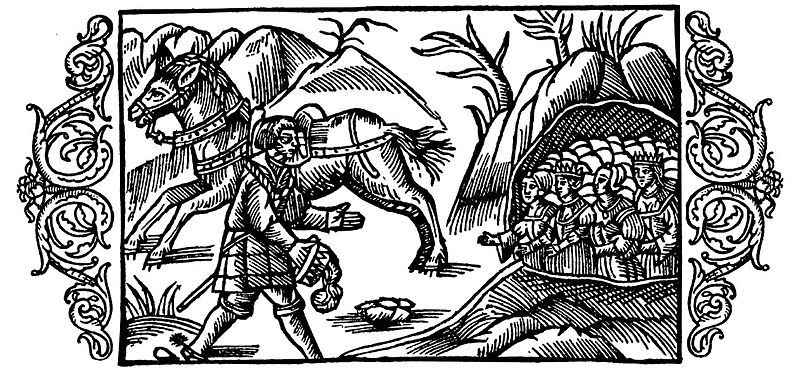
A 17th century woodcut depicting a petitioner approaching the fairies in their hollow hill.
Mary Sharratt is an American author living in Pendle Witch country in northern England, the dramatic setting for her novel, Daughters of the Witching Hill, based on the true story of the folk healer and wisewoman, Elizabeth Southerns and her family. Mary is also the author of Illuminations: A Novel of Hildegard von Bingen. Visit her website.
I recently assigned my students an article by Kathleen Erndl – “Is Shakti Empowering for Women? Reflections on Feminism and the Hindu Goddess.”[1] I’m sure, like Erndl, many have been fascinated by this question, especially within the Indian context. Does the presence of an abundance of goddesses necessarily translate to social empowerment for women? The answer is indeed complicated in that one cannot reify all goddess worshippers under one static rubric.
Having said that, however, I would like to posit that generally speaking, it would be fair to say Indian culture is a patriarchal one, and that the presence of a goddess tradition does not translate to independence for women. Firstly, the kind of goddesses worshipped by both men and women, are not necessarily the assertive, independent kind. They are often those such as Lakshmi and Saraswati who are maternal and nurturing, and important in their own right. All too often, however, these virtuous traits have been used to disempower women, to keep them in their “socially assigned places.”
There is evidence from early Hindu literature that the above goddesses may initially have been independent forces, but they soon came to be tamed as consorts of male gods; Lakshmi as Vishnu’s wife, and Saraswati as Brahma’s. Second, fierce and independent goddesses such as Kali and Durga may have a large following, but it is only in certain cases such as in Tantric theology specific to the goddess Shakti, identified with Kali, that ritual practices may do away with gender roles, that both male and female members have equal access to Kali. But the important question would be – outside of the ritual context, how do practitioners of Tantra regard women? In other words, do women have equal social – and not merely equal ritual – status? I am not an expert in Tantric discourse, but judging by various commentaries, I have reason to believe that this does not necessarily translate to gender equality in the social setting.
My quest here, however, is to provide an example of what a community with a strong, female leader may look like. I thought of this example because I have been intrigued with and fascinated by my own family experience regarding the cult of Kalawati Aai or Mother Kalawati (I do not use the term “cult” derogatorily as “a group with a powerful and controlling leader” but in the classical sense of “practices centering on an object of reverence”). My aim is to provide a picture of often conflicting ideals within the Hindu setting, to shed light on how this can play out on the ground. My information on Kalawati Aai – considered a saint by her devotees – comes from hearsay and hagiographical accounts for I never met her; she died almost forty years ago.[2]
Because the dates for the life of Socrates are certain, it is safe to conclude his mother, Phaenarete, was born about 500 BCE. She seems to have lived well past menopause and thus was certainly alive to see the start of construction of the Parthenon (447 BCE) and probably its completion (432 BCE). As was traditional for many Greek mothers, after menopause she became a priestess, pharmacist and obstetrician.
The relevance of the chronology for Phaenarete requires some context to appreciate. Writing had yet to be widely adopted during her life (the alphabet was not standardized until about 400 BCE). Literary evidence in particular for the practice of medicine before and during her life is scarce. Although Hippocrates was a contemporary of her son, nothing survives of medical writings from antiquity that can confidently be attributed to him. Parmenides and Empedocles (contemporaries of Phaenarete) appear to have been medical practitioners, but what survives of their poetry relates to nature philosophy in general and only in places to medical theory.
Hence, it is extraordinary that an account of Phaenarete’s medical practice survives in Plato’s dialogue, Theaetetus, 149a-150a (hereafter “PMP”). Though PMP was composed by Plato in the 300s BCE, he emphasizes it is based on a transcript of an actual conversation from the late 400s BCE. PMP records what Socrates said about his own mother. It is as authoritative a source of information about her as it is about the origins of the sine qua non of medical practice: optimizing human reproduction.
While evidence exists for women healers in many ancient cultures, the specifics PMP provides show postmenopausal mothers were especially important to early Greek medicine. Curiously, there was no word for ‘menopause’ itself, a fact that suggests it was thought of more in metaphysical than physical terms. Evidence indicates it was thought of as a type of ‘virginity’ (parthenia), the metaphysical meaning of which can be detected in its association with goddesses such as Artemis and Athena (cf. ‘Parthenon’ for her temple’s name). It marked the completion of the ‘internship’ of motherhood, the prerequisite to graduate to become a priestess of Artemis. The name of Socrates’s mother, Phaenarete, evinces that religious context: it essentially means “Revelator.” The Greek for “obstetrician,” maia, also evinces that context: it was also the name of a goddess. The status such a word then connoted is lost in translating it, as many do, as ‘midwife.’Continue reading “The Mother of Socrates: Priestess, Pharmacist, Obstetrician by Stuart Dean”
Society has created this vortex of fear surrounding women aging. Yet, as I turn 30, I am only feeling awe. Awe over everything I accomplished in my twenties and awe in all the things yet to be realized in my thirties. The interesting thing is how other people are experiencing me turning thirty. Some are reminiscent of their twenties or how their experienced their thirties. Others start to bring up certain things which are apparently still lacking in my life. The biggest ones are a husband and children. They look at my eve of thirty-hood as the clock ticking away on me finding love and most definitely on my biological clock.


 The Association for the Study of Women & Mythology (ASWM) will be hosting this year’s Conference, “Seeking Harbor in Our Histories: Lights in the Darkness” at the Boston Marriot Burlington Hotel on 1-2 April 2016.
 “If there is one chant in the universe it is to create.”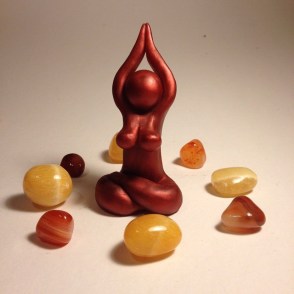
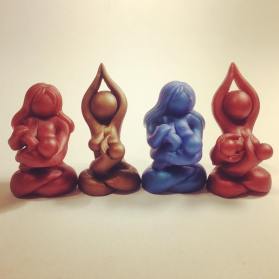
 inches tall or taller. The goddesses I make are all about three inches tall and there’s a reason for that: they fit in the palm of my hand. When I create them, I feel as if I’m part of an unbroken lineage stretching back 30,000 years to the person who carved the Goddess of Willendorf. I feel connected to the priestesses of the Mesopotamian temples who sculpted hundreds upon hundreds of tiny clay goddesses. Someone commented on my sculptures once saying, “
 Coloring is a fast growing trend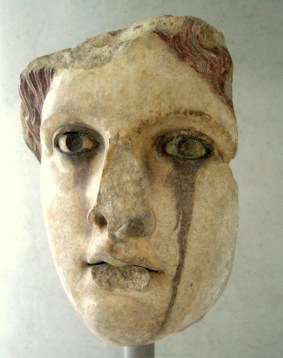
 I have recently been looking at the Goddess Ananke. Ananke and Her consort Khronos, were primal energies emerging from chaos, producing the world egg and then wrapping themselves around it causing it to burst. Out of that egg came the world and all that it contains. Just imagine, the world being formed by two energies – those of Inevitability or Necessity and by Time. How simple and yet how complex.
 As an artist and author, my time is often divided between painting and writing
 I recently assigned my students an article by Kathleen Erndl – “Is Shakti Empowering for Women? Reflections on Feminism and the Hindu Goddess.”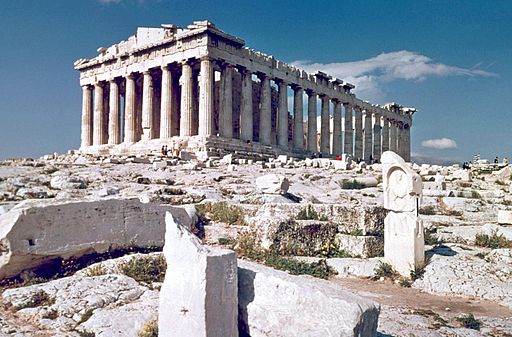
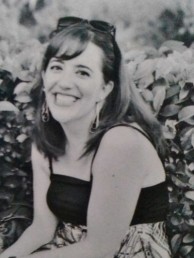 Society has created this vortex of fear surrounding women aging. Yet, as I turn 30, I am only feeling awe. Awe over everything I accomplished in my twenties and awe in all the things yet to be realized in my thirties. The interesting thing is how other people are experiencing me turning thirty. Some are reminiscent of their twenties or how their experienced their thirties. Others start to bring up certain things which are apparently still lacking in my life. The biggest ones are a husband and children. They look at my eve of thirty-hood as the clock ticking away on me finding love and most definitely on my biological clock.
 Feminism and Religion