Lilith has been a misunderstood, appropriated, and redeemed woman throughout the ages. Many feminists claim her as an empowering figure in Jewish mythology, her story reclaimed by contemporary artists such as Sarah McLachlan, who created the all-women music tour, “Lilith Fair.” Some queer scholars have surmised that Lilith had a romantic relationship with Eve. Others have claimed that Lilith was a demon who seduced men and strangled children in the night. Quite a disparity, isn’t it?
The first time I painted her, I wrote about my subsequent leaving of the church here on Feminism and Religion. Based almost entirely on Judith Plaskow’s beautiful midrash, “TheComing of Lilith,” I’ve painted a second Holy Woman Icon rendition of Lilith. In the Jewish tradition, midrash is akin to climbing inside the story—inside the Torah—and imagining what happened in the places where the text offers no description; it is the space between the letters, the creative imagination within the narrative that makes the story come alive.
According to Plaskow’s midrash, God created Adam and Lilith from the same earth. Tired of Adam demanding that she be subservient to him, Lilith left the Garden of Eden. She was later befriended by Eve and her legacy of empowering women continues today. Adding a queer twist to this feminist midrash, some claim that Lilith and Eve became lovers, as well.Continue reading “Painting Lilith, Queering Lilith by Angela Yarber”
Embodiment is a feminist principle which has, as its basis, two fundamental criteria. First, humans require their bodies to live. We must acknowledge that our existence is tied to our bodies. This fact grounds us in this world. Here, and not in some other-worldly place, we live out our lives. We are dependent on our bodies and what the world provides for our survival. In other words, humans are inseparable and interconnected to this world. Humans are not above nature as the Western hierarchical dualist mindset would suggest.
Second, embodiment challenges the hierarchical dualistic notion that the mind and body are separable by connecting the mind to the body. Humans do not exist because they think, as Descartes once said. Rather, humans exist because of a complex system of interactions between body and mind. Without the body, the mind fails and vice versa. The link between the mind and the body has led many feminist theorists to reject any sort of existence beyond this physical life. That is a topic for another time. Continue reading “Supporting Embodiment: Societal and Jewish Views on Body Modification by Ivy Helman”
Rabbi Amorai said: “Where is the garden of Eden: He answered himself: “In the earth.”
Sefer haBahir, 12th century Provence
For many liberal Jews, the phrase “tikkun olam” has been an important rallying cry. The phrase is often used as synonymous with “social justice,” but has more esoteric roots. Tikkun olam, repair of the world, refers to a kabbalistic view of creation. In this view, the Divine set out to create the world by vacating a space, an empty space within which creation could occur. The Divine then created vessels, planning to pour divine light into them, in order to form all created things. But when the divine light was poured into the vessels, the vessels could not hold the effulgence. They shattered, scattered sparks of light and shards of the vessels everywhere. Since then, the cosmic job of humanity is to find these sparks of light and free them to rejoin the One.
Isaac Luria, a Jewish mystic in the city of Sfat, told this tale of creation in the seventeenth century. It caught the Jewish imagination and has been wildly popular as a Jewish creation myth ever since. It captures our longing for wholeness and our experience of brokenness. It also offers a parallel with the Big Bang (a hot seed of light that expands into the universe as we know it) that many find quite compelling. I have loved this story for a long time. To me, it is reminiscent of the story of birth: an empty space that becomes full, then leaks out into the world as a new being. Yet as a feminist who is also committed to sustainability, as more news of our planet’s scorching rolls in, I find this myth is beginning to crack. Continue reading “Judaism, Feminism, and The Twoness of Creation by Jill Hammer”
Last week, Lech Lecha was the parshah, Isaiah 40:27-41, the haftarah. It was also the anniversary of Kristallnacht and the fall of the Berlin Wall. And, if you hadn’t heard, the United States elected Donald Trump. Interestingly all four of these occurred not just on the same week, but also all on the same day. What lessons might we pull from this coincidence?
It is already clear the reasons why electing Donald Trump was a tragedy. Many blogs and news articles exist explaining what is wrong with him; he is sexist, racist, anti-Semitic, Islamophobic, homophobic, xenophobic, transphobic, anti-immigration and makes fun of handicapped people. This privileged white, heterosexual, rich capitalist man denies also global warming. So, not only will women and minorities of all different kinds potentially and most likely suffer under his presidency, his environmental policies may have devastating long-term, perhaps permanent, effects on all beings.
Never has it been more difficult for me to affirm that “love trumps hate” as during this unprecedented United States election season. After watching the Republican Convention last July in mute horror, I took to bed for several days, overwhelmed by the presentiment that everyone–blacks, women, Jews, Latinos, Muslims, queers– other than a certain breed of white American males was doomed to shameless malignment and persecution. The palpable hatred in Donald Trump’s acceptance speech seared me, arousing my ancestral memory of various persecutions of Jews, Muslims, and others–not something I usually think about or choose to foreground. For several months now, I have been haunted (and almost paralyzed) by fear.
Hence Ani Tuzman’s The Tremble of Love: A Novel of the Baal Shem Tovhas come as an especially welcome, healing antidote, affirming as it does the power of “unshakeable faith even in the presence of inhumanity” (473). I cannot say that I fully have such faith, but this novel, if anything can, leads me towards it. Page after page is filled with compelling examples of love’s power to disarm hatred and assuage pain.
Early on, a tale is told of a young man fearlessly facing three would-be highwaymen who have stopped the wagon in which he is riding with a rabbi’s wife and her three children, one of whom is disabled:
We live in a dystopia. This world is filled to the brim in dichotomies: poverty and extreme excess, hunger and mountains of food, disease and cutting-edge medicine, materialism and an immense environmental crisis, and hour-long walks for water and hour-long luxurious baths. There are so many parts of our world that are not just unfair, unequal, broken and undesirable, but violent, traumatic and deadly. And, sometimes it feels like it is only getting worse, or at least, again teetering on the edge of yet another catastrophe.
Most of the world’s religious traditions agree that this is not the way the world should be. My own religious tradition, Judaism, traces this separation between the Creator’s utopia, the Garden of Eden, and our current situation all the way back to the beginning of humankind. The actions of the first two humans resulted in exile from the Garden: enter the world diametrically opposed: dystopia. Nonetheless, the Jewish religious tradition’s call for tikkun olam (repairing the world) suggests that it is possible to lift the veil between the Divine and us and consequently recreate the utopian Eden once again. One could say it is why we are here.
That being said, while the dystopian genre has been around for many decades, I have noticed a recent rise in the popularity of dystopian fiction. While I have always had a keen interest in science fiction, from Star Trek to FireFly and beyond, I myself have, as of late, become an avid reader of dystopian novels. I blasted through the Divergent series by Veronica Roth, have reread The Fifth Sacred Thing by Starhawk more times than I can count and just began my dip (25 pages) into The Mandibles by Lionel Shriver – not so action-packed as the others. I’ve also been, one could say, addicted to dystopian films (yes many were books first) like The Hunger Games, Maze Runner, Gattaca, The Fifth Element and Serenity to name just a few.
As Rosh Hashana and Yom Kippur approach, I am in the midst of my annual process of asking forgiveness to everyone I have knowingly wronged in the last year. During this time, Jews atone for our wrong-doings. We are tasked with not only asking for forgiveness, but making things right with those we have wronged.
This year, I’m realizing that I have been missing out on so many aspects of forgiving. What about the forgiveness I am not aware I need? I need to learn to forgive us and to invite others to call me out on the ways I have inflicted harm on them. Continue reading “Atonement, Forgiveness, and Feminism by Debra Guckenheimer”
There is an old Jewish custom to use a red thread, tied around a bedpost or a child’s wrist, to keep away demons. In particular, the red thread is said to keep away Lilith, the female demon who steals children. Women still give away red threads at the Western Wall in Jerusalem as a segulah, or protection amulet. Feminist poet Alicia Ostriker reclaims this symbol as a reminder of the umbilical cord, the connection between a human childbearer and a child, and an intimation of the cosmic interconnectedness of all things. She writes:
the disturbing red thread invisible yet warm travels between earth and heaven, vibrates through starless void…
does it carry the pulse of our prayers like a bulge in a snake
dozing, like a stream of hungry, bloody hope, do all the red threads join
form a web
Alicia Ostriker, The Volcano Sequence (University of Pittsburgh Press, 2002), p.11-12.
On August 4th, I visited Auschwitz. In the beginning, the reality of the experience did not match my surrealist expectations of it. I expected to walk onto the grounds and get hit over the head with the heaviness of what happened there, to feel a sense of deep connection to the land covered in the ashes of my people, to have the opportunity to mourn the loss of the members of my family I never met and to be utterly speechless as to the twisted systematization and industrialization of murder that took place there. That blow never came. Why?
The day of my visit was out-of-this-world hot. My guided tour, in Czech, started at 2pm. I was early so I wandered among the crowd outside of the site. There were families lounging on the lawns eating ice creams and drinking cokes. There were tourists taking selfies. There were lots of conversations and lots of laughter. I was pretty convinced that I was the only Jew around.
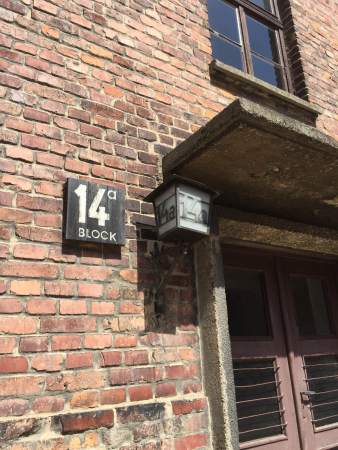
Upon entering the grounds, I was stunned by how green and lush it was. There were many old brick buildings, seemingly orderly, with lanterns and building signs hanging outside the entrances. Among it all, upwards of 500 people clustered in groups walked from place to place.
The tour began with a basic history of the events of the Holocaust with “exhibits” contained within 3 or 4 different buildings. The guide seemed to me to have memorized a script in which we went from one building to another looking at the “exhibits,” most of which consisted of nothing more than one or two oversized pictures and maps. Outwardly, I sensed no sentiment in the guide and no spirit in the exhibitions either. Her voice was monotone, pronouncing the Czech in such a syllable-by-syllable fashion that it was nearly incomprehensible. Most exhibition rooms were sparse, if they had any objects at all other than the black and white pictures and maps. The tour and exhibitions portrayed such a distance from the events it was almost as if they didn’t happen there, in that place.
Zyklon B
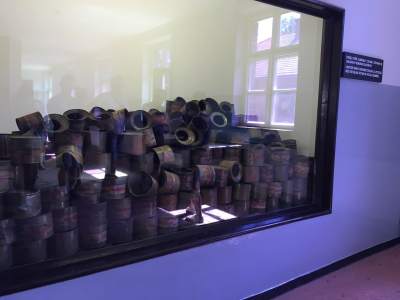
There were a few buildings with objects all hermetically sealed behind glass once again keeping us at a distance. One room housed a display of used Zyklon B canisters and had an artist’s small scale all-white model of the “process of extermination,” meaning the “changing rooms,” “showers” and crematoriums – with tiny people crammed into the areas and bodies piled on the floors next to the ovens. Two other buildings contained large displays, again behind glass and removed from their context, of what the exhibition called “evidence of the destruction:” piles of hair loosened from the burlaps sacks they had been founded in when the camp was liberated; shoes of the victims and a large (two-story) container filled with the pots and pans the victims had packed and brought with them but never used.
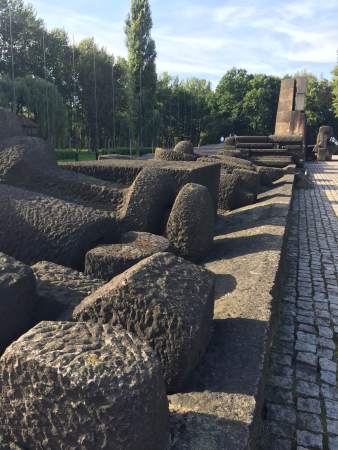
After we finished our tour of Auschwitz 1, we were given a 15 minute break and were instructed to reassemble by the bus that would take us to Auschwitz-Birkenau. Once there, we rushed through the camp at such a pace that we were done in about 45 minutes. In spite of the rush, I did manage to leave two stones on the pillars, which marked where the ashes of the victims were scattered (buried?). We glanced at the memorial at the back of the camp as well as what was left of the bombed-out crematoriums. Returning to the front of the camp, we ducked into a reconstructed dormitory and a reconstructed bathroom building. The guide asked if we had any questions. Silence. The tour was done.
I stood there debating what to do. Do I leave? Do I stay? I was pretty confident that it didn’t feel right to just go. So, I headed back to the memorial. The tour guide had said that each of the smaller stones creating the steps and floor commemorated one of the 1.1 million Jews killed in Auschwitz. Yet, it was unclear as to the meaning of the large stones. After circling the large stones and a futile attempt to make some meaning out of them, I went and sat on the stairs of the memorial and just looked out over the place and the people there.
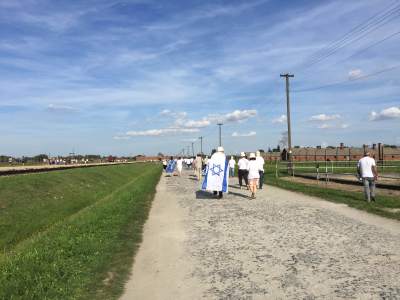
Still puzzled but needing to catch the train, I made my way to the entrance. In front of me was a group of Israeli Jews wrapped in Israeli flags, looking the Superhero part. Something changed. Maybe I didn’t need the sad, mournful, pit-of-the-stomach experience. Maybe I’ve had it enough, learned about it enough, taught it enough and lived with it enough. Maybe my pilgrimage there as a witness to the horrors was enough.
It was those Israeli Jews that I needed. Walking into Auschwitz was one thing, but they were proud Jews walking out. I followed them. We, Jews, were the lucky ones who got to leave. Isn’t that something!
Ivy Helman, Ph.D. is feminist scholar and faculty member at Charles University and Anglo-American University in Prague, Czech Republic where she teaches a variety of Jewish Studies and Ecofeminist courses. She is an Associate of Merrimack College‘s Center for the Study of Jewish-Christian-Muslim Relations and spent many years there as an Adjunct Lecturer in the Religious and Theological Studies Department.
When I was in high school, I once gave a speech summarizing what I had learned about G-d through my dog. I still chuckle at the idea. I cringe sometimes and wonder what others thought of the piece. Oh, the seeming immaturity of such an idea and perhaps naiveté. I’m still embarrassed by my high school self.
The connection, on which I drew, included some of the ways I had come to love my four-legged friend as well as the way I interpreted his actions as love for me. I remember I had a list of ten things my dog had taught me about the divine. There was definitely a mention of unconditional love, being happy to see me, probably something about not being angry or ever holding a grudge, sharing secrets, perhaps a lesson on patience, and, of course, many more which I can’t remember. This is beginning to sound like my blog post about Hanukkah, isn’t it? What were the other two nights? What were the other six comparisons? Oh, never mind. Continue reading “The Dog and the Divine by Ivy Helman”


 Lilith has been a misunderstood, appropriated, and redeemed woman throughout the ages. Many feminists claim her as an empowering figure in Jewish mythology, her story reclaimed by contemporary artists such as Sarah McLachlan, who created the all-women music tour, “Lilith Fair.” Some queer scholars have surmised that Lilith had a romantic relationship with Eve. Others have claimed that Lilith was a demon who seduced men and strangled children in the night. Quite a disparity, isn’t it?
 Embodiment is a feminist principle which has, as its basis, two fundamental criteria. First, humans require their bodies to live. We must acknowledge that our existence is tied to our bodies. This fact grounds us in this world. Here, and not in some other-worldly place, we live out our lives. We are dependent on our bodies and what the world provides for our survival. In other words, humans are inseparable and interconnected to this world. Humans are not above nature as the Western hierarchical dualist mindset would suggest.
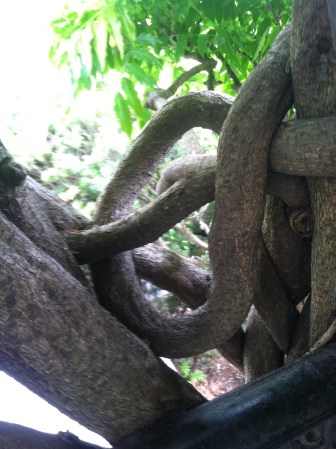 Isaac Luria, a Jewish mystic in the city of Sfat, told this tale of creation in the seventeenth century. It caught the Jewish imagination and has been wildly popular as a Jewish creation myth ever since. It captures our longing for wholeness and our experience of brokenness. It also offers a parallel with the Big Bang (a hot seed of light that expands into the universe as we know it) that many find quite compelling. I have loved this story for a long time. To me, it is reminiscent of the story of birth: an empty space that becomes full, then leaks out into the world as a new being. Yet as a feminist who is also committed to sustainability, as more news of our planet’s scorching rolls in, I find this myth is beginning to crack.
  Last week, Lech Lecha was the parshah, Isaiah 40:27-41, the haftarah. It was also the anniversary of Kristallnacht and the fall of the Berlin Wall. And, if you hadn’t heard, the United States elected Donald Trump. Interestingly all four of these occurred not just on the same week, but also all on the same day. What lessons might we pull from this coincidence?
 Never has it been more difficult for me to affirm that “love trumps hate” as during this unprecedented United States election season. After watching the Republican Convention last July in mute horror, I took to bed for several days, overwhelmed by the presentiment that everyone–blacks, women, Jews, Latinos, Muslims, queers– other than a certain breed of white American males was doomed to shameless malignment and persecution. The palpable hatred in Donald Trump’s acceptance speech seared me, arousing my ancestral memory of various persecutions of Jews, Muslims, and others–not something I usually think about or choose to foreground. For several months now, I have been haunted (and almost paralyzed) by fear.
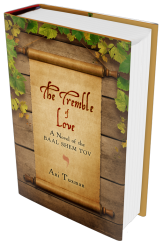 Hence Ani Tuzman’s
 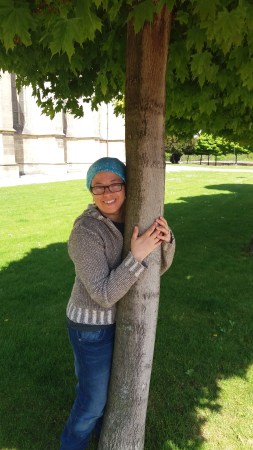 We live in a dystopia. This world is filled to the brim in dichotomies: poverty and extreme excess, hunger and mountains of food, disease and cutting-edge medicine, materialism and an immense environmental crisis, and hour-long walks for water and hour-long luxurious baths. There are so many parts of our world that are not just unfair, unequal, broken and undesirable, but violent, traumatic and deadly. And, sometimes it feels like it is only getting worse, or at least, again teetering on the edge of yet another catastrophe.

 When I was in high school, I once gave a speech summarizing what I had learned about G-d through my dog. I still chuckle at the idea. I cringe sometimes and wonder what others thought of the piece. Oh, the seeming immaturity of such an idea and perhaps naiveté. I’m still embarrassed by my high school self.
 Feminism and Religion