We the People by Joyce Zonana

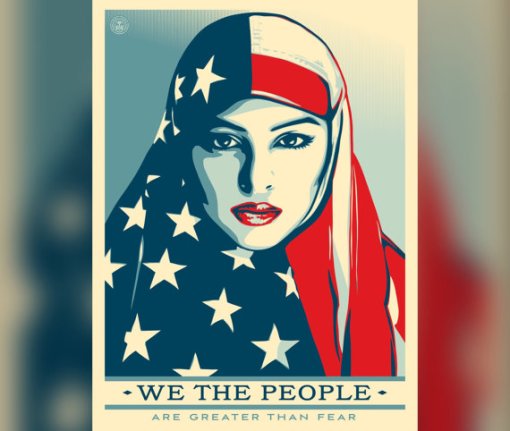
jz-headshotDuring the January 21st Women’s March in New York City, I was inspired and delighted by so many of the signs women and men had crafted to express their opposition to the current disastrous regime in the United States: “Grab America Back,” “Support Your Mom,” “Sad!,” “Miss Uterus Strikes Back.”  But one image stood out, mesmerizing me:  that of a woman proudly wearing an American flag as hijab, with a message below—“We The People Are Greater Than Fear.”  For several blocks as we made our way up Fifth Avenue, I walked beside a woman carrying that sign, and it became, for me, the most powerful symbol of the resistance we must all wage during the dark time ahead.

il_570xn-1174082361_2sxw
Poster by Shepard Fairey
images-1
Munira Ahmed photo by Ridwan Adhami

The image, based on a photograph of Munira Ahmed by Ridwan Adhami, was created for the Women’s March by graphic artist Shepard Fairey (who also designed the iconic image of Barack Obama, “Hope”).  It offers a striking visual challenge to a long-held orthodoxy, now brought to the fore by Donald Trump and his gang:  that Western-style liberal democracy (epitomized by the United States) is incompatible with Islam.  And, perhaps even more specifically, that Islam is incompatible with feminism.

Many Western women—including feminists—are still bound by the Orientalist worldview that encumbered our liberal feminist foremothers.   Continue reading “We the People by Joyce Zonana”

A Gift Offered in Faith and Love by Elise M. Edwards

elise-edwards“The day begins with the sun and ends with the moon and stars; what you do in between is your gift to the world.” – Reyna Craig

The new year has begun, and many of us take this marking of time as an occasion to set intentions, goals, plans, or resolutions for the year ahead.  For us feminists, the year ahead holds clear challenges.  We know that the bodies, spirits, minds, hearts, and souls of women, racial and ethnic “minorities,” and all sorts of vulnerable people will be attacked.  We know that the protections secured under the law for these bodies, spirits, minds, hearts, and souls have been eroded and continue to be dismantled in the name of… well, what exactly? Justice? Life? Religion?

We’ve seen voting rights eroded in the name of democratic ideals.  We’ve seen challenges to bodily autonomy in the name of life.  We’ve seen state-sanctioned murder in the name of law and order.  We’ve seen a rise in religious intolerance in the name of religious liberty.  Our work in this age must be to continue to expand our collective understandings of these ideals.  This is the gift we offer to the world.

Continue reading “A Gift Offered in Faith and Love by Elise M. Edwards”

The Reason for Hope Is the Creative Process of Life by Carol P. Christ

carol p. christ photo michael bakasIn these these days when many of us are gripped by paralyzing despair as we come to terms with the election as President of a racist, sexist bigot who has created a climate of fear and promises to undo much of the progressive legislation of the past fifty years, I find it appropriate to reiterate an insight that has sustained me through many years of sadness and disappointment about the state of our world.
“Hope is not to be found in optimism so much as in a primal understanding of what matters most.” In other words, the reason for hope is not to be found in the knowledge or rational calculation that our efforts will succeed in saving life on earth but rather in the conviction or inner knowing that it is right to try. Continue reading “The Reason for Hope Is the Creative Process of Life by Carol P. Christ”

My Reaction to the Election Results by Elise M. Edwards

elise-edwardsI wanted to stay in bed yesterday morning.  I wanted to stay in bed for the whole day.  When I heard that Trump won the US Presidential election, I didn’t know how to deal with it.  How can I accept this reality?  I still don’t have an adequate answer.

Turn to prayer? Yes.  Do some writing? Ok. I’ll also take every hug and kind word that’s offered to me.  And still, my emotions will be raw for a long time.  I cry at random moments.  My voice catches unexpectedly.  I feel that so many Americans embraced a vision of the country that is intensely hostile to people like me (women, African-Americans, Black Lives Matter sympathizers, liberals, intellectuals). How can I not take that personally? Dismissing the harm of Trump’s open hostility or accepting it in deference to some supposedly higher goal feels like rejection too.  It justifies and legitimizes his contempt and denies the seriousness of it.  Do we really accept a man who speaks so openly of sexual assault because he promises to bring jobs back?  That denigrates women and all assault victims. The hatred directed at immigrants, Muslims, and LGBTQA persons is even more unrestrained and horrifying!

Continue reading “My Reaction to the Election Results by Elise M. Edwards”

Dystopian Fiction Inspiration and Religious Lessons by Ivy Helman

me-hugging-treeWe live in a dystopia.  This world is filled to the brim in dichotomies: poverty and extreme excess, hunger and mountains of food, disease and cutting-edge medicine, materialism and an immense environmental crisis, and hour-long walks for water and hour-long luxurious baths.  There are so many parts of our world that are not just unfair, unequal, broken and undesirable, but violent, traumatic and deadly.  And, sometimes it feels like it is only getting worse, or at least, again teetering on the edge of yet another catastrophe.
Most of the world’s religious traditions agree that this is not the way the world should be.  My own religious tradition, Judaism, traces this separation between the Creator’s utopia, the Garden of Eden, and our current situation all the way back to the beginning of humankind.  The actions of the first two humans resulted in exile from the Garden: enter the world diametrically opposed: dystopia.  Nonetheless, the Jewish religious tradition’s call for tikkun olam (repairing the world) suggests that it is possible to lift the veil between the Divine and us and consequently recreate the utopian Eden once again.  One could say it is why we are here.

That being said, while the dystopian genre has been around for many decades, I have noticed a recent rise in the popularity of dystopian fiction.  While I have always had a keen interest in science fiction, from Star Trek to FireFly and beyond, I myself have, as of late, become an avid reader of dystopian novels.  I blasted through the Divergent series by Veronica Roth, have reread The Fifth Sacred Thing by Starhawk more times than I can count and just began my dip (25 pages) into The Mandibles by Lionel Shriver – not so action-packed as the others.  I’ve also been, one could say, addicted to dystopian films (yes many were books first) like The Hunger Games, Maze Runner, Gattaca, The Fifth Element and Serenity to name just a few.

Continue reading “Dystopian Fiction Inspiration and Religious Lessons by Ivy Helman”

Can Good Theology Change the World? Part 2 by Carol P. Christ

Carol P. Christ by Michael Bakas high resoultionIn the first blog in this series, I argued that one of the hallmarks of a good theology is recognizing that the source of authority must be located in individuals and communities who interpret texts and traditions as they encounter divinity anew in the present. In our new book Goddess and God World, Judith Plaskow and I suggest that a second hallmark of good theology is the “turn to the world.” What we mean by this is not only that divinity is immanent in the world, but also that the purpose of human life is to be found in this world—not the next.

The God of traditional theologies is pictured as an old man with a long white beard who rules the world from heaven. It is commonly assumed by those familiar with this picture that the purpose and meaning of human life is not to be found in this world—but rather in heaven. This assumption is increasingly being challenged. Many people no longer believe in life after death. The purpose of morality is increasingly being understood as improving the conditions for the flourishing of human and other forms of life—not on gaining the approval of a God who has the power to assign individuals to heaven or hell in the next world. Continue reading “Can Good Theology Change the World? Part 2 by Carol P. Christ”

What My Mothers and Mentors Taught Me about Self-Care by Elise M. Edwards

Elise EdwardsDuring another week of killings, war, protests, and debates about whether Black Lives Matter or Blue Lives Matter, I’m concerned about the toll it takes on those who are witnessing the violence and fighting for justice.

I’m not on the front lines of these battles, but I can feel my energy draining, nonetheless. Over the past few days, while I’ve stayed informed about the latest tragedies and conflicts, I’ve intentionally limited my exposure to most news and social media outlets. I’ve begun preparing for a contemplative retreat with other women who also care about justice.  For me to continue to participate in any effort of transforming society, culture, or the church, I must nurture my mind, spirit, and body.

Audre Lorde put it like this:

“Caring for myself Is not self-indulgence.  It is self-preservation, and that is an act of political warfare.”

Self-care is a radical practice of self-love. It is absolutely necessary when engaged in conflict against those who do not show love to you, or worse, those who seek to destroy you.  Your survival and your flourishing are defiantly brave.  Self-care honors the God who created you, the One who loves you, and the Spirit who sustains you. Continue reading “What My Mothers and Mentors Taught Me about Self-Care by Elise M. Edwards”

Remember by John Erickson

Remember the loss, because we’re going to need it for the tomorrows to come and for those that need our protection the most: the next generation. Remember, we are Orlando; now, tomorrow, and always.

WEHO CA (June 7, 2015)©2015 Rebecca Dru Photography All Rights Reserved http://www.rebeccadru.com

I want to tell you a short story about the small town of Ripon, WI. On May 19, the local newspaper, The Ripon Commonwealth, which has served as the town’s paper since 1864, published a story regarding the political right’s uproar concerning President Barack Obama’s executive order that all public schools must allow transgender individuals to use the bathroom which matches that of their gender identity. Angry and upset, the paper’s education reporter wrote an article expressing his clear disdain for the President and also expressing a clear lack of empathy, understanding and sheer bigotry towards the transgender community.

Growing up in Ripon, I always read the paper when it came out on Wednesday evenings. Those of you who grew up in a small town can attest to the luxury of seeing friends, family members, and even the smallest ongoings in one’s town in print for the entire town to see and talk about. However, one thing I never saw in the paper was the clear hate I read in Mr. Becker’s article (the author of said piece). Enraged, I immediately asked myself: what can I do? Having connections back in Wisconsin, I immediately turned to friends who owned businesses, a friend who is the Director of a vocal and important group in the town, and community organizations and friends to begin to write letters. Continue reading “Remember by John Erickson”

(((Israel))) by Ivy Helman

me hugging treeThe BBC just ran a story about white supremacist and neo-Nazi groups targeting Jews by signaling each other to their presence on various social media sites through the use of (((this symbol))).  Of course, this is all based on the assumption that a “typically” Jewish last name signifies the bearer is also Jewish.  Through a Google app (since removed) that could recognize patterns such as ((())), these Jewish people began to receive anti-Semitic comments.  There has been a general outcry of disgust among Jews and other minority groups as to the problematic targeting of Jews in this fashion.

The same cannot be said about the BDS movement and people’s willingness to call it out for what it is.  This to me is hypocritical!  According to its website, the BDS movement, or Boycott, Divestment and Sanctions, seeks to end what it understands to be the colonialism, apartheid and oppression of Palestinians in Israel through various financial, commercial and international means.  It accuses Israel of human rights violations, genocide, ethnic cleansing and other war crimes as well as illegal occupation (of the Palestinian lands, not just the occupied territories). Continue reading “(((Israel))) by Ivy Helman”

What Traci West Taught Me about Dominant and Excluded Voices by Elise M. Edwards

Elise EdwardsIn my previous post, I mentioned a book I am writing about how theological and ethical considerations in architectural design can define good architecture.  In that post and in ones to follow, I am acknowledging the feminists and womanists and mujeristas who have influenced me while also opening up the dialogue to the feminists in this community who continue to inspire and guide me to do my best work.

But today, instead of talking about creativity or architecture, I want to discuss how I arrived at the conviction that community decisions about how we ought to live—whether those are decisions about laws, institutional policies, religious practices or architectural buildings—need to include the voices of the diverse people they directly and indirectly influence. Continue reading “What Traci West Taught Me about Dominant and Excluded Voices by Elise M. Edwards”