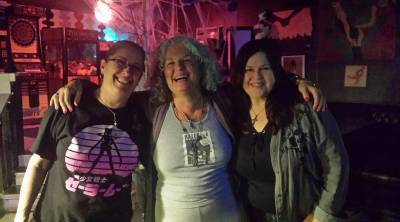
“Closer to Fine:” Trans Femme Reflections on the Sacred Found in Lesbian Music Culture by Nathan Bakken

“I’m trying to tell you something about my life.” I joke with my friends that if the 1990’s weren’t so transphobic, I would have thrived as a trans lesbian. Citing my knowledge of the L Word, Pacific Northwest flannel sensibilities, and Spotify playlists as my reasoning; I embody a millennial genderqueer take on lesbian stereotypes. The only thing missing is an exclusive attraction to women which― I would argue―is the main factor holding me back from waving the lesbian pride flag high. Though I write with a particular levity, I cannot deny the role that lesbian singer songwriters and folk/rock singers have played in cultivating my sense of self and my sense of the Divine. The Holy, for me, is wrapped up in the the harmonies of the Indigo Girls, the raspy blues of Melissa Etheridge, the heart-breaking riffs of Tracy Chapman, and the tear-jerking truths of Brandi Carlile.  These women have gifted me Divine Imaginaries of what justice is, who God is, and how I fit in.

In full trans-parency (pun intended), I hold a small level of fear in writing this piece. As the rhetorics of Transgender Exclusive Radical Feminists (TERF) appear to be touching the mainstream, I am reminded that these rhetorics are deeply tied to lesbian music culture. The Michigan Womyn’s Music Festival holds itself as a historic cultural object created by the amazing and radical work of lesbians and feminists and lasted from 1976 – 2015. MichFest, as it was later known, also uplifted and validated the concept of “womyn-born-womyn” only spaces. A concept with the intention to center the experiences of cis women, and the impact of  discriminating against trans people.  I reference this not to tear at the scabs of these two communities as we continue healing. Rather, I am naming the irony that my anthems for my survival are also the songs that have historical ties to mindsets and movements that prohibited my community from experiencing them first hand.

But this piece isn’t about trans exclusive feminists. This piece is about the soundtrack of my survival, and the powerful women who’s wise words guide that experience. The following four songs are invitations into my survival.

Closer to Fine – Indigo Girls

“The less I seek my source for some definitive, the closer I am to fine.” Since I was 17, this lyric has echoed in my mind. I would drive around Seattle listening to this song on a mix CD, wondering if I would ever get close to fine. Masked in their flawless harmonies, Amy Ray and Emily Saliers words gave me comfort and language to articulate my experiences. They mixed joy and laughter with the harsh truth of growing older. They gave room for a multiplicity of perspective and called out institutions and dominant epistemologies as inefficient modes of knowledge gaining. I was gifted a queer critical lens, a slightly Gnostic view of God, and an acknowledgement that “[t]here’s more than one answer to these questions/ Pointing me in a crooked line.”

Silent Legacy- Melissa Etheridge

To say that Melissa Etheridge’s 1993 album “Yes I Am” is not one of the best albums―let alone queer albums―ever created is homophobic. I wish I could tell you I’m being facetious. I am not. While her singles “I’m the Only One” and “Come to My Window” remain as her most popular hits; the song “Silent Legacy” is a testimony to queer feminist survival. I encourage you to set aside some time to listen to this song as if it were a prayer. In five minutes, Etheridge manages to describe and enflesh the impact of spiritual trauma on the queered body. Each verse unpacking the silent internalization of misogyny, homophobia, and transphobia. Each chorus echoing a prayer to heaven. Only to finish with Etheridge repeating the phrase “Oh my child,” building her emotions from tenderness to rage as if she, herself, embodies God calling us home to protect us.

Talkin’ Bout a Revolution – Tracy Chapman

I confess, my conversion to the Gospel of Tracy Chapman occurred later than I would prefer. Knowing her for her iconic lesbian anthem “Fast Car,” it wasn’t until I discovered her full discography about two years ago that I felt held in her words. With “Talkin’ Bout a Revolution” as the first track on her first album, “Tracy Chapman.” Chapman sets a specific tone for the album. The album is a protest. She reveals a portrait of her experiences of the United States in 1988, one that does not shy away from harsh realities of racial injustice and domestic violence. And at the same time gives tender insights into how to love someone. Chapman’s wisdom grounds my survival in the hardest truths of our world. That if I am to survive, I must ensure others’ survival as well.

The Joke- Brandi Carlile

Brandi Carlile feels like home. As an out lesbian musician of my home state of Washington, Carlile’s music reaches the depths where few dare to dive.  I recognize the majority of this soundtrack dates to the late ‘80’s and early ‘90s, Brandi Carlile’s “The Joke” is from her Grammy Award winning 2018 Album “By the Way I Forgive You.” Carlile is contemporary, current, and continuing the legacy paved before her. Her song―“The Joke”―echos like a ghost of queer future. Carlile’s voice is moving forwards while reaching back. She gives assurance, not that it gets better, rather that it gets different. Carlile invites the listener into the act of survival.

As a queer theologian, I tend to search for scripture in the most secular of places. These women have formed a gospel where the Divine Imaginary provided is an invitation to all people to the radical act of survival. As a trans femme person, I know, and these women testify, that one can survive and thrive simultaneously. Because “there’s more than one answer to these questions/ Pointing me in a crooked line/ And the less I seek my source for some definitive / The closer I am to fine.”

P.S. I believe that my fair, sincere, and soft mention of the “TERF/trans exclusion” conversation can spark strong push back from some of the readership of this blog. I am aware that we (cis and trans) who are in Feminist theological spaces need to continue engaging seriously in conversation around this topic and start working together to construct something from it. I would like for my post to be a part of starting that conversation. The heart of my post is that there is something profound in the liberative music created by these amazing and powerful women. Part of that profundity, is that I, a trans feminine queer person, heard an invitation into a legacy of liberation and justice. So I invite you, whoever you are, reading this to reread my piece. Reread it, knowing this is a small part of a larger conversation, and the heart of the conversation is a painful history of exclusion and transphobia and simultaneously a history of liberation and justice.


Nathan Bakken (they/them), originally from Seattle, WA, has found home in Boston, MA. Raised Roman Catholic, Nathan stands firm in the intersection of Christianity and Esoteric Spirituality. They earned their Master of Divinity, and Master Certificate in Religious Conflict Transformation, from Boston University School of Theology with particular focus in trans and queer theologies, queer spiritual practice, and the intersection of pop culture and theology.
The Finish Line by John Erickson

I see it…do you?

It’s just within reach and I’m almost there…the proverbial finish line to my Ph.D.

That’s right folks, I’m graduating.

To say that this has been an easy journey, one that many of you have read about and witnessed, would be an understatement.  For many of us, that finish line is far away or getting there seems more like a hope and dream rather than a reality.  Whether or not it is because of economic hardships, life in general, or the regular types of “isms” that so many of us face while trying to better ourselves via academic enrichment, the struggle is real. Continue reading “The Finish Line by John Erickson”

Gendered Only In Expression by Chris Ash

“I want you to see this new piece I wrote for our newsletter,” said Sister Ann.
We were safe inside the dining room of the Episcopal convent where she lived and I was an extended guest, and yet she spoke in hushed tones that suggested she realized the controversial nature of what she was about to say.

“This whole piece – it’s about the idea that being ‘born again’ clearly indicates the concept of God as mother.” She laid out her argument about wombs and motherhood and the feminine divine. It was a fairly essentialist argument (being the mid-nineties), but it was the first time I’d heard any modern Christian reference God as anything other than father, son, male. Before finding the Episcopal cathedral where I regularly attended services, I’d had two general experiences of the divine: the evangelical, conservative, patriarchal God of my father’s church, and the gender-creative spirit found in practices that were fairly alternative for my small, South Carolina town. Continue reading “Gendered Only In Expression by Chris Ash”

What Gender is God Anyway? by Janet Maika’i Rudolph

Adult Daughter (“AD”): Hi Mom, Alex said to tell you “hi.”

Me: That’s nice. How is she?

AD: How are “they?” Alex uses “they,” mom.

Me: Oh right, sorry. I am having some trouble wrapping my head around using “they” and “them.”

AD: Well mom, that is something you’re going to just have to get over.

Using “they” to refer to one person short circuits my long life of grammar training. I found my mind resisting the plural no matter how many times I reminded myself that Alex uses plural pronouns. As I considered my brain’s resistance to “they/them,” I realized that singular gendered pronouns are truly a cultural construct. I went on to muse that maybe Alex was on to something bigger than themselves. I began to think about the Bible, arguably the foundational document of our patriarchal society, and how it uses a plural form while referring to a singular or one God.

Continue reading “What Gender is God Anyway? by Janet Maika’i Rudolph”

Priestesses at the Parliament by Rae Abileah, Bekah Starr & Chaplain Elizabeth Berger

During the first week of November 2018, 12 graduates and current students of the Kohenet Hebrew Priestess Institute attended the Parliament of the World’s Religions in Toronto, Canada. The Parliament is a conference with a 125-year-old history that has grown to an estimated 10,000 participants representing more than 200 spiritual traditions. To share a Jewish feminist perspective with the Parliament’s attendees, we sought to create moving experiences and  intimate spaces through a variety of invited and informal initiatives.

Priestessing Panels

Many of us were slated to speak at the Parliament, and rather than just show up and give an academic presentation on a panel, we brought the feminist spirit of Kohenet into our sessions, moving rows of chairs to create a circle, guiding participants through embodied practices rather than giving speeches, and crafting ritual. Continue reading “Priestesses at the Parliament by Rae Abileah, Bekah Starr & Chaplain Elizabeth Berger”

Lifting the Veil – #WontBeErased by Joyce Zonana

Samhain is upon us. Halloween. The Day of the Dead. All Saints’ Day. All Souls’ Day. That liminal time of year when the doorways to what the Celts called the Otherworld, Annwn in Welsh, are open. In New York City, we have the 45th annual Village Halloween Parade, a queer extravaganza of puppetry, masquerade, and cross-dressing that draws some 60,000 participants and over 2 million onlookers. Elsewhere, we have children in costume and lawns covered with plastic skeletons and illuminated ghouls. Everywhere, if we’re lucky, we might catch a glimpse of  “the piper at the gates of dawn,” the vision granted Rat and Mole in Kenneth Grahame’s The Wind in the Willows: “something very surprising and splendid and beautiful”—Pan the goat-god, boundary-crosser, Friend and Helper, trans-being.

jz-headshotJust last week—a few days after the New York Times reported on the Trump administration’s efforts to define transgender out of existence—I read for the first time Welsh writer Arthur Machen’s 1894 novella, The Great God Pan, today considered a classic of horror fiction. Condemned as “morbid” and “abominable” by most critics when it was first published, the tale was hailed as “un succès fou” by Oscar Wilde, recuperated in the 1920s by H. P. Lovecraft, and particularly praised more recently by Stephen King, who called it “maybe the best” horror story “in the English language.”
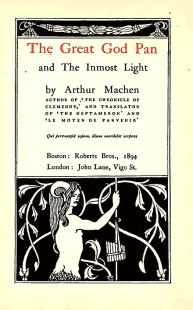
440px-Title_page--The_great_god_Pan
Original edition with cover illustration by Aubrey Beardsley

The “queer” tale (the word “queer” recurs frequently throughout) is told by a series of straight-laced Victorian men, each of whom is horrified by the unspecified behavior and bearing of a mysterious woman, Helen Vaughan. Readers are led to suspect that Helen is guilty of some sort of sexual excess or transgression, but nothing is specified until after her suicide, when the medical examiner reports that he was “privileged or accursed” to see the “skin, and the flesh, and the muscles, and the bones, and the firm structure of the human body that I had thought to be unchangeable, and permanent as adamant, beg[i]n to melt and dissolve”: Continue reading “Lifting the Veil – #WontBeErased by Joyce Zonana”

The Hershee Bar: Saving A Lesbian Sacred Place (While there is still one left) by Marie Cartier (Part II)

(l to r) Bartender Burt, Marie Cartier, and owner Annette Stone

Why is this bar still important? (Read Part I)

For the gender queer, marginalized community who are testing the waters of gender difference by frequenting this bar, many for the first time, for the pool leagues, and yes, the college folks, but also the working class people, and the tentative younger folks, this may be “the only place.” For the democracy of a gay bar creates a conversational cauldron for marginalized people to “hear themselves into speech” to quote the theological Nelle  Morton.

I am quoted in an article done by Virginia Pilot report Amy Poulter saying that “LGBTQ bars are also tasked with filling in the gaps as religious spaces, support groups and the go-to location to celebrate milestones and mourn losses. Bars like Hershee are often the only place LGBTQ people feel at ease and comfortable in their own skin.”

And I added, “And the council, they need to realize what they have before they destroy it.” Continue reading “The Hershee Bar: Saving A Lesbian Sacred Place (While there is still one left) by Marie Cartier (Part II)”

The Hershee Bar: Saving A Lesbian Sacred Place (while there is still one left) by Marie Cartier (Part I)

(l to r) Bartender Burt, Marie Cartier, and owner Annette Stone

I spent last weekend in Norfolk, Virginia.  I was brought there by the folks at Old Dominion University; my visit was brainstormed and facilitated by y Professor Cathleen Rhodes who teaches in the Women’s Studies Department and also manages a magnificent archive of historic LGBTQ+ spaces The Tidewater Queer History Project. This project has a walking tour of significant LGBTQ+ spaces in the area, an online archive, and graduate students intensely interested in archiving the remains of past and current LGBTQ+ sites for study, and community.

I was brought to the area because I wrote the book Baby, You Are My Religion:  Women, Gay Bas and Theology Before Stonewall. The thesis of my book is that gay bars before 1975 (pre-Stonewall) served as alternate church spaces and community centers for people exiled from all other spaces. There was literally no other public space for gay women to go in the 40s through the early 70s, as so attested to by 100+ informants that I interviewed for the book. Continue reading “The Hershee Bar: Saving A Lesbian Sacred Place (while there is still one left) by Marie Cartier (Part I)”

Forgotten Female Surrealists by Mary Sharratt

While Frida Kahlo is arguably the world’s most famous woman artist, most women in the surrealist movement have been overlooked. But Frida’s sister surrealists now seem to be experiencing a long overdue resurgence, with recent international exhibitions showcasing Leonora Carrington, Meret Oppenheim, and Dora Maar. The 2017 documentary film, Out of the Shadows, focuses on Penny Slinger. (For more on Slinger and her work, check out her spookily accurate Dakini Oracle.) American art photographer Lee Miller is the subject of The Age of Light, Whitney Scharer’s boldly feminist debut novel which sold to Little Brown and Company for seven figures, following a fierce bidding war.
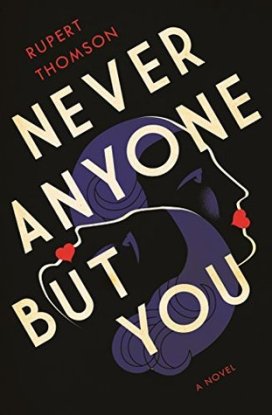
far never anyoneThough I was familiar with these artists, Rupert Thomson’s novel, Never Anyone But You, reveals two extraordinary women I’d never heard of—Lucie Schwob aka Claude Cahun (1894 – 1954) and Suzanne Malherbe aka Marcel Moore (1892 – 1972). They met as teenagers and fell irrevocably in love, beginning a passionate relationship which would endure until Cahun’s death. In a twist of fate no novelist could invent, Moore’s widowed mother married Cahun’s divorced father and the two secret lovers became stepsisters, enabling them to live together without suspicion in an age when lesbian relationships were taboo. Moving to Paris in the 1920s, they adopted androgynous pseudonyms and became involved in the newly fledged surrealist movement. In 1937 they left Paris for Jersey. Later, when the Germans occupied the island, the women created an anti-Nazi propaganda campaign. They were arrested and sentenced to death, but the war ended before their executions could be carried out. Continue reading “Forgotten Female Surrealists by Mary Sharratt”

Celebrating Pride: Honoring the Spiritualities of Queer Holy Women of Color by Angela Yarber

With rainbow colors erupting from even the big box stores, I find my super queer-feminist-self scratching my head at the way Pride has transformed into a capital enterprise. I mean, I’m pretty stoked that the cultural climate seems to be slightly more affirming of queer people, but as queer culture is commodified, I cannot help but think of what is being lost or forgotten. And I want to shout from the rooftops that the rich spiritual history of Pride rests firmly on the shoulders of queer women of color who have marched and meditated, prayed and protested long before rainbow Pride headbands were available at chain stores across the land. It is for this reason that, in honor of Pride Month, the Holy Women Icons Project (HWIP) has launched a 7-Day Online Queer Spirituality Retreat that celebrates seven different queer holy women of color.

HWIP’s 7-Day Online Queer Spirituality Retreat is an opportunity to subversively queer your spirituality, and for the LGBTQ+ community to celebrate our spirituality without having to translate it through the lens of heteronormativity. Open to everyone, the Queer Spirituality Retreat features seven different queer women of color: Pauli Murray, Frida Kahlo, Perpetua and Felicity, the Shulamite, Marsha P Johnson, Guanyin, and Gloria Anzaldúa. Each retreat day takes about 20 minutes and includes an inspirational quote, an icon image, a reflective essay, a guided writing exercise, a ritual exercise, and a closing blessing. The most important part of the retreat is, of course, the revolutionary queer women who make it possible. So, allow me to briefly introduce you to seven queer women of color who should make us all proud…

Continue reading “Celebrating Pride: Honoring the Spiritualities of Queer Holy Women of Color by Angela Yarber”