The Hershee Bar: Saving A Lesbian Sacred Place (while there is still one left) by Marie Cartier (Part I)

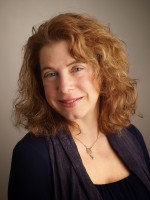
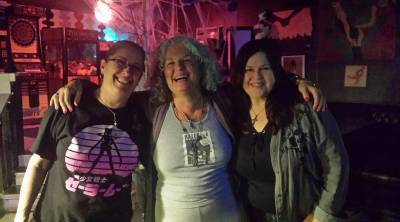
(l to r) Bartender Burt, Marie Cartier, and owner Annette Stone

I spent last weekend in Norfolk, Virginia.  I was brought there by the folks at Old Dominion University; my visit was brainstormed and facilitated by y Professor Cathleen Rhodes who teaches in the Women’s Studies Department and also manages a magnificent archive of historic LGBTQ+ spaces The Tidewater Queer History Project. This project has a walking tour of significant LGBTQ+ spaces in the area, an online archive, and graduate students intensely interested in archiving the remains of past and current LGBTQ+ sites for study, and community.

I was brought to the area because I wrote the book Baby, You Are My Religion:  Women, Gay Bas and Theology Before Stonewall. The thesis of my book is that gay bars before 1975 (pre-Stonewall) served as alternate church spaces and community centers for people exiled from all other spaces. There was literally no other public space for gay women to go in the 40s through the early 70s, as so attested to by 100+ informants that I interviewed for the book. Continue reading “The Hershee Bar: Saving A Lesbian Sacred Place (while there is still one left) by Marie Cartier (Part I)”

Forgotten Female Surrealists by Mary Sharratt

While Frida Kahlo is arguably the world’s most famous woman artist, most women in the surrealist movement have been overlooked. But Frida’s sister surrealists now seem to be experiencing a long overdue resurgence, with recent international exhibitions showcasing Leonora Carrington, Meret Oppenheim, and Dora Maar. The 2017 documentary film, Out of the Shadows, focuses on Penny Slinger. (For more on Slinger and her work, check out her spookily accurate Dakini Oracle.) American art photographer Lee Miller is the subject of The Age of Light, Whitney Scharer’s boldly feminist debut novel which sold to Little Brown and Company for seven figures, following a fierce bidding war.
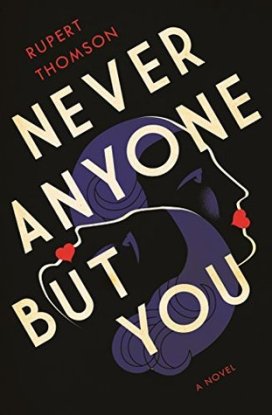
far never anyoneThough I was familiar with these artists, Rupert Thomson’s novel, Never Anyone But You, reveals two extraordinary women I’d never heard of—Lucie Schwob aka Claude Cahun (1894 – 1954) and Suzanne Malherbe aka Marcel Moore (1892 – 1972). They met as teenagers and fell irrevocably in love, beginning a passionate relationship which would endure until Cahun’s death. In a twist of fate no novelist could invent, Moore’s widowed mother married Cahun’s divorced father and the two secret lovers became stepsisters, enabling them to live together without suspicion in an age when lesbian relationships were taboo. Moving to Paris in the 1920s, they adopted androgynous pseudonyms and became involved in the newly fledged surrealist movement. In 1937 they left Paris for Jersey. Later, when the Germans occupied the island, the women created an anti-Nazi propaganda campaign. They were arrested and sentenced to death, but the war ended before their executions could be carried out. Continue reading “Forgotten Female Surrealists by Mary Sharratt”

Celebrating Pride: Honoring the Spiritualities of Queer Holy Women of Color by Angela Yarber

With rainbow colors erupting from even the big box stores, I find my super queer-feminist-self scratching my head at the way Pride has transformed into a capital enterprise. I mean, I’m pretty stoked that the cultural climate seems to be slightly more affirming of queer people, but as queer culture is commodified, I cannot help but think of what is being lost or forgotten. And I want to shout from the rooftops that the rich spiritual history of Pride rests firmly on the shoulders of queer women of color who have marched and meditated, prayed and protested long before rainbow Pride headbands were available at chain stores across the land. It is for this reason that, in honor of Pride Month, the Holy Women Icons Project (HWIP) has launched a 7-Day Online Queer Spirituality Retreat that celebrates seven different queer holy women of color.

HWIP’s 7-Day Online Queer Spirituality Retreat is an opportunity to subversively queer your spirituality, and for the LGBTQ+ community to celebrate our spirituality without having to translate it through the lens of heteronormativity. Open to everyone, the Queer Spirituality Retreat features seven different queer women of color: Pauli Murray, Frida Kahlo, Perpetua and Felicity, the Shulamite, Marsha P Johnson, Guanyin, and Gloria Anzaldúa. Each retreat day takes about 20 minutes and includes an inspirational quote, an icon image, a reflective essay, a guided writing exercise, a ritual exercise, and a closing blessing. The most important part of the retreat is, of course, the revolutionary queer women who make it possible. So, allow me to briefly introduce you to seven queer women of color who should make us all proud…

Continue reading “Celebrating Pride: Honoring the Spiritualities of Queer Holy Women of Color by Angela Yarber”

Long Beach, California – 2018 Pride! by Marie Cartier

Photos by the author unless otherwise indicated

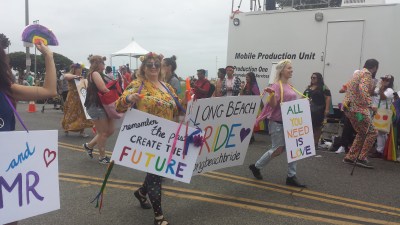
Last year I published a photo essay with pictures of Long Beach, CA’s Pride week-end. You can see last year’s photo essay here. I also published a photo essay of the Los Angeles Resist March from last year here.

It feels more important than ever to re-member/ re-attach ourselves to the normality of resistance, freedom, solidarity, courage and joy. I hope the pictures here help you FAR family to re-member your activist selves and re-invigorate them if they are in need of it. I know mine was before the past week-end. Here are photos from the Long Beach Dyke March on Friday night, and the Long Beach Gay Pride parade on Sunday morning.

Continue reading “Long Beach, California – 2018 Pride! by Marie Cartier”

Bible Study Back in the White House after 100 Years – And… They Still Hate Gays and Women! by Marie Cartier

So, I am perusing my twitter feed and I come across this headline:

White House Bible Study Led by Pastor Who Is Anti-Gay, Anti-Women and Anti-Catholic

The opening paragraphs read like my LGBTQ+ religious studies nightmare:

“The first Bible study group held for the U.S. Cabinet in at least 100 years is led by a pastor who believes homosexuality is ‘illegitimate,’ who doesn’t believe women should preach and has described Catholicism as a ‘false’ religion.

Ten members of the Cabinet, including Vice President Mike Pence, Secretary of State Mike Pompeo, and Education Secretary Betsy DeVos, sponsor the study group, which holds meetings lasting between one hour and 90 minutes every Wednesday, according to BBC News. It unfolds at a location in Washington, D.C., that is kept secret for security reasons.

Its leader is Ralph Drollinger, a pastor and president of Capitol Ministries: an organization which aims to ‘evangelize elected officials and lead them toward maturity in Christ.’”

Continue reading “Bible Study Back in the White House after 100 Years – And… They Still Hate Gays and Women! by Marie Cartier”

Another Gay Bar Closes – Paradise Lost by Marie Cartier

It’s where I went when I wanted to be around other gay people when John Kerry debated George Bush in 2004 for the presidency. I had just moved to Long Beach from Los Angeles and I was still figuring out the city. I didn’t have access to the debate on my TV at home, and I needed to see it. The bartender turned it on for me and we all gathered around and watched. By we all, I mean the gay men and lesbians who frequented that corner café and bar.

I remember laughing so hard that day when someone in the bar said what I still love as a quote, “John Kerry: Bring complete sentences back to the White House.”

Later when I met my girlfriend, who would become my wife, we were living a few blocks apart and in the middle of those few blocks was The Paradise Café. We didn’t have access to the lesbian TV series smash The L-Word. We often went to the Paradise and guilted them into turning it on. We’d sit at the bar with French fries, which to this day I think are the best fries in Long Beach, and watch The L-Word, chiding a lot of gay men around us that they needed to watch to and catch up on this “amazing show!!”

It was where I went, where tons of us went after gay marriage was declared legal in California. I went in with a friend of mine, Carolyn Weathers, who is the cover girl on my book, Baby, You Are My Religion: Women, Gay Bars, and Theology Before Stonewall (BYAMR).

Continue reading “Another Gay Bar Closes – Paradise Lost by Marie Cartier”

Bridging Beyond Binaries: Painting Gloria Anzaldúa by Angela Yarber

One of the great joys of being an artist and writer is working on commissions, enlivening in paint, canvas, and word the stories of revolutionary holy women who have emboldened and inspired the one commissioning the Holy Woman Icon. Gloria Anzaldúa was on my list of holy women for a while when Dr. Robyn Henderson-Espinoza finally gave me the nudge to paint her by commissioning an icon. Anzaldúa gave Robyn—and so many others—the framework, the bridgework, for dismantling the binaries of difference, for finding the beauty that resides at the borderlands of race, gender, and sexuality. As a scholar-activist, Robyn speaks of Anzaldúa as a patron saint, saying:

“Anzaldúa has always been for me the bridge between theory and action, and her work, both in writing and teaching, compels me to live into my vocation as a public theologian, which at root is bridging across lines of radical difference. Without Anzaldúa and without her bridging frame, I am unable to do the work that I now do. This icon offers me a visual reminder of the ways in which I’m called to be a bridge in curating communities of radical difference.”

Queer borderlands. Chicana borderlands. Feminist borderlands. Gloria Anzaldúa (September 26, 1942 – May 15, 2004) was an American scholar who focused on the intersections among queer theory, feminist theory, and Chicana cultural theory. Born in the Rio Grande Valley of south Texas, Anzaldúa also bridged the borders of personal and academic writing, weaving together theory with lived experience, English with Spanish, and inviting readers into a new world—Mundo Zurdo—that transcended these seeming binaries. Continue reading “Bridging Beyond Binaries: Painting Gloria Anzaldúa by Angela Yarber”

Mary Daly: Can I Love the Luddite and Deplore the Transphobe? by Dirk von der Horst

David’s Loves, Jonathan’s Laments by Dirk von der Horst

Mary Daly was one of the most prescient voices of her time with regard to environmental disaster.

Daly was also an explicitly transphobic thinker.

These two facts are deeply related.

What links these two directions in her thought is a radically anti-interventionist ethic.  Daly repeatedly shows how the patriarchal impulse to control everything in the world not only destroys womens’ lives but is destroying the living, natural world.  She describes boundary violation as one of the key elements of control, and her concern for the ability of nature to be on its own terms extends to such unconscious phenomena as comets.  In Quintessence: Realizing the Archaic Future, she laments scientists “harpooning a comet, just to see what’s inside,” revealing the extent of her respect for the integrity of natural processes. (3)

In contrast to the technological use of science to bend nature to human purposes, Daly advocates participation in Be-ing.  Be-ing is a natural process of unconstrained movement, in which various Selves and Elemental forces unfold.  In an unalienated state of participation in Be-ing, connection is genuine and unforced, and the relations that emerge in this process further spur the development and creativity of a natural unfolding process.  Among the many words Daly reclaims and plays with, her use of “Wild” describes women’s participation in Be-ing, and it especially brings out a sense of uncontrolled creativity.

Continue reading “Mary Daly: Can I Love the Luddite and Deplore the Transphobe? by Dirk von der Horst”

David’s Loves, Jonathan’s Laments by Dirk von der Horst

David’s Loves, Jonathan’s Laments by Dirk von der Horst

LGBTQ+ people in biblical religions often turn to the story of Jonathan’s love for David as an example of biblical affirmation of same-sex love.  The biblical narrative in 1 and 2 Samuel stresses Jonathan’s love for David from the moment David and Jonathan meet to Jonathan’s death after which David utters the famous words, your love to me was wonderful, passing the love of women.” Nevertheless, “love” can indicate many different kinds of relationship, both sexual and non-sexual, and one finds much resistance among biblical scholars to reading Jonathan and David as a model of sexually-expressed love between men.  While some passages in the text are sexually suggestive, nothing in the Bible explicitly states, “David and Jonathan had sex.”  Thus, the strategy of holding up Jonathan and David as a biblical vindication of same-sex love and desire only throws LGBTQ+ people back into the exhausting state of being endlessly debated.

My new book, David’s Loves, Jonathan’s Laments: Gay Theology, Musical Desires, and Historical Difference speaks from the pain of the experience of being caught in the crosshairs of that debate.  Inspired in large part by Mary Daly, it also speaks from an impatience with the state of being stuck in a debate that endlessly repeats itself.  This inspiration from Daly is only one way in which feminist thought deeply informs my project of rethinking the relationship of Jonathan and David.

Continue reading “David’s Loves, Jonathan’s Laments by Dirk von der Horst”

Reflections on Marriage by Ivy Helman

studyMy partner and I are getting married in a little over a month.  She, a lawyer, and I, a professor, live in the Czech Republic.  Technically, we aren’t getting married because the Czech Republic doesn’t have marriage equality.  Our relationship will not be recognized in the U.S.  For that, we need to be married in a state or nation that has marriage equality.  Germany might soon.  Other options would be a number of EU countries or the United States, but that doesn’t affect our status in the Czech Republic.  Finally, our marriage will also not be recognized by some in Jewish circles as well since the ketubah, the Jewish marriage document which possesses legal status in Jewish courts, is between two women.

There is nothing legal about our Jewish wedding except one could argue its Jewishness. So, the day after our wedding our relationship will have the same recognition as it had the day before and the day before that.   This would not be the case if we were a heterosexual couple.  It reminds me of the countless commitment ceremonies that took place before marriage equality in the United States.  They were not prohibited (like the marriages that slaves had because slaves weren’t considered people under the law or eligible to enter into legal contracts while in bondage (see pages 301-302).  Yet, similar to the “contubernal relationships” of slaves performed by their masters or other slaves (page 302), they weren’t particularly legal either.  Despite the ceremony, there was no change in status of the couple within society.  Yet, recognition was and still is an important component of both struggles for rights.  In fact, according to Darlene Goring in “The History of Slave Marriage in the United States,” (345-346), the process of gaining legal recognition was very similar for both ex-slaves and the marriage equality community in the United States. Continue reading “Reflections on Marriage by Ivy Helman”