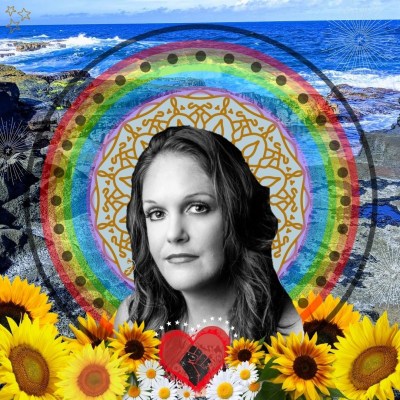
As the American Embassy was bombed in 1999, I was hunkered in a Russian Orthodox Church, gazing at the brooding, whitewashed faces of icons, hands raised in endlessly frightening benediction. Hundreds of men met my eye, as I found myself asking, “Where are all the women?” In 2005, the sun peaked over the horizon on Mount Sanai as I entered the chapel at Saint Catherine’s Monastery, which houses the oldest collection of Christian orthodox icons in the world. As a sensory overload accosted my eyes, ears, and nose, I scanned the scene to find only two women crammed among all the icons; one was a nameless daughter sacrificed by her own father. Where were all the women? A few years later, I knelt at the Temple of 1,000 Buddhas in Thailand. Not a woman could be found. Where are all the women?
For over a decade, I’ve painted folk-feminist icons of revolutionary women from history and mythology, a subversively artistic attempt to answer my own question by painting the women who have been ignored, excluded, or strategically erased. From Pauli Murray to Sarasvati, Gloria Anzaldua to Papahanoumoku, this work continues to be a gift, joy, and a tremendous part of the mission of my non-profit, the Tehom Center, which empowers marginalized women by teaching about revolutionary women through art, writing, retreats, and academic courses. Continue reading “Subversive Sister Saints by Angela Yarber”



 Around the age of 8, or maybe 10, I learned my aunt had had a hysterectomy. I remember visiting her house either shortly before or after the operation. I can’t remember which, and it doesn’t really matter. At the time, I don’t think I even knew what a uterus was or that I too had one.
  I’ve been thinking a lot about something my grandmother would always tell me: “When life hands you lemons, sometimes you have to make applesauce.” I know, it sounds crazy, but life right now appears to be more on the crazy than the sane side.