What’s Good About Good Friday? by Barbara Ardinger

Barbara ArdingerI grew up Calvinist and Republican in a suburb of St. Louis, Missouri. My parents belonged to—but rarely attended—Immanuel Evangelical & Reformed Church in Ferguson, Missouri. When children reached the age of twelve, they were “confirmed” in the church, which meant taking a Bible class taught by the minister, Rev. Press, and then going through a ceremony that made them eligible to take communion, which in that church was grape juice and tasteless crackers. Transubstantiation? I learned what the word meant, but I had (and still have) no idea if it really happens.
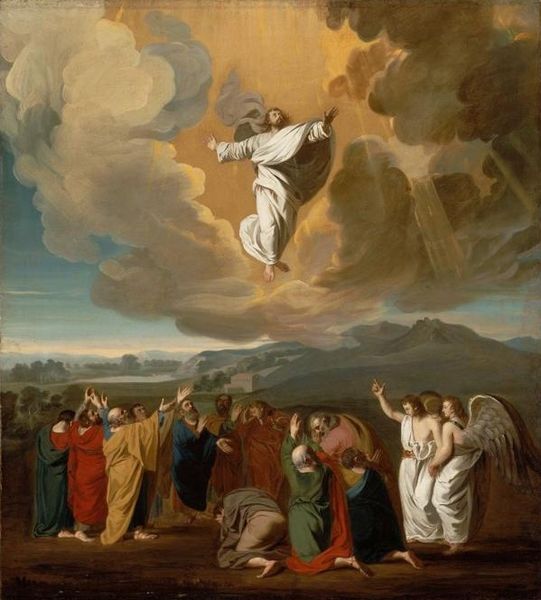
Ascension by John Singleton Copley (1775)

I’ve always been one to ask untidy questions, so of course I asked a lot of questions in confirmation class. God tells us half a dozen times in the Old Testament, for example, that he is a “jealous god.” How, I asked Rev. Press, can a jealous god be a loving god? What’s good about a jealous god? (A couple decades later, when I was studying the Aramaic Bible as translated by George M. Lamsa from the Pshitta manuscripts, I learned that the correct word is “zealous.” That was no help. I still don’t see much good in either jealousy or zealotry.) A week or two later, I asked Rev. Press, “What’s good about Good Friday?” Shortly thereafter, my mother advised me to stop asking questions in confirmation class. (Can we assume she’d received a pastoral phone call?) Continue reading “What’s Good About Good Friday? by Barbara Ardinger”

GODDESS AND SACRED COW: A RE-EXAMINATION OF THE MYTHOLOGY OF THE SACRED BULL by Carol P. Christ

carol-christStatue_of_Egyptian_Goddess_Hathor_from_Luxur_Museum_EgyptMost archaeologists and visitors to museums assume that when they see a horned bovine, they are faced with the image of the male God or the image of the bull sacrifice.  In the minds of many, these two are one, as we have been taught that the male God who was the consort or son-lover of the Goddess was sacrificed. Yet horned Goddesses are not infrequent in the history of religions and Hindus still revere the sacred cow.  

Cattle have played an important role in human life from the beginning of agriculture.  Cows provide milk which is also turned into butter, cheese, and yogurt.  Most of the young males and some of the females are killed for meat or leather, while a few males are kept to impregnate the females.  Though the “raging bull” is the lens through which most of us think about mature male bovines, I have been told by a friend who raised cattle that in fact bulls are for the most part gentle and even sweet–though of course they are also potentially dangerous.

Before the industrial revolution, there was also a third category of bovines, the castrated males, known as oxen, who were used as “beasts of burden”–to pull plows, litters, and after the invention of the wheel, wheeled vehicles. Many people assume that only bulls have horns. This is not the case.  Recently a friend who was raised on a dairy farm described to me the pain experienced by young female cows when their horns are burned out. So let us think again about the images of the horned bovines found in museums.  Given that cows and oxen were long-term companions of early “man” and early “woman,” why should we assume that all horned bovines are bulls?  Continue reading “GODDESS AND SACRED COW: A RE-EXAMINATION OF THE MYTHOLOGY OF THE SACRED BULL by Carol P. Christ”

Dialogues With Our Children by Kelly Brown Douglas

Son: My friends and I were stopped for going 61 mph in a 55 mph zone, frisked and had our car searched. We thought the police were going after the car of white boys in front of us going at least 70, but they stopped us instead.

Mother: It’s not the first time.

Intergenerational dialogues are key to Alice Walker’s womanist definition. This definition includes a dialogue between a mother and a daughter in which the daughter announces that she is going to Canada and taking others with her. The mother replies that she would not be the first one to make such a journey.  During this Women’s History Month, I as a womanist am reminded of the dialogues that haven take place between black women and their children. These inter-generational dialogues have been fundamental to helping black children to “survive and be whole” in a world that looks down on their blackness and attempts to limit their ambitions. Continue reading “Dialogues With Our Children by Kelly Brown Douglas”

Knowledge is Power by Kelly Brown Douglas

If knowledge is power, not knowing is privilege.

It has long since been understood that knowledge is power. Women and other subjugated voices have recognized that those who control the world are those who define the world— and define not simply what counts as knowledge—that is the content of knowledge, but they also define the production of knowledge—that is what sources and means are considered resources for knowing. Just as Michael Foucault has made this clear in his deconstruction of discursive power, so have womanists and black feminists like Patricia Hill Collins who have called for an “epistemology of knowledge, where the meaning of knowledge itself, in terms of content and production, is re-examined and re-defined. For it is undeniable that the what and ways of knowing peculiar to marginalized groups and classes of people are rarely considered knowledge—perhaps “wisdom,” “folkways,” “customs,” “superstitions,” or “women’s intuition,” but not knowledge, not something worth knowing and thus not something worth teaching. Why am I talking about all of this today? Continue reading “Knowledge is Power by Kelly Brown Douglas”

On Pronouns and Liberation in the Classroom by Ivy Helman

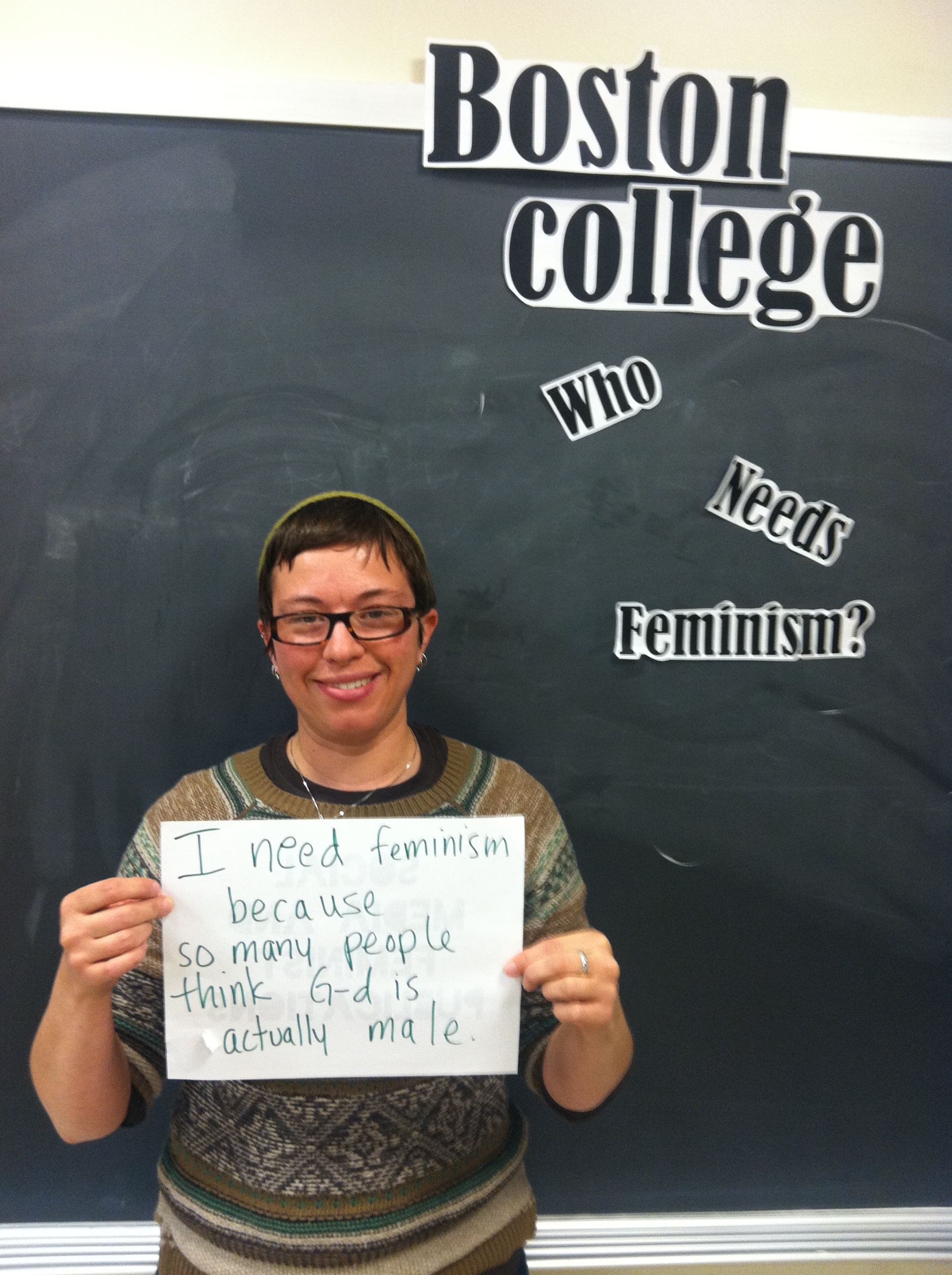
photoIn my introduction to Christianity class, almost every one of my students (who come from diverse religious backgrounds – primarily Roman Catholic, Protestant and Muslim), continues to believe that the best image if not the only appropriate image for G-d is male.  When probed they may speak generically about G-d as genderless, an entity or spiritual presence of some kind, yet conclude by affirming their belief that G-d is male often by adding something along the lines that G-d is best described as Father.  Some go so far in these affirmations that they articulate G-d’s maleness as fact.  It never fails that every semester I struggle with how to address this basic feminist issue within the classroom.

At least as early as 1973, Mary Daly, in Beyond G-d the Father: Towards a Philosophy of Women’s Liberation, articulated the problematic basis of the relationship between gender and divine imagery.  She argues that “If G-d in ‘his’ heaven is a father ruling ‘his’ people, then it is in the ‘nature’ of things and according to divine plan and the order of the universe that society be male-dominated.”  In other words, if maleness is associated with divinity, then the power, domination and running of society by men seems to be divinely ordained. Continue reading “On Pronouns and Liberation in the Classroom by Ivy Helman”

And Thus God made a Covenant with Hagar in the Wilderness by Michele Stopera Freyhauf

Freyhauf, Feminism, Religion, Durham, Old Testament, Blogger, BibleWe are familiar with the covenant God made with Abraham and Moses, but are you aware that God also made a covenant with Hagar?

In the wilderness Hagar encounters a deity at the well named Beer-lahai-roi (Genesis 16). Water and wells are important because they symbolize fertility and life. Wells for women are common places where they met their future spouses. Because wanderers in the desert need water to survive, water itself becomes a symbolic of life-giving or life.

In the seemingly barren dessert, the fertile Hagar finds out that she is pregnant and going to be the mother of many children. Hagar is promised progeny in a motherless state.  According to Pamela Tamarkin Reis, this is called the “after-me” descendants, which guarantees Hagar that her children will live for “immeasurable generations;” a pattern that fits within the scope of this promise. This same promise of progeny is also given to Eve in Genesis 3:20, providing and interesting parallelism between Eve and Hagar.

It is worth pointing out the irony exists in this promise.  Sarai uses Hagar to “build her up.” According to Nahum Sarna, to be built up in terms of the number of children that you have, implies that you are mother to a dynasty.  In this pericope, however, it is Hagar, not Sarai that is built up through this divine promise.

This patterns of promise exists within the birth narrative through the annunciation of Ishmael and the promise of progeny.  It is through this narrative that Hagar enters into a covenantal relationship with the deity.  According to J. H. Jarrell, birth narratives have six common elements that establish this relationship:  mother’s status, protest, offer, son’s future forecast, Yahweh naming, and acceptance of the contract. Hagar’s story contain these elements:

  1. Mother’s Status:  Hagar is without child because she is a virgin (16:1).
  2. Protest:  Hagar flees from her mistress (16:8).
  3. Offer:  Return to your mistress and submit to her authority (16:9).
  4. Son’s Future Forecast:  He will live at the east of all his brothers (16:12).
  5. Yahweh Naming:  You will bear a son Ishmael because the Lord has given heed to your affliction (16:11).
  6. Acceptance of the Contract:  She called the name of the Lord (16:13).

Continue reading “And Thus God made a Covenant with Hagar in the Wilderness by Michele Stopera Freyhauf”

SPECIAL AAR SERIES Part 2: Gamer-Player/ Gamer-Avatar: The Potential of a Video-Gaming Body by Sara Frykenberg with introduction and response by Mary Hunt

Sara Frykenberg Mary HuntIntroduction:

This is one of four papers presented in Chicago at the Annual Meeting of the American Academy of Religion, November 17, 2012, in a session entitled  “Feminism, Religion and Social Media: Expanding Borders in the Twenty-First Century,” organized by Gina Messina-Dysert and chaired by Rosemary Radford Ruether with Mary E. Hunt as the respondent. What follows is the general response followed by, after each of the contributions, Hunt’s appreciative analysis. The first paper was posted here on Feminism and Religion, and the other two papers are posted here and here on the Feminism in Religion Forum

General Remarks by Mary Hunt:

The stated purpose of the panel is to discuss “how digital projects are remapping the feminist theological terrain and creating opportunities for a wide range of voices to participate in ongoing and new conversations related to feminist issues in religion.” These writers have done that and more. Continue reading “SPECIAL AAR SERIES Part 2: Gamer-Player/ Gamer-Avatar: The Potential of a Video-Gaming Body by Sara Frykenberg with introduction and response by Mary Hunt”

Exposure by Elise M. Edwards

Before I feared too much disclosure, but now I seek to channel revelations of personal experiences into exercises that inform the moral and intellectual agency of everyone in the classroom, including me.

I have always been a bit nervous when people share personal experiences in non-intimate settings.  For the past several years, I’ve been in an academic environment where people routinely discuss and reflect upon significant life events.  There were times that I was very uncomfortable listening to classmates discuss abortions, first sexual experiences, and encounters with racism.  Even though they did not use graphic or disturbing language, I questioned the appropriateness of sharing intimate details of one’s life in a classroom.

So when I was preparing to teach my own course on Christian Ethics, I was careful to define a course policy that related to sharing and participation.  In part, it reads: “While students are encouraged to use the course material to reflect on their own experiences and develop their own theological-ethical perspectives, sharing intensely personal reflections is not required  – in fact, it is discouraged to maintain the professional atmosphere of the classroom.“  In class, we discuss conceptions of God and religious faith as they are applied to complex issues like sexuality, racial reconciliation, war, and medicine.  The potential for conflict and personal attack is always present in the classroom because we often have deep commitments and personal beliefs on these issues, so I wanted to curb the amount of personal reflection that occurs in the corporate setting.

Over the course of the semester, though, my perceptions have changed due to well-written memoirs and personal statements I have read recently, the profound statements my students have shared, and the teaching philosophy I am developing.  Whereas before, I feared too much disclosure, now I seek to channel revelations of personal experiences into exercises that inform the moral and intellectual agency of everyone in the classroom, including me. Continue reading “Exposure by Elise M. Edwards”

THE INTERPRETER; or An Introduction to Hermeneutics by Daniel Cohen

 He showed us that every text contains two messages, one formed by the ink and the other by the spaces left between the inked letters, the material included and that which was excluded, and that the message was never complete if only the first text was read.

(Hermeneutics: The art or science of interpretation, especially of scripture. Oxford English Dictionary)

It was all the interpreter’s fault.

He came to our city looking for employment. It was soon clear that he had a wide knowledge of many languages, and most of our merchants began to employ him in their dealings with foreign traders. We saw him speeding from one to another, in those sandals of his with the odd widening at the heels, often pausing to tell one merchant of a recent purchase of interest by another. It seemed that trade prospered with his coming. Our merchants became wealthier and busier than they had ever been. Continue reading “THE INTERPRETER; or An Introduction to Hermeneutics by Daniel Cohen”

Painting Virginia Woolf by Angela Yarber

As I painted her icon, I knew that “the room of one’s own” must engulf more space on the canvas than she did, her heart beating in the room and outside of it, and her arms outstretched as though she is inviting other women into the room.

I first encountered her in the lyrics of a song.  The Indigo Girls shaped my adolescence, molding me into a young feminist as I sang in harmony with other teenage girls:

 They published your diary

And that’s how I got to know you

The key to the room of your own

And a mind without end
And here’s a young girl

On a kind of a telephone line through time

And the voice at the other end

Comes like a long lost friend
So I know I’m alright

Life will come and life will go

Still I feel it’s alright

‘Cause I just got a letter to my soul

Emily Saliers and Amy Ray (the Indigo Girls) were singing about Virginia Woolf, naming the song after her.  As I belted out the lyrics with my soon-to-become-feminist friends, I had yet to learn who Virginia Woolf was and how her life and work had shaped my own.  All I knew as I harmonized those many years ago was that this woman must be special if the Indigo Girls dedicated a song to her.  I felt a longing to know her, to learn more about her, for her to call me on that telephone line through time and tell me I’m alright.  Accordingly, Virginia Woolf is our Holy Woman Icon for September. Continue reading “Painting Virginia Woolf by Angela Yarber”