

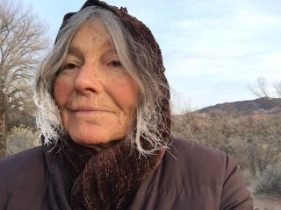
 I recently returned to Maine after what can only be called a harrowing journey from the Southwest. Grateful to feel beloved earth under my feet, I walk along the pine strewn woodland paths to keep myself sane. My animals have been ill, my neighbor was hospitalized briefly, other neighbors deliberately destroyed my garden wall crushing a baby balsam, and used this property as their personal ski slope, the threat of the C/virus looms – there are no words to describe this kind of exhaustion. As a PTSD survivor all my senses are on permanent scream. The simplest task has become monumental. And I am only one of so many…
Each day I attempt to feel gratitude for what is good in my life.
Momentary peace is found in the Dark Green Religion of Hope that I experience walking under every balsam, lichen, wet leaf, deciduous tree, listening to chickadees, phoebes, juncos, and finches, meandering along the swollen brook – Just to see clear mountain waters rushing to the sea reminds me that Nature’s rhythms are my own, and that most of the time I am not breathing with her – unless I take these walks. Somewhere along the way over these last weeks I have lost access to my body (PTSD). Continue reading “La Llorona and the Dark Green Religion of Hope by Sara Wright”
 Very early in Henri Bosco’s 1948 novel Malicroix, a young man, Martial de Mégremut, living placidly amid fruitful orchards in a tame Provençal village, receives a letter informing him he has inherited “some marshland, a few livestock, a ramshackle house” from a reclusive great-uncle, Cornélius de Malicroix. Against his family’s strenuous objections–with alarm they speak of “marshes, mosquitoes, miasmas”–Mégremut resolves to travel alone to the remote Camargue to claim his “wild” Malicroix inheritance. The house is on an island, and to reach it Mégremut must cross a rough river, at night, in a frail wooden boat piloted by a taciturn old man who meets him at dusk in the middle of a vast plain.
 I awakened this morning to frozen raindrops hanging from trees – jeweled beads, snow capped hills, and a cacophony of spring songs – I was serenaded by robins, chickadees, phoebes, goldfinches, and nuthatch tweets as I walked out the door into the early morning sun. I listened for the cardinals, who for the moment were absent. It was cold! 28 degrees at the end of April speaks to anomalies, or more realistically, Climate Change.
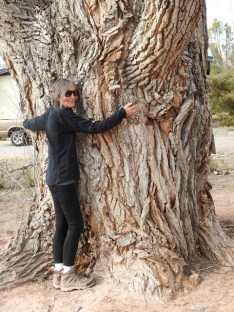 A couple of days ago after an exhausting day of chores I lay out in the sun in my snow pants against the tree I call the “Mother Pine” because she shelters so many creatures from birds to bears. It was late afternoon and the sun was sparkling like a cracked diamond through a myriad of branches over my head. I closed my eyes and listened to an evergreen symphony. The songs produced by pines and other conifers as needles sway and touch soothed me. How much I loved the sound of light winds slipping through the trees.
 Canadian Geese have been on my mind a lot lately. This past winter I have missed the skeins of geese that fly back and forth up and down the river appearing every single morning like clockwork. In Abiquiu when winter turned to spring I noted that the geese were behaving in much the same way the Sandhill cranes did before they migrated, splitting into pairs or groups of three and flying erratically. I was puzzled. I didn’t recall witnessing such behavior before this year. I wondered about migration patterns. Were the geese shifting their flight patterns too? Or perhaps the small groups I saw were staying year round? Some days it almost seemed as if these water birds were confused by something.
 Full Seed Moon 3/9/20
 I have been writing and celebrating ritual for half of my life. The equinoxes and solstices and the cross quarter days (May 1, August 1, All Hallows, and February 2) comprise the eight spokes of the year. What I have learned from my research is that virtually every Indigenous culture follows this calendar in a general way – What I have gleaned from personal experience is that during these ritual periods my body is opened to the Powers of Nature in very specific ways that can be positive or/and negative.
 This post follows last week’s post:
 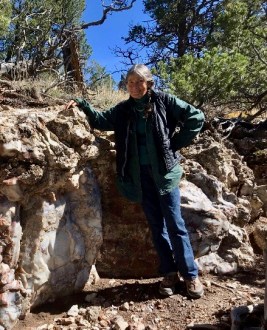 Scientist Diana Beresford Kroeger proved that the biochemistry of humans and that of plants and trees are the same – i.e. the hormones (including serotonin) that regulate human and plant life are identical. What this means practically is that trees possess all the elements they need to develop a mind and consciousness. If mind and awareness are possibilities/probabilities then my next question isn’t absurd: Do trees have a heartbeat?
 Feminism and Religion