Ozymandias and Other Patriarchal Ego-isms by Janet Maika’i Rudolph

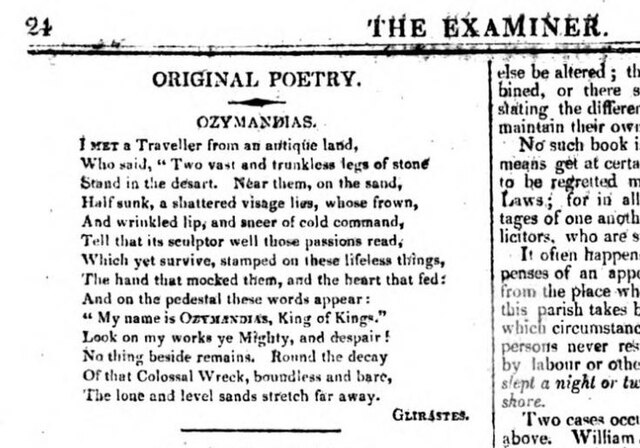
I met a traveller from an antique land
Who said: “Two vast and trunkless legs of stone
Stand in the desert . . . Near them, on the sand,
Half sunk, a shattered visage lies, whose frown,
And wrinkled lip, and sneer of cold command,
Tell that its sculptor well those passions read
Which yet survive, stamped on these lifeless things,
The hand that mocked them, and the heart that fed:
And on the pedestal these words appear:
‘My name is Ozymandias, King of Kings:
Look on my works, ye Mighty, and despair!’
Nothing beside remains. Round the decay
Of that colossal wreck, boundless and bare
The lone and level sands stretch far away.”

Percy Bysshe Shelley 1792 – 1822

There has been discussion of what to name Trump’s ever-expanding ballroom. Some have suggested naming it after Epstein. I would suggest naming it after Ozymandias from Shelley’s poem. 

There is something about building projects that feed to the patriarchal ego.  The Patriarchal ego stands on permanence, largess and if that involves crushing those “below” them, that is just how it is.  Pre-patriarchal pagan systems focus on the cycles of life and are based on an understanding that impermanence is what life is all about. Life works on cyclic movement. The seasons, the moon, the sun, the stars, all is in motion and all presages different aspects of the wheel of life.

Continue reading “Ozymandias and Other Patriarchal Ego-isms by Janet Maika’i Rudolph”

Legacy of Carol P. Christ: Was Ariadne the Most Graceful Bull-leaper of All? Deconstructing and Re-visioning Greek Mythology

carol-christ

This post was originally published on March 3rd, 2014.

Sometimes we think of Greek myth as a pre-patriarchal or less patriarchal alternative to the stories of the Bible. After all, Goddesses appear in Greek myths while they are nearly absent from the Bible. Right?

So far so good, but when we look more closely we can see that Greek myth enshrines patriarchal ideology just as surely as the Bible does.  We are so dazzled by the stories told by the Greeks that we designate them “the origin” of culture. We also have been taught that Greek myths contain “eternal archetypes” of the psyche. I hope the brief “deconstruction” of the myth of Ariadne which follows will begin to “deconstruct” these views as well.

bull leaping ring before 2000 bc phourniAriadne is a pre-Greek word. The “ne” ending is not found in Greek. As the name is attributed to a princess in Greek myth, we might speculate that Ariadne could have been one of the names of the Goddess in ancient Crete. But in Greek myth Ariadne is cast in a drama in which she is a decidedly unattractive heroine.

In the story told by the Greeks, Ariadne falls in love with Theseus, a handsome young man who was sent with 11 other Greek young people to be fed to a monster (who is half man, half bull) known as the Minotuar. The Minotuar is Ariadne’s half brother (see below). Because of her “love” for Theseus, Ariadne helps him to murder her brother.  She then flees with Theseus on his boat.

However, this “love story” does not have a “happy ending” as Theseus abandons Ariadne on a nearby island–long before he arrives home in Athens. Theseus is ever after celebrated as a hero who killed a monster, while Ariadne is just another cast-off female.  Whose story is this? Continue reading “Legacy of Carol P. Christ: Was Ariadne the Most Graceful Bull-leaper of All? Deconstructing and Re-visioning Greek Mythology”

Samhain and the Goddess by Judith Shaw

The wheel of the year is turning us once again toward the dark half of the year. Here in the United States, the bright, shining days of youth and achievement receive the most attention. Death and darkness are rarely honored and often feared.

But the ancient Celts had a completely different view of their place in the world. With a strong belief in reincarnation, the Celts saw death as simply a point of transition in a very long series of lives. People honored the darkness of both night and winter as starting points. In the Celtic worldview a day began at sunset, not sunrise, and the New Year began on Samhain, October 31—the midpoint between Fall Equinox and Winter Solstice.

Samhain, one of the four great fire festivals of Celtic tradition, might have begun long before the Celts arrived in Ireland under the influence of an ancient goddess, Tlachtga (tclak ta). She was most likely from the time of the Fir Bolgs, (fair bolak) the Bronze Age inhabitants of Ireland from the East, and later incorporated into the Celtic pantheon.

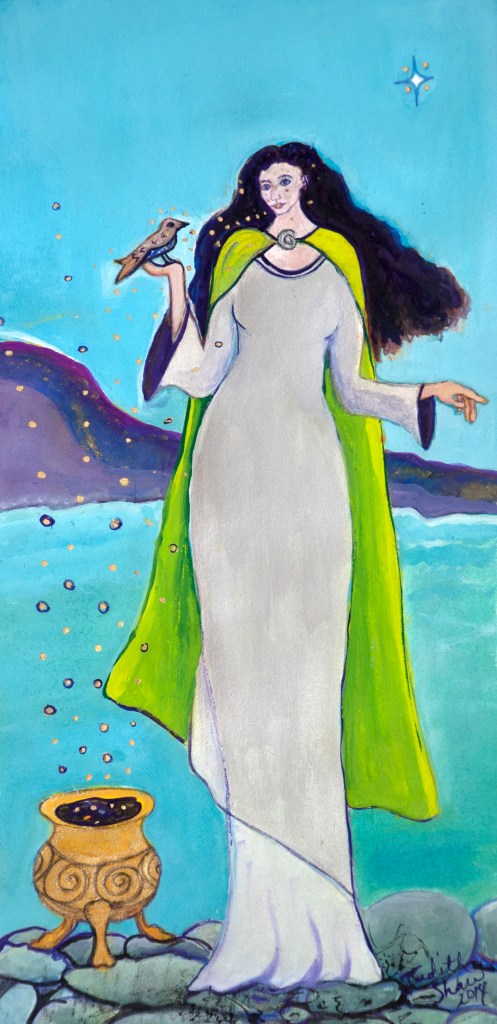
Tlachtga--celtic-goddess-painting-by-judith-shaw
Tlachtga, Celtic Goddess of Sun & Lightning, gouache on paper
Continue reading “Samhain and the Goddess by Judith Shaw”

Threshold Time, by Molly M. Remer

Step by step,
we make our way.
Breath by breath,
we choose.
Day by day,
we see where we are.
Let us remember
that we do not really finish anything,
we tumble with the turning
which is right where we belong.

It is now
in this liminal space
between the cauldron
and the cave,
as obligation struggles
to come roaring back
into center,
that we sense what we truly need
whispering beneath the surface
of all that clamors to co-opt our time
and all that howls
to claim our attention.
Stand steady.
Inhabit your own wholeness.
Cast a one word
spell of power: return.
Step into the sacred
right where you are.
Re-collect yourself.
Reclaim your right
to your own life.
Defend your edges.
Give clarity space
to crystallize
and your own knowing
space to emerge.
It is vital,
this work of reclamation.
Hold it holy.
Let the knots unravel.
Set yourself free.

Continue reading “Threshold Time, by Molly M. Remer”

Legacy Of Carol P. Christ: The Great Commandment for Women: Love and Care for Yourself as You Love and Care for Others

carol-christ

This post was originally published on Feb. 3rd, 2014.

A rabbi known as Jesus of Nazareth taught that you should  “love God with all your heart and your neighbor as yourself.”  Charles Hartshorne, philosopher of relationship and a twentieth century advocate of the “two great commandments,” added that it should be understood that this means that God wants you to love yourself too.

I quote Hartshorne’s midrash on the great teaching often because, sadly, too many women—and some men too–have been taught to love their neighbors at the expense of themselves, to care for others, but not to care as much for themselves.  Continue reading “Legacy Of Carol P. Christ: The Great Commandment for Women: Love and Care for Yourself as You Love and Care for Others”

Merrows: The Enchanting Mermaids of Celtic Mythology by Judith Shaw

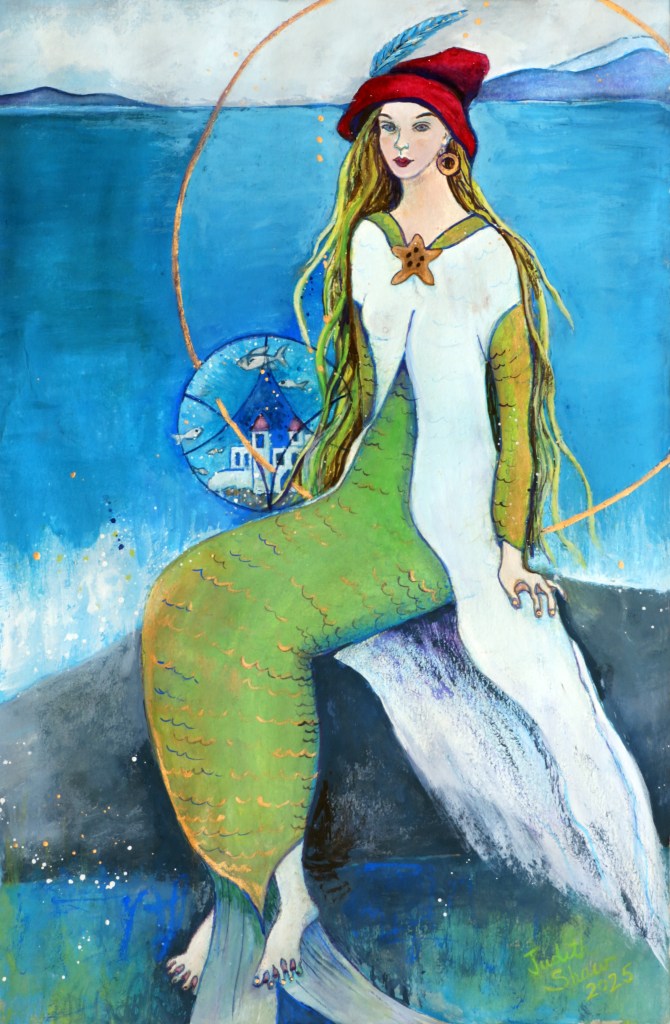
Mermaids have captivated our imaginations worldwide for thousands of years. Across cultures, mermaids are depicted in differing ways—as a dangerous seductresses like the Greek sirens, or as one who could grant immortality like the Japanese ningyo.  

Celtic Ireland, with its abundance of fairies and magical beings has its own kind of mermaid, the Merrow. This term derives from the Gaelic word, “murúch,” which translates as “sea maiden.”

A Merrow‘s Longing by Judith Shaw, gouache on paper, 12″x18″
Continue reading “Merrows: The Enchanting Mermaids of Celtic Mythology by Judith Shaw”

The Cauldron of Life: Destruction and Creation in Celtic Myth, Part 2 by Judith Shaw

Branwen’s Story

Branwen, sister of King Bran the Blessed, was cherished for her gentleness, compassion, and beauty. As the mother of the future king in the tradition of the Old Tribes of the British Isles, she embodies Sovereignty. She is the source of all life, ruling over both the spirit and the land.

Branwen, Celtic Goddess painting my Judith Shaw
Branwen: Celtic Goddess of Love and Compassion by Judith Shaw

We first meet Branwen when the Irish King Matholuch arrives, his fleet signaling peace with a great shield pointing outwards. He asks for Branwen’s hand in marriage—a significant event, as no woman of the old tribes had ever left her people for a foreigner, much less she who would give birth to the next king. Nonetheless, Matholuch is welcomed ashore, and Branwen is summoned.

Continue reading “The Cauldron of Life: Destruction and Creation in Celtic Myth, Part 2 by Judith Shaw”

The Cauldron of Life: Destruction and Creation in Celtic Myth, Part 1 by Judith Shaw

With each passing day, the world spirals deeper into chaos under the weight of the most unsuitable and morally bankrupt president the United States has ever elected. In nearly every aspect of life—from politics to economics to technology to the environment—the world as we knew it is gone. We find ourselves caught between chaos and creation. We are in liminal times.

Badb, Dark Goddess by Judith Shaw
Badb: Fate Weaver by Judith Shaw
Continue reading “The Cauldron of Life: Destruction and Creation in Celtic Myth, Part 1 by Judith Shaw”

The Wisdom of Cerridwen: Transforming Her Cosmic Brew by H. Bryon Ballard

Moderator’s Note: This is the Preface to the recently published anthology, The Wisdom of Cerridwen: Transforming Her Cosmic Brew.

Cerridwen, ancient Queen,
Dark Mother, take us in.
Cerridwen, ancient Queen,
Let us be reborn.
—a Reclaiming chant

The Cauldron, Julia Jeffries

Open these pages and relish the words of this divine Mother, this wild Sister, this trickster and keeper of the Cauldron of Eternity! Spend time with Her. Learn Her sacred ways, Her stories, Her lore.

I learned the chant above at the Glastonbury Goddess Conference where I taught several years ago. I often use it in both my private meditations and in public rituals. It is simple but direct, quite unlike the Goddess it honors. I learned how to pronounce Her name from a Welsh-speaking colleague who gave it a rolling “r” and an emphasis on the second syllable. Keh-RRRHID-wen. Try it. So delicious to say.

Continue reading “The Wisdom of Cerridwen: Transforming Her Cosmic Brew by H. Bryon Ballard”

Pandora/Gaia—Bringer of Gifts by Judith Shaw

As we move deeper and deeper into full autocratic rule, the timeless themes found in mythology help me find my way. 

My first thought for these days was of Pandora, whose story in the myth of Pandora’s Box serves as a powerful metaphor for the complexities of human choice—relevant today by the choice of many to elect Trump, resulting in multiple destructive consequences. 

Hope Endures, by Judith Shaw, gouache on paper, 7.5″x10″
Continue reading “Pandora/Gaia—Bringer of Gifts by Judith Shaw”