Mermaids have captivated our imaginations worldwide for thousands of years. Across cultures, mermaids are depicted in differing ways—as a dangerous seductresses like the Greek sirens, or as one who could grant immortality like the Japanese ningyo.
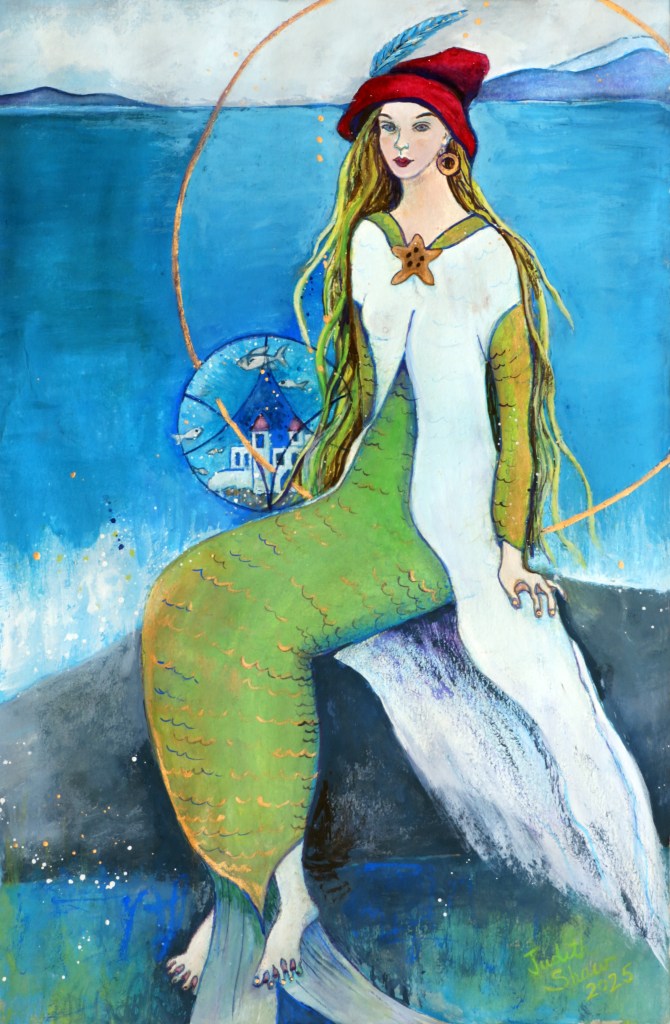
Celtic Ireland, with its abundance of fairies and magical beings has its own kind of mermaid, the Merrow. This term derives from the Gaelic word, “murúch,” which translates as “sea maiden.”
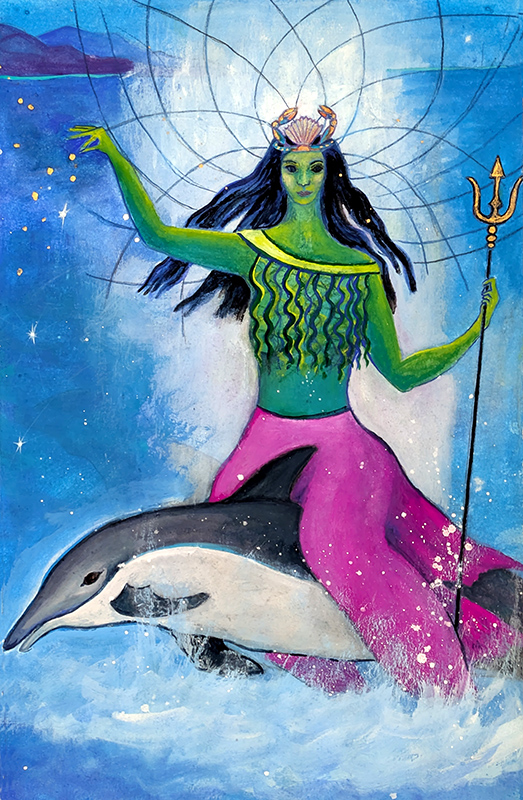
A Merrow‘s Longingby Judith Shaw, gouache on paper, 12″x18″
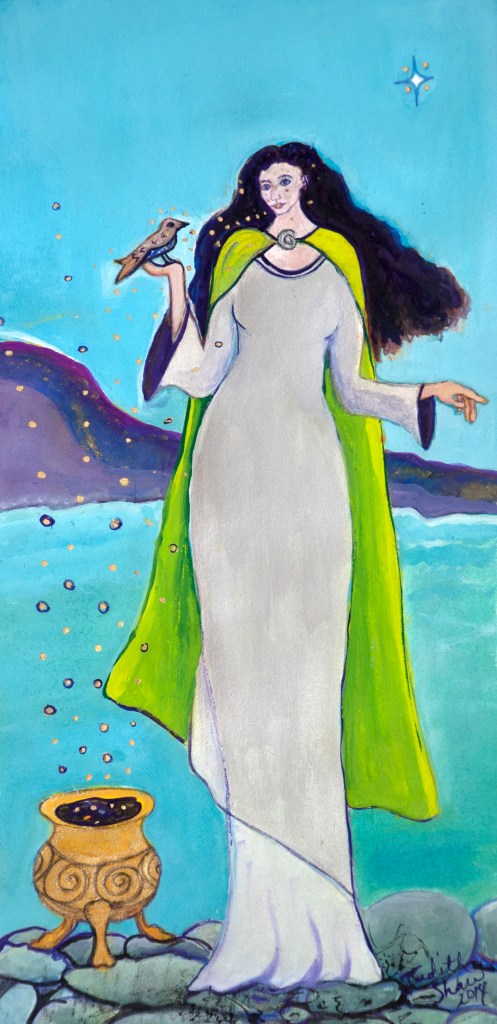
Branwen, sister of King Bran the Blessed, was cherished for her gentleness, compassion, and beauty. As the mother of the future king in the tradition of the Old Tribes of the British Isles, she embodies Sovereignty. She is the source of all life, ruling over both the spirit and the land.
Branwen: Celtic Goddess of Love and Compassion by Judith Shaw
We first meet Branwen when the Irish King Matholuch arrives, his fleet signaling peace with a great shield pointing outwards. He asks for Branwen’s hand in marriage—a significant event, as no woman of the old tribes had ever left her people for a foreigner, much less she who would give birth to the next king. Nonetheless, Matholuch is welcomed ashore, and Branwen is summoned.
With each passing day, the world spirals deeper into chaos under the weight of the most unsuitable and morally bankrupt president the United States has ever elected. In nearly every aspect of life—from politics to economics to technology to the environment—the world as we knew it is gone. We find ourselves caught between chaos and creation. We are in liminal times.
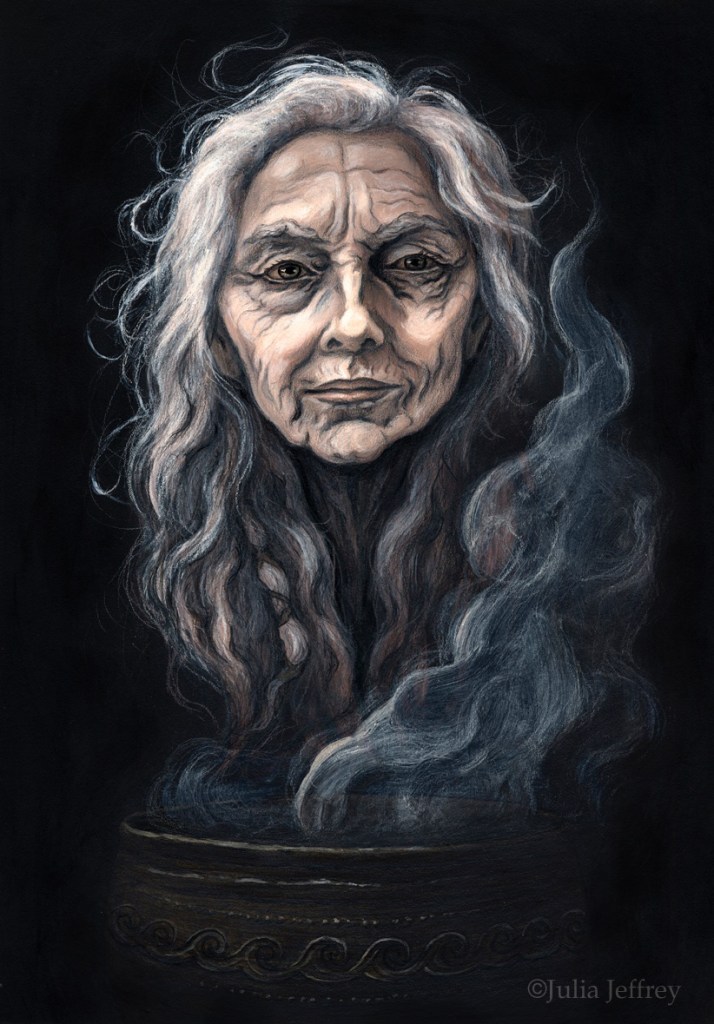
Cerridwen, ancient Queen, Dark Mother, take us in. Cerridwen, ancient Queen, Let us be reborn. —a Reclaiming chant
The Cauldron, Julia Jeffries
Open these pages and relish the words of this divine Mother, this wild Sister, this trickster and keeper of the Cauldron of Eternity! Spend time with Her. Learn Her sacred ways, Her stories, Her lore.
I learned the chant above at the Glastonbury Goddess Conference where I taught several years ago. I often use it in both my private meditations and in public rituals. It is simple but direct, quite unlike the Goddess it honors. I learned how to pronounce Her name from a Welsh-speaking colleague who gave it a rolling “r” and an emphasis on the second syllable. Keh-RRRHID-wen. Try it. So delicious to say.
As we move deeper and deeper into full autocratic rule, the timeless themes found in mythology help me find my way.
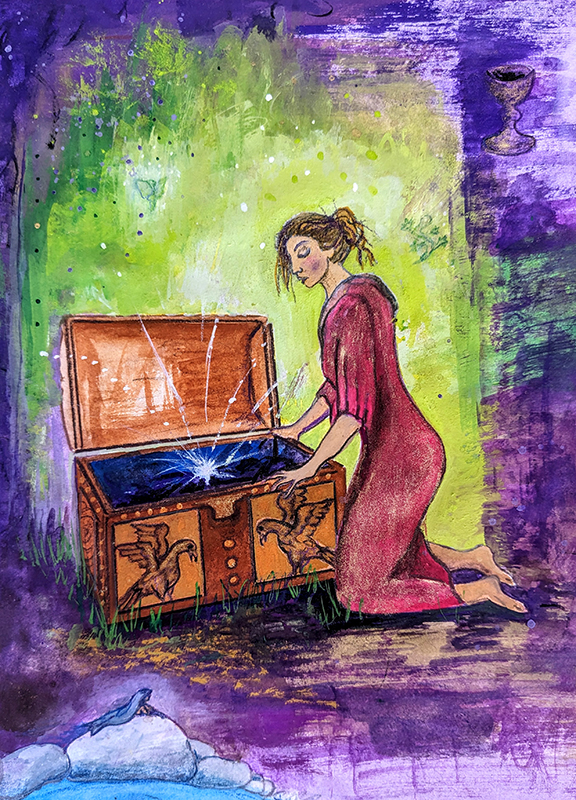
My first thought for these days was of Pandora, whose story in the myth of Pandora’s Box serves as a powerful metaphor for the complexities of human choice—relevant today by the choice of many to elect Trump, resulting in multiple destructive consequences.
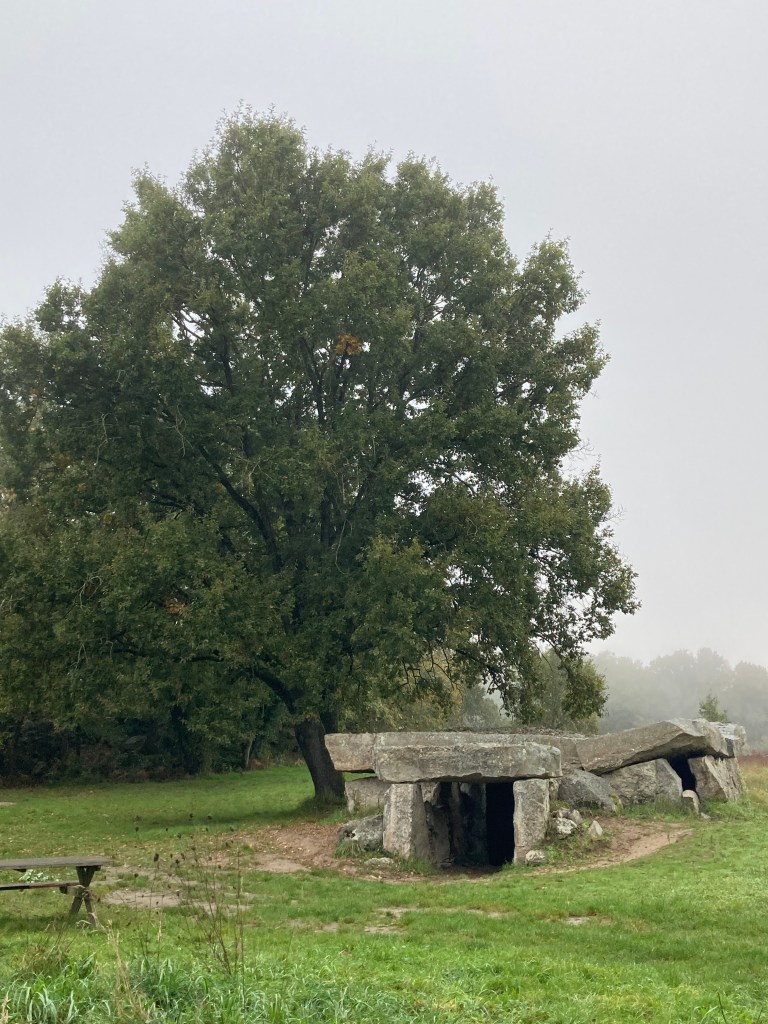
In preparation for my hysterectomy, I decided to spend a night in a dolmen at Samhain last year, to seek guidance and healing. I chose Dolmen de Bajouilière in Saint-Rémy-la-Varenne, in Northern France, a site I had discovered by chance the previous year on my local explorations.
This well-preserved structure, with its spacious square divided into two rooms, felt inviting and safe for an overnight ritual. Though I am accustomed to spending nights in neolithic monuments, mostly in the UK, I felt some hesitation, partly due to my intermediate French and unfamiliarity with the local spirits.
Nevertheless, I recognized this resistance as part of the ego’s fear of the unknown, and I gave myself permission to retreat if needed. If I would feel too vulnerable, it wouldn’t serve my body and spirit ahead of the surgery. Please join me on my overnight Samhain Ceremony full of deep imagery and transformation as I shed my womb three times…
In the origin stories of the Greek deities the overarching importance of water, which surrounds their domain, is undeniable. Water held the power of life, death and renewal.
In each successive pantheon of Greek goddesses and gods — the Primordials, the Titans, and the Olympians — a goddess and a god ruled the seas together. During the time of the Primordial deities, it was Thalassa and Pontus, followed by the Titans, Thetys and Oceanus, and Doris and Nereu, and finally by the Olympians, Amphitrite and Poseidon.
“Amphitrite, Greek Sea Goddess,” gouache on paper, 11″ x 17″ by Judith Shaw
The exact day of the Winter Solstice ushers in what I think of as the Winter Solstice Season — a ten day period when, in the northern hemisphere, the sun barely moves from it’s most southerly position in the sky. The days are very short and the nights are long, long, long.
At this time of year I embrace the worldview of my Celtic ancestors who relished the darkness in a way that is foreign to us today. Every day began at dusk not dawn. The new year began on October 31, as the cold set in and the world turned toward the dark. The harvest was in, thanks were given, and nature was moving into its period of death. I find an inherent wisdom in this counting of time.
In this moment, my connection to trees feels especially profound. I find such beauty in the winter trees, naked of their green and golden finery, etching stark lines in the sky. As we drew near to the solstice, I felt compelled to create a new painting that expresses my love for winter trees and the Winter Solstice.
With this season of the festivals of light upon us (Hanukkah, Christmas, Solstice, Kwanzaa), I wanted to focus on the more joyful aspects of our lives. For that, I have been diving into passages about joy and singing in the bible.
Sometimes when I write these posts, they take me in directions I never thought to go. This post is one of them. The surprise direction I found is in the Psalm below:
Sing unto him, sing psalms unto him: talk ye of all his wondrous works. Glory ye in his holy name: let the heart of them rejoice that seek the LORD. Psalm 105:2-3 KJV
Find some pine trees and a wide rock in the sun. Settle down and feel gratitude curl around your shoulders. Listen to the wind sense that there is sorrow too in this place, deep and old, threaded through the lines of sun slices of shadows. It tells of what has been lost, what has been stolen, of silenced stories, and of fracturing. Make a vow, silent and sacred, to do what you can, to rebuild the web to reweave the fabric. Lie on your back in the pine needles, feel your body soften into the ground and become still. Allow yourself to feel held, heavy bones and soft skin becoming part of the land. Wonder how many of your ancestors kept other people from becoming ancestors themselves. Watch the sunlight making tiny rainbows through your eyelashes and pines. Find a pretty rock. Don’t take it. Leave it where it belongs, on the land that gave it birth. Go home. Keep your promise.