

 In folklore Old women are believed to control all aspects of Nature – Fire, Earth, Air and Water, but in myth and story they have a special relationship with water.
The title “witches in the weeds” emerged after I did some research on the Datura plant. This plant is usually associated with old women and sorcery in myth and story. For example, in European mythology, the dark goddesses, Hecate, and Baba Yaga are associated with Datura. Datura is considered to be a ‘witch weed’ and is categorized as a poison along with deadly nightshade, henbane and mandrake. The seeds and flowers have a history of creating visions, delirious states, and causing death. Datura thrives in wilderness areas. Old women, dark goddesses and Datura have a lot in common.
Women and birds have been associated since Neolithic times. Scholar and mytho-archeologist Marija Gimbutas unearthed many bird-women sculptures that were fashioned out of clay in “Old Europe”. Old women in particular are most often associated with owls, herons, crows, ravens, and black birds of all kinds. It is probably the relationship between women and birds that is one of the roots behind the belief that old women can fly. The other root behind flight can probably be found in the relationship between women healers and the plants they used. Plants like Datura contain alkaloid properties (scopolamine, hyoscyamine, and atropine) that are capable of producing visions of flight and are used by folk healers and medicine women and men. Continue reading ” Witches in the Weeds by Sara Wright”
 My birthday was last Wednesday. Perhaps more than any other time of the year (yes, even more than Rosh Hashanah and Yom Kippur), the days and weeks leading up to my birthday are filled with personal reflection. Not that religious and secular new years don’t give me pause to reflect, but I think the lack of buzz around this personal event seems to offer me more space and time to think.
 In the ancient world, snakes represented fertility, creativity, rebirth, wisdom and, even, death. They were often closely connected to female goddesses, priestesses and powerful human females who were the embodiment of such powers. For example, there is the Minoan goddess/priestess holding the two snakes in her outstretched arms. She is closely linked with fertility and domesticity. Similar figurines, with similar associations and dating to approximately 1200 BCE, have also been founded in the land of what once was Canaan, where Israelites also lived. Medusa, in whose hair lived venomous snakes, turned men who looked at her to stone. Ovid’s account of the creation of Medusa credits the Greek goddess Athena with Medusa’s lively hair. Another Greek legend says Perseus, after killing Medusa, gave her head to Athena who incorporated it into her shield. Athena, the goddess of wisdom, is portrayed often with snakes wrapped around her as a belt and/or on the floor next to her.
  A few months ago
 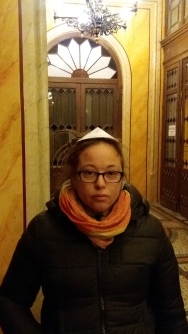 Last week Sunday, my partner and I were in Budapest, Hungary. We stopped at the Dohany Street Synagogue, the second largest synagogue in the world and the largest in Europe. After we bought our tickets and proceeded through security, we decided to go into the synagogue first and then the museum.
 A female friend recently posted an article by a woman writer about motherhood. The article was entitled “Children are NOT life’s flowers” (referring to a famous Russian saying which means that children are what makes life beautiful).
 It is amazing that in the current atmosphere of bringing out into the open so many issues, motherhood is not much discussed. Sexuality, gender and abuse are OK to speak about and question. At the same time, it is only within medical profession that such issues as “baby blues” or post-partum depression are valid topics.
 I’m heartbroken by yet another shooting in the United States. I want to believe that all humans are, deep-down, intrinsically good. I want to trust humans to act in the best interests of others. I want peace between and inside human beings. I want animals to be cared for, respected and deemed inherently valuable. I want humanity to live in harmony with nature. And, I want human societies that are just, equal and fair.
 I saw an interesting headline the other day entitled: “Olympic Gymnast Hits Back at Body-Shaming.” I immediately thought, “Wow not again.” The fact that body-shaming is even an expression is a disheartening commentary on the society we live in today. Women’s bodies have long been the subject of casual objectification in our culture and in the media. The fact that people think it’s ok to comment on a woman’s body, in whatever fashion pleases them, blows my mind. Not only is it disrespectful, but it comes from the problematic way society equates a woman’s worth with her beauty.
 Feminism and Religion