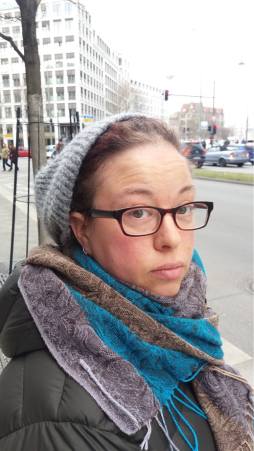
What Happened When I Dared to Wear a Kippah by Ivy Helman

20171203_124919Last week Sunday, my partner and I were in Budapest, Hungary.  We stopped at the Dohany Street Synagogue, the second largest synagogue in the world and the largest in Europe.  After we bought our tickets and proceeded through security, we decided to go into the synagogue first and then the museum.

We walked into the synagogue.  A younger man (maybe 20) was handing out paper kippot (yarmulke in Yiddish).  My partner and I both put our hands out but were refused.  There was an elderly man there who said that the kippot were only for men.  That didn’t surprise me initially as I take my students to the Jewish Museum in Prague and I often argue with the elderly ladies over the right and acceptability of women wearing kippot.  They begrudgingly give my female students kippot saying “only as souvenir,” which boils my blood.  Usually, by the time they give the women kippot even those who traditionally wear them are too shamed to do so.   Continue reading “What Happened When I Dared to Wear a Kippah by Ivy Helman”

“When You Know for Yourselves” by Oxana Poberejnaia

A female friend recently posted an article by a woman writer about motherhood. The article was entitled “Children are NOT life’s flowers” (referring to a famous Russian saying which means that children are what makes life beautiful).

A number of women contributed comments under this post. The discussion revolved around the image of an ideal mother and how we real mothers should relate to it.

It is amazing that in the current atmosphere of bringing out into the open so many issues, motherhood is not much discussed. Sexuality, gender and abuse are OK to speak about and question. At the same time, it is only within medical profession that such issues as “baby blues” or post-partum depression are valid topics.

Continue reading ““When You Know for Yourselves” by Oxana Poberejnaia”

Bans are Bandages not Solutions by Ivy Helman

meandmini1I’m heartbroken by yet another shooting in the United States.  I want to believe that all humans are, deep-down, intrinsically good.  I want to trust humans to act in the best interests of others.  I want peace between and inside human beings.  I want animals to be cared for, respected and deemed inherently valuable.  I want humanity to live in harmony with nature.  And, I want human societies that are just, equal and fair.

Even though I’m certain this world is achievable, it does not exist.  In fact, it often feels like we take one step forward, but something changes and we go back again.  This type of existence is no way to live.  In fact, Las Vegas was yet another example of how our way of life is worse than that.  It’s quite literally killing us.  And, I’m beyond any sort of ability to articulate just how upset I am. Continue reading “Bans are Bandages not Solutions by Ivy Helman”

Missing a Teachable Moment: The Purple Dress by Marilyn R. Freedman

Intelligent and impish eyes took in my approach, and the little girl moved away from the post office doors. But not before I saw her sweet face with round cheeks still full of baby fat squished against the glass. With slightly messy, curly blond hair and wearing a shiny, deep purple, ruffled dress-up dress, she looked pretty, happy, and confident. This was her world, wherever she was. When I smiled, though, she turned away, shy of a stranger.

I got into the long line with my kid and listened to the little girl’s dad discuss gift card values with her older brother. The boy named an amount, and the dad commented about how expensive it was. “What a great way to teach a little economics and finance,” I thought.

Continue reading “Missing a Teachable Moment: The Purple Dress by Marilyn R. Freedman”

Tall Order by Sarah Kiefer

I saw an interesting headline the other day entitled: “Olympic Gymnast Hits Back at Body-Shaming.” I immediately thought, “Wow not again.” The fact that body-shaming is even an expression is a disheartening commentary on the society we live in today. Women’s bodies have long been the subject of casual objectification in our culture and in the media. The fact that people think it’s ok to comment on a woman’s body, in whatever fashion pleases them, blows my mind. Not only is it disrespectful, but it comes from the problematic way society equates a woman’s worth with her beauty.

People have diverse ideas of beauty, and different cultures value different physical qualities, but this does not mean that those who don’t live up to the ideal should be shamed. In the article, Gymnast Aly Raisman relates an experience at an airport where a female employee recognized her and mentioned one of the reasons was “because of her muscles.” A male colleague then stated “Muscles? I don’t see any muscles” and “continued to stare” making Raisman feel uncomfortable. She then took to twitter to relay the events stating: “I work very hard to be healthy and fit. The fact that a man thinks he can judge my arms pisses me off.  I am so sick of this judgmental generation.” Continue reading “Tall Order by Sarah Kiefer”

Reflections on Marriage by Ivy Helman

studyMy partner and I are getting married in a little over a month.  She, a lawyer, and I, a professor, live in the Czech Republic.  Technically, we aren’t getting married because the Czech Republic doesn’t have marriage equality.  Our relationship will not be recognized in the U.S.  For that, we need to be married in a state or nation that has marriage equality.  Germany might soon.  Other options would be a number of EU countries or the United States, but that doesn’t affect our status in the Czech Republic.  Finally, our marriage will also not be recognized by some in Jewish circles as well since the ketubah, the Jewish marriage document which possesses legal status in Jewish courts, is between two women.

There is nothing legal about our Jewish wedding except one could argue its Jewishness. So, the day after our wedding our relationship will have the same recognition as it had the day before and the day before that.   This would not be the case if we were a heterosexual couple.  It reminds me of the countless commitment ceremonies that took place before marriage equality in the United States.  They were not prohibited (like the marriages that slaves had because slaves weren’t considered people under the law or eligible to enter into legal contracts while in bondage (see pages 301-302).  Yet, similar to the “contubernal relationships” of slaves performed by their masters or other slaves (page 302), they weren’t particularly legal either.  Despite the ceremony, there was no change in status of the couple within society.  Yet, recognition was and still is an important component of both struggles for rights.  In fact, according to Darlene Goring in “The History of Slave Marriage in the United States,” (345-346), the process of gaining legal recognition was very similar for both ex-slaves and the marriage equality community in the United States. Continue reading “Reflections on Marriage by Ivy Helman”

Making America What Again? Reflections for the 4th of July by Sara Frykenberg

I find myself asking (again), when the religious right, evangelicals, and Christian fundamentalists hear Trump say, “Make America Great Again,” do they really hear him saying, “Make America Christian Again?” How can the really hear him saying that in light of what this man has actually said and actually done? The answer: because of the same mythical purity that erases the violence, slaughter, and atrocity attached to this “Christian nation’s” founding.

Sara FrykenbergMy mother sometimes likes to watch the movie “Independence Day,” on the 4th of July—you know, the one where Will Smith, the gutsy and heroic Marine pilot, Jeff Goldblum, scientist, and Bill Pulman, president, save the Earth from extraterrestrial invasion? It’s an action film loaded with implicit myth and exceptionalism, extolling “mankind’s” common humanness in the face of annihilating, “alien” difference. The heroes ultimately unify the globe with fly-by-the-seat-of-your-pants “American” ingenuity, luck, and bravery. Continue reading “Making America What Again? Reflections for the 4th of July by Sara Frykenberg”

Is This How Patriarchy Began? by Carol P Christ

In my widely read blog and academic essay offering a new definition of patriarchy, I argued that patriarchy is a system of male dominance that arose at the intersection of the control of female sexuality, private property, and war. In it, bracketed the question of how patriarchy began. Today I want to share some thoughts provoked by a short paragraph in Harald Haarmann’s ground-breaking Roots of Ancient Greek Civilization. Haarmann briefly mentions (but does not discuss) the hypothesis that patriarchy arose among the steppe pastoralists as a result of conflicts over grazing lands. As these conflicts became increasingly violent, patriarchal warriors assumed clan leadership in order to protect animal herds, grazing lands, and the women and children of the clan. Continue reading “Is This How Patriarchy Began? by Carol P Christ”

Internal Strife – External Conflict by Oxana Poberejnaia

As Po said in “Kung Fu Panda”: “I’m gonna get myself some Inner Peace… Inner piece of what?”

This basically lays out a path of spiritual work for most of us. We aim for peace, yet somehow we feel that we must do something in order to achieve it – rather than just be peaceful.

Another joke that captures this paradox perfectly is:

“My son started doing meditation. Well, that’s something. At least he’s not sitting around doing nothing.”

Sitting around doing nothing seems to be the worst sin in our society. Buddhism is quite radical in this regard. The path to Enlightenment leads through sitting around and doing nothing. Anything and everything else that we do to keep ourselves busy is determined by society, hence impermanent, hence not the truth. Continue reading “Internal Strife – External Conflict by Oxana Poberejnaia”

Resisting Shame and Choosing to Live through the Loving Eye by Stephanie N. Arel

This week, I finished reading The Politics of Reality: Essays in Feminist Theory by Marilyn Frye, a text I had not encountered in my studies of feminism (in literary theory, psychology, philosophy, or theology) until now. In some ways, I wish I would have read it sooner. In other ways, I am grateful for this more recent rendezvous. From my current position and perspective – theoretical and personal – I was, I think, more able to hear the core message Frye conveys than I would have been years ago. I have less to protect now, and my ego is less fragile. In the text, she names the mechanisms around which Western – and patriarchal – cultures are founded. Her argument is fluent and cogent, even as it threatens the stability this culture offers. Our lives are embedded in it, even if our personal ethics point to alternative, feminist ways of living. Frye pushes her readers to live alternatively, so that we can recognize the times that we conspire/feed into/comply with patriarchal messages and clean the residue of servitude off of our skin.


For the purposes of this post, I engage two opposing concepts Frye presents in the text: the arrogant eye and the loving eye. Located in the chapter entitled “In and out of Harm’s Way: Arrogance and Love,” Frye investigates how men in phallocentric culture exploit and enslave women. The opposing, contradictory eyes of arrogance and love directly relate to the experience of shame which effectively serves to subjugate women in patriarchal culture.


Shame functions within what I call a logic of exposure. Shame relates intimately to the concept of being seen.  Affectively, shame results from our interest/excitement being partially truncated. For instance, we are drawn to someone (real or imagined); we are interested in their response to us, and somehow something interferes with the desire to connect. Contact is cut off, and interest/excitement partially halted. Shame ensues. We experience that someone (real or imagined) seeing us as other, different, foreign, maligned, wrong, or worthless. We are seen wrongly. This misperception alleviates joy and relates to the gaze of the arrogant eye under which (as the default gaze of phallocentric culture) we often find ourselves seeking approval.

Continue reading “Resisting Shame and Choosing to Live through the Loving Eye by Stephanie N. Arel”