Claiming the Power to Choose Our Lovers and Partners by Carol P. Christ

My dear friend Carol Lee Sanchez once told me that the women of the Laguna Pueblo– whose culture is an egalitarian matriarchy–taught her that women must choose their men, not wait for the men to choose them.* This was a new idea for me, and though I was attracted to it, I found it difficult to assimilate. The reason I did not understand what Carol Lee was teaching me was that I was still operating out of a patriarchal binary: either the man was in control, or the woman must be.

Like many otherwise independent women, I have often reverted to a kind of passivity in love affairs. As a girl, I was taught to wait for the man to choose me. As a feminist I knew better, but I didn’t know how to change this cultural pattern, especially when most of the men I knew still expected –even if only unconsciously– to be in charge. In addition, having learned that a man who wants an independent feminist woman is hard to find, I often gave up on ever finding a man. Not actively looking, I would be pleasantly surprised when a man took an interest in me. Then, all too often, I would give myself to him, hoping that he was the right one. Continue reading “Claiming the Power to Choose Our Lovers and Partners by Carol P. Christ”

“Womenspiration” for International Women’s Day by Elise M. Edwards

elise-edwardsHappy International Women’s Day!  I hope it is a happy day for you as we recognize women’s achievements throughout the world.  Our FAR community is not only for or about women, but as feminists in some form or another, collectively we support women, their growth, their health, and their contributions to the world.  On a day like today, we should take note of what still needs to be done and recommit ourselves to our work.  But let’s not rush past an opportunity for joy and celebration. Many generations of women have fought for equal rights and participation in all sectors of society, and we have made progress. To commemorate that legacy today, I am highlighting just a few of the women who inspire me with their lives and with their work. They are my “womenspiration.”  My hope is that you join me in recognizing them and that as you read about them, you reflect on the women who inspire you.

Continue reading ““Womenspiration” for International Women’s Day by Elise M. Edwards”

Activism Helps You Heal: #RESIST #NeverAgain by Marie Cartier

Here we are, as I write this,  a week after the horrible shooting of 17 students and teachers in Parkland, Florida. And the beginnings of a new student led movement: #NeverAgain—never another school massacre like what happened in Florida.

Today, one week after this horrific event, you had massive student walk-outs all over the country to protest the government’s refusal to do anything substantive about it. Here are images of student protests.

One of the out spoken survivors of the Parkland shootings, Emma Gonazlez, has turned into a spokeswoman/teen, for the movement, fueled by her fiery speech the day after the shootings.

Emma Gonzalez

She has continued to speak out as have the other students.

And the movement grows. 

I am a college teacher, a college teacher in two public universities. I teach students one to four years older than the students at Parkland. Last week at one of the public schools I teach at there was an active shooter warning that turned into a hoax. I have in the past been on lock down because an active shooter was on campus. This is a very real problem for me.

Today I heard the president of the United States suggest that the solution to the every growing problem of gun violence is to arm teachers or other school officials with weapons. As a black belt in karate, I have had gun training and gun safety as part of my training and it is part of my self-defense resume. I had to learn it. What I can tell you about owning a gun (which I don’t) is that having a gun is not the same as knowing how to us one. I know how to disarm someone, if I am lucky and the fight goes in my favor. Anyone with any experience in self-defense will tell you that the quickest way to escalate a situation is to introduce a gun into the situation.

Continue reading “Activism Helps You Heal: #RESIST #NeverAgain by Marie Cartier”

Reflections on the Theology of Simone Weil by Elisabeth Schilling

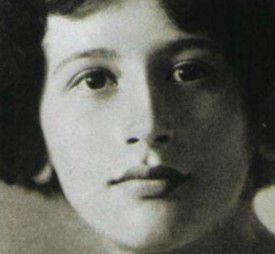
French philosopher and mystic Simone Weil, in Gravity and Grace, says forgiveness is knowing I am other than what I imagine myself to be (9).  For Weil, our true selves seem to be inextricably intertwined with each other, with the universe; knowing this can bring compassion for the self and world.

Upholding the constructed self that needs to be justified, protected, and admired can cause a lot of stress within our bodies and perhaps violence in relationships. Weil says that the cause of war is that we do not know we have access to the universe in our own bodies (86). Sometimes I feel that we avoid each other, looking in to each other’s eyes, because we cannot bear the weight of energy, the collision of spinning vortex that might occur the closer we move. Our DNA might hold memories, shared vibrations with ancient mountains, and the bodies we inhabit feel so intensely. Every cell seems alive with sensation, and most of us want to avoid the pain that cannot always be extracted from the pleasure that is also ready to be encountered.

One of my students asked me, as we discussed Weil in class, why we should improve, try to become better people, what the point was of anything. I don’t always know the answer to these questions or what might prompt them, but what I think for the time being is that we get up off the floor because there are these moments of intimacy where the universe is felt through our veins, and to experience that, even occasionally, might be worth everything. To do what we might be destined to do, to co-create and do that in healing, pleasurable ways, is to align with something beyond, but not excluding, ourselves.

Continue reading “Reflections on the Theology of Simone Weil by Elisabeth Schilling”

Time Traveling Letter to Kids of the 70s (especially you, Natalie) by Natalie Weaver

Hmmm…. Time Travel?  Maybe, I suppose.  I recall a strange video clip in which Steven Hawking throws a Time Travelers’ Party.  He sends an invitation for a fancy soiree, holds the event, and sets the scene where future folk will find a welcome reception at specific coordinates in the past, should they find the means to get there.

Then, there’s the Baby and Bird pub in Oxford, England, where the famed Inklings writers convened to share manuscripts.  There was a curious tile in the wall of one of the more private rooms, wherein, while drinking my Pimm’s Cup, I was told by some cat playing cards that Tolkien, Lewis, and company made a pact to use that tile as a sort of gathering horcrux, if they discovered they could get meet up again after crossing into the world beyond.  I can imagine that conversation among pipe-smoking guys in tweed, very seriously stacking their hands together, imbuing their spirits into a piece of decorative ceramic.  I hope it is a true story.  I’ve heard enough Brian Greene to appreciate theoretically how perhaps skipping ahead to the future is possible.

My greatest sympathy, though, for the time theorists goes to my old professor, who used to pray for things to be different in his past.  He said he believed God could change anything.  I thought it was eccentric, and I sort of think he was praying for particular events and things to actually have been different.  I admit, his level of specificity is hard for me to brook, but the concept makes a measure of sense when I consider that a person’s past is still actively present in her or his personhood insofar as we are constantly remembering, revaluing, and reintegrating ourselves in one way or another.

From a transcendental personal perspective, things that are decades old condition certain meanings, values, and tolerances in the present self. I have lunch with a friend every couple of months, and there is a never a visit that goes by in which she does not recount and somehow integrate the experience of having a gun pointed at her head.  Our stories, especially how we re-member them, great and small, live on in us.  It occurs to me even as I write that our conditioning is not even our own exclusively; we carry legacies of the human and cultural past in our embodied presents.  And, we presume the future every time we make a promise.

I am reminded of St. Augustine here and largely persuaded to appreciate the value of recognizing something like a perpetual NOW: Continue reading “Time Traveling Letter to Kids of the 70s (especially you, Natalie) by Natalie Weaver”

Let’s Keep Dancing by Esther Nelson

My children remember when they were in elementary school, I played Simon and Garfunkel’s popular song, “I am a Rock” (written by Paul Simon), several times daily.  I loved it.  Stark and sad, yet brutally honest, the song reflected an aspect of myself I did not realize anybody else knew about.
The narrator, early on, sings “I’ve built walls.” We soon learn that the “deep and mighty” walled fortress’ job is to keep pain—understood to be a direct result of friendship—at bay.  Even more poignant is the narrator’s assertion that love is the culprit of shed tears so they refuse to “disturb the slumber of feelings that have died.”

The fourth stanza follows: Continue reading “Let’s Keep Dancing by Esther Nelson”

Questions that Matter: What is Feminism? by Elise M. Edwards

elise-edwardsIt certainly is a busy time of year for me, but I’m fortunate that many of the events I am participating in offer a chance to share what is important to me.  Next week, I’ll be speaking to a group of students in one of my campus’ residence halls about feminism and Christianity.  For this informal setting, I was allowed to choose my own topic under the broad heading of “Questions That Matter.” I’ve decided to take on the f-word in religion and attempt to explain why it’s important to me and how it relates to my religious identity.  Although I’m still trying to figure out what to say, I’d like to share my thoughts so far and get some insight from you. Continue reading “Questions that Matter: What is Feminism? by Elise M. Edwards”

Opening Our Hearts Through Armenian Dance by Laura Shannon

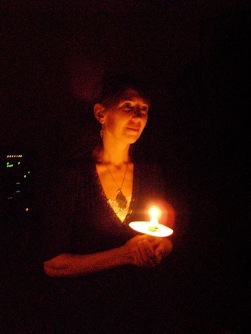
The candle represents the light of love, compassion and connection kindled in our hearts as we dance.
In these challenging times, one of the hardest things to do is to keep our hearts open. Grief and despair tend to shut them down. And even among close friends, colleagues, family members, and people with whom we share worship, when we clash over differing political opinions, trust can swiftly erode. These kinds of losses and sorrows can make us just want to close the doors to our hearts.
Yet hardened hearts and minds are not going to help us overcome conflicts and affirm connections. Only if we can open our hearts to one another, holding the fullness of our (and others’) feelings in a compassionate way, can we weather the storms which threaten to divide us further. And only if we are united can we find our way together through those storms.
One of the best ways I know to connect with others and to open my heart is through the joyful experience of traditional circle dance, particularly Armenian dances. I have written previously on this blog (The Dance of MemoryThe Wishing Tree) about Armenian dances and their ancient roots, their links to the pre-Christian Goddess, and how they affirm survival throughout the traumas of history. I have also written about my friend and colleague Shakeh Major Tchilingirian and her inspiring Circle of Life project, which brings Armenians, Turks, Kurds, Assyrians, and other survivors of atrocities and genocide to dance together for reconciliation.

Continue reading “Opening Our Hearts Through Armenian Dance by Laura Shannon”

If You Can’t Flirt, Don’t Have Sex by Trelawney Grenfell-Muir

If you don’t know how to flirt, you shouldn’t be having sex with anyone.
I admit it… I used to love flirting. It can be incredibly fun. I flirted outrageously with guys I had no intention of dating, and guys flirted with me who weren’t interested in dating me. It wasn’t about sex, either. It was just awesomely fun. The only time I minded was if it turned out they were married/in a committed relationship.
Flirting is like dancing. Both people have to agree to participate. It involves a lot of asking the other person what s/he is comfortable with. Sometimes it is kind of sexual, sometimes it is beautifully spiritual or exciting intellectually. Sometimes it’s tequila body shots, sometimes it’s holding a gaze just a little longer than normal, sometimes it’s making witty but not cruel jokes at the other person’s expense. But it has to be fun, it has to be happy. Like sexual intimacy. If at any point, one party becomes uncomfortable, the other party has to back up and figure out why, and what is needed now.

Continue reading “If You Can’t Flirt, Don’t Have Sex by Trelawney Grenfell-Muir”

Sisterhood, Service, Sovereignty: The Living Spirit of Avalon by Elizabeth Cunningham

Like so many women, I read Marion Zimmer Bradley’s The Mists of Avalon and got caught up in her vision of the Holy Isle and the priestesses who knew how to navigate those mists and travel between the worlds. Like so many women, I wished Avalon existed still.

In fact, Avalon does exist, because Jhenah Telyndru did more than wish. In 1995 she founded The Sisterhood of Avalon. Twenty-two years later, the Sisterhood is going strong and growing, attracting members from all over the world. I urge you to explore their website where the Sisters speak eloquently about their vision, structure, and purpose.

Continue reading “Sisterhood, Service, Sovereignty: The Living Spirit of Avalon by Elizabeth Cunningham”